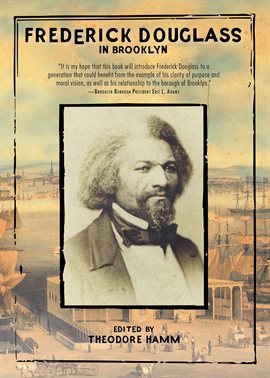
Edited by Theodore Hamm 222 pages
https://slpl.bibliocommons.com/item/show/1387932116
Reviewed by Rae C.
I try to read anything that Douglass has written or texts of speeches he has given and this book is fantastic! Douglass at his best, with a lot of Brooklyn history as well. This is an imprint of Akashic, a truly unique publisher. All fans of Douglass should read this. Some of the material will be familiar, but much won't. Not to be missed is Douglass' speech on John Brown, including his esteem for Brown as a family man (apparently the men and the women cleared the dinner dishes).
And his speeches on Lincoln, while a little bit of blind hero-worship, also illustrate the contrast between how Lincoln related to Douglass, compared to other powerful men, i n particular one abolitionist:
On one occasion a well-known abolitionist said to me. “Come,
Douglass, let’s walk down Broadway together.
I’m never ashamed to walk with a Negro.”
It never occurred to him that I might be ashamed to walk with him.
Sources of Danger to the Republic is as relevant today as it was then. And What Shall Be Done with The Negro? is still all to frighteningly relevant.
…Inferior race! It is an old argument. All nations have been
compelled to meet in in some form or the other since mankind have been divided
into strong and week, oppressors and oppressed.
Whenever and wherever men have been oppressed and enslaved, their
oppressors and enslavers have in every instance found a warrant for such
oppression and enslavement in the alleged character of their victims. The very vices and crimes which slavery
generates are usually charged in the peculiar characteristic of the race
enslaved. When the Normans conquered the
Saxons, the Saxons were a coarse, unrefined, inferior race. When the United States wants to possess
herself of Mexican territory, the Mexicans are an inferior race. When Russia wants a share of the Ottoman
Empire, the Turks are an inferior race, the sick man of Europe. So, too, when England wishes to impose some
new burden on Ireland, or excuse herself for refusing to remove some old one,
the Irish are denounced as an inferior race.
But this is a monstrous argument.
Now,
suppose it were true that the Negro is inferior instead of being an apology for
oppression and proscription, it is an appeal to all that is noble and
magnanimous in the human soul against both.
When used in the service of oppression, it is as if one should say,
“That man is weak; I am strong, there I will knock him down, and as far as I
can I will keep him down. Yonder is an
ignorant man. I am instructed, there I will do what I can to prevent his being
instructed and to withhold from him the means of education. There is another who is low in his
associations, rude in his manners, coarse and brutal in his appetites,
therefore I will see to it that his degradation shall be permanent, and that
society shall hold out to him no motives or incitements to a more elevated character.” I will not stop here to denounce this
monstrous excuse for oppression. That
men can resort to it shows that when the human mind is once completely under
the dominion of pride and selfishness, the reasoning faculties are inverted if
not subverted.
I
should like to know what constitutes inferiority and the standard of
superiority. Must a man be as wise as
Socrates, as learned as Humboldt, as profound as Bacon, or as eloquent as
Charles Sumner, before he can be reckoned among superior men? Alas! if this were so, few even of the most
cultivated of the white race could stand the test.
It is so well put together, the source and footnotes help to really paint a full picture of the world Douglass was living in and the challenges he faced every time he was invited to speak somewhere. For example, Tilton's comments on the 5 directors of Brooklyn Academy of Music who (unsuccessfully) opposed Douglass speaking engagement February 8, 1866:
"We understand the names of the five dissenting directors are to be written on shells and deposited in the Brooklyn Historical Society's collection of Long Island fossils."