Showing posts with label Abraham Lincoln. Show all posts

Thursday, April 11, 2019

Courting Mr. Lincoln


Courting Mr. Lincoln by Louis Bayard   352 pages
I’ve long admired Abraham and Mary Lincoln. To me, they are the most fascinating people in American history. In this telling of their story, author Louis Bayard focuses not on Abe’s assassination or Mary’s probable mental illness or shrewdness. Instead Bayard focuses on their courtship.  And here we get to see a calmer, more focused and a more womanly Mary Todd.

The novel is told from two viewpoints, that of Mary Todd and Lincoln’s BFF, Joshua Speed. 

In Mary’s sections, Bayard focuses on the facts from 1839-1842. He describes Mary’s arrival at her sister’s house in the growing capital of Springfield, Illinois.  She as there to catch a husband, but it is apparent that Mary is no wall flower. I won’t say she came off as aggressive, but she had a passion for politics as well as a keen intellect. Readers get to watch the couple’s first meeting, their secret meetings at a friend’s home that led to their engagement in 1840, the collapse of the relationship in 1841, and their reunification and marriage in 1842. If anyone came off as a shrew during this time, it was Mary’s sister, Elizabeth. 

In Speed’s section, readers have an opportunity to witness a 19th- century bromance. They went virtually everywhere together, lived together, and even slept in the same bed. But before we can label Lincoln as bisexual, readers must remember that their sleeping arrangement was bit uncommon during that time. Bayard subtly hints at Lincoln and Speed’s possible sexual relationship in the way that they word the same color vest to a party and took care of each other when they were very ill. There was also some touching of hands on hands and hands on shoulders when the other seemed to need a subtle. If readers are looking for definitive proof that the two men were intimately involved, it can’t be found.

The novel, for me, was not a fast read, nor was it as engrossing as I had hoped. However, the alternating stories were well told and provided a much deeper understanding of Mary Todd Lincoln and Joshua Speed. Therefore, “Courting Mr. Lincoln receives 4 out of 5 stars in Julie’s world.

Thursday, January 31, 2019

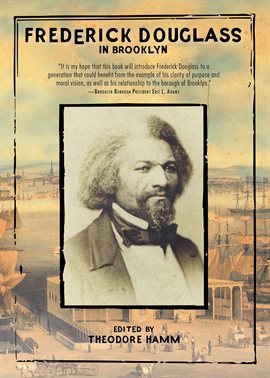
FREDERICK DOUGLASS IN BROOKLYN


Frederick Douglass In Brooklyn

Edited by Theodore Hamm  222 pages

https://slpl.bibliocommons.com/item/show/1387932116

Reviewed by Rae C.


I try to read anything that Douglass has written or texts of speeches he has given and this book is fantastic!  Douglass at his best, with a lot of Brooklyn history as well.  This is an imprint of Akashic, a truly unique publisher.  All fans of Douglass should read this.  Some of the material will be familiar, but much won't.  Not to be missed is Douglass' speech on John Brown, including his esteem for Brown as a family man (apparently the men and the women cleared the dinner dishes).

And his speeches on Lincoln, while a little bit of blind hero-worship, also illustrate the contrast between how Lincoln related to Douglass, compared to other powerful men, i n particular one abolitionist:
On one occasion a well-known abolitionist said to me. “Come, Douglass, let’s walk down Broadway together.  I’m never ashamed to walk with a Negro.”  It never occurred to him that I might be ashamed to walk with him. 

Sources of Danger to the Republic is as relevant today as it was then.  And What Shall Be Done with The Negro? is still all to frighteningly relevant.
…Inferior race! It is an old argument. All nations have been compelled to meet in in some form or the other since mankind have been divided into strong and week, oppressors and oppressed.  Whenever and wherever men have been oppressed and enslaved, their oppressors and enslavers have in every instance found a warrant for such oppression and enslavement in the alleged character of their victims.  The very vices and crimes which slavery generates are usually charged in the peculiar characteristic of the race enslaved.  When the Normans conquered the Saxons, the Saxons were a coarse, unrefined, inferior race.  When the United States wants to possess herself of Mexican territory, the Mexicans are an inferior race.  When Russia wants a share of the Ottoman Empire, the Turks are an inferior race, the sick man of Europe.  So, too, when England wishes to impose some new burden on Ireland, or excuse herself for refusing to remove some old one, the Irish are denounced as an inferior race.  But this is a monstrous argument.
                Now, suppose it were true that the Negro is inferior instead of being an apology for oppression and proscription, it is an appeal to all that is noble and magnanimous in the human soul against both.  When used in the service of oppression, it is as if one should say, “That man is weak; I am strong, there I will knock him down, and as far as I can I will keep him down.  Yonder is an ignorant man. I am instructed, there I will do what I can to prevent his being instructed and to withhold from him the means of education.  There is another who is low in his associations, rude in his manners, coarse and brutal in his appetites, therefore I will see to it that his degradation shall be permanent, and that society shall hold out to him no motives or incitements to a more elevated character.”  I will not stop here to denounce this monstrous excuse for oppression.  That men can resort to it shows that when the human mind is once completely under the dominion of pride and selfishness, the reasoning faculties are inverted if not subverted.

                I should like to know what constitutes inferiority and the standard of superiority.  Must a man be as wise as Socrates, as learned as Humboldt, as profound as Bacon, or as eloquent as Charles Sumner, before he can be reckoned among superior men?  Alas! if this were so, few even of the most cultivated of the white race could stand the test. 

It is so well put together, the source and footnotes help to really paint a full picture of the world Douglass was living in and the challenges he faced every time he was invited to speak somewhere. For example, Tilton's comments on the 5 directors of Brooklyn Academy of Music who (unsuccessfully) opposed Douglass speaking engagement February 8, 1866:
"We understand the names of the five dissenting directors are to be written on shells and deposited in the Brooklyn Historical Society's collection of Long Island fossils."

Thursday, June 21, 2018

Young Lincoln


Young Lincoln  by Jan Jacobi   208 pages


Abraham Lincoln is still popular in the twenty-first century. Rather unusual for a man who’s been dead for more than 150 years. Best-selling novelists, historians and  mystery writers are among the many genres who tackle our sixteenth president, the man most consider our greatest president ever.


One thing we don’t have though, is many authors writing about his childhood, at least from a novelistic approach. Most of us know that his mother died young, and he was raised by a overbearing father and stepmother. Most books that I have read either concentrate on his adulthood, especially after he became a lawyer and started pursing his political ambitions.


But Jan Jacobi has given readers a rare glimpse into just how hard life was for young Abe with his new young adult novel, “Young Lincoln.” The cover is beguiling, isn’t it? 


Abe and his sister, Sarah grow up under the domineering personality of their father. Life in Indiana is hard.  The cabin is either too hot or too cold. There isn’t always enough to eat, which could account for Abe’s lankiness.


He jumps at the chance to to take a flatboat down the Mississippi to New Orleans. This changes his whole outlook on life, and he never looks back.


After moving to New Salem, Illinois, Abe becomes a shopkeeper and begins to study law. He also falls in love with the beautiful Ann Rutledge.

Jacobi’s story takes us from Abe’s life as a little boy until he is elected to the Senate. The beginning is rather rushed, racing from one scene to another, almost if Abe knows that his life will be short and he must fit in as much as he can.


About a third through, the writing settles down and reads can esacpe into the primitive world of early-1800s America.  But Jacobi keeps his audience in mind and doesn’t try to go too deep, espcecially into Abe’s bouts with melancholy (or depression as we would know it today).


Perhaps the most poignant scene in the book is the very last one. I won’t give it away, but readers, I hope, will be amazed at how well Jacobi foreshadows Abe’s death. This book is geared toward middle school readers, whom I sure have learned about Abe’s demise. Hopefully, they too will be able to see the poetry in that last scene.  It’s worth reading the whole book alone. 


“Young Lincoln” receives 5 out of 5 stars in Julie’s world.


Thursday, May 3, 2018

Abraham Lincoln: Pro Wrestler


Abraham Lincoln: Pro Wrestler (Time Twisters #1) by Steve Sheinkin    160 pages


I’ve been obsessed with Abraham Lincoln and his family since I was a kid; I can’t get enough of him and his wife, Mary Todd.


In this delightfully imagined work, the fourth graders in Ms. Maybee’s class hate history. “It’s BORING!” Step-siblings Abby and Doc, especially Doc, are the loudest opponents of history. When Lincoln hear how much all the kids don’t like history, he decides to teach them a lesson.


Thanks to time travel Lincoln shows up in current time to teach them a lesson. He’s decided that he won’t go back to Springfield, Illinois, to win the 1860 presidential election, but instead, he wants to pursue a different dream: that of becoming a pro wrestler. Wrestling was much, much different in the 1860s than it is today, and thankfully, Sheinkin doesn’t delve into that. But that means that history is broken if Lincoln pursues his dream


It’s up to Abby and Doc to get him back to Springfield and fix history. As they learn about Lincoln and his life, they experience life in the 1860s and unwittingly learn about our greatest president ever.

At the end of the book, Sheinkin adds a chapter that tells what aspects of the story are true and what are not.  I think that young readers will enjoy history in this manner, and without meaning to, learn something. Even I learned something! Abraham Lincoln: Pro Wrestler receives 5 out of 5 stars in Julie’s world.