
Showing posts with label literary. Show all posts

Tuesday, December 21, 2021

The Anomaly

“The Anomaly” by Herve Le Tellier (translated from the French by Adriana Hunter) 400 pages

This is the weirdest book I have ever read…and I’ve read some doozies over the year. It won France’s Prix Goncourt in 2020 (a prize in French literature, given by the académie Goncourt to the author of "the best and most imaginative prose work of the year"). 

First, let’s talk about why I wanted to read it. From the back cover: “…an international phenomenon, the dizzying whip-smart novel blends crime, fantasy, sci-fi, and thriller as it plumbs the mysteries surrounding a Paris-New York flight.” I knew it could get a little weird because of the fantasy/sci-fi aspect and I was willing to accept that, but, honestly, I expected a more traditionally plotted novel. I had only a vague overarching idea of what was happening as I was reading. But I was curious as to what the fuss is all about, so I read Every. Single. Word.  All the way to a bunch of gobbled-gook that ended with

                                                                         e


                                                                         n

                                                                        d 


Don’t ask me what that was about. 

The novel is broken into two parts. The first part is about a large group of characters and their lives are told in flashbacks as they hurtle through the air from Paris to New York. I think. They hit God-awful turbulence that had me feeling queasy myself.  The air-traffic controllers along the way begin to show panic about the flight which only added to the uneasiness of the flight. The plane does land safely in New York. Trouble is, that same flight, with the same crew, and the same passengers landed at JFK in March. But now it’s June. 

I think the reason that it was noticed has something to do with the pilot, but I’m not really sure. The plane is diverted to a hanger where it and passengers and crew are held as the government tries to determine what the heck has happened. Can you hear the “Twilight Zone” theme playing in the background? 

It is determined that everything about this flight is identical. The passengers even have the exact same DNA, the exact same memories and the exact same physical. The second half of the book is about the passengers from the March flight meeting those who just arrived on the June flight. Government officials take to substituting the passenger’s last name with either March or June so they were easily identifiable. 

Unfortunately there is no viable conclusion to this work, and it sort of tapers off. I don’t even know how to rate this novel. Therefore, I’ll go to the middle of the rating system and give “The Anomaly” 3 out of 5 stars in Julie’s world. 


Thursday, October 14, 2021

The Address

The Address by Fiona Davis 400 pages 

Author Fiona Davis, known for her use of iconic Manhattan landmarks as characters in her novel, features the Dakota Apartment Building. That name may ring a bell to contemporary readers, even though the building dates back to the 1800s. Just outside The Dakota is where rock legend John Lennon was murdered. Lennon’s untimely death is mentioned, but more as a historical footnote than a contribution to the plot. 

Davis also uses dueling timelines to create the landmarks settings. This time the story vacillates between 1884 and 1984. 

In 1884, Sara Smythe is the head housekeeper of London’s Langham Hotel. Looking out the window of her office, Sara sees a child dangling from an open window. Her quick reaction saves the child. The child’s father is struggling architect Theodore Camden. He is eternally grateful and eventually offers Sara the position of manager of the Dakota…in the U.S. 

Sara accepts and sails for New York. The Dakota is not yet finished, but Theodore and Sara make a great team. So much so that later, when Theodore strikes out on his own, Sara goes with him. 

In 1984, Bailey Camden is just out of rehab and ready to start her life afresh. Bailey is not biologically related to Theodore, but is the great-granddaughter of his ward. The former interior designer isn’t sure what to do, so she enlists her “cousin” Melinda to help her at the Dakota, which she is vigorously renovating. Gutting is probably a better word, as Melinda is taking Theodore’s former apartment and making it sleek and sophisticated. 

Davis allows the readers to see the struggles of Sara and Bailey and what secrets the Dakota hides… and now. We also get to see the building’s grandeur at two distinct times. The secrets involve the stabbing of Theodore and a missing sheath that could hold the key to who inherits Theodore’s fortune. 

I’ve loved all of Davis’ other novels and this one is no exception. “The Address” receives 5 out of 5 stars in Julie’s world. 


Thursday, July 15, 2021

Meeting in Positano

Meeting in Positano (translated from the Italian by Brian Robert Moore) by Goliarda Sapienza 256 pages

What attracted me to this novel was that it was set in Positano, a town south of Naples on the Amalfi coast. I love Italian settings. Picking up the book paid off because Positano is more than a setting; it’s a character in the book.  Author Sapienza does a wonderful job describing its beauty.

Sapienza worked as an actress from the late 1940s to the early ‘50s.  She made six films and after worked dried up, she worked in other areas of the movie industry. However, after her death in 1996, her husband found several novels that she had written and began publishing them.

In this novel, she is scouting locations and meets Erica Beneventano, a lovely widow. The two women become very intimate friends, not lovers but almost. This story is a bit confusing. First, I was never completely sure who the narrator was. It’s supposed to Goliarda, but at times I felt as if the words were coming from Erica. And at other times, the plot seemed more like a memoir than a fictional piece, especially since author Goliarda uses her own name as her character’s name (that was really off-putting).

Basically this is Erica’s life story. The book could also be labeled as “based on a true story,” with Erica taking the lead as most of the story was hers. As Goliarda goes about her movie business, the two women become very close, not lover-close, by closer than sisters.

Life was not easy for Erica. She was a middle sister, forced to go to work at an early age, married to one of her father’s ex-business associates and forced to have an abortion that results in her inability to conceive more children Sometimes I couldn’t follow the plot, which I found quite frustrating. But the beauty of the writing and the descriptions kept me reading. 

I was dismayed at the end when I found an Afterword by Goliarda’s husband, Angelo Pellegrino. The back of the book also contained a timeline of Goliarda’s life and pictures of Positano. I wish I had read them first. I believe if I had, I wouldn’t have had such a hard time following the book’s action.  Therefore, “Meeting in Positano” receives 3 out of 5 stars in Julie’s world.


Wednesday, September 11, 2019

The Witch of Pale Harbor


The Widow of Pale Harbor by Hester Fox     291 pages
Author Hester Fox had gained a new fan. Granted this is the only book of hers that I have read, but I loved it.  Part romance, part literary, part gothic, part ghost story and part thriller, “The Widow of pale Harbor” has a light creepy factor that makes it a perfect fall read.

Both of the main characters, Sophronia Crarver and Gabriel Stone, are haunted by the deaths of their spouses. Not literally, but the ghosts of their lives travel with Sophronia and Gabriel. Gabriel has left Concord, Massachuestts, for Pale Harbor, Maine, to become a transcendentalist minister. His late wife, Anna, has aspired to that for him, although he knows little about the movement. Sophronia is the widow of one of the town’s wealthiest and most influential residents. When he died, the town was sure he was murdered and convicted Sophronia without the benefit of a trial. Since then, she has not left the grounds of her large home, Castle Carver, that she shares with Helen, a woman she plucked out of the poorhouse. Helen has that creepy factor that reminded me of Mrs. Danvers from “Rebecca.”

I was hooked from the first sentence of the twisty novel: “This was the fourth dead raven to appear of Sophronia Carver’s front path in as many weeks, and there was no explaining it away as coincidence this time.” Isn’t that wonderful? Whenever I head about a raven, my thoughts immediately fly (no pun intended), to Edgar Allen Poe. His works play an important part of this novel.

Gabriel tries to settle into Pale Harbor, but it’s not as easy as he’d hoped. The people want to welcome him into their hamlet, but when he loses their trust when he befriends Sophronia. 

There are so many twists in the novel that I could barely put it down; It’s one of those that will keep y’all up all night. I loved it! “The Widow of Pale Harbor” receives 6 out of 5 stars in Julie’s world.

Tuesday, June 25, 2019

Ice

Ice by Anna Kavan, 193 pages

"In this haunting and surreal novel, the narrator and a man known as the warden search for an elusive girl in a frozen, seemingly post-nuclear, apocalyptic landscape. The country has been invaded and is being governed by a secret organization. There is destruction everywhere; great walls of ice overrun the world. Together with the narrator, the reader is swept into a hallucinatory quest for this strange and fragile creature with albino hair. Acclaimed upon its 1967 publication as the best science fiction book of the year, this extraordinary and innovative novel has subsequently been recognized as a major work of literature in its own right." Summary courtesy of Goodreads

There is a plot to the novel but it is loose. In fact, it can be hard to keep track of what is going on because of the hallucinations. But that seems to be the point. It is a psychological examination of destruction and control. It's about what might happen at the end of the world.

It is notable that no characters are named. The prose is beautiful. The forward and afterword help give background and context to the novel. I would recommend this to those like science fiction and those that like literary fiction.

Thursday, January 31, 2019

The Rain Watcher


The Rain Watcher by Tatiana de Rosnay    240 pages

Most readers will recognize de Rosnay as the author behind “Sarah’s Key,” which ranks right up with “Rebecca” as haunting stories that stick with readers for years after they were first read. The four novels that came after “Sarah’s Key,” never afforded de Rosany the same success. Now  four years after her last novel, that bestselling success is so close, yet so far away.

Set in contemporary times, “The Rain Watcher” takes place in Paris. The Malegarde family has come together to celebrate parents’ Lauren and Paul’s fortieth wedding anniversary as well as Paul’s seventieth birthday.  Lauren is an American by birth, Paul is French, They have two children, Tilia who is caught up in an unhappy marriage and resides in France. Linden is an internationally known photographer and calls San Francisco home.

It’s been raining in Paris for weeks and the Seine is rapidly rising. The waters are expected to rising well above the historic flooding of 1910. As the Seine rises, so does the tension. Each of the four characters has secrets they are hiding. The family, already partially estranged, is at a breaking point. When illnesses strike, the family must learn to let go. It’s a hard lesson for those involved.

Most of the writing was beautiful. De Rosany did a wonderful job in describing the flood waters and the rain. Every time they were mentioned, virtually on every page, a new image seemed to present itself.  Kudos for that.

On the down side, de Rosnay provides readers with an agonizing detail of the Paris streets and androissments. It would have help had there been a map on the inside front and back covers. I felt lost when she began naming streets and neighborhoods that I had no concept of location. I don’t believe that de Rosnay writing for an international audience…or at least am American one. The overload of French words also got in the way.

Still the beauty of the writing, sans the above problems, help me give “The Rain Watcher” receives 3 out of 5 stars in Julie’s world. I wanted so bad for this to be a novel that would capture my soul the way “Sarah’s Key” did, but---heavy sigh---it just didn’t happen.


Wednesday, August 22, 2018

Catcher in the Rye


Catcher in the Rye by J. D. Salinger   240 pages

A copy of this literary classic has been languishing on my shelf for years, so that’s why I chose it as my July read for my 2018 Reading Resolution (I picked 12 books to read that having been in my library for ages). Most people I know had to read this in high school, but growing up in Arkansas, we didn’t have summer reading lists.

And now I know why I’ve been putting it off for years…what a drag of a story. I realize that the story is only three days and nights in the life of sixteen-year-old Holden Caulfield, but omg, what a whiner.

There is one consolation to this story of Holden’s New York adventures after he gets expelled from yet another prep school: teenage angst has changed since Salinger published this in 1951. The biggest difference is that instead of goddamn, teenagers today use the F-bomb and the MF word. 

And the way he called every "old [their name]," drove me up a wall.

 “Catcher in the Rye” receives 1 out of 5 stars in Julie’s world.

Wednesday, May 30, 2018

The Myth of Perpetual Summer


The Myth of Perpetual Summer by Susan Crandall  368 pages


Not long ago I wrote a review for Joanne Bischof’s Sons of Blackbird Mountain. I call it the first “must read” of 2018. Well, I just found the second “must read” of the year, The Myth of Perpetual Summer, and probably the best beach read I’ve ever come across. To quote the back cover, “A struggling girl uncovers her family’s history and sees how the lies of the past echo throughout their dysfunctional lives today.”


It sounds cliché to say that this novel about family and the secrets they harbor is haunting, powerful and beautifully writer, but those are the best words to describe this story. It’s Southern gothic at it’s finest.


The story starts in August 1972 in San Francisco. Tallulah James has just learned that her brother, Walden, had been arrested for murder in New Orleans. Readers may think this is going to be about Walden, but it’s really about Tallulah. All she knows is that she must get home to him, a home that she left nine years ago and has not been in contact with her family since.


The story revolves around Tallaluah’s growing up in Lamoyne, Mississippi with her two brothers, sister, parents, and grandmother. Chapter Two shifts back to 1958 Lamoyne. Her parents are largely absent, and she feels the weight of raising her twin younger siblings, not to mention making sure the family’s reputation doesn’t get any more smeared than it already is. Her dad is a professor at the local college, and her mother is more interested in “causes” than in child-rearing. Their explosive relationship plays havoc on the entire family. The matriarch of the family, is the Southern-to-the-bone grandmother, who does her best to guard the family’s secrets and.


There is some beautiful writing in this novel, and here are a few lines that I just adored:

            “…everyone knows that is brains were leather, Grayson wouldn’t have enough to saddle a June bug.)”

            “He knows more hiding places in this town than a stray cat.”


            “I will the storm to take is time as the grumbling sky argues for a faster arrival.”


            “The anew quickly spread to Margo, a forest fire hopping from tree to tree.”


But then betrayal and death shake Tallaluah to the core.


I have never read Crandall before, but I’m sure gonna get some of her books. The Myth of Perpetual Summer receives 6 out of 5 stars in Julie’s world.


Thursday, May 10, 2018

Sons of Blackbird Mountain


Sons of Blackbird Mountain by Joanne Bischof   352 pages


Welcome to 2018’s first “must read! This is a powerful and haunting novel of family, life and love in 19th-century Appalachia.

An Irish lass, Aven is the widow of the Benn Norgaard. She’s been through a lot in her short life. She grew up in a workhouse and once she aged out, she was circumstantially forced to marry Benn. Readers don’t see any of her life in Norway, which in my opinion was both good and bad. I was very interested in her prior life, but there were really no opportunities for a lengthy flashback.


She has just traveled across an ocean and traveled more miles than she can count to the foot of Virginia’s Blackbird Mountain. She is expecting to find her late husband’s great-aunt who is raising three boys.  As she begins to trudge along the dusty trail, she encounters a man who only responds with gestures.

Along with a friendly dog, she follows the quiet man up the mountain until she reaches a large red house and a scattering of outbuildings. She learns that great-aunt Dorothe has recently passed and the “kids” are full-grown men.


The men---Jorgan, Haakon and Thor---are each in need of more than what Aven can offer them.

They grow apples on 300 acres; the mortgage almost fulfilled. They make their living selling hard cider to the neighbors. Jorgan keeps the buildings and machinery in perfect working order. Haakon makes the deliveries, but it’s Thor who tends the apple trees.


Jorgan and Haakon are well-drawn characters, complex and shallow at the same time. But it’s Thor who leapt off the page for me.  Deaf and mute, Thor can read lips. He has a hardness and a softness that comes takes center stage depending on what part of the story is being read.


Author Bischof does an excellent job explaining how Thor communicates with other with American Sign Language. It doesn’t interfere with the story and is as a natural part of the story as the plot. Bischof’s prose is beautiful. Sometimes I had to stop and re-read a sentence it was structured so beautifully.


A character-driven story, readers come to know Aven and the brothers as if they were real people, living their lives through good times and bad times. I found lots of gasping moments as the story moves from late summer in 1890 to early fall. 


Of the thirty-two books I have read so far this year, this is by far the best, and the one that will linger in my soul for months to come. Sons of Blackbird Mountain receives 6 out of 5 stars in Julie’s world.

Wednesday, August 9, 2017

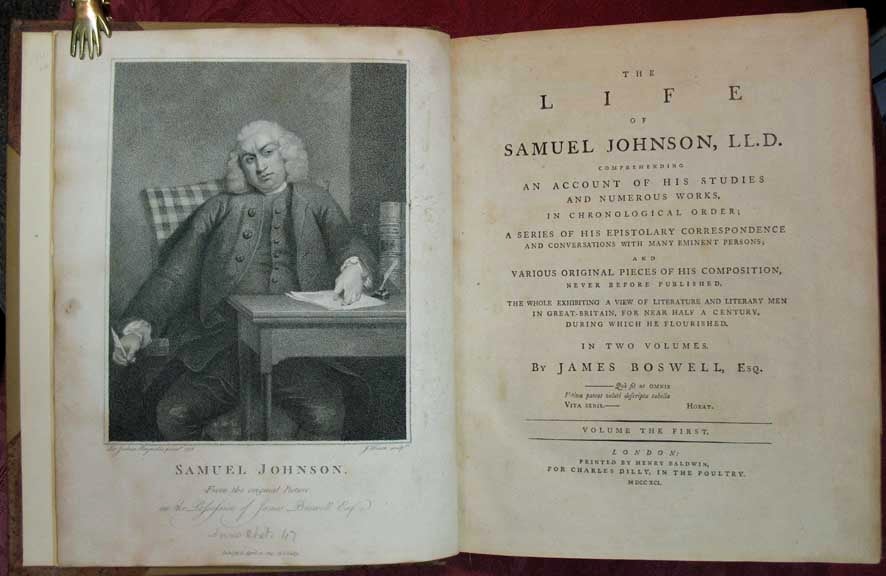
Boswell's Life of Johnson


Dr Samuel Johnson was a man of remarkable accomplishments, having distinguished himself as a poet, novelist, essayist, dramatist, linguist, etymologist, critic, and journalist, the melancholy ornament of the literary, political, and social worlds of eighteenth century London.  Yet he would, perhaps, be little remembered today were it not for his biography, a labor of love painstakingly assembled by his admirer, disciple, and friend James Boswell

     Who to the sage devoted from his youth,
     Imbib'd from him the sacred love of truth;
     The keen research, the exercise of mind,
     And that best art, the art to know mankind.

Boswell's Life of Johnson follows the subject's dictum that a man's character is best revealed in his mundane, everyday life rather than his public works.  The result is not only a book that is a Life, but a book that lives, and perhaps "the most perfect example of biography that was ever exhibited."

Thursday, December 29, 2016

The Other Einstein

The Other Einstein by Marie Benedict  304 pages

I don’t know much about scientist Albert Einstein except that he won a Nobel Prize for his Theory of Relativity. I even read, some time ago, Driving Mr. Albert: A Road Trip Across America with Einstein’s Brain by Michael Paterniti. All that I remember from that nonfiction piece is that Paterniti, along with the man who performed the autopsy, drove from New Jersey to California with Einstein’s brain to give to Einstein’s granddaughter. It was rather silly, if memory serves me correctly.

So one might wonder why I would be interested in this piece of historical fiction. Basically, I really, really, really enjoy the women-behind-the-men genre that is so popular right now. Other books in this genre that reads might find fascinating are The Paris Wife and The Aviator’s Wife.

In this work, we get to meet Mileva “Mitza” Maric. She is a brilliant woman, studying to be a physicist in the early 20th century. All her life, her parents have encouraged Mitza to pursue a life of the mind. Not only did they recognize her intelligence, but she had a physical deformity that they believed deemed her unmarriageable.

The story opens in 1896 as Mitza and her father are walking through the humid, “foggy, Zurich streets to the Swiss Federal Polytechnic campus.” She is the only female enrolled to study physics. There are five men in her class, one of whom is Albert Einstein.

The first 100 pages of the novel drag. It seems most of the scenes are repetitive and the science gets in the way. They are about science, Mitza’s determination and brilliance, and the two’s attraction toward each other.

When Mitza and Albert go on a romantic getaway to Lake Como in Italy, the novel takes off. Albert comes off as a royal a**hole. I wonder how much of that is really true. But, this is  biographical fiction.


The Other Einstein receives 4 out of 5 stars in Julie’s world. 
Thursday, July 21, 2016

Lilac Girls

Lilac Girls by Martha Hall Kelly     496 pages

Debut novelist Martha Hall Kelly spent 10 years researching and five years writing this haunting novel of three women as Hitler begins his mad march across Europe. It is based on the true story of an American philanthropist; a Polish woman incarcerated at Ravensbruck, the female-only Nazi concentration camp; and the only female doctor in that hellhole. “The story is told from three points of view: the victim, the hero, and the villain, together creating a complex picture of an unimaginable time in history” I cannot remember what review I read this sentence in, but it was powerful enough to warrant my writing it down.  The novel begins in 1939 and ends in 1959.

We first meet the heroine. Hundreds, thousands, of people are fleeing France in advance of what they fear will happen: Hitler. Former actress and Broadway start Caroline Ferriday is now a humanitarian, doing her best to help as a volunteer at the French consulate in New York. One of the people who needs her help is French actor Paul Rodierre. Caroline spends her own money sending care packages to French children.

Next we meet the victim, Polish teenager Kasia Kuzmerick. Kasia works with underground, delivering messages. It’s very dangerous work. She is caught and sent to Ravenbruck, where she become one of the “Ravenbruck Rabbits,” women who were subjected to the Nazi SS leader Goerring’s medical experiments. The author was candid about what happened to these women, but did not go into such depth as to make this reader give up on the story. I had a basic knowledge of the experiments happening, but didn’t know any of the details.

Herta Oberheuser is the villain. An ambitious young doctor, she answer an ad in the paper for a government medical position and winds up performing horrendous atrocities on the Ravensbruck ladies. Herta is the most difficult character to understand. In 1939, she is eager to work in medicine, but as the war drags on, she seems almost eager to perform the experiments.

I found the shifting of point of view easy to follow. Well, except that the author did a great job leaving this reader hanging at the end of each section. I was sad to reach the conclusion of Lilac Girls.  I wanted to keep reading about Caroline, Kasia, and Herta. I did, however, read somewhere that Hall Kelly is writing a prequel to this story. I personally can’t wait to get my hands on it. I literally flew through all 496 pages of this book in two days.


I give Lilac Girls 6 out of 5 stars; the highest rating in Julie’s world.

Sunday, March 13, 2016

The Green Road

The Green Road by Anne Enright   304 pages

Longlisted for the 2015 Man Booker Prize
I wasn’t familiar with Anne Enright’s work before I was given The Green Road as a gift. The synopsis sounds wonderful:

From internationally acclaimed author Anne Enright comes a shattering novel set in a small town on Ireland's Atlantic coast. The Green Road is a tale of family and fracture, compassion and selfishness―a book about the gaps in the human heart and how we strive to fill them.
Spanning thirty years, The Green Road tells the story of Rosaleen, matriarch of the Madigans, a family on the cusp of either coming together or falling irreparably apart. As they grow up, Rosaleen's four children leave the west of Ireland for lives they could have never imagined in Dublin, New York, and Mali, West Africa. In her early old age their difficult, wonderful mother announces that she’s decided to sell the house and divide the proceeds. Her adult children come back for a last Christmas, with the feeling that their childhoods are being erased, their personal history bought and sold.
A profoundly moving work about a family's desperate attempt to recover the relationships they've lost and forge the ones they never had, The Green Road is Enright's most mature, accomplished, and unforgettable novel to date.

I even saved it until I had to spend some time in an airport. It starts out pretty good, but quickly goes downhill in my opinion. The beginning and the ending are the best parts.

The story starts in 1980 with Hanna, seemingly the youngest of the Madigan brood. Mom Rosaleen has taken to her bed after the oldest, Dan, announces he wants to become a priest. The story then shifts to focus on Dan. It is 1991. He is living in New York. Not sure what his occupation is as the story is more about his life as a gay man and the AIDS epidemic more than anything. The next section focuses on Constance, stilling living in Ireland, in 1997. She is at a hospital to determine if the lump in her breast is cancer. The next shift is on Emmet, who is, I think, a missionary in Mali in 2002. As I read these sections, I felt that Enright kept the reader at arm’s length. Then the story jumps back to the Madigan home for Christmas 2005.

The father, who we don’t see much of, died ten years (I think) earlier. Rosaleen is the same melodramatic matriarch that she was in Hanna’s section. There are no explanations of how the four ended up like they did, which made me feel disconnected to the character’s problems.


I give The Green Road 2 out of 5 stars.

Thursday, September 17, 2015

The Awful Mess: A Love Story

The Awful Mess: A Love Story by Sandra Hutchison  410 pages

When Mary and Roger Bellamy’s marriage falls apart, Mary seeks solace in the small community of Lawson, New Hampshire. Lawson is typical of a very, very small town. “Everyone in town knows about the young divorcee from Boston who bought Miss Lacey’s house.”  And she’s hardly unpacked!

Mary isn’t a religious person, but she has made her first new friend in Arthur Tennant, the rector of St. Andrew’s Episcopal Church. She looks forward to their meetings on the Main Street Bridge. She enjoys Arthur’s company. She knows he’s in an unhappy marriage and can both sympathize and empathize his position. Before long, each falls into a serious case of like.

Arthur is also helping Mary and introducing her to some of the other locals…in particular the town cop, Winslow. Each feels the attraction. Winslow is single and extremely handsome.

Mary is enjoying settling down into her new life. She was able to keep her job as an editor thanks to telecommuting. Now she’s gotten word that the company is getting ready for a big layoff.  She is hopefully that she’ll get lucky and survive. After all, there isn’t any publishing industry job sin Lawson.

There’s a lot going on in Mary’s life: Arthur, whom she had a one-night stand; Winslow, whom she’s unsure of her feelings; and the potential of having to pack up and move when she’s just settled in. And oh yeah, she’s pregnant. After years and years of being told she was incapable of having children, it looks like a miracle has happened! Then Roger reappears to wreak havoc on her life. His interference is shocking.

Mary is a no-nonsense kind of gal. She picks herself up and dusts herself off when the going gets tough. And boy, oh boy, are things getting tough.

I’m a new fan of author Hutchison. I thoroughly enjoyed her other novel, The Rib and Thigh Bones of Desire. Her characters are down to earth and believable, the story lines realistic, the pacing is superb. I was pulled in immediately with the first sentence. Hutchison creates vivid worlds and characters.

I highly recommend The Awful Mess; A Love Story. It’s the perfect book to curl up on the couch with…I wasn’t able to put it down.

 I give it 5 out of 5 stars.

Thursday, August 13, 2015

The Grace Keepers

  
The Grace Keepers by Kirsty Logan     308 pages

           The timeframe for this novel is obscure. It could be the near future or the far past. Whenever it is, land is scarce. Most of the world, it seems is covered with water. There isn’t the overcrowding of today’s time. In fact people are classified into two groups: the landlockers (those inhabiting the mainland) and the damplings (those who float on the sea). I got the impression there was no “mainland.” Instead, people traveled from island to island via boat, and not a motor boat either.

There are two main protagonists. First in North. She is a young girl of about sixteen. She works as a circus performer with the Excalibur, a floating troupe of acrobats, clowns, dancers, and trainers who sail from archipelago to archipelago, entertaining in exchange for food. North, whose parents are dead, performs a dance routine with a bear.

Then there is Callanish. Also a young girl. Her role in the world is to administer Restings to the dead. That is, she performs burials as sea for those who have died. I didn’t really get the part the birds, or graces, play in the ceremonies. Each time a person is laid to rest, a grace is starved to death. When the bird dies, the mourning period is over. I wish Logan had given a more detailed description of the birds. They are small, which is about all the readers learn of them. Callanish lives alone.

There isn’t a strong, suspenseful plot. There are peaks and valley in the storyline and a couple of gasping moments. I didn’t find myself staying up late, reading one more chapter to find out what happens.

The gorgeous cover and the link to Scottish myths and fairytales are the main reasons I wanted to read The Grace Keepers. The cove is evidential of Logan’s lyrical writing style. I don’t’ know much about Scottish myths and fairytales, and there is nothing in the text that indicates what the inspiration is. Logan is a Scot living in Scotland, so maybe you have to already have this knowledge to make the connections. 

Although this rather dystopian novel doesn’t have a strong plot, its other qualities are why I rate this novel four out of five stars.


I received The Grace Keepers from Blogging for Books in exchange for this review.

Tuesday, July 21, 2015

The Little Paris Bookshop

The Little Paris Bookshop by Nina George   392 pages

The Little Paris Bookshop is quite an unusual bookstore with an equally unusual proprietor. Monsieur Jean Perdu’s bookstore is floating barge along the Seine. Perdu considers himself a literary apothecary.. He can prescribe just the write book to meets the needs of the buyer.
However, there is one person Perdu cannot ease the symptoms of what ails him, no matter what book he selects. That person is himself. He is heartbroken. Twenty-one years ago, his true love, Manon, left him. She sent a letter which he has never opened because he is sure it contains usual lines: “it’s not you, it’s me;” “I’m not ready for the love you have to give;” yada, yada, yada.

But now things are changing in his apartment building. A new tenet has arrived with only the clothes in her back. The building manager asks all the residents for a donation. Perdu has been assigned a table.
Yes he has a table, but that means entering the lavender room he shared with Manon, which has been sealed shut for twenty-one years. Torn between his reluctance to enter the room and his desire to help his new neighbor, Catherine, he wills himself to enter and takes the table across the hall.

Catherine find Manon’s letter and returns it. Faced with its actual presence again, Perdue opens it. Manon’s words shock him to his core; what she says and requests is nothing, nothing, like he imagined.
Perdue decides to go looking for Manon to learn for himself if her words were true. He casts off the lines of his barge and begins the long trek south to Manon’s home. He is joined by his two cats, and at the last second, by another apartment-building neighbor, Max, who is looking to escape his sudden fame and complete writer’s block.

The story of the journey takes up roughly two-thirds of the book. I didn’t care for the slapstick antics that ensued. It didn’t help that an Italian chef, also looking for a long-lost love, joined the merry cast. The slapstick got in the way of the story for me, making the story seem somewhat unbelievable. I also felt lost with all the names of the villages that the characters traveled through, even though the author supplied one. All in all, I really like the first and last fourths of the story. The characters evoked empathy in these sections.

Sunday, May 24, 2015

Saint Mazie

Saint Mazie by Jami Attenberg     336 pages

Mazie Phillips’ story opens in 1907 when she receives a diary for her 10th birthday. 

Rescued from her abusive parents and poverty in Boston by her sister, Rosie, she is now a New Yorker. Mazie LOVES New York. She loves it streets, the men and women who live there, the air, everything. The diary entries are typical of a developing young lady. As the Jazz Age blossoms, Maize blossoms. The entries are spasmodic until about 1916.

Rosie had married a wealthy man who owns the Venice movie theater. Now Rosie is sick, and Mazie needs to help at the theater. Her brother-in-law, Louis, needs someone who is honest and good with money. Therefore she is put in the ticket cage. She feels like a caged animal.

Mazie knows everyone in the neighborhood---from the bums to the upper lower class. That’s who lives in the Bowery. Then the Great Depression hits. Poverty and homelessness become more widespread. By this time, Mazie owns the Venice and throws it open to those most in need. Oh, she’s still showing the movies, but those who need a warm/cool place to stay for awhile are welcome.
The diary entries continue to be spasmodic and include a chorus of voices that help fill in Mazie’s story. While Attenberg’s story ends in 1939, the “Queen of the Bowery,” as she was known, died in 1961.

I was attracted to this story for two reasons: 1) Supposedly more than 90 years after Mazie began writing in her diary, it’s discovered by a documentarian in search of a good story. However, readers never hear from the movie-maker until the last third of the book.  It didn’t work for me. 2) Maize was a real person living; she was profiled in Joseph Mitchell’s Up in The Old Hotel, a collection of short stories based on real people.


I was never able to get into the plot or the characters. In my opinion, Attenberg wasn’t able to pull off the story. That’s why I’m giving Saint Mazie two out of five stars.