Showing posts with label Austria. Show all posts

Monday, May 24, 2021

Blessed Charles of Austria

 Blessed Charles of Austria: A Holy Emperor and His Legacy by Charles Coulombe, 374 pages

The subtitle of this biography of the last of the Habsburg monarchs is certain to raise a few eyebrows.  At best, Charles was helpless as Austria-Hungary went down in defeat in the last years of World War I, ultimately being dissolved by the victorious Allies into a handful of feuding ethno-states.  What kind of legacy could he have?  More generally, how is it possible for an emperor to be "holy"?  Did not the high priests of Enlightenment indelibly write their verdict that "no one can reign innocently" across the pages of history in the blood of Louis XVI and his family?

As Charles Coulombe relates, the life of Blessed Charles was dominated by three great loves - his God, his family, and his people.  These were not competing, but complimentary, just as his love for his wife only reinforced his love of his children, and his children his love of his wife.  These were loves tested, proven, and refined through suffering, yet loves to which Charles remained faithful with his whole heart.  It is for this reason that he has been raised to the altars of the universal Church even as the men who supplanted and persecuted him are increasingly maligned or forgotten.

It is no doubt possible to construct a coherent biography of Charles of Austria, based entirely on his external acts, which portrays him as yet another incompetent Machiavel, interested only in power, badly exercising it when he had it and futilely attempting to regain it after he lost it.  This would seem superficially plausible, but would miss the inner life of the man and the self-sacrificial ideal of rulership he represents.  It would also do nothing to change the disastrous course the world has been on since at least 1914.

Tuesday, December 31, 2019

And In the Vienna Woods


And In the Vienna Woods Trees Remain by Elisabeth Asbrink   464 pages

As y’all know, I don’t read nonfiction that much. I do, but it has to really caprture my attention.  And this one, by author of the internationally bestselling “1947” did. 

It’s the story of Otto Ullman, a thirteen-year-old Jewish boy who is sent form Austria to Sweden at the eruption of World War II. Alone. His story is fascinating. One of the things that enticed me was the back blurb mention that Otto becomes BFFs with Ingvar Kamprad, who grows up to become the founder of IKEA.

I believe that this is an important book for scholars of the period and those seeking this type of knowledge. There is lots of information on Sweden’s, Austria’s, and even Switzerland’s positions during the War. However, it is too much information for nonscholars like me. I was ready to abandon the book by page 75, but instead I just read the parts about Otto and how he esacaped the Nazis and his life in Sweden. He was part of Kindertransport-like event to save the children of Austria.

I was disappointed that Ingvar Kamprad didn’t show up until near the end. And in my opinion, I didn’t much see the relationship. I did learn how the name IKEA came about: he added his initials to the village’s name. Ingvar Kamprad Elmtardy Agunnaryd (IKEA).

“And in the Vienna Woods Trees Remain” seems to be thoroughly researched, and as I wrote earlier, I believe it is an important book for those studying this perios. Therefore,  “And in the Vienna Woods Trees Remain” receives  2 out of 5 stars in Julie’s world.


Wednesday, October 16, 2019

The Last Train to London


 The Last Train to London by Meg Waite Clayton    464 pages
I expected a lot after reading the Amazon blurb for this book: “a pre-World War II-era story with the emotional resonance of “Orphan Train and “All the Light We Cannot See,” centering on the Kindertransports. Those are two of my favorite novels in recent years.

This novel covers 1936 to 1940 as Truus Wijsmuller and her efforts to smuggle Jewish children out of Nazi Germany. The story is told through two viewpoints and short chapters. Truus and fifteen-year-old Stephan Neuman.  

All Stephan want to do is write plays, go to the theater and hang out with his new Zofie-Helene, a Christian girl he meets through his barber. Zofie is a math prodigy. I didn’t understand what she was saying half of the time, and I think contributed to my unfavorable reponse to the story.

As the story opens, Stephan and Zofie live in Vienna, a city on the edge with the imminent threat of a Nazi invasion. The wander through the city, mostly through a complex cave system, popping up here and there, that seemed a tad ludacrious to me.

Truus, a member of the Dutch resistance, begins to smuggle children out of Germany, making more and more trips into the occupied country. Maybe this is my twenty-first century perspective talking, but I found that the way she instructed all the children to call her Tante Truus (Aunt Truus) creepy. I understand that it was necessary given the unforeseeable encouters they would have, but it made me extremely uneasy. Also, I found her sections lacking tension; she never seemed to be in real danger, even when she was escorting thirty children across the border. And that is my biggest complaint of this novel---lack of tension. Never did I feel thatStephan, his five-year-old brother Walter, Zofie, Truus or the children were in life-or-death situations.

Because of the short chapters, I never felt a real connection to any of the characters.  The most positive aspect of ready this lengthy novel is that the name Truus Wijsmuller may now be recognized for the great work that she did. Truus is credited with saving over 10,000 Jewish children from the Nazi horrors.

Due to its lack of tension and the inability to make me connect with the character,  The Last Train to London”  receives 2 out of 5 stars in Julie’s world.

Thursday, May 3, 2018

Mozart's Last Aria

Mozart’s Last Aria by Matt Rees   336 pages

I was excited to find this novel. I’m not as literate about Wolfgang Amadeus as I would like to be or should be. I have to admit that I just grabbed its without reading the synopsis, where it’s been languishing on my shelf for years. This novel was part of my 2018 New Year’s Resolution to read one book a month that has been hanging  out in my personal library for years.


 Basically this is about Mozart believing he had been poisoned, which caused his death.


When his sister, Madame Maria Anna Berchtold von Sonnenburg, learns of his passing, she heads to Austria to pay her respects to his widow and children. There she becomes an amateur sleuth, trying to learn who would have poisoned the brother she hadn’t spoken to or correspondent with, in three years.

I was extremely disappointed in this story; I had a hard time getting into it and an even harder time caring about the plot or about his sister. Therefore, Mozart’s Last Aria receives 1 out of 5 stars in Julie’s world.

Sunday, December 6, 2015

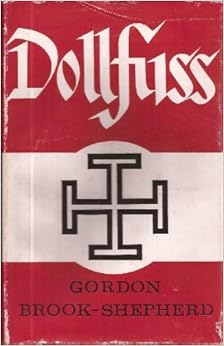
Dollfuss

Dollfuss by Gordon Brook-Shepherd, 284 pages

In 1932, Engelbert Dollfuss, until then a little known government minister and agrarian reformer, accepted the office of Chancellor of Austria.  In 1933 he closed Parliament and outlawed the Marxist and Nazi parties, leading to a brief civil war between government-backed militias and socialist paramilitaries which climaxed in the use of artillery to reduce socialist strongholds in the working class suburbs of Vienna.  In 1934, after a little over a year of dictatorial rule, he was murdered during a coup attempt by Austrian Nazis.

Shepherd firmly situates Dollfuss' public career in the context of the particular problems of his time and place, only briefly surveying his life before becoming Chancellor in order to devote the bulk of the book to the labyrinthine politics of interwar Austria.  In this account, Dollfuss' primary aim - and his legacy - was the cultivation of a distinct Austrian identity which was independent of the departed Habsburgs and resilient enough to resist the pan-Germanism which animated both the far right and far left.