Showing posts with label Revolution. Show all posts

Monday, January 29, 2018

Human Acts

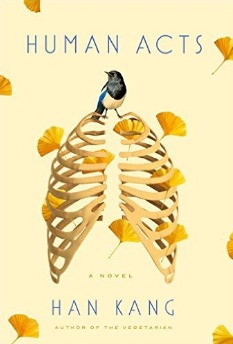
Human Acts by Han Kang (3 stars, 226 pages, paperback) 

This novel tells several perspectives of the events and aftershocks of the 1980 Gwangju Uprising in South Korea. It starts off following a boy, Dong-ho, looking for his friend among the bodies of those slain by the military. The following chapters run with the perspectives of other characters introduced in the first chapter, taking place up to 33 years after the event itself. More and more heartbreaking details about the events of one fateful day reveal themselves as the story goes on.  

There’s a good chance you never knew this happened. (Even if you were tuned into world news in 1980, the only American newspaper carrying coverage of this event on Newsbank was the Christian Science Monitor.) Maybe you never knew that South Korea even had dictators at all. I sure didn’t. The book struggles with difficult themes of death and whether a culture or even just a person can recover from atrocity. And I really mean struggles. I’m not certain the author (and/or translator) knew 100% what she wanted to say.


This was a difficult book to read. Every new chapter brought with it the realization of who we were following and what they were going to tell me, and I would moan and say aloud “Please no!” Whatever it was I was afraid of did not fully manifest, though. I was never reduced to a puddle of sorrowful tears, like I was expecting. The language was brutally beautiful and evocative, but somewhat scattershot. I was always left a little unsure how to feel. But then, this is a very difficult theme to write effectively about, and not a theme I seek out, so I don’t really fault the author (and/or translator). Ultimately, this is a troubled, difficult exploration of grief.

Wednesday, August 2, 2017

Lenin, Stalin, and Hitler

Lenin, Stalin, and HitlerLenin, Stalin, and Hitler: The Age of Social Catastrophe by Robert Gellately, 594 pages

The closing years of the First World War saw an unprecedented wave of human liberation sweep across Europe.  The repressive tyrannies that had shackled the human spirit for so many centuries, particularly the traditional regimes of the Russian, German, Habsburg, and Ottoman empires, were at long last swept away.  Idealists were finally free to pursue lofty visions of a better world without superstitious nonsense about human limitations, and they found their visionaries in such men as Lenin, Stalin, and Hitler.  The screams of their tens of millions of victims echo still today, even if many, now as then, seem deaf to them.

Although he certainly identifies the many similarities his subjects shared, Gellately also highlights differences, notably the contrast between Hitler's "consensus dictatorship" as against the Soviet Bolshevik dictatorship, resulting in revolutionary Communism as opposed to evolutionary Nazism, expressed in differences between the "arbitrary and sweeping terror" under Lenin and Stalin and the "aimed terror" of Hitler.  While providing surprises and insights even for those familiar with the period, Lenin, Stalin, and Hitler manages to be an accessible introduction to the darkest chapter in human history so far, from the conditions which encouraged so many to commit themselves to the inhuman ideologies of Leninism, Stalinism, and Hitlerism, through the clash of those ideologies in a social catastrophe "so utterly unprecedented in all its many horrific faces, that it raised questions about the very meaning and future of Western civilization."

Saturday, June 13, 2015

Magic Lantern


When the world changed in 1989, Timothy Garton Ash was there.  In June, he was with Solidarity leaders in Warsaw on the night of the first free elections in Poland since World War II, then he was in Budapest to witness the funeral of Imre Nagy, the hero of the 1956 revolt against Soviet domination.  In November, he walked across the space in Berlin where the Wall once stood, then sat in on strategy sessions with Vaclav Havel in the Magic Lantern Theater in Prague.

It is in the Magic Lantern that the book not only gets its name but its theme.  The peaceful revolutions of 1989 were largely made by intellectuals, but, in Ash's view, were remarkably free from new ideas.  The "revolutionaries" brought down their governments by holding them accountable to their own standards and the standards of their Western neighbors.  With the use of naked force declared illegitimate by the national governments and (even more importantly) the Soviets, the communist system was exposed as an empty fortress.  This is very much an eyewitness account of the drama as it unfolded, seen from the best seats in the house, written while the echoes were still ringing off the walls.

Thursday, January 15, 2015

The Family Romanov: Murder, Rebellion & The Fall Of Imperial Russia


Although not one of my favorite historical periods, I’ve always had a small fascination with the whole “missing princess” story.  I hadn’t read many non-fictional accounts of the Romanov family so I didn’t know a lot of what was happening in Russia during this time.  This book was well written and kept everything pretty simple so I got a much clearer picture of how Nicholas was ignoring and sometimes exacerbating the problems that the poor were facing in Russia, which certainly went a long way towards explaining why the Russian Revolution happened.  Actually both the October and May Revolutions were pretty well explained.  I also felt like I had a better grasp on why World War I actually started and how the various powers became involved.  Before reading this book, if someone had asked me, I would have said “an archduke got shot” but this book actually pretty simply explained the land situation and who was allied with who and why.  I’m not sure that I learned a lot of new information about the family themselves, because I knew more about them going into the book, but there were some interesting tidbits about them, especially the children, as well.  Overall, I’d have to say that I really enjoyed the book and would definitely recommend it to anyone with an interest in this time period or Russian history.