Showing posts with label Yahoos. Show all posts

Monday, June 20, 2022

Welcome to Hell

Welcome to Hell by "Bad" Billy Pratt, 178 pages

Repeatedly, in the collection of blog posts that make up Welcome to Hell, author Billy Pratt earnestly declares the mission of the writer to be the arduous distillation of truth from experience.  Given such a seemingly grandiose conception of his vocation, the reader might expect a diatribe against contemporary illusions and delusions.  Whether attracted or repelled by that prospect, what he will find if he dares to open the book is a series of vignettes, some funny, some poignant, some simply depressing, most of them defying cheap moralizing and instead inviting understanding.  What emerges is a portrait of Hell, a realm of aging adolescent consumers searching ever more desperately for validation or just the next dopamine fix, having already pawned their youth and healthy relationships.

An obvious trap for a collection of this kind is for the entries to become numbingly repetitive, but Pratt's descriptive approach avoids this entirely.  At the same time, the strong thematic unity and the unmistakable voice of the author keeps it from feeling disjointed.  The whole reads less like a haphazard bunch of essays than a carefully constructed novel in the tradition of Zola, albeit one holding up a mirror to a very different world.

Tuesday, December 14, 2021

Unsettling of America

The Unsettling of America: Culture and Agriculture by Wendell Berry, 223 pages

In this early work, Wendell Berry decries what he sees as the continuing colonization of the North American continent, concentrating on the colonization of the rural by the urban.  This colonization is carried out by technocratic elites who reduce everything to economics, ignoring the human, social, and environmental costs of their policies.  Although Berry's subject is agriculture, his theme is over-specialization and fragmentation, a feature of modern life that of itself tends to transform all human interaction - even "charity" - into forms of money-exchange.  The alternative, he insists, must be the invention (or recovery) of an economics, a politics, a philosophy, and even a theology of limits.

This was always intended as an argumentative work, a new salvo in an ongoing debate.  Now it is a mostly forgotten volley in a debate that has moved on, but its echoes can, perhaps, still be heard in the hills.  While it is explicitly tied to the particular time and place in which it was composed and published, with considerable space taken up by criticism of academic and political figures in power or in fashion in the late '70s, the underlying principles are hardly outdated, and what it has lost in ripped-from-the-headlines relevance is compensated for by what it has gained in historical value.

Monday, September 13, 2021

True and Only Heaven

The True and Only Heaven: Progress and Its Critics by Christopher Lasch, 532 pages

Christopher Lasch's story of progress and its critics is, as the subtitle suggests, really two stories.  The first, counterintuitively, is the tale of the nineteenth century critics of industrialization and enlightenment and their warnings about atomisation, alienation, and decadence.  The second is that of twentieth century American progressives as they came to increasingly view the masses as the object rather than the protagonist of historical processes.   Uniting these narratives is Lasch's apocalyptic understanding that the end of progress is not a realized utopia, but an insatiable demand for more of everything, resulting in a fundamental rejection of all boundaries and limitations.

The True and Only Heaven is not merely a book that should be read by anyone seeking to understand the current century and the two which preceded it.  It is a book that no one can plausibly claim to understand the world in its present moment without having read.  Lasch even profoundly explicates matters only peripheral to his central concern - the transformation of the civil rights movement from moral suasion to black power, for instance.  Indeed his analysis is so brilliant that it illuminates even areas he does not directly touch - his treatment of syndicalism, for example, reveals a previously unexpected foundation beneath Nolte's theory of fascism.  Yet another mark of Lasch's genius are the uses to which his thoughts can be put that he did not foresee and would not have sympathised with.  This is entirely fitting for a narrative the great theme of which is hope, for hope, Lasch tells us, depends upon faith in an "underlying order of things [that] cannot be flouted with impunity."

Thursday, November 7, 2019

Sex Matters

Sex MattersSex Matters: How Modern Feminism Lost Touch with Science, Love, and Common Sense by Mona Charen, 238 pages

Over the course of the last fifty years, all of the leading indicators show that American women have become more unhappy, both absolutely and relative to men.  According to nationally syndicated columnist and bestselling author Mona Charen, it is no accident that this coincides with the cultural triumph of a feminist movement that values empowerment over love even as the sexual revolution brought into being a new order founded upon lies, resulting in a pornography-soaked hookup culture which leaves unsatisfied the deepest desires of both men and women.  In Charen's analysis, the antihumanism of the sexual revolution is the result of a fundamental misunderstanding of sex as something self-referential rather than intrinsically other-directed.

Charen is a political pundit, not a philosopher, and while this book barely mentions Republicans or Democrats it is suffused by the techniques of the social sciences as the method by which political legitimacy is asserted in the modern world.  As always in such cases, the response of readers to the book is likely to be a combination of their prejudice for or against the central thesis and their evaluation of how accurately such an approach models reality.

Tuesday, May 21, 2019

Anti-Mary Exposed

The Anti-Mary ExposedThe Anti-Mary Exposed: Rescuing the Culture from Toxic Femininity by Carrie Gress, 196 pages

For Carrie Gress, the feminism which rose to prominence in the '60s and '70s and quickly became cultural orthodoxy only pretended to offer women liberation, instead promoting a distorted perversion of femininity.  In her telling, the vanguard of the women's movement consisted of its most dysfunctional members, and they have used the power of the media to shape a concept of the modern woman after their own image - vulgar, shallow, petulant, self-absorbed, and, above all, hostile to the Marian ideals of virginity and motherhood.  More than an ideological struggle, Gress presents this as nothing less than a diabolical plot to replace the Marian "fiat" with the Luciferian "non serviam".

This is definitely a book written for the choir, and a women's choir at that.  Anyone who does not accept Gress' premises will not be swayed by demonic testimony reported by exorcists.  For believers, there is another danger, in that Gress' sensationalism sometimes lends to her subjects a glamour that covers the tired banality of yesterday's transgressions.  That the book is aimed almost exclusively at women is both inevitable and fitting, given Gress' contention that women's identities have always been influenced, for better or worse, far more by other women than by men.  Thus it is that she advances the icon of "not only a well-behaved woman who made history but the best-behaved woman around whom all of history turns" to oppose that of a high-heel stomping on a human face, forever.

Monday, August 13, 2018

Gulliver's Travels

Gulliver's TravelsGulliver's Travels: An Account of the Four Voyages into Several Remote Nations of the World by Jonathan Swift, 343 pages

In Swift's classic satire, the adventure-prone naval surgeon Gulliver finds himself repeatedly stranded in strange lands, where he meets the tiny Lilliputians, the giant Brobdingnagians, the ivory tower intellectuals of Laputa, and the superhuman intelligent horses, the Houyhnhnm.  In the process, again and again he is confronted with the inexplicable base depravity of the human race, never more bitingly than in his encounter with the virtuous Houyhnhnm, for whom the men who live alongside them, the disgusting Yahoos, are a byword for foulness and a source of considerable perplexity.

Gulliver's Travels is often treated as a children's story and, apart from the modern dismissive attitude towards fantasy, it is difficult to imagine why.  Swift's contempt for prideful, fallen humanity can only be described as Brobdingnagian.  In the eighteenth century, this was understandably the source of considerable controversy - now, for some reason, it is only commented upon when Swift focuses his ire on the female of the species.

Friday, August 10, 2018

Satyricon

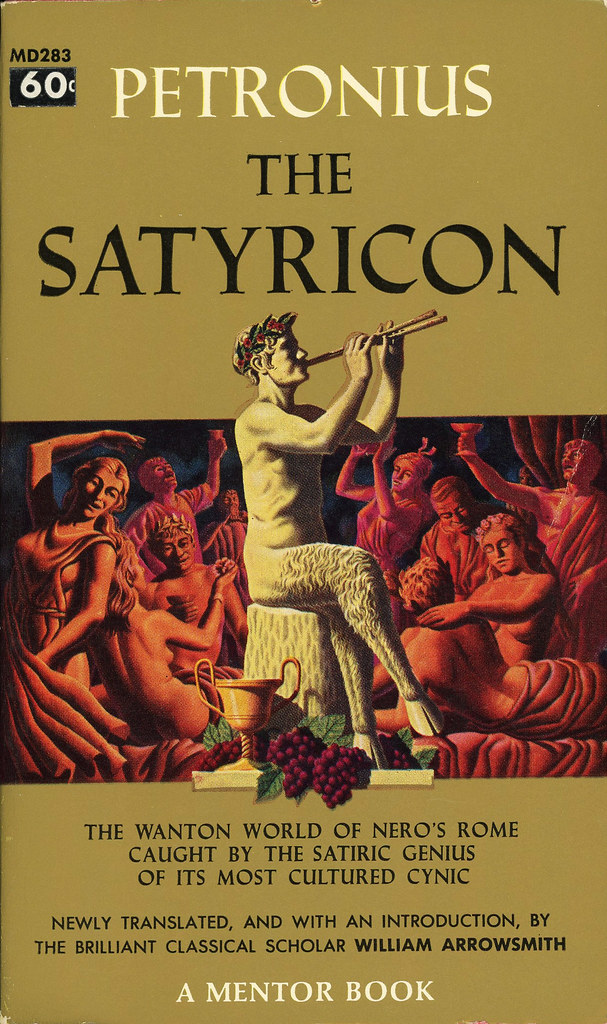
Image result for Petronius The SatyriconThe Satyricon by Petronius, translated by WC Firebaugh, 253 pages

One of the first novels, the sprawling Satyricon survives only in fragments, but fortunately these fragments form a more or less continuous text comprising most of books fifteen and sixteen of the original.  The story follows a group of well-educated but impoverished friends and rivals as they make their way through the decadent society of southern Italy during the reign of Nero, falling into and out of adventures ranging from the orgiastic rites of Priapus to the interminable dinner party of the wealthy bore Trimalchio.  At the center of many of these episodes is the beauty of the former gladiator Encolpius' boy lover Giton, a source of desire and therefore conflict for men and women alike.

As aimless as it is obscene, for the modern reader Petronius will recall Hunter S Thompson at his best or Jack Kerouac at his most popular.  It is certainly testament to the truth of Qoheleth's adage that there is nothing new under the sun.

Wednesday, June 13, 2018

Conspiracy

ConspiracyConspiracy: Peter Thiel, Hulk Hogan, Gawker, and the Anatomy of Intrigue by Ryan Holiday, 295 pages

In 2007, the website Valleywag, part of the Gawker family of gossip sites, outed Silicon Valley entrepeneur Peter Thiel as gay.  Five years later, Gawker published a "highlight reel" of moments from a sex tape involving Terry Bollea, better known as Hulk Hogan, and the then-wife of his then-best friend, a tape which had been made by said friend without Bollea's knowledge or consent.  Thiel, through intermediaries, secretly paid for Bollea's lawsuit against the website, a suit which ultimately resulted in a nine-figure judgment and the bankruptcy of Gawker.  Conspiracy is the story of how all this transpired, a story involving a determined, methodical billionaire, a company of brash, arrogant bloggers, and an aging sports entertainment superstar with mountains of baggage.  It's the story of why as well as how, and also the story of what happened after, when the conspiracy to bring down Gawker was revealed and a backlash began as the media came more and more to support Gawker's argument that journalists should be entirely free from any form of responsibility or accountability.

Holiday doesn't dwell on that last part, preferring to quote Machiavelli and ruminate on the nature of conspiracies.  It might have been interesting to contrast this case to the lawsuits resulting from Rolling Stone's false accusations of rape by members of a UVA fraternity and the complicity of the college administration, which unfolded simultaneously with the Hogan-Gawker case but involved an establishment publication and lacked a crusading billionaire.  Likewise, although he speculates as to whether the mainstream media would have been as sympathetic to Brietbart as they were to Gawker, he does not mention the demonstrated lack of sympathy when Matt Drudge was sued by Sidney Blumenthal a decade earlier.  Indeed, while he states that "Champerty - the funding of lawsuits you have no direct interest in - dates back to at least medieval times", he cites no other actual instances, preferring to lament the outcome of the 2016 presidential election.

If Holiday seems uninterested in, or blind to, the similarities between this story and other recent legal and journalistic events, he more than makes up for it with his thoroughness telling the story he has chosen to tell.  Remarkably, he was able to secure the cooperation of all of the principals and much of the supporting cast.  One of the major themes of the book is the question of how much empathy a journalist should have with his subjects, and while no definitive answer is given, Holiday himself exhibits considerable empathy and an evident desire to treat his subjects fairly.  At the same time, he keeps the narrative moving forward at a brisk pace, not always easy when dealing with years of interminable legal maneuvers.

Saturday, February 3, 2018

Ex-Friends


This is political commentator and literary critic Norman Podhoretz's memoir of how political and aesthetic disagreements destroyed his friendships with some of the luminaries of the '50s New York literary and intellectual scene.  This sometimes amounts to a gossipy settling of scores - Podhoretz seems to have a perfect memory when it comes to put-downs, and clearly treasured many of the attacks against him as personal badges of honor - but more often is accompanied by what seems to be genuine affection and equally genuine pain and regret.  At a minimum, it is a lively account of what it was like to be an ambitious young New York intellectual at a time when it seemed as if New York was the capital of the cultural world.

Saturday, December 23, 2017

Slouching Towards Bethlehem

Slouching Towards BethlehemSlouching Towards Bethlehem by Joan Didion, 238 pages

Slouching Towards Bethlehem collects a series of Joan Didion's short essays from the 1960s, covering subjects from Alcatraz to Howard Hughes to the CPUSA, but mostly herself and triple-faced California - LA, San Francisco, and Sacramento.

The title essay relates the author's experiences exploring Haight-Ashbury during the Summer of Love, which exemplifies her overarching (but not overpowering) theme of the emptiness at the heart of '60s America, an emptiness so profound that even those who feel it - like those San Francisco hippies - lack the words to describe it or the means to escape it.  Yet the most remarkable piece may be "On Morality", in which she diagnoses American post-War social fragmentation, not as the result of a lack of morality, but the surfeit of it - innumerable competing individual moralities each demanding validation.

Saturday, September 30, 2017

Scoop

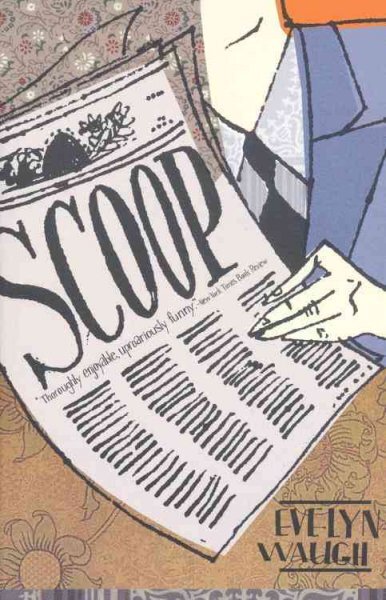
Scoop by Evelyn Waugh, 321 pages

William Boot is not a reporter, rather, he writes the nature column "Lush Places" for the Daily Beast.  It is only through a misunderstanding that he is dispatched to the obscure African nation of Ishmaelia, where the Fascist Blacks are fighting the Communist Reds, except that in this case the Blacks call themselves the Whites and the Reds call themselves the Blacks and there seems to be more fighting among the foreign press corps than among the native people.

Waugh's breezy satire of the self-referential world of the press will not cease to amuse as long as reporters and politicians remain.

Friday, May 19, 2017

Road to Wellville

The Road to WellvilleThe Road to Wellville by T Coraghessan Boyle, 476 pages

In the first decade of the twentieth century , the capital of healthy living was Battle Creek, Michigan, and the center of Battle Creek was the Sanitarium made famous by Dr Harvey Kellogg.  Dr Kellogg, in turn, is one of the main characters of T Coraghessan Boyle's tragicomic novel of those seeking health and those seeking wealth in Battle Creek.  He is joined by the Lightbodies, Will and Eleanor, she devoted mind and body to the Doctor's gospel of healthy living, he somewhat more reluctant and skeptical; Charlie Ossining, a would-be cereal entrepeneur who increasingly comes to suspect that his partner, Bender, is conning him as well as their investors; and Dr Kellogg's Luciferian adopted son, George.  Individually and collectively, they must struggle to stay fit in a treacherous world of obsession, greed, lust, and daily enemas.

Boyle is undoubtedly a skilled writer, and there are definite moments where The Road to Wellville shines.  More frequently, however, there is a certain atmosphere of artificiality - the characters are not quite realistic enough to be entirely believable, not quite caricatured enough to be absurd.  The novel seems to promise a colorful cast of characters, from the quacks at the Sanitarium to the hustlers in the town, but remains stubbornly focused on the main characters, of whom only Kellogg is particularly interesting.  Combine this with the indulgent length of the novel, and many readers are likely to find reading about Dr Kellogg's Sanitarium as interminable as Will Lightbody found his stay.

Saturday, May 13, 2017

Hillbilly Elegy

Hillbilly ElegyHillbilly Elegy: A Memoir of a Family and a Culture in Crisis by JD Vance, 257 pages

Hillbilly Elegy is a tour through the childhood of its author, JD Vance, a childhood set in a world of crime, poverty, violence, substance abuse, mental illness, and shattered families.  From the revolving door of father figures to the preoccupation with respect to the outspoken religiosity to the feeling of being an outsider to mainstream American society, much of Vance's upbringing would not be out of place in a memoir of growing up in the inner city, except that his home was in a "holler" in the backwoods of Kentucky.  Not that Vance is interested in comparing narratives of victimhood or arguing about privilege - his goal is to describe the function and dysfunction of hillbilly America at the dawn of the 21st century through the lens of his own experience.  

It is this experience that is the heart of the book - Vance is wise enough to understand that the problems involved are as complex as life.  His observations do not fit into sociological boxes and do not result in a 6-point public policy proposal.  In his estimation, the crisis faced by his family and culture is not so much an economic crisis as a crisis of values, itself sparked by alienation and a loss of dignity in a society where poverty is considered a personal failing.  At one point, Vance recalls attending one of his mother's court hearings and noticing that the judge and lawyers all spoke with "newscaster accents" quite unlike those of his family and friends.  The sense that "people like us" don't hold positions of influence and authority, don't attend Ivy League schools or start successful businesses, dogged him for much of his life, and although he did eventually graduate from Yale and settle into a stable marriage, one of the major themes of the book is that he couldn't have done so without a great deal of help - beginning with his grandparents and sister and including sympathetic high school teachers, college professors, and the United States Marine Corps.  The lesson is that the only cure for a vicious culture is a virtuous culture, and the first virtue (Peguy's "little one who leads them all") is theological - hope.

Saturday, February 7, 2015

Disaster Artist


Some years ago, legendary film critic Ken Begg opined that the only way a truly great bad movie can be produced in an era of homogenization, market studies and test audiences is as a vanity project.  The Room is certainly delightfully terrible in every aspect - from set design to music, but especially the script and acting - and every aspect was under the control of one remarkable man, writer-director-producer-star Tommy Wiseau.  But who is Tommy Wiseau?

Since no one seems better qualified to answer that question than best friend and co-star Greg Sestero, it's a bit of a disappointment that he doesn't seem to have a complete answer.  Even in private, Wiseau has been reluctant to discuss his life and deliberately mysterious.  Even the source of The Room's six million dollar budget is unclear.  Yet perhaps Sestero gives the only answer possible - Tommy Wiseau is The Room, and The Room is Tommy Wiseau.

Well-written and consistently entertaining, The Disaster Artist is not only a good description of a slow-motion catastrophe, but also an interesting portrait of struggling actors in LA.