Showing posts with label Satire. Show all posts

Thursday, August 19, 2021

I Am Charlotte Simmons

I Am Charlotte Simmons by Tom Wolfe, 676 pages

She is Charlotte Simmons, the valedictorian of her high school in the tiny Appalachian town of Sparta, North Carolina, with qualifications impressive enough to earn her a full scholarship to elite DuPont University.  Having long held herself aloof from the squalid debauchery of her hillbilly peers as a result of both her Momma's uncompromising religious moralism and her academic mentor's elevated vision of the life of the mind, Charlotte is wholly unprepared for the sophisticated decadence she finds at DuPont.  The present life of her peers is the reckless pursuit of pleasure in preparation for their future pursuit of wealth and power, and Charlotte is alone and far from home.  Who is Charlotte Simmons?

Wolfe began his career as a novelist late in life, after having already made himself famous as a journalist and cartoonist.  It is precisely his sharp observations that power his writing, although it is his connected determination to always present these observations squarely, without sensationalism but also without flinching, no matter how sensitive the topic, which is his most valuable trait.  Wolfe's deep satire is not caricature or parody, but a revelation of the absurdities we ordinarily fail - or refuse - to notice.  Meanwhile, I Am Charlotte Simmons is surprisingly moving, with it being much easier to become emotionally invested in Charlotte's choices and fate than in those of Sherman McCoy.  Unfortunately, the book does fall apart somewhat about two-thirds of the way through, as though Wolfe knew the ending he wanted to get to but had to derail the story to get it there, although even here there are moments worth remembering.

Friday, August 7, 2020

Campusland

CampuslandCampusland by Scott Johnston, 323 pages

There is perhaps no more comfortable place than an elite American university.  This is certainly true of Devon, where English professor Ephraim Russell's biggest worry is beating out a rival for tenure and freshman Lulu Harris frets over being on the cover of a magazine and finding bedmates who meet at least some of her standards.  It is a fragile idyll, however, and it is about to be turned upside down by the ambitions of an activist grifter and an imperious diversity commissar.  

Campusland reads like a combination of an artless Bonfire of the Vanities and a version of the movie PCU where the wacky band of misfits has been pushed to the periphery.  The result, while entertaining, is unsatisfying, as the novel makes a dramatic tonal shift as the climax approaches and Kafka is suddenly swapped with National Lampoon.

Tuesday, June 9, 2020

In Our Time

In Our TimeIn Our Time by Tom Wolfe, 119 pages

In Our Time collects a number of sketches written or drawn by Tom Wolfe in the years leading up to 1980, with most of the drawings having appeared in the "In Our Time" feature in Harper's magazine.  Together, they present a portrait of America, and especially New York, that is as amusing as it is incisive.

For Wolfe, the hidden significance of the '70s was that it was the decade when the counterculture of the '60s became the culture.  If the '60s witnessed the rise of the young barbarians, the '70s saw their triumph.  Just as importantly, it was when they began, despite their own best efforts, to grow old.

Friday, June 14, 2019

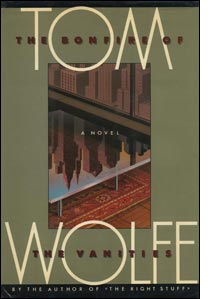
Bonfire of the Vanities

Image result for The Bonfire of the VanitiesThe Bonfire of the Vanities by Tom Wolfe, 659 pages

Sherman McCoy imagines himself a Master of the Universe, spending his days making multi-million-dollar bond trades, or, as his wife puts it, collecting golden crumbs.  Larry Kramer is an Assistant District Attorney in the Bronx, Jewish by birth but Irish by vocation, his heavy caseload and meager pay compensated for by fantasies of power and virility.  Peter Fallow is a reporter for the City Light tabloid, struggling to stay sober long enough to write a story that will justify his continued employment.  All of them are desperately trying to find, keep, and increase their place somewhere in the heap of humanity that is 1980s New York, the capital of the world.  In their persons, the worlds of finance, politics, and the press collide, though in the end their defeats seem to possess more dignity than their victories.

In 2007, The New York Times published a retrospective on Wolfe's debut novel in which it crowed that "the New York of 'Bonfire,' to a degree that might well have shocked people in 1987, no longer exists."  It is true, of course, that street crime in New York is far below the flood crest of the '70s and '80s, but street crime - as opposed to the fear of street crime - plays only an incidental part in The Bonfire of the Vanities, and the last decade has certainly witnessed a resurgence of social unrest and tribalism, complemented by an outrage culture endemic to social media and epidemic in the press, so that we seem more than ever to be living in Bonfire's jungle.  For proof, one need only compare the treatment of Sherman McCoy by a fictional tabloid with the treatment of the Duke Lacrosse players by the actual New York Times.  The same Qoheleth who informs us that "all is vanity" also reminds us that "there is nothing new under the sun."

Sunday, December 9, 2018

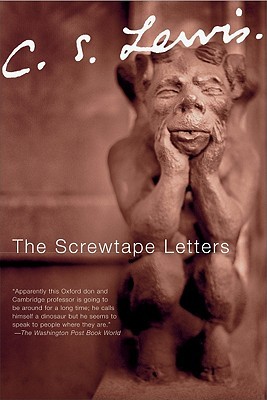
The Screwtape Letters

The Screwtape Letters by C. S. Lewis      Paperback: 211 pgs.       

     This inventive and witty satire consists of letters purportedly written by a demon named Screwtape, offering advice on how best to ensure the damnation of a human soul.  Though it is an old book— Lewis wrote it (and it is set) during World War II— it is just as relevant to a 21st century audience as to those who read it over 75 years ago.  What shines through the most to me is Lewis’ amazing wisdom and insight into human nature and the nature of good and evil.  Lewis sees through temptations into the core issues involved and then explains it all to us through the pen of the fictional Screwtape.  It is therefore an excellent source for Christians to go to for knowledge of the real devil’s strategy and tactics.  The only major temptation missing here, as Christian writer Steve Farrar points out, is the attempt to keep people from studying the Bible.  We never see Screwtape urge his nephew to keep his “patient” (the man he’s tempting) from God’s Word— yet this is surely a major part of the devil’s strategy in real life.

     The edition I read also includes a speech by Screwtape, called “Screwtape Proposes a Toast,” written in 1959.  Lewis imagines here what Screwtape would say at a graduation ceremony of demons about to go out on their first assignments.  Lewis, through the mouth of Screwtape, explains the dangers of excess in democracy (resulting in evil and injustice), especially in our educational system.  Lewis even posits an interesting theory of why the United States fell behind the Russians at the beginning of the Space Race in the late 1950’s.

     One thing to keep in mind when reading this book is the “demonic” authorship.  What Screwtape loves, Lewis means us to hate; what the demon hates, we should love; what he thinks is good, we should abhor and vice-versa.  Also, demons aren’t exactly known for telling the truth, so in a few cases, Screwtape’s descriptions and judgements may not be entirely accurate.  Nevertheless, Lewis has made Screwtape’s observations mostly very accurate, so as to explain truth through the demon’s pen.  Not that Christians (let alone non-believers) are likely to agree with everything Lewis says.  I certainly don’t, but my disagreements with him are very few and far between.  To me, this is still one of the greatest books I’ve ever read; a great guide to truth, temptation, human nature, good and evil, and even reason.  I highly recommend it!

 (posted for John W.)

Monday, August 13, 2018

Gulliver's Travels

Gulliver's TravelsGulliver's Travels: An Account of the Four Voyages into Several Remote Nations of the World by Jonathan Swift, 343 pages

In Swift's classic satire, the adventure-prone naval surgeon Gulliver finds himself repeatedly stranded in strange lands, where he meets the tiny Lilliputians, the giant Brobdingnagians, the ivory tower intellectuals of Laputa, and the superhuman intelligent horses, the Houyhnhnm.  In the process, again and again he is confronted with the inexplicable base depravity of the human race, never more bitingly than in his encounter with the virtuous Houyhnhnm, for whom the men who live alongside them, the disgusting Yahoos, are a byword for foulness and a source of considerable perplexity.

Gulliver's Travels is often treated as a children's story and, apart from the modern dismissive attitude towards fantasy, it is difficult to imagine why.  Swift's contempt for prideful, fallen humanity can only be described as Brobdingnagian.  In the eighteenth century, this was understandably the source of considerable controversy - now, for some reason, it is only commented upon when Swift focuses his ire on the female of the species.

Friday, August 10, 2018

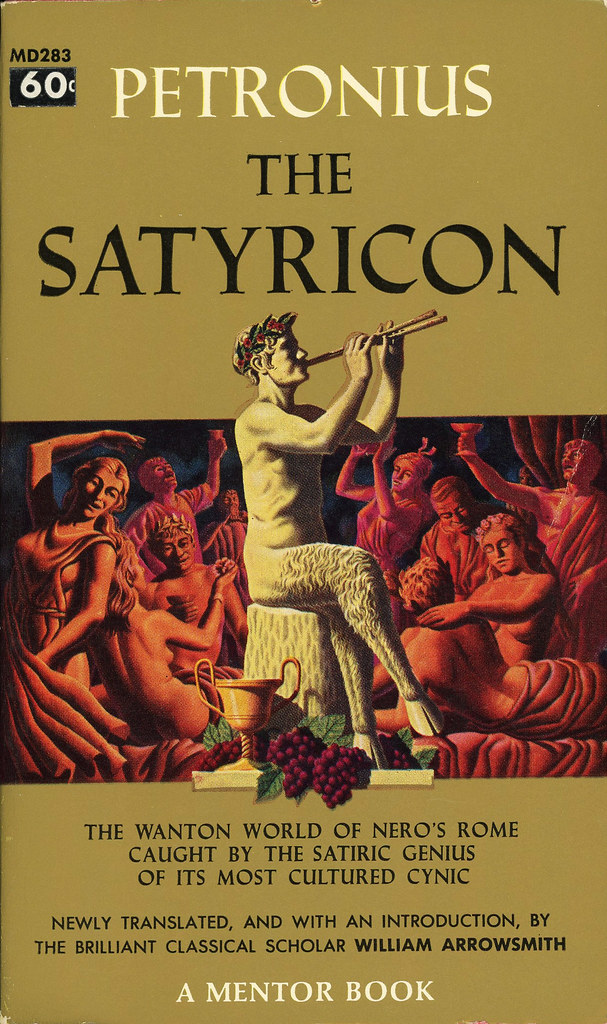
Satyricon

Image result for Petronius The SatyriconThe Satyricon by Petronius, translated by WC Firebaugh, 253 pages

One of the first novels, the sprawling Satyricon survives only in fragments, but fortunately these fragments form a more or less continuous text comprising most of books fifteen and sixteen of the original.  The story follows a group of well-educated but impoverished friends and rivals as they make their way through the decadent society of southern Italy during the reign of Nero, falling into and out of adventures ranging from the orgiastic rites of Priapus to the interminable dinner party of the wealthy bore Trimalchio.  At the center of many of these episodes is the beauty of the former gladiator Encolpius' boy lover Giton, a source of desire and therefore conflict for men and women alike.

As aimless as it is obscene, for the modern reader Petronius will recall Hunter S Thompson at his best or Jack Kerouac at his most popular.  It is certainly testament to the truth of Qoheleth's adage that there is nothing new under the sun.

Thursday, July 5, 2018

The Loved One

The Loved OneThe Loved One by Evelyn Waugh, 164 pages

Although Dennis Barlow initially came to Los Angeles to write for the movies, he soon found a more tasteful job working at the Happier Hunting Ground pet cemetery.  Then his host kills himself and the funeral arrangements fall to him, bringing him to Whispering Glades, the human cemetery, where he quickly becomes the third leg of a mortifying love triangle.

Waugh's satirical work often centers around his hatred of the vulgar, and given his estimation of America as the empire of vulgarity and Hollywood as its capital, it is no surprise that his usual grotesques are even more grotesque than usual here.  Yet it is the Englishman who comes off worst in the end - his mention of Henry James is neither accidental nor superfluous.

Wednesday, February 7, 2018

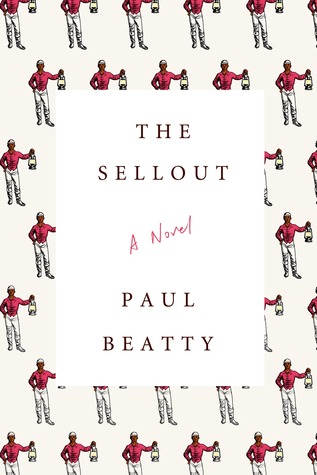
The Sellout

The Sellout by Paul Beatty   304 pages
The black narrator, Bonbon, grew up in a “disappeared” L.A. suburb, once an “agrarian ghetto” called Dickens, where he was subjected to his father’s sociological, and abusive, experiments about race.  Despite his father’s attempts to indoctrinate him into ‘black’ thinking, Bonbon is ultimately also called the Sellout because his character, although himself an African-American, does not espouse African-American stereotypes, he just doesn’t get the ‘black’ thing. As a grown man, Bonbon discovers one day that his town has ceased to exist, and he sets about to rectify the situation.  He elicits help from his friend, Hominy, the last surviving member of TV's Little Rascals (he was Buckwheat’s understudy). Help is really not the appropriate term as Hominy insists on being enslaved and Bonbon suffers through his role as massa. Part of the solution to making Dickens visible is to reintroduce segregation, first on buses, then in the schools. As one can imagine, imposing voluntary slavery and apartheid onto an American community eventually causes a legal nightmare, and the case ends up in the Supreme Court.
This novel is a daring satire about race relations in contemporary America. Nothing is sacred - politics, pop culture, the media's portrayal of African-Americans - so many aspects of U.S. life are targeted and turned upside-down by Beatty's razor-sharp musings. This book is often very funny, and full of ideas and snipes at deserving targets, but not an easy book to read if you are easily offended. The plot is clearly ridiculous, but it does allow a very full discussion of race - the stereotypes, the archetypes, and array of attitudes from subtle to extreme.

Posted By:  Regina C.

Holy Cow!

Holy Cow! By David Duchovney   206 pages
I thought the least I could do is read a book from one of my displays and I could use some humor after the recent reads, so I was drawn to the premise of the story:
Elsie Bovary and her best friend Mallory are living life as only contented cows can, until they decide to sneak out one night and flirt with the bulls. Elsie, however, is drawn to the light of the Box God inside the farmhouse, where she watches the gory details of meat processing, and finally understands where her mother disappeared to. She resolves to escape her inevitable fate by running away to India, where cows are revered and thus safe from harm. There are no secrets in a close-knit community and soon Jerry and Tom have convinced Elsie that escape is their only means of self-preservation. Jerry, or Shalom as he calls himself after his recent conversion to Judaism, wants to be in Israel among his ‘people’, who have an aversion to all things pig-related, so he will be safe from slaughter. Tom, the anorexic turkey in light of pending Thanksgiving, aims to live in Turkey, where surely turkeys are esteemed and not eaten. Does the trio make it to their desired destinations?
I’d love to say I recommend the book, but it is just too … in so many ways. There are many laugh-out-loud phrases, which is to be expected in a story narrated by a cow and all expressions are of the teenaged-bovine variety. But these inane moments are interspersed with some deep personal views about human maltreatment of animals; not that I disagree with the author’s opinion, but the preachy parts deter from the silliness of the story. The writing style, although intended to reflect the immaturity of the narrator, is awkward and grating throughout, just annoying enough to make you reconsider finishing the book. 

Posted By:  Regina C. 

Wednesday, November 15, 2017

Horatian Satires and Epistles

Horatian Satires and Epistles by Alexander Pope, 109 pages

     Bear me, some God!  oh quickly bear me hence
     To wholesome solitude, the nurse of sense:
     Where Contemplation prunes her ruffled wings
     And the free soul looks down to pity Kings!

This short book collects a series of satirical pieces devised by Alexander Pope in open imitation of Horace and Donne.  Pope, inspired by his predecessors, and like them

     To Virtue only and her friends, a friend

hears in their works the voice of a Muse, or perhaps of Conscience

     ('Tis Reason's voice, which sometimes one can hear)

and finds in that inspiration the power to condemn the vices and follies of his age as they did theirs

     If there be force in Virtue, or in Song.

Though the targets of Pope's satire are now generally obscure, the wit remains, and many of his lessons are eternally potent.

     So when you plague a fool, 'tis still the curse,
     You only make the matter worse and worse.

Although his poetry was generally rejected by an age that disdained form and craft, perhaps Pope's care and precision will experience a rehabilitation in a coming age exhausted by formlessness, tired of calculated spontaneity and simulated sincerity.  Then his prophecy will be validated

     Truth guards the Poet, sanctifies the line,
     And makes immortal, Verse as mean as mine.

Saturday, September 30, 2017

Scoop

Scoop by Evelyn Waugh, 321 pages

William Boot is not a reporter, rather, he writes the nature column "Lush Places" for the Daily Beast.  It is only through a misunderstanding that he is dispatched to the obscure African nation of Ishmaelia, where the Fascist Blacks are fighting the Communist Reds, except that in this case the Blacks call themselves the Whites and the Reds call themselves the Blacks and there seems to be more fighting among the foreign press corps than among the native people.

Waugh's breezy satire of the self-referential world of the press will not cease to amuse as long as reporters and politicians remain.

Thursday, January 19, 2017

In the Springtime Everything is New All Over Again: A Dark Humor Short Story


In the Springtime Everything is New All Over Again: A Dark Humor Short Story by Esmerelda Q. Jones  26 pages

This short story has an unnamed narrator who is a writer. Based off a running joke with her (since they share a room) sister, the narrator names her protagonist Carl. The she spends the rest of the story coming up with the plot and plot twists for poor ol’ Carl.

I didn’t think it was funny, and it rubbed me the wrong way. Basically because it goes against the basic rule of fiction writing: Nothing is more boring than a character sitting around thinking and not acting. Granted this is a writer thinking, but it’s just as boring.


The one saving thing about this short story is just that: it’s short. That’s why I give In the Springtime Everything is New All Over Again: A Dark Humor Short Story 2 out of 5 stars in Julie’s world.

Saturday, February 6, 2016

Flying Inn

The Flying Inn by GK Chesterton, 320 pages

First published in 1914, The Flying Inn takes place in an England where a combination of a moralistic progressivism and an Islamic fad have resulted in the closing of every public house in England.  A renegade pub owner and an Irish rebel take to the road with a barrel of rum and a wheel of cheese to satisfy a thirsty nation.

The conceit allows Chesterton to exercise both his poetic whimsy and satiric bite.  The novel is peppered with drinking songs celebrating the traditional joys of life, while the plot skewers politicians, socialists, capitalists, journalists, aesthetes, and religious enthusiasts.  As with most of Chesterton's fiction, the plot is vanishingly thin, little more than an excuse to bring his sane protagonists into contact with the wider world in all its insanity.

Tuesday, July 28, 2015

Year Zero

Year Zero by Rob Reid, 357 pages

Cover image for Aliens love music, but are dreadfully untalented at creating it. When they discover human music they become addicted and quickly begin downloading every piece they can find. It isn't until after they've done this that they realize they've just committed the biggest copyright violation since the Big Bang, and that the resulting fines is enough to bankrupt the universe. Their natural plan is to destroy the Earth, however Carly and Frampton decide to recruit Nick Carter, a music lawyer who is on the brink of being fired to arrange licenses and avoid disaster. Nick now has forty-eight hours to save humanity, find a way to keep his job, all while hopefully wowing the hot girl who lives down the hall from him.

The plot was fun and over the top, and the story was overall hilarious. I would definitely recommend this book to fans of Douglas Adams, and similar science fiction authors.

Saturday, June 14, 2014

Worst Person Ever

Worst Person Ever by Douglas Coupland
100 read
of 301 Pages

Worst. Book Ever... well not ever but this month.   I was really disappointed by Coupland's latest because I had liked some of this past works and this sounded interesting.  Raymond Gunt is a cameraman that hasn't worked for awhile but gets a job on a Survivor Like show.  A series of events tries his limited (non-existent)  patience.   

I understand that Gunt is supposed to be unpleasant and the novel a satire of the shallowness of modern society.  However, Gunt goes beyond unpleasant, he is one-dimensional nastiness and the satire rarely escalates above that of a 12 year old boy.

Wednesday, March 26, 2014

Notes from the Internet Apocalypse

Notes from the Internet Apocalypse by Wayne Gladstone
216 Pages

The Internet is gone, suddenly and completely.  Society is lost and trying to adapt in a world where information is no longer just a click away.   Cats are forced to do tricks over and over because there is no youtube.  Pornography has a renaissance on Times Square and one psychic librarian has begun answering reference questions for a fee.   The main character Gladstone has teamed up with two friends to find the internet again and is soon the center of controversy when he is identified as the Internet Messiah and people turn to him as either the savior of the internet or the man that will return the scourge of life.

There is lots of humor about how people cope with the loss of something that is a part of their daily lives but it does begin to wear thin about 2/3's into the book.  The underlying theme of the satire is how people have depended upon the shallow interface of the internet to fill in a lack of interpersonal relationships and after it is gone, they are at sea as how to interact with the world again.