Showing posts with label Journalists. Show all posts

Friday, June 14, 2019

Bonfire of the Vanities

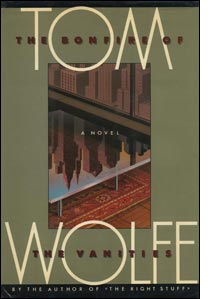
Image result for The Bonfire of the VanitiesThe Bonfire of the Vanities by Tom Wolfe, 659 pages

Sherman McCoy imagines himself a Master of the Universe, spending his days making multi-million-dollar bond trades, or, as his wife puts it, collecting golden crumbs.  Larry Kramer is an Assistant District Attorney in the Bronx, Jewish by birth but Irish by vocation, his heavy caseload and meager pay compensated for by fantasies of power and virility.  Peter Fallow is a reporter for the City Light tabloid, struggling to stay sober long enough to write a story that will justify his continued employment.  All of them are desperately trying to find, keep, and increase their place somewhere in the heap of humanity that is 1980s New York, the capital of the world.  In their persons, the worlds of finance, politics, and the press collide, though in the end their defeats seem to possess more dignity than their victories.

In 2007, The New York Times published a retrospective on Wolfe's debut novel in which it crowed that "the New York of 'Bonfire,' to a degree that might well have shocked people in 1987, no longer exists."  It is true, of course, that street crime in New York is far below the flood crest of the '70s and '80s, but street crime - as opposed to the fear of street crime - plays only an incidental part in The Bonfire of the Vanities, and the last decade has certainly witnessed a resurgence of social unrest and tribalism, complemented by an outrage culture endemic to social media and epidemic in the press, so that we seem more than ever to be living in Bonfire's jungle.  For proof, one need only compare the treatment of Sherman McCoy by a fictional tabloid with the treatment of the Duke Lacrosse players by the actual New York Times.  The same Qoheleth who informs us that "all is vanity" also reminds us that "there is nothing new under the sun."

Thursday, June 7, 2018

Love and Ruin

Love and Ruin by Paula McLain   400 pages

Paula McLain burst onto the literary scene with “The Paris Wife,” and if you haven’t had the pleasure of reading that novel, grab a copy as soon as you can. In that novel, McLain wrote about famed author Ernest Hemingway and his first wife, Hadley. 


After that book, she thought she was done with Hemingway. However, in a conversation at St. Louis County Library, she told the packed house that she had had a dream about him, after which she felt compelled to tackle the adventurous writer once again.


By this point in his life, Hemingway has had moderate success as a writer, but he had yet to write “A Farwell to Arms,” which catapulted him to superstardom.  It’s 1936. Tensions are starting to run high across Europe as Hitler comes to power. The world is afraid another war is imminent. The Spanish Civil War, however, is in its infant stages


Hemingway loved adventure, and so did Martha (Marty) Gelhorn. A St. Louis-girl, she bucked the conventions of her upper social status. A writer herself, Marty published her first book, “The Trouble I’ve Seen” to rave reviews.


As 1936 turns to 1937, Marty and her mother take a trip to Key West, where she meets Hemingway.  Although they were attracted to each other, Ernest was still married to his second wife, Pauline.

As the war in Spain heated up, Marty talked the editor of “Collier’s” to assign her to cover the conflict as a special correspondent.  She also runs into Hemingway again, and their passion ignites. McLain follows the couple around the world, through their ups and downs, through 1944.


Much like “The Paris Wife” and Melanie Benjamin’s story of the Charles and Anne Morrow  Lindbergh  in “The Aviator’s Wife., I felt like a fly on the wall as I watched two authors try to write under one roof, two people with an adventurous nature coursing through their and two  lovers love and fight.


The only downfall upon reaching the conclusion of “Love and Ruin,” is that readers have to wait for the next Paula McLain novel. Sure hope it’s soon.  “Love and Ruin” receives 6 out of 5 stars in Julie’s world.

Tuesday, September 12, 2017

The Boys in the Bunkhouse

The Boys in the Bunkhouse: Servitude and Salvation in the Heartland by Dan Barry    352 pages

"In the tiny Iowa farm town of Atalissa, a group of intellectually disabled men, all from Texas, lived in a tired old schoolhouse. Every morning, well before dawn, they were bussed to a processing plant to eviscerate turkeys in return for food, lodging, and $65 a month. From 1974 until 2009, the men lived in near servitude, enduring increasing neglect, exploitation, and physical and emotional abuse—until state social workers, local journalists, and one tenacious government lawyer helped these men achieve their freedom.

New York Times columnist Dan Barry reveals how these men in an Iowa schoolhouse remained nearly forgotten for more than three decades. Drawing on exhaustive interviews, he dives deeply into their lives, recording their memories and suffering, their tender moments of joy and persistent hopefulness—their endurance of harrowing circumstances. Barry explores why this small heartland town remained all but blind to the men’s plight, details how those responsible for such profound neglect justified their actions, and chronicles the lasting impact of a dramatic court case that has spurred advocates—as well as President Obama—to push for just pay and improved working conditions for people with disabilities."


I felt it was easier to use the summary from Goodreads than write my own --- mostly because I don't think I would have been able to write something this compelling (and I would left something out, I'm sure).  This was a book that was hard to read, but hard to put down. You feel like you must be reading fiction at times, because you don't want to believe that all of this happened. And that people could be treated this way.  Actually, I can believe that humans would treat other humans this way, which is why this book was upsetting at times.  Dan Barry does a wonderful job of bringing this story to life, in a way where you get to know the different men in the story, in a way that is compassionate, but heartbreaking.  


Wednesday, September 7, 2016

Malcolm Muggeridge

Cover image for Malcolm Muggeridge: A Biography by Gregory Wolfe, 423 pages

From an early age, Thomas Malcolm Muggeridge - the "Thomas" was apparently dropped even by family members early on - combined an appreciation for the power of language with an keen understanding of the difference between appearance and reality.  A long career in journalism, in print, radio, and finally television, only affirmed the importance of these perceptions, and their entanglement - for language can be used to disguise or unmask reality.  Muggeridge spent much of his career as an unhappy iconoclast, bouncing between jobs, trying and failing to become appreciated as a novelist or dramatist.  He worked as a correspondent in India, Egypt, Moscow, and Washington DC, forming friendships with the likes of George Orwell and Graham Greene.  Predicting the dissolution of the British Empire, reporting on the murderous famines in the Soviet Union, and criticizing the soap opera atmosphere surrounding Britain's Royal Family earned him a remarkably diverse set of detractors, however nothing brought more sustained criticism than his gradual conversion to Christianity, first to a Lewisian "mere Christianity" and eventually to the fullness of Catholicism.  To those who had admired Muggeridge as the quintessential outsider and slaughterer of sacred cows, such a surrender seemed a treasonous betrayal so wholly out of character with the man as to suggest a nervous breakdown or senility.

It is the major theme of Gregory Wolfe's excellent biography that Muggeridge's conversion, far from an uncharacteristic aberration, was in fact the product of a lifelong struggle to answer the question Christ posed to His disciples - "Who do you say that I am?"  "St Muggs" the septuagenarian apologist is, in Wolfe's narrative, the same child who read the Bible in secret so as not to scandalize his socialist father, the same college student who spent time at the Oratory of the Good Shepherd in the company of Wilfred Knox, and the same young man whose first overseas adventure was as a teacher hired by a missionary group.  In Muggeridge's case, at least, the eye so adept at detecting the flaws of others was not blind when turned inward, and the seeker after truth could not be satisfied, in the end, with anything less than Truth Himself.

Thursday, December 4, 2014

Vanished

Vanished by Irene Hannon, 328 pages


Moira Harrison hits someone in an accident on a deserted road one rainy night.  Lost and confused from the accident, Moira was relieved when someone else shows up assuring her that he called 911 and help is on the way.  Moira passes out and when she comes to, an hour has passed and there is no sign of the man who stopped to help, the person she hit, or any emergency service people.  The police, when she calls them, obviously don’t believe her story, thinking that she was disoriented from the accident.  She decides to speak to a private investigator, and, with a recommendation in hand, contacts Phoenix, Inc., and speaks to Cal Burke.  Burke is intrigued by the case and agrees to check it out pro bono, since Moira can’t pay their fees.  Moira, a reporter so no stranger to investigation, also helps him out on stake-outs and other tasks.  As the two spend time together, they become aware of a growing attraction that neither wish to act on until the case is solved.  As readers, we get to know a lot more information than the characters and are clearly introduced to the perpetrator early on in the book.  However, the intrigue and suspense are still fun.  The Christian romance is also handled pretty well and doesn’t overpower the rest of the story.  People who like any of these aspects will probably enjoy this story.