Showing posts with label Chesterbelloc. Show all posts

Tuesday, July 2, 2019

Knight of the Holy Ghost

Knight of the Holy GhostKnight of the Holy Ghost: A Short History of GK Chesterton by Dale Ahlquist, 171 pages

Like Chesterton's own biographies, Knight of the Holy Ghost is not a conventional retelling of a man's life, but rather an allusive attempt to express his personality.  If there is anyone now alive qualified to write such a book, it is Dale Ahlquist, who has spent decades studying and celebrating his subject.  Here, he considers the larger-than-life Chesterton in three complementary roles - as man, writer, and saint - yet it is as the titular knight that these are united.  Recognizing that, as he wrote in The Ballad of the White Horse, "the old barbarian" had now "come with scroll and pen", Chesterton took up his own pen with the same spirit with which the protagonists of The Ball and the Cross took up their swords, or Innocent Smith took up his pistol.  Chesterton was a knight of the Holy Spirit because he was a knight of the apocalypse, which is to say a knight of revelation.  In his voluminous writings, whether poetry or fiction, biography or criticism, apologetics or journalism, he lays bare the follies but also the wonders of the world, and yet he does so not merely for the joy of the unmasking, but in order to discover and rediscover the One who has overcome the world.

Tuesday, May 28, 2019

Four Men

Image result for four men bellocThe Four Men: A Farrago by Hilaire Belloc, 149 pages

This is Belloc's tale, or rather tales within a tale, of a man called Myself and his companions, whom he nicknames Grizzlebeard, the Sailor, and the Poet, as they wander the beloved countryside of their home county of Sussex, which we are assured was "the first place to be created when the world was made" and will be "the last to remain, regal and at ease when all the rest is very miserably perishing on the Day of Judgement by a horrible great rain of fire from Heaven."  The four men (who, needless to say, are all variations on the author) pass their time speaking or, just as often, singing sound nonsense and enchanting sense, including the stories of how St Dunstan led the devil about by the nose and how Mr Justice Honeybubble delivered his famous Opinion at the Cricketers' Arms.

Tuesday, May 14, 2019

Ballad of the White Horse

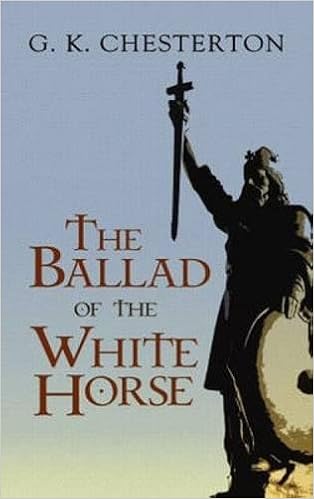
Image result for ballad of the white horseThe Ballad of the White Horse by GK Chesterton, 154 pages

Chesterton's remarkable epic poem takes as its subject the legendary history of King Alfred - the great king of Wessex who defeated the Danes at the battle of Ethandune and drove them from the south of England.  Chesterton celebrates this as a triumph of Christian civilization over a barbarous paganism, but he also understands that all such victories are provisional (and providential), for the barbarians always return, like grass on the chalk horse.

     And all the while on White Horse Hill
     The horse lay long and wan,
     The turf crawled and the fungus crept,
     And undid the work of man.

Yet this is not fatalism, for it is the fatalism of the pagans that Chesterton denounces as nihilism.

     'What have the strong gods given?
     Where have the glad gods led?
     When Guthrum sits on a hero's throne
     And asks if he is dead?'

He suggests that such is always the result of attempts to know - and thus control - what is to come.

     'The wise men know all evil things
     Under the twisted trees,
     Where the perverse in pleasure pine
     And men are weary of green wine
     And sick of crimson seas.

     'But you and all the kind of Christ
     Are ignorant and brave,
     And you have wars you hardly win
     And souls you hardly save.'

And with Alfred's voice he directs every generation to the necessary work of recovery.

     'And though the skies alter and empires melt
     This word shall still be true
     If ye would have the horse of old
     Scour ye the horse anew.'

Monday, February 12, 2018

Superstition of Divorce

The Superstition of Divorce by GK Chesterton, 150 pages

In this collection of essays Chesterton brings his legendary wit and commonsense to bear against one of the most pernicious superstitions of our highly superstitious age - the bizarre belief that the natural bonds of duty and devotion between a man and a woman, as formalized in marriage, can be dissolved by magical words pronounced by a court.  The danger of this superstition, in Chesterton's view, is the threat it poses to the family, the essential and paradigmatic form of human community and the chief bulwark against both anarchy and tyranny.  Supported by the powers of commerce and the state, wielding the abnormal as a weapon against the normal, advocates of easy divorce demand the respectability of marriage while denying the very elements that make marriage worthy of respect.  In his usual charming, rambling way Chesterton contends that the superstition of divorce depends upon the substitution of the banal servility of mere contract for the romantic, creative freedom of the vow.

Monday, December 11, 2017

The Making and Unmaking of the English Catholic Intellectual Community

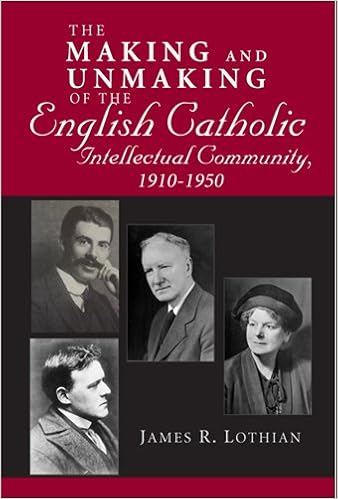
The Making and Unmaking of the English Catholic Intellectual Community 1910-1950 by James Lothian, 383 pages

From the late eighteenth century through the middle of the twentieth, many English intellectuals felt the pull of the Catholic Church.  There are many reasons for this, including the Romantic predilection for the Middle Ages, the search for a secure authority in a time of change, dissatisfaction with the Erastianism of the Church of England, admiration for the coherence of Catholicism, and attraction to continental Catholic culture.  A number of books have been written about the various figures involved (Literary Converts), as well as a number of studies published about the literature they produced (The Return of Christian Humanism).  James Lothian, however, seeks to fill a void by concentrating on English Catholic intellectual life during the period roughly bounded by the World Wars, when it was dominated by a circle centered on Hilaire Belloc, a circle which included such luminaries as GK Chesterton, Eric Gill, Evelyn Waugh, and Christopher Dawson.

The story of how Belloc's influence waxed and waned is well worth studying, but there are some major problems with Lothian's approach.  One is the of narrowness of scope.  For excellent reasons, Lothian chooses to concentrate on the intellectual development of English Catholicism during a four decade period.  This is all well and good.  But history cannot be so neatly divided, and Lothian's brief synopsis of nineteenth century English Catholicism, while it cannot justly be expected to be comprehensive, nonetheless seems to fall short by failing to even mention the Catholic undercurrents among the Gothic Revivalists, the Pre-Raphaelites, or the Decadents, still less contemporary Anglo-Catholic figures such as CS Lewis, Dorothy Sayers, and TS Eliot, or even Christopher Dawson's involvement with Triumph or Belloc's influence on Dorothy Day and EF Schumacher.  Even worse, Lothian's understanding of intellectualism too often seems to be limited to social and political ideas - this is particularly egregious when studying thinkers who themselves insisted that such ideas could never be isolated from ethical, aesthetic, philosophical, or theological concerns.

Another problem is connected to the major theme of the book, the strengths and weaknesses of Belloc's approach.  Unfortunately, despite an apparent attempt to be even-handed, Lothian cannot help but frame the history of "Bellocianism" in a manner that reveals his particular biases.  Early on, noting St Pius X's condemnation of Modernism, he defines Modernism as "the common desire to adapt Catholicism to the intellectual, moral, and social needs of today", and goes on to regret that the "Bellocians" had little sympathy with it.  On the surface, this seems inexplicable, since it is difficult to imagine interviduals more fixated on examining "the intellectual, moral, and social needs of today" than Belloc, Chesterton, and McNabb.  The truth is, of course, that the Modernism condemned by Pius was far more than Lothian's facile description suggests.  By casting it in this superficial way, however, he is able to indulge in the treasured myth of a paradoxically insular "fortress Catholicism" which somehow managed to attract a number of brilliant converts and spark an intellectual renaissance despite being entirely inward-looking and "sterile."  The post-war Church is then praised as being open and involved in the world, despite having nothing distinctive to say.  In this backhanded way, Lothian unfairly faults Belloc's circle for turning their collective back on modernity, when the real issue is not whether the Church should engage with the world, but howOnce again, the difference is between two visions of the Church: as a fundamentally supernatural body teaching eternal truths both in and out of season, or as an essentially human institution which must struggle to get along in the world as best it can.

Belloc and his admirers believed that capitalist democracy would ultimately prove as incompatible with the Catholic belief in the dignity of the human person as socialism and Nazism.  As a result, they presented a distinctly Catholic critique of contemporary Britain.  This was largely abandoned during the War, both as a result of the pressures of wartime and the efforts of a government-employed propagandist, and not resumed afterwards.  For Lothian, this embrace of the status quo, and thus the entire "unmaking of the English Catholic intellectual community", somehow represents a victory rather than a defeat.

Friday, October 6, 2017

Man Who Was Thursday

The Man Who Was Thursday: A Nightmare by GK Chesterton, 281 pages

Thursday is one of the seven heads of a global anarchist conspiracy bent on overthrowing all order and authority, under the leadership of the terrible, terrific genius Sunday.  He is also Gabriel Syme, a policeman bent on infiltrating that looking-glass world where black is white and right is wrong, a nightmare that might be more real than he suspects.

Like Kafka turned upside down, The Man Who Was Thursday depicts life as a nightmare duel with an unknown adversary, each of us seemingly alone against a world ruled by sinister forces - but not nearly as alone as we imagine.

Monday, January 23, 2017

Belloc

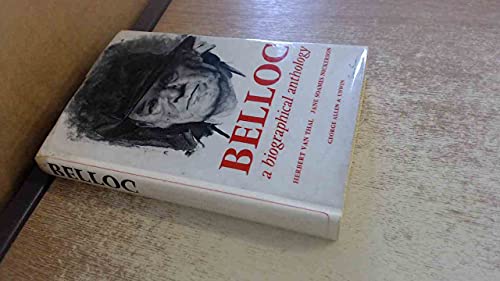
https://pictures.abebooks.com/isbn/9780048280046-us.jpgBelloc: A Biographical Anthology by Hilaire Belloc, edited by Herbert van Thal, 379 pages

This anthology collects snippets from only a few of the over 150 books Hilaire Belloc wrote during his eventful life.  The selection includes memoirs, fiction, history, biography, political commentary, and poetry, all the varied outpouring of Belloc's restless wit.  As a "biographical anthology", the book is arranged chronologically, and the editor has included notes before many of the entries containing biographic and bibliographic information.  The book does not omit some of Belloc's more controversial writings - a passage is included from The Jews as well as a letter from a trip to North Africa that is, at minimum, remarkably callous.

The greatest pleasure is Belloc's consistency - whether haranguing the rich, remembering a sailing trip through perilous waters, or discussing the character of Charles I, Belloc is always unmistakably Belloc.  To read him is to listen to an expert conversationalist talking late into the night, seasoning his anecdotes with good humor and unforgettable observations, and if the line between fancy and fact is often indistinct, that is only another part of his charm.

Wednesday, May 25, 2016

The English Way

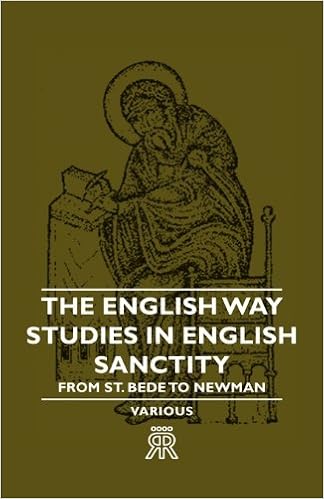
The English Way: Studies in English Sanctity from St Bede to Newman, edited by Maisie Ward, 328 pages

The English Way collects short biographical essays about English Catholics from St Bede and Alfred the Great to Bishop Challoner and Bl John Henry Newman, written by some of the finest English Catholic writers 1933 had to offer, including GK Chesterton, Hilaire Belloc, Christopher Dawson, and Fr Bede Jarrett.  The whole is meant to sketch an "English way" of sanctity.

The collection has all the diversity and unevenness to be expected of a compilation of biographies by different authors, many of them originally appearing elsewhere.  Fr Jarrett's reflection on St Aelred of Rievaulx takes the form of an exploration of the nature and importance of friendship as it is found in the life of the author of Spiritual Friendship, while Belloc's contribution uses the life of St Thomas Becket to launch a cannonade against error, and Dawson devotes most of his piece on William Langland to a detailed critical study of Piers Plowman.  Perhaps the unexpected highlight is E I Watkin's impassioned defence of Baroque art in his celebration of the life and poetry of Richard Crashaw.  Still, the individual pieces, however worthy by themselves, never do coalesce to form a greater whole.

Wednesday, February 10, 2016

Heretics

Heretics by GK Chesterton, 305 pages

It might seem odd that Chesterton wrote Heretics before he wrote Orthodoxy, but it has been the case throughout history that right belief is usually discovered through an examination of wrong belief.  In this book Chesterton takes on all the fashionable thinkers of his own time with his customary blend of good humor, biting wit, and common sense.  Many of those thinkers are now forgotten - although there are exceptions such as Rudyard Kipling, HG Wells, and George Bernard Shaw - but their errors are more enduring than their memories.  Indeed, Chesterton even refutes errors that would not become popular until long after he was dead.

Chesterton's primary theme, threaded throughout the book, is that there is no such thing, in reality, as a materialist or a cynic - all men are ruled by ideas, and some of those ideas are wrong, and no idea is more wrong than the idea that ideas have no consequences.

Saturday, February 6, 2016

Flying Inn

The Flying Inn by GK Chesterton, 320 pages

First published in 1914, The Flying Inn takes place in an England where a combination of a moralistic progressivism and an Islamic fad have resulted in the closing of every public house in England.  A renegade pub owner and an Irish rebel take to the road with a barrel of rum and a wheel of cheese to satisfy a thirsty nation.

The conceit allows Chesterton to exercise both his poetic whimsy and satiric bite.  The novel is peppered with drinking songs celebrating the traditional joys of life, while the plot skewers politicians, socialists, capitalists, journalists, aesthetes, and religious enthusiasts.  As with most of Chesterton's fiction, the plot is vanishingly thin, little more than an excuse to bring his sane protagonists into contact with the wider world in all its insanity.

Wednesday, January 13, 2016

Return of Christian Humanism

Cover image for The Return of Christian Humanism: Chesterton, Eliot, Tolkien, and the Romance of History by Lee Oser, 165 pages

One of the three seems not to fit - Chesterton, the English fabulist who converted from Anglicanism to Catholicism, Tolkien, the English fantasist and all-but-cradle Catholic, and Eliot, the American Modernist poet who converted from Unitarianism to Anglicanism.  Of course, put another way, Eliot was only four years older than Tolkien, but Chesterton was fourteen years older than him.  Or it could be pointed out that while Chesterton flourished a short time before, during, and after the First World War and Eliot did his best work between the wars, The Lord of the Rings wasn't published until the '50s.  Yet none of them seem as out of place as Oser's untitled fourth subject, 19th century Deist critic Matthew Arnold.  Oser describes Arnold as having recognized a central problem for an agnostic humanism - an inability to balance the anarchic tendencies of romantic progressivism with the rigidity of neo-classicism.

According to Oser, the proof of that inability can be found in the exhaustion of the humanist tradition with Beckett and the anti-humanism that has subsequently ascended to power within the academy, with the collapse of the humanities as a consequence.  To rebuild it is necessary to embrace the "romance of history", which means meaningfully engaging with religion generally and Christianity particularly, especially the more-than-mere Christianity of the romantic reactionaries Chesterton, Eliot, and Tolkien.

Monday, October 13, 2014

Napoleon of Notting Hill

http://www.chesterton.omne.pl/style/images/books/covers/The%20Napoleon%20of%20Notting%20Hill.jpg
The Napoleon of Notting Hill by GK Chesterton, 300 pages

In the far off future of eighty-years-from-now, the King of England is an absolute monarch, but one selected randomly by lottery.  When the newest occupant of the throne begins whimsically issuing decrees establishing special sumptuary rules for local officials and heraldic totems for London neighborhoods, the last thing he expects is for someone to take him seriously.  Yet that is exactly what happens, when the mayor of Notting Hill refuses to accept a plan by the surrounding municipalities to build a highway through his town, instead choosing to defy all the rules of business and common sense and rally his loyal halberdiers around the standard of the Red Lion.  Will tender Romance be trampled underfoot by brutal Fact, or will imaginative Sanity triumph over blinkered Madness?

This was Chesterton's first novel, and already his gifts are in full evidence, not least his evocation of the poetry that surrounds us every day, demonstrating how even a humble grocer, seen rightly, is a fabulous merchant trading in exotic goods from distant lands, and every community a sacred fellowship.

Friday, February 28, 2014

The Crisis of Civilization

http://g.christianbook.com/dg/product/ingram/w185/554628.jpg
The Crisis of Civilization by Hilaire Belloc, 242 pages

Adapted from a series of lectures Belloc delivered at Fordham College in 1937, The Crisis of Civilization is essentially a distillation of his view of European history.  By his account, the fall of classical civilization was ameliorated by the preservation and defense of the best part of ancient culture combined with a new spiritual unity in the Middle Ages.  The decline of the medieval order resulted in the dissolution of Christendom during the Reformation, which directly inspired the new slavery of capitalism and the horrors of its offspring, communism.  This is, needless to say, very different from the "Whig history" conventionally accepted in Belloc's time, and different from the presentist biases of our own postmodern era.  Its only defense, Belloc might say, is that it is true.

Belloc's primary concern is social, which means that it is, inevitably, ethical.  The rise of the modern absolutist state, he claims, dissolved the intermediary institutions that formerly tied men together in bonds of fellowship, thereby exposing the poor to the tyranny of the usurious rich.  The former order, based on a hierarchy of values, was replaced by a materialistic hierarchy of wealth.  Belloc's concern is for the dispossessed masses who, themselves the victims of private monopolies, are attracted to utopian dreams of socialist monopoly.  His antidote is a system of small property.  Government must be enlisted to encourage small business and small landholdings against the natural advantages modern technology gives to massive conglomerates.  Most of all, he insists on the need for a renewal of morality which opposes usury and plutocracy.

The book is easy to read but thick with ideas.  The ideal historical companion to Belloc's The Servile State.

Tuesday, February 4, 2014

The Path to Rome

The Path to Rome by Hilaire Belloc, 448 pages

In 1901, Hilaire Belloc made a vow that he would walk from Toul, where he had served in the French army as an artilleryman, across Lorraine, over the Alps, and through northern Italy to Rome.  The Path to Rome is the tale of that pilgrimage, day by day, town by town,

"Across the valleys and the high-land
With all the world on either hand

Drinking when I had a mind to,
Singing when I felt inclined to;
Nor ever turned my face to home
Till I had slaked my heart at Rome."

For Belloc, Rome is not only his destination, but something to be found everywhere on his journey, a presence synonymous with civilization.  There is no real narrative thrust to this book, and other than a brief passage involving a perilous mountain ascent the only tension involves Belloc trying to make it to Milan before his money runs out.  Belloc mocks literary conventions, promising to tell a story about a bandit, for example, then, 200 pages later, writing merely that the bandit died a long time ago.  This book is a long walk with a remarkable man, listening to his perspectives, touching on history, philosophy, theology, poetry, and oenology, amongst many, many other topics.  Yet Belloc never stays with a subject long enough for a lecture or debate, since he is, as he sees it, merely observing what any reasonable person would observe, and if there's a problem, it's that there are so few truly reasonable people.  The book is enjoyable if, like me, you find Belloc a fascinating and entertaining companion.  If not, he probably wouldn't want to share the path with you, either.