Showing posts with label books not at SLPL. Show all posts

Thursday, July 7, 2022

Cry Wolf

Cry Wolf: A Political Fable by Paul Lake, 215 pages

After the farmer died, the animals of Green Pastures Farm managed to keep things going.  It wasn't always easy - they couldn't reach the fruit on the higher branches of the trees, and the mouths of lambs proved to be poor substitutes for hands when it comes to milking cows - but the community managed to come together under the Laws left by the farmer and not only survive, but thrive, even defeating an invading bear.  Until, that is, more sympathetic outsiders present themselves, and the clever owl uses the magic of words to bring down the laws and plunge the farm into a spiral of chaos from which it may not recover.

Cry Wolf is a straightforward reimagining of Animal Farm, not only updated for the 21st century - as if such a thing was necessary - but with a revised set of anthropological assumptions, so that it bears little more than a conceptual resemblance to Orwell's original.  Where it does more deeply echo Orwell is in Lake's awareness of the power of words, particularly as they are defined and redefined so that they become tools for confusion rather than communication, and in the ease with which slogans can evoke the power of sentiment to overthrow reason.  What Lake most memorably adds is his exposure of late modern decadence, particularly the unwarranted conviction that a very precarious situation is, in fact, the natural state of things, the unmerited confidence that any disruptions are merely manageable exceptions, and the baseless belief that there are no higher desires than comfort and peace.

Monday, June 20, 2022

Welcome to Hell

Welcome to Hell by "Bad" Billy Pratt, 178 pages

Repeatedly, in the collection of blog posts that make up Welcome to Hell, author Billy Pratt earnestly declares the mission of the writer to be the arduous distillation of truth from experience.  Given such a seemingly grandiose conception of his vocation, the reader might expect a diatribe against contemporary illusions and delusions.  Whether attracted or repelled by that prospect, what he will find if he dares to open the book is a series of vignettes, some funny, some poignant, some simply depressing, most of them defying cheap moralizing and instead inviting understanding.  What emerges is a portrait of Hell, a realm of aging adolescent consumers searching ever more desperately for validation or just the next dopamine fix, having already pawned their youth and healthy relationships.

An obvious trap for a collection of this kind is for the entries to become numbingly repetitive, but Pratt's descriptive approach avoids this entirely.  At the same time, the strong thematic unity and the unmistakable voice of the author keeps it from feeling disjointed.  The whole reads less like a haphazard bunch of essays than a carefully constructed novel in the tradition of Zola, albeit one holding up a mirror to a very different world.

Wednesday, May 11, 2022

Birgitta of Sweden

Birgitta of Sweden: Life and Selected Revelations by St Birgitta of Sweden and others, translated by Albert Ryle Kezel, 235 pages

St Birgitta (often referred to as St Bridget but here given the more Teutonic variant in order to distinguish her from her more popular Irish namesake) was born in Sweden around 1303 and died in Rome in 1373.  Such was her reputation that she was canonized less than two decades later.  Beginning in early girlhood, she experienced a series of mystical visions of varying nature and subject matter, all drawing her into an ever more passionate love for God, a consuming flame that demanded to be spread to others. 

The core of St Birgitta's visions, as they are presented here, are of a dissolute monk (unnamed but known to the visionary) who interrogates God as to His nature and the nature of His creation.  This runs through an impressive catalogue of objections to God's existence, not only general questions about the existence of evil but also more specific inquiries into the cruelty of beasts, the economy of salvation, and the purpose of pleasure, all resolved with holy clarity and simplicity.  The collection of texts is rounded off with the rather dry Life prepared for her canonization and a selection of moving prayers to Christ and His Mother.

Tuesday, March 1, 2022

Nostos

Nostos by John Moriarty, 698 pages

"Nostos", I am told, means "homecoming", in particular referring to the homecomings of the heroes of the Trojan War.  In John Moriarty's poetic memoir, his particular home is an impoverished farm in the Irish countryside, a shadowy place of earth and blood, far from the seemingly well-ordered certainties of modernity.  He is exiled from this place by Darwin and his companions, whose arrival was as fatal to the old European mythos as that of Cortes was to the Aztecs.  His restless wanderings take him first to England, then to Greece, and finally to the New World, through myths both ancient and modern, before he is allowed to return at last to that still point he left in his beginning.

It is natural to compare Nostos to Finnegan's Wake, not only because the authors are both Irish, or because both delight in wordplay and allusion and repetition, or because the Liffey features in both works, or even because Moriarty explicitly references Joyce repeatedly.  Both attempt to describe something that eludes description, to discover or recover something mysterious yet fundamental, although Moriarty's commodius vicus of recirculation begins and ends upriver of Howth Castle and environs, and even beyond Eve and Adam.  Nostos is a unique and unforgettable work, full of beauty and wonder and (best of all) hope.

Monday, September 27, 2021

Essays

Essays on Catholicism, Liberalism, and Socialism Considered in Their Fundamental Principles by Juan Donoso Cortes, translated by Rev William McDonald, 347 pages

In his celebrated 1988 Gifford lectures, Alisdair MacIntyre exposed the failure of both the modernist "encyclopedic" and postmodernist "genealogical" approaches to ethics, a failure rooted in their incommensurability, their inability to meaningfully dialogue with and assimilate alien systems.  Now we stand in the ruins of those towers of human pride, with leaders who, whether from knavery or imbecility or some mixture of the two, leap uncomprehendingly from one to the other, asserting at one moment that "my truth" is something manufactured, and at the next that it issues from the Delphic prophetess Science, once her mad ravings have been suitably interpreted by her labcoated priests.  If reason is the slave rather than the master of the passions, every subjectivity is at war with every other, convenient lies contending with convenient lies, and so the heathen rage.

This was all warned against by Juan Donoso Cortes in the early nineteenth century.  The liberal superstition that truth will triumph in a free marketplace of ideas is belied by the fact that men do not seek the truth, to the contrary, even when the Truth appeared to them they mocked Him, spit on Him, and ultimately crucified Him.  The entire liberal project is founded on the mistaken belief that human freedom consists of the power to choose between good and evil rather than the ability to will the good.  The result is moral chaos, the war of all against all by other means, and sin, Cortes reminds us, is nothing more or less than disorder, the confusion of lesser goods for higher, ending in the disunion of soul and body which is death.  Life, then, is order, true order, the harmony which exists in the presence of the supreme mysteries in the light of which all apparent contradictions are resolved.   

Tuesday, August 3, 2021

Christus Vincit

Christus Vincit: Christ's Triumph Over the Darkness of the Age by Bishop Athanasius Schneider and Diane Montagna, 421 pages

In the relatively new but vital tradition of book-length interviews of Catholic prelates, popularized by Cardinal Ratzinger and continued by Cardinal Sarah, Christus Vincit is an expansive, free-ranging conversation with the auxiliary bishop of Nur-Sultan, the capital of Kazakhstan.  It might understandably be asked what this man of the peripheries has to offer the Church and the world.  Quite a bit, as it turns out, and if little of it is new, most of it is excellent.

The heart of Bishop Schneider's message is that the naturalistic turn the Church took in the twentieth century has been a disaster pastorally, evangelically, and theologically.  To counter this, he calls for a renewed emphasis on the supernatural and the transcendent.  Again he reminds us that human beings are embodied creatures rather than pure spirits, that history is not Providence but has a providential aspect, and that while all earthly economic and political arrangements, debates, and crises are passing, there is a Kingdom which is eternal.  Unfortunately, there is also a certain amount of conspiratorial thinking, mostly involving the Freemasons, some of which may be true but which generally seems out of place and fantastical.

Tuesday, July 6, 2021

Liberalism

Liberalism: A Critique of Its Basic Principles and Various Forms by Louis Cardinal Billot, SJ, translated by Msgr George Barry O'Toole and Thomas Storck, 67 pages

Written in the last years before the First World War, Liberalism is a masterful critique of the political ideology of the so-called Enlightenment.  Cutting right to the heart of the matter, Cardinal Billot exposes the core dogma of liberalism as the enthronement of liberty as the supreme good, and demonstrates how this is corrosive of every human institution and relationship.  Prophetically, he foresees the paradoxical condition of the thoroughly dehumanized mass man who will tolerate no power above or beside him save that of the omnipotent state.  In closing, he distinguishes three types of liberals - the consistent, revolutionary, luciferian liberal, the supposedly moderate liberal who imagines that he can command the revolutionary forces of destruction to only go so far and no further, and the Catholic liberal who, in attempting to separate his politics from his faith, inevitably betrays both.

As incisive as they are short, Cardinal Billot's essays are, if anything, more powerful today than they were when they were written, since history has only added to the evidence for his claims.

Saturday, June 19, 2021

Hanging God

The Hanging God by James Matthew Wilson, 81 pages

In 2017, James Matthew Wilson released The Vision of the Soul, a magnificent argument for imagination and beauty as portals to truth.  It is difficult to read this collection of poetry, published a year later, outside of the light or shadow of the earlier work.

     It pleases, rather,
     In wakefulness
     To praise and bless
     What grows and gives
     To thoughtless matter
     Its purposes.

In The Hanging God he confirms that he is an artist rather than an ideologue.  The poems collected here, on subjects ranging from friends' weddings to vicious lovers to the Way of the Cross, have the freedom to be beautiful without being forced to prove some abstract point.

     For our ideas are fading things,
     Wants change with what the weather brings,
          But this stamped weight of being remains.

Of course, in so doing, he makes his case, and offers considerable pleasure besides.

     Chastening us that though our time seems dire,
     Much has endured through beating rains and fire,
     And good can still be made in this dark season.

Monday, May 3, 2021

Integralism

Integralism: A Manual of Political Philosophy by Thomas Crean and Alan Fimister, 279 pages

A spectre is haunting what was the West - it is the spectre of Integralism.  All the powers of the old liberalism have entered into an unholy alliance to exorcise this spectre: Democrat and Republican, libertarian and socialist, German and Brit, Dorsey and Zuckerberg, Bezos and Gates.  

This may seem a trifle overblown.  It is true, however, that as the liberal consensus crumbles, engaged Catholics, and especially younger Catholics, have begun looking for traditional alternatives to the naked emperor of modernity.  One of the most trenchant criticisms of the movement has been the lack of agreement as to what, precisely, is meant by "Integralism", particularly in a country founded on the rejection of throne and altar.  Is Integralism equivalent to Falangism, or is it a particular flavor of common-good conservatism, or is it a fundamentally unserious social-media phenomenon with no meaningful content whatsoever?

Although disagreements will no doubt continue, with the publication of Crean and Fimister's manual at least the last is no longer an entirely plausible answer.  Without being argumentative, they carefully build their argument for a rational society and a politics which respects the entire human person.  Although their conclusions are unlikely to convince anyone who does not agree with their premises, their political philosophy is at least coherent, which is more than can be said for any of the post-modern alternatives.  The result is a challenge to many, and an invitation to a few.

Thursday, April 29, 2021

The Day Is Now Far Spent

The Day Is Now Far Spent by Robert Cardinal Sarah and Nicolas Diat, translated by Michael J Miller, 343 pages

The hour is late indeed, says Cardinal Sarah in this book-length interview with his favorite interlocutor, Nicolas Diat.  The Church, he tells us, is riven by dissension, compromised by unbelief, and stained with sin.  Meanwhile, the decadent ruins of Christendom are in the grip of a "fundamentalist liberalism" that pursues wealth and power (often under the guise of "justice" and "liberation") while treating the sacred with indifference and contempt.  The irony is that, by attempting to place himself at the center of the world, modern man has created a world in which he is increasingly superfluous.  Not content in its iconoclasm with the destruction of its own past, the neo-colonialist West actively works to erase the cultures of Africa and Asia even as it plunders their lands of their natural resources.  

It is necessary, then, for faithful Catholics to resist the temptations of compromise and despair.  This demands the cultivation of virtue and excellence - "The Church does not have the right to be mediocre."  Fittingly for the author of The Power of Silence, while Sarah's message is urgent, it is not primarily a "call to action", but a call to prayer and contemplation.  "Your mission is not to save a dying world... Your mission is to live out with fidelity and without compromise the faith you received from Christ."

Tuesday, July 28, 2020

Decline and Fall of Western Art

The Decline and Fall of Western Art by Brendan MP Heard, 319 pages

It is not particularly hard to say that the emperor has no clothes.  It is easy enough to notice when he flaunts his nakedness with the same assertiveness with which the modern art world flaunts its ugliness.  It is more difficult to explain why this deranged naked man is dancing his way through our museums and public spaces.  It is even more difficult to imagine how we can get him to stop.

To his credit, it is the difficult things that Brendan Heard attempts in The Decline and Fall of Western Art.  The extent to which he succeeds is another matter.  His account of the historical breakdown of Western art is tentative and somewhat superficial, with Picasso, Duchamp, and Kandinsky as the expected villains.  However, Heard is canny enough to understand that our cultural ruin has its roots in political and theological disorders, and his analysis of the impact of materialism and feminism on art is better developed, although more vituperative.  Heard's solutions hinge on a metaphysical revival, to which end he proposes a kind of mere neo-Platonism compatible with a wide variety of religious commitments.

Heard sets his ambitions high, but his scanty one-page bibliography is one sign that his reach exceeds his grasp.  He writes with passion and wit, but certain errors suggest that he is parroting second-hand (and possibly second-rate) sources rather than speaking from personal experience - although St Thomas Aquinas was doubtless more of a Platonist than is commonly supposed, he was certainly not a believer in a "universe-as-God Neoplatonic philosophy".  As this is Heard's first book, it can be hoped that there will be sequels, and that he and his writing will grow deeper and broader with time.

Tuesday, July 14, 2020

Scholia to an Implicit Text

Scholia to an Implicit Text, Nicolas Gomez-Davila, Bilingual ...Scholia to an Implicit Text by Nicolas Gomez-Davila, translated by Roberto Pinzon, 195 pages

Nicolas Gomez-Davila was born in Colombia, but spent much of his childhood in Paris, including two years in which he was bedridden with pneumonia.  Recovering and returning to his homeland, he set about assembling one of the largest private libraries in the country, which served him as a kind of secluded smithy in which he refined and shaped his volumes of aphorisms.  Scholia to an Implicit Text is thus far the only work of his to be published in an English translation.

A "defeated unbeliever" who turns modern skepticism back on itself, fishing "with a net of doubts", a careful crafter of sentences who insists on the importance of the sensuous and the liturgical, a romantic reactionary who knows that the past is irrecoverable but not unrepeatable, Gomez-Davila is profound and provocative and never, ever boring.  He is also not an ideologue - central to his worldview is the rejection of the distinctly modern belief that problems require solutions rather than understanding.  The values that Gomez-Davila treasures do not require defence because they are eternal and indestructible, whereas every sin is its own worst punishment, and therefore the twentieth century "will bequeath nothing but the traces of its hustle and bustle at the service of our filthiest desires."

It could be worse, of course, and will be, if Gomez-Davila is correct in his assessment that totalitarianism is the natural end of modernity, "the technification of politics."  "A totalitarian state is the structure into which societies crystallize under demographic pressures," when solitude and the inner life have been made impossible.  "The 'rational', the 'natural', the 'legitimate' are only that which is customary.  To live in compliance with an enduring political constitution, behaving according to enduring customs, surrounded by enduring objects, is the only way to believe in the legitimacy of the ruler, in the rationality of habitudes, and in the naturalness of things."  All that being rejected, the world is waiting, not for Pericles, but for another, doubtlessly very different, Pol Pot.

Tuesday, February 11, 2020

From Fire By Water

Image result for from fire by water
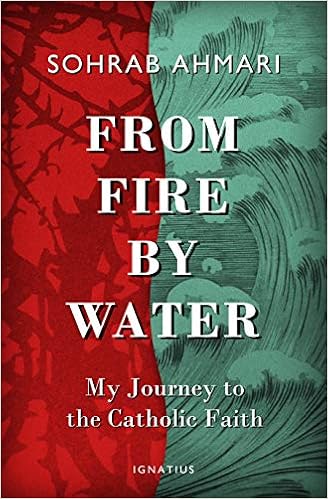
From Fire By Water: My Journey to the Catholic Faith by Sohrab Ahmari, 207 pages

Sohrab Ahmari is a classic immigrant success story.  Born to intellectual, secular Iranian parents several years after the Islamic Revolution, his mother brought him to the US as a teen.  Starting out in a Utah trailer park, able to understand the language but not always the culture due to his love of Hollywood films, he managed to earn his way into the Ivy League and eventually a job as op-ed editor of New York's premier newspaper, the New York Post.  

But that isn't what this book is about.  Rather, as the subtitle indicates, it is an explanation of the lifelong journey that led to his 2016 reception into the Catholic Church.  Beginning with his childhood as a dissident Persian boy in love with an ideal America as the alternative to the mullahs, he then explores his disappointment with the real America, his adolescent passion for Nietzsche and collegiate passion for Trotsky and later embrace of neoconservatism and, finally, his ultimate dismissal of all utopian ideologies.  Through it all, he movingly relates his growing recognition of the human need for order and therefore authority, an order and an authority not imposed by force but grown from sacrifice.

Saturday, February 1, 2020

Road From Decadence

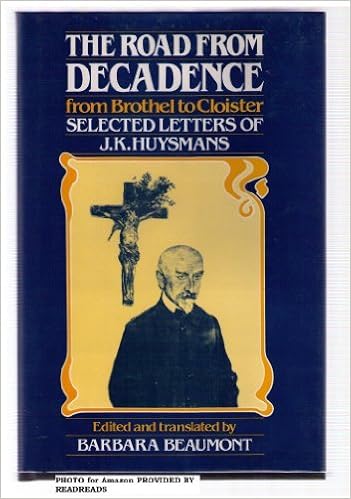
Image result for road from decadence"The Road from Decadence: From Brothel to Cloister: Selected Letters of JK Huysmans by JK Huysmans, edited and translated by Barbara Beaumont, 235 pages

This collection of letters spans four decades and includes the author's correspondence with such literary luminaries as Emile Zola, Guy de Maupassant, Stephane Mallarme, Paul Verlaine, and Leon Bloy, as well as less famous figures with whom he was involved financially, socially, or spiritually.  Through the chronological arrangement it is easy to trace Huysmans' journey from Realism to Decadence to conversion, and to witness how through these transitions he remains stubbornly consistent in his dissatisfaction with the world and rejection of every form of sentimentality and superficiality.  Although his devoted admirers will doubtlessly enjoy this collection, there is admittedly little here to interest a wider audience.

Friday, December 13, 2019

The Flame Is Green

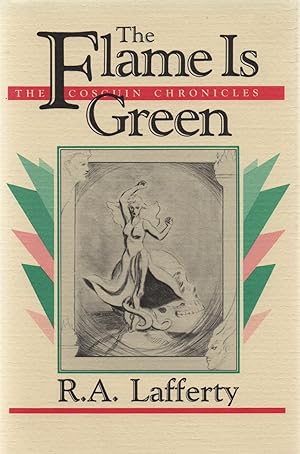
Image result for The Flame Is GreenThe Flame Is Green by RA Lafferty, 245 pages

In the middle of the nineteenth century, poor Irish fisherman Dana Coscuin is drafted into a revolution.  Not the revolution of the radicals who are really superficial, not the revolution of liberals who are really quite close-minded, not the red revolution which claims to be new but is as old as Adam, but the green revolution, which is older still and yet ever new.   Although he only knows one song, Dana sings his way into a company of fighters who dance across Europe, from the Carlist hills to 1848 Paris to partitioned Poland, wrestling with principalities and powers as well as flesh and blood.

The Flame Is Green is set in a reenchanted world.  The characters consistently intuit future events, although not always accurately, and perform feats that are physically impossible or seemingly inexplicable.  Everything is connected, and even the greatest surprises are accepted graciously.  The novel will not be to everyone's taste, but no one will mistake it for anything else.

Tuesday, September 24, 2019

Lenten Lands

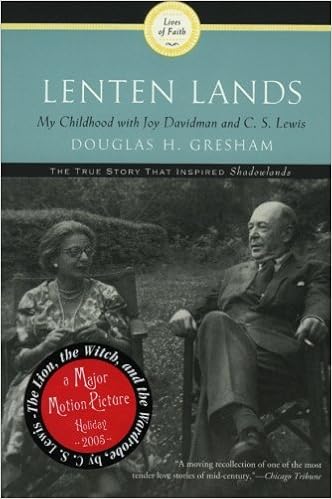
Image result for lenten lands douglas greshamLenten Lands: My Life with Joy Davidman and CS Lewis by Douglas H Gresham, 213 pages

Douglas Gresham is the younger son of the authors WL Gresham and Joy Davidman.  After his parents' divorce, his mother took him to England, where she had become close friends with the brothers CS (Jack to his friends) and WH (Warnie) Lewis.  In time, Jack and Joy would wed, and Lewis legally adopted the Gresham boys.  Lenten Lands is Gresham's memoir of his time at the Kilns, as the Lewis' home was called, from the earliest days when it seemed an enchanted place, to later years when it became for him an emblem of loss and grief.

This is a personal book.  Lewis' writings are barely mentioned, and anyone seeking insight into them (other than A Grief Observed) is sure to be disappointed.  It is also Gresham's book, giving his perspective and not anyone else's, and it is focused on his life rather than being "CS Lewis As I Knew Him."  It has to be said that it is all the more charming for that, and it would be an enjoyable read even if Lewis had never written a word.

Tuesday, May 28, 2019

Four Men

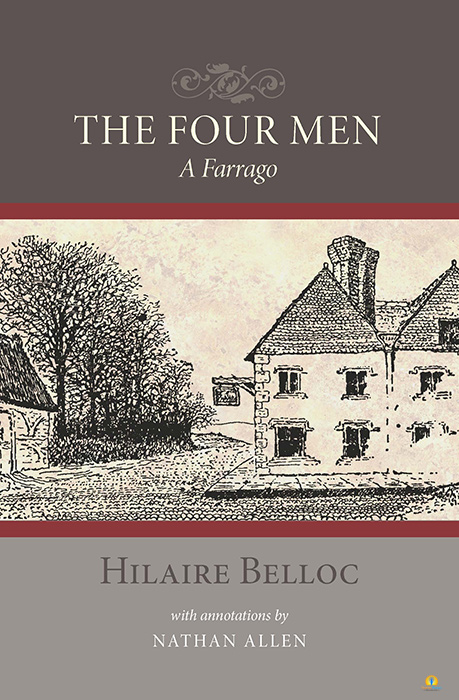
Image result for four men bellocThe Four Men: A Farrago by Hilaire Belloc, 149 pages

This is Belloc's tale, or rather tales within a tale, of a man called Myself and his companions, whom he nicknames Grizzlebeard, the Sailor, and the Poet, as they wander the beloved countryside of their home county of Sussex, which we are assured was "the first place to be created when the world was made" and will be "the last to remain, regal and at ease when all the rest is very miserably perishing on the Day of Judgement by a horrible great rain of fire from Heaven."  The four men (who, needless to say, are all variations on the author) pass their time speaking or, just as often, singing sound nonsense and enchanting sense, including the stories of how St Dunstan led the devil about by the nose and how Mr Justice Honeybubble delivered his famous Opinion at the Cricketers' Arms.

Saturday, January 19, 2019

Inventing Eastern Europe

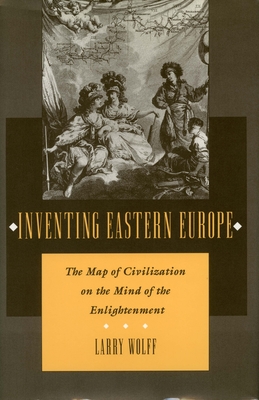
Image result for inventing eastern europe larry wolffInventing Eastern Europe: The Map of Civilization on the Mind of the Enlightenment by Larry Wolff, 374 pages

In this survey of 18th century travel literature, Larry Wolff explores how Enlightenment authors charted the domains of civilization and barbarism, making Western Europe the focus of the former and Eastern Europe - or, more evocatively, the European Orient - as the frontier.  For the progressive writers of the eighteenth century, the eastern nations were clearly behind the West on the univocal path of human development, and eastern backwardness served the Western intellectual elite not only as reassurance of their own status but as an inspiration to great "civilizing" projects, to be undertaken with or without the agreement of the peoples concerned.  This division of the continent, Wolff contended in 1994, underlay but was not effaced by the later Cold War division, and with the Cold War now over, the older division would resurface.  

Inventing Eastern Europe is a triumph of postmodern scholarship - obvious and tendentious.  With considerable skill and intelligence Wolff conquers the eighteenth century writers who conquered the East, taming them to his narrative.  Wolff's case is strengthened by his prescience, as today's enlightened Western elites regard Eastern populists with the same familiar smug revulsion.  It also serves as a model for understanding those journalists who have, especially since 2016, embarked upon adventures in Middle America in search of confirmation of their own biases.

Friday, June 1, 2018

After Writing

Image result for after writing pickstockAfter Writing: On the Liturgical Consummation of Philosophy by Catherine Pickstock, 273 pages

Alfred North Whitehead famously characterized all of a European philosophy as "a series of footnotes to Plato."  For some postmodern philosophers, Plato has become the serpent in the garden who began Western civilization's obsession with objective, and therefore objectivizing, truth.  Through a careful reading of the Phaedrus, Catherine Pickstock argues that, contrary to this postmodern reading, what the great philosopher upheld was not a reified abstract truth, but a lived love of the good.  Indeed, at the heart of the Socratic project is a denial of easy certitude in favor of careful development, focused on a paideia of virtue.

In Pickstock's understanding, Plato's embodied dialectic is essentially liturgical, and the acknowledgement of the transcendent stands against a technocratic, commercial, leveling secular ethos which rejects reality for utility, the gift for the given.  Postmodern nihilism is thus revealed as the culmination rather than the rejection of indifferent rationalism.  A genuine alternative is found in the fulfillment of the Platonic vision in the practice of the medieval Christian liturgy, a work of praise that crowns and completes the ordinary world of work.  Leaving behind the postmodern world of alienation and absence, the narrative of becoming which constitutes the Mass restores the relational and personal through its revelation of the superabundant plentitude of the good.

Pickstock takes up two monumental tasks - a reinterpretation of postmodern philosophy and a liturgical analysis which challenges both the Tridentine traditionalist and postconciliar modernist approaches.  Her tools are the tools of deconstruction, and those who have little sympathy with that method will find it hard going, but Pickstock uses reason neither to bind mystery nor to sow confusion, but rather to open up the portals of the sublime.

Wednesday, December 27, 2017

Heresy of Formlessness

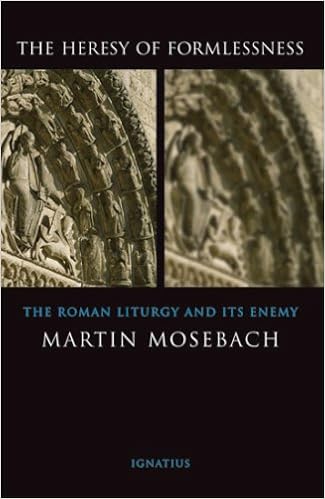
The Heresy of Formlessness: The Roman Liturgy and Its Enemy by Martin Mosebach, translated by Graham Harrison, 209 pages

Martin Mosebach freely confesses that progress has passed him by.  He has not learned that words are meaningless, that truth is nothing but a bigoted opinion, or that beauty is entirely in the eye of the beholder.  He still clings to antiquated prejudices - that religion ought to connect man to a higher reality, that the best of what has been thought and done in past ages can never be irrelevant, that no one can consume trash and expect to remain healthy.  Most indicative of his backwardness is his belief that human beings are both soul and body, and that therefore what we believe and what we do are interconnected.

In the wake of the Second Vatican Council, a new wave of iconoclasm swept through the Catholic Church.  Great artworks which had stood the test of time were replaced with up-to-date substitutes which were obsolete the day after they appeared.  Even kitschy works that, though undeniably second rate, were popular with the average Catholic were replaced, when they were replaced at all, with pieces that allegedly spoke to modern sensibilities, but which pleased few beyond the artists who were paid to produce them and their clerical patrons who paid dearly for the pleasure of believing they were with-it.  Simultaneously, an elaborate language of ritual and gesture which had developed over the course of millennia was simply abandoned.  The iconoclasts claimed that all of this was distracting and unnecessary, modern man having outgrown the need for symbols, beauty, and supernatural hope.

In The Heresy of Formlessness Mosebach makes the case that the iconoclasts were wrong.  The nature of man, he contends, has not changed since the Stone Age.  We still live and die by symbols, still crave beauty, are still bound together - to the extent we are bound together at all - by rituals both civic and religious.  As a novelist by trade, his arguments are affective rather than logical, his investigations personal rather than philosophical or theological.  Ironically, this makes his book somewhat formless - the final essay, tacked on in the third edition, while cromulent in itself, greatly diminishes the power of the conclusion by its placement.