Showing posts with label pilgrimages. Show all posts

Tuesday, November 13, 2018

Laurus

LaurusLaurus by Eugene Vodolazkin, translated by Lisa C Hayden, 362 pages

Laurus is a beautiful, subtle novel set in a vividly recreated Medieval Russia.  It tells the story of Arseny, called Rukinets and Ustin and Amvrosy and Laurus, a doctor, a penitent, a pilgrim, and a hermit, not successively but progressively, as he and his world are poisoned by sin and healed by grace.  

In her introduction, translator Hayden candidly discusses the difficulties of bringing Vodolazkin's deliberately inconsistent use of archaic language into English - without being able to experience the original, it seems that she has done an excellent job, reinforcing the story's intimations of the relationship between time and eternity, the living and the dead.  This is only one of many profound themes in this marvel of a novel - richly imaginative, empathetic without being sentimental, historically authentic and yet timeless.

Friday, January 27, 2017

Merrie England

Merrie EnglandMerrie England: A Journey through the Shire by Joseph Pearce, 136 pages

Merrie England describes a trip through modern England in search of the eternal England, a quest for the country's "soil-soul", "the plush, solid ground of primal realities."  On foot and by train, Joseph Pearce travels from Norwich through Ely, Peterborough, and York to Lindisfarne, then west along the Scottish border to the Lake District and south along the Welsh border before cutting east to Oxford, London, and finally the shrine to Our Lady at Walsingham.  But Pearce does not travel alone, he takes with him Chaucer, Shakespeare, Wordsworth, Newman, Hopkins, Chesterton, Tolkien, and many others besides.  Though they may appear to be ghosts, they are in some ways more alive than anyone living today.

Pearce obviously takes a portion of his inspiration from the travel books of Hilaire Belloc (The Cruise of the "Nona", The Path to Rome), the subject of one of his well-received biographies, but he lacks Belloc's light touch.  Too often Pearce comes across as a lecturer rather than a convivial companion - he spends paragraphs excoriating post-industrial ugliness where Belloc would have dismissed it with a contemptuous wave of his hand and moved on to more interesting matters.  Likewise, Pearce's choice to make his traveler an anonymous "pilgrim", while it may heighten audience identification, wears out its welcome as the reader is repeatedly told what the pilgrim thinks and feels - a walk with Joseph Pearce would doubtless be more interesting than having Joseph Pearce describe a walk anyone might take.  Then, too, while there are numerous illustrations of places mentioned in the text, there is no map, a strange omission in a book partially inspired by Tolkien.

Wednesday, April 13, 2016

Roman Pilgrimage

Cover image for Roman Pilgrimage: The Station Churches by George Weigel, Elizabeth Lev, and Stephen Weigel, 401 pages

Across many cultures, across many eras, the concept of pilgrimage was and is highly esteemed.  The modern western worldview, with its flat earth where every point is interchangeable with every other, is the exception.  Yet large numbers of people still travel to places like Compostela, Jerusalem, and Rome (not to mention Mecca, the Ganges, and Gettysburg), seeking something greater than themselves.  In addition to physical pilgrimages, there also exist chronological ones - Lent, for example, or Ramadan.  Combining the physical and the temporal, in the past few decades students and faculty at the Pontifical College of North America have revived the traditional medieval Lenten pilgrimage to the "station churches" of Rome.  It is this practice, both ancient and new, which is the subject of Roman Pilgrimage.

George Weigel, noted papal biographer (Witness to Hope) and Catholic commentator (Evangelical Catholicism), weaves together the station, the Mass readings, and the readings from the Divine Office for each day into a reflection that walks the reader one day at a time down the road of Lent and beyond, through Easter Week to Divine Mercy Sunday.  This is supplemented with architectural, artistic, and historical commentary on each station by Elizabeth Lev, author of The Tigress of Forli.  A generous sprinkling of gorgeous pictures of Rome's historic churches, taken by Stephen Weigel, tie the whole together, along with maps tracing the pilgrimage routes through the Eternal City.  The result is a spiritually, intellectually, and aesthetically rich guide to "the ultimate pilgrimage" - from Holy Thursday through Good Friday and Holy Saturday to Easter Sunday - through death into new life.

Wednesday, September 17, 2014

Pilgrim's Progress

The Pilgrim's Progress by John Bunyan, 303 pages
 
Cover image for The pilgrim's progress : from this world, to that which is to come / John Bunyan ; edited with an introduction and notes by Roger Pooley.John Bunyan wrote Pilgrim's Progress while in prison for religious non-conformity in the late 17th century, and it quickly acquired the status of a classic.  The book is the allegorical tale of Christian, who leaves his home in Destruction to seek the Celestial City of his Lord and Savior.  Along the way he faces obstacles such as the Slough of Despond and the Valley of Humility, encounters friends such as Patience and Faithful and not-friends like Talkative and Pliable, and moves - or is pulled - onward until he reaches his goal.  Then Part II begins, as his wife and children follow him across the same allegorical landscape.
 
Many of Bunyan's creations are vivid manifestations of spiritual truths, which is why some of them - Vanity Fair, the Giant Doubt - have become cultural touchstones.  The actual narrative, on the other hand, is awful.  The title implies an actual progression, but, in part due to the nature of allegory and in part due to the author's theological positions, there is no character development and therefore no real progress.  Most of the vignettes could be swapped out with others happening earlier or later without difficulty - there's no real reason why Christian couldn't fight Doubt when he fights Apollyon and vice versa, or why the Slough of Despond couldn't be swapped with the Enchanted Land.  The problem becomes worse in the sequel, which repeats much of the original, adds little of value, and lacks even the slightest sense of danger or drama.
 
A book better read for cultural literacy than for pleasure.

Monday, April 28, 2014

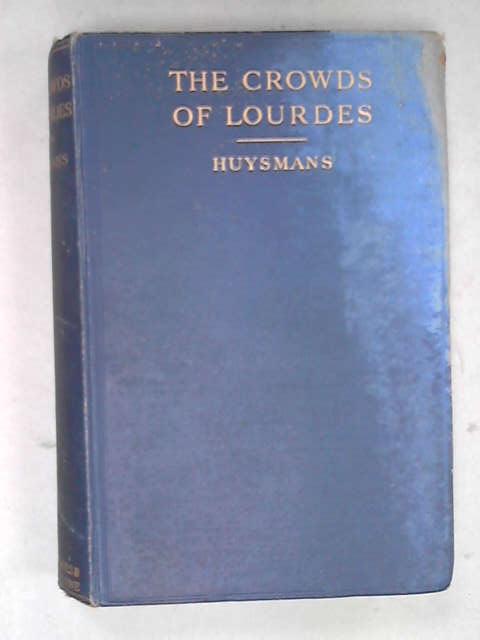
Crowds of Lourdes

http://images.worldofrarebooks.co.uk/1386611978RLG_1.jpg
The Crowds of Lourdes by Joris-Karl Huysmans, translated by William Henry Mitchell, 260 pages

This is Huysmans' account of an extended visit to the great Marian shrine at Lourdes, intended, no doubt, as a counterpoint to Zola's work on the same subject.  In contrast to Zola, who famously declared that even if he saw a miracle firsthand, he would not believe it, Huysmans multiplies accounts of miraculous healings even while frowning upon hysteria and popular fervor.  Utilizing the same powers of description he uses to powerfully evoke medieval artwork in his novels, he presents the hopeful as a cavalcade of human horrors, a veritable Mutter Museum of deformities.  Meanwhile, he turns his jaundiced eye towards the art and architecture of the shrine, and ends by concluding these so debased as to form evidence of a demonic plot against the Virgin.

He does not spend much time relating the story of St Bernadette, except a brief description of her life and character as a pious, but unintelligent and unimaginative peasant girl.  Repeatedly, Huysmans ponders why some find cures at Lourdes while others do not, and he never discovers a satisfactory answer.  The greatest of the miracles he finds at Lourdes, rather, is the spirit of the place itself, the continuing unseen presence there of the Mother of God:

"In this city of our Lady there is a return to the earliest ages of Christianity, a flowering of loving care that will last as long as people are beneath her spell in this haven of her own.  Here you get an idea of a people made up of various fragments, and yet so united as never any people was; they will be broken up tomorrow by departures, but unity will be restored by the arrival of fresh constituents, brought hither by fresh trains, and nothing will be changed; there will be the same devotion and the same patience and faith."