Showing posts with label Orthodoxy. Show all posts

Friday, June 5, 2020

Spiritual Life

St. Theophan the Recluse - WritingsThe Spiritual Life and How To Be Attuned To It by St Theophan the Recluse, translated by Alexandra Dockham, 320 pages

In the middle of the nineteenth century, a young Russian woman in the grips of a profound spiritual crisis approached a holy monk for advice.  The resulting correspondence was preserved and collected in this book, which quickly became a Russian Orthodox classic.  St Theophan's balance of holy zeal and humane sympathy fully justifies this judgement of posterity.

For Latins, the obvious comparison is with St Francis de Sales, and indeed The Spiritual Life closely resembles the Introduction to the Devout Life in its attempt to chart a path to God for those living in the secular world.  If the Frenchman's work is more developed, the Russian's is more accessible, at least partially due to having been written two centuries closer to our own time.

Tuesday, February 18, 2020

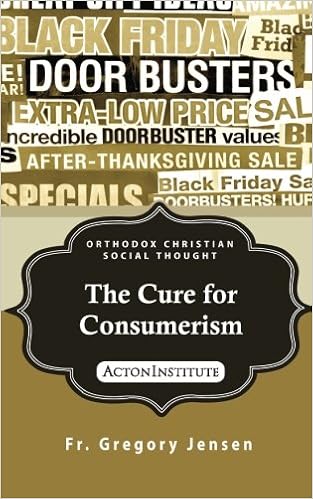
Cure for Consumerism

Image result for The Cure for Consumerism Jensen, GregoryThe Cure for Consumerism by Fr Gregory Jensen, 148 pages

Christianity has always had an ambivalent relationship with the world.  The world is, after all, simultaneously what the Lord overcame and what He died to save.  The world belongs to God, and yet His people are not of this world, and the world hates Him and them.  The goods of the world participate in the goodness of God, for otherwise they would not be goods, and they can serve as a ladder to Him, but divorced from their relationship with the Supreme Good who is their source and purpose, every ideal becomes an idol.

It is in light of this that Fr Jensen considers and reconsiders the Orthodox attitude towards capitalism.  He argues that the marketplace may be reimagined, not merely as an unfortunate necessity that must somehow be accommodated, but as a realm of genuine goods that ought to be nurtured.  The Christian can properly order the goods of the marketplace, and thus escape from the perils of idolatry, through a personal practice of asceticism.

Unfortunately, it is here that Fr Jensen's exposition seems naive, as he seems to fall into the peculiarly modernist delusion that a tool is a purely neutral object void of its own logic.  This causes him to neglect the reality of the free market as a social sphere which inevitably tends to totalize its own values.  While this may be resisted on the personal level, it can only be counterbalanced by a greater social force.

Tuesday, April 16, 2019

Way of a Pilgrim

Image result for The Way of A Pilgrim And The Pilgrim Continues His WayThe Way of a Pilgrim and The Pilgrim Continues His Way by Anonymous, translated by RM French, 224 pages

Sometime in the 1850s, an anonymous Russian peasant attending Divine Liturgy heard St Paul's injunction to "pray without ceasing" and went in quest of a method to put it into practice.  In time, he found this in hesychasm - the practice of praying, with every breath, the Jesus Prayer: "Lord Jesus Christ have mercy on me."  The purported record of his journeys, both physical and spiritual, was supposedly discovered some time later in a monastic library, and circulated widely among Russian monks before being discovered by the outside world.

In the opening passages of this memoir, the author rejects the sound advice of a variety of holy men on growth in the spiritual life, as none of them are able to offer him a concrete technique to accomplish his specific goal of living in a state of perpetual prayer.  This is the danger of the book - it is easy to ignore the repeated insistence on the necessity of spiritual direction and seize upon hesychasm as a shortcut or "simple trick to grow closer to God".  This danger is heightened by the apparent speed of this pilgrim's progress, but will be avoided by the careful reader.  Such a reader is also likely to notice that the sequel is very different in style and tone from the original, lending credence to the claim that one or both is a pious fable rather than a genuine memoir.  This in no wise detracts from a genuinely moving story of faith and growth in holiness.

Tuesday, November 13, 2018

Laurus

LaurusLaurus by Eugene Vodolazkin, translated by Lisa C Hayden, 362 pages

Laurus is a beautiful, subtle novel set in a vividly recreated Medieval Russia.  It tells the story of Arseny, called Rukinets and Ustin and Amvrosy and Laurus, a doctor, a penitent, a pilgrim, and a hermit, not successively but progressively, as he and his world are poisoned by sin and healed by grace.  

In her introduction, translator Hayden candidly discusses the difficulties of bringing Vodolazkin's deliberately inconsistent use of archaic language into English - without being able to experience the original, it seems that she has done an excellent job, reinforcing the story's intimations of the relationship between time and eternity, the living and the dead.  This is only one of many profound themes in this marvel of a novel - richly imaginative, empathetic without being sentimental, historically authentic and yet timeless.

Monday, March 9, 2015

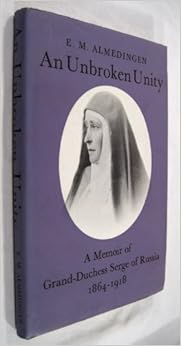
Unbroken Unity


Elisabeth was born into the royal house of Hesse, and married Grand-Duke Sergei of Russia, an uncle of the future Tsar Nicholas II.  She was related in one way or another to all the royals of Europe - Queen Victoria was her grandmother - but the ties to the Romanovs were stronger than others - her aunt was the wife of Tsar Alexander II, while her sister was the Alexandra who married Nicholas II.  After several years of marriage, Elisabeth joined the Russian Orthodox Church, a move which inevitably influenced her sister, whose reluctance to convert from Lutheranism was an impediment to her proposed marriage to the Tsar.  

Elisabeth's conversion was not primarily dictated by political or family pressures - she fully embraced her new faith, without losing her own Western perspective.  After her husband was murdered by socialist terrorists in 1905, she founded an order of nuns following a rule she devised herself, modifying the Basilian rule standard in Russian convents.  The order was devoted to the service of the poor, primarily by operating a hospital, an orphanage, and outreach in the slums of Moscow.  After the Bolsheviks seized power, she chose to remain in her convent, and was ultimately arrested and brutally murdered by being savagely beaten and thrown down a mine shaft.

Almedingen has constructed a solid hagiography, writing about a time and place that she knew well.  As a hagiography, it has certain limitations, and more cynical readers will find plenty to roll their eyes at.  Yet the most compelling elements are also the most undeniable.

Wednesday, July 16, 2014

Lost in the Taiga

 
http://d.gr-assets.com/books/1327951094l/1166194.jpgIn 1978, a team of Soviet geologists stumbled across a ramshackle cabin deep in the Siberian wilderness.  The cabin was occupied by a family of six, two parents, two sons, two daughters.  The parents had fled from civilization with the eldest children forty-two years earlier, and carved out a precarious existence in the taiga.  The younger children - all well into middle age - had never known any other life. 
 
The Lykov family were Old Believers, a sect which split from the Russian Orthodox Church in the 17th century over liturgical reforms and the increasing power of the state over the Church.   Their ancestors fled to Siberia and founded the town of Lykova with their coreligionists to escape the tighter controls of European Russia.  After the Bolsheviks began their persecution of religious believers of all kinds, the Lykovs took refuge in the mountains.  And stayed there.
 
The author, Peskov, was a Soviet journalist who visited the Lykovs and devoted a series of newspaper stories to them, drawn back for repeat visits by his friendship with the family (although by that point they were reduced to two - the father and the younger daughter) and the interest of his readers.  This book is, essentially, a collection of those articles smoothed into a continuous narrative.  Peskov tells their tale very sympathetically, even if he sometimes shrugs at their odd preoccupations.  His affection cannot hide a certain amount of tragedy, however, as the family's rejection of "the world" - this being everyone outside the family - leads inevitably to the last survivor, Agafia, slowly growing older, unable to live with others, alone in a hut in the midst of the frozen wilderness.

Monday, July 14, 2014

Last Man in Russia

Cover image for The last man in Russia : the struggle to save a dying nation / Oliver Bullough.

This is the story of Russian Orthodox priest and dissident Fr Dmitry Dudko, the story of twenty-first century Russia, and the story of author Bullough's quest through the latter to understand the former.  Or maybe it's the other way around.

Today's Russia faces a declining population, staggering levels of governmental corruption, and epidemic rates of alcoholism.  The origins of this situation lie in the nation's seventy year experience of communism, which sought to crush the Church, the family, and the individual human spirit.  Fr Dmitry fought against the state on all these levels, becoming one of the leaders of the Russian spiritual revival of the seventies.  He fought for community and communion, for faith and trust.  He did so even though the hierarchy of his own church had been suborned by the communist government.  He fought against enemies of flesh and blood as well as against principalities and powers.

This description may suggest an inspirational story of one man's triumph over a totalitarian state.  The story of Fr Dmitry, however, is a tragedy, and his tragedy is Russia's.  Bullough does an incredible job of telling the story of a man and his country, and the suffering, horror, and betrayal they shared.