Showing posts with label nuns. Show all posts

Wednesday, August 20, 2025

Leonie Martin

Leonie Martin: A Difficult Life by Marie Baudouin-Croix, translated by Mary Frances Mooney, 157 pages

Leonie was born in 1863 to Ss Louis and Zelie Martin, the third of their six children, all daughters, who survived into adulthood.  All six eventually became nuns, with five joining the Carmelite monastery at Lisieux.  Leonie alone entered the Visitandine order at Caen, finally persevering on her third attempt.  Then again, Leonie had always been the difficult one, a sickly child, struggling with disobedience at home and failing in her studies at school, a trial and a worry to the mother who died when she was 14.  How she overcame these shortcomings, not alone but through the grace of God and her saintly intercessors, is the great theme of this short book.

Although Leonie Martin has not been canonized, Marie Baudouin-Croix's biography is unmistakably a hagiography.  It elides difficult, complex issues, notably the mental illness that afflicted Louis Martin in his later days, simplifying them into hardships to be overcome with the holy serenity of faith.  The problems this presents are more than compensated for by the author's evident understanding of, and sympathy with, the religion and religious life of the Martin family.  This is undoubtedly her story as Leonie herself would have liked it told.

Saturday, December 29, 2018

The Lonely Hearts Hotel: A Novel

The Lonely Hearts Hotel: A Novel by Heather O’Neill               Audiobook: 12 hours, 2 minutes      Hardback Book:  400 pages                  

Great bittersweet story.    Reminds me of Pierrot, the sad French clown pining for his love, Columbine (cue the French accordion music).    But that is another story.   This story begins with the pregnancy of an unwed mother’s dropping their babies off at a Catholic orphanage in Montreal.    The children grow up unloved and brutalized by the nuns though they form bonds with the other children in the orphanage through their comical antics and musical abilities.   They have such tragic beginnings and even more tragic lives as they are treated like scum by the nuns and beaten for any thing and most times for no reason other than the nuns dislike the children because they feel they are abhorrant for being born out of wedlock to women who were looked down upon as whores and the children were made to pay for the sins of their mothers just for breathing.    The children somehow manage to keep their sanity though many crazy things happen to them and they fall in love.    Rose, the girl loves to dance to Pierrot, the boy’s piano playing.     A rich female benefactor offers the mother superior a large donation is she will let them come to her house to play piano and sing and dance for her guest which gets them a lot of gigs with the rich folks in town and become quite lucrative for the nuns.    After they are released from the orphanage at 19 the boy and 17 the girl.     The boy was adopted by a rich donor to the orphanage who heard the boy playing piano while he was there and was taken with the beautiful mellifluous tones.   The girl was sent to work as a maid and a nanny for a well-to-do family whose children were terrors, but, because of the girl’s winning way with children she was able to win the children’s adoration because she is always doing stuff that is Waaaaay out there herself.    She often dances with an invisible bear, etc.    Much more happens in this household which leads to a big change in Rose’s life.    Around this same time Pierrot has been writing to Rose at the orphanage but the nuns throw his letters away leaving him to think Rose received them but was not speaking to him for leaving.   In truth she never knew about the letters.   There paths come so close to crossing so many times over the years and each finds themselves in amazing circumstances learning new skills and making new connections.    Great story, if sad at times.   There is so much happening all the time throughout the book and the reader will be spellbound to find out what comes next.      I don’t want to give any more away but trust me this is an awesome book truly defining the when life gives you lemons make lemonade outside of the box survivalist thinking.    Just excellent.   It is a must read if you like stories with lots of loosends that come together in markedly unique ways it is a total pageturner!    I recommend this book for adults, maybe older teens,  there are many things that happen that are pertinent to the story but maybe a little too adult themed.   GOOD BOOK, I applaud you, Heather O’Neill you really capture the spirit of the moments.   
 - Shirley J.

Saturday, June 10, 2017

Rocking-Horse Catholic

A Rocking-Horse Catholic by Caryll Houselander, 148 pages

Noted twentieth century spiritual writer and mystic Caryll Houselander was not born to Catholic parents, nor was she an adult convert, rather, like her contemporary JRR Tolkien, she was brought into the Church as a child when her mother converted - hence "rocking-horse Catholic" instead of "cradle Catholic".  A Rocking-Horse Catholic is her short memoir about her long education in the ways of God and men.

Although the book includes accounts of three mystical experiences in which the supernatural broke abruptly into the world of the author, the focus is on her growth through the influences of those around her, some despite and some because of their imperfections.  Throughout, Houselander maintains a charming tone, approaching even the most trying times and people with at least a retroactive generosity and spirit of gratitude, seeking - and finding - her Lord in the crowd.

Saturday, February 4, 2017

Journey to Carith

Journey to Carith: The Story of the Carmelite Order by Peter-Thomas Rohrbach, OCD, 366 pages

The Order of the Brothers of the Blessed Virgin Mary of Mount Carmel was founded in the twelfth century on Mount Carmel, biblical home of the prophet Elijah, who at one time was commanded by God to "Go, and hide yourself by the torrent of Carith, east of the Jordan."  The medieval Carmelites, claiming Elijah's legacy for themselves, took this as a commandment to pursue charity and remove themselves from the sinful world.  Journey to Carith follows their quest to fulfill this vocation across nine centuries, through the heights of holiness and the squalid swamps of decadence, while noting those flowers of Carmel that bloomed in the latter as well as the former.

Journey to Carith was first published in the mid-'60s, and it bears the marks of its era.  Rohrbach seems uncomfortable with contemplation as an end in itself, and is therefore a bit too eager to insist on its value as a complement to the active life.  Likewise, Rohrbach is decidedly rationalistic - he flatly declares that the story of Elijah's ascension into heaven on a fiery chariot is merely a metaphor for his death - although this is an asset when dealing with the early history of the Carmelites, as shrouded in legend as it is.  The greatest strength of Journey to Carith, however, is Rohrbach's understanding of the Carmelites not primarily as an institution but as a family of prayer extending down through the centuries.

Monday, December 26, 2016

Katharine Drexel

Katharine DrexelKatharine Drexel: The Riches-to-Rags Story of an American Catholic Saint by Cheryl CD Hughes, 259 pages

St Katharine Drexel was the second of three children - all daughters - of Francis Drexel, scion of the Drexel banking empire.  With the death of their parents, the sisters - known collectively as the "All Three" - inherited a fortune worth hundreds of millions of dollars in today's money.  In keeping with the practice of their devout parents, the Drexels contributed to a wide variety of charitable and philanthropic enterprises, but Katharine went one step further than the others, abandoning wealth and comfort for a life of poverty and hardship as the foundress of the Sisters of the Blessed Sacrament, a religious order dedicated to staffing schools for Native American and African-American children.  By the time of her death in 1955 at the age of 97, there were over five hundred SBS sisters staffing 49 elementary schools, 12 high schools, and Xavier University in New Orleans, as well as 37 missions.

In this biography, Cheryl Hughes does not detail the minutiae of the saint's struggles to found and grow her order, only briefly passing over St Katharine's struggling with floodwaters in Arizona and catching typhus in Harlem.  The focus of this book is exactly where it should be - on Katharine's inner life and motivation.  Hughes finds the center of Katharine's life and work in her devotion to the Eucharist, the sacrament of total divine surrender that inspired her own total pouring out of self for others and thus transformed her into a source of inspiration for generations to come.

Saturday, November 26, 2016

Life and Revelations

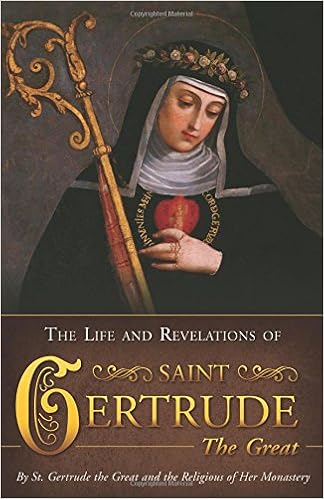
The Life and Revelations of St Gertrude the Great, Virgin and Abbess of the Order of St Benedict, written and compiled by the religious of her monastery, 565 pages

St Gertrude was entrusted to the nuns of the monastery at Helfta at the age of five and remained there until her death at the age of forty-six.  From her mid-twenties she received frequent visions of Jesus, His Virgin Mother, and a number of saints, and increasingly became regarded as a holy woman and sought out as a spiritual advisor.  Only one of the five books included in The Life and Revelations was authored by St Gertrude herself, the others were written by anonymous members of her community, no doubt largely after the saint's death.  Her memory was neglected in the waning of the middle ages, but was rediscovered during the Catholic Reformation, serving as an inspiration to saints including Teresa of Avila, Philip Neri, and Francis de Sales.

The Life and Revelations is not a compendium of divine revelations as a form of divination, but rather a vast treasury of devotions.  St Gertrude's questions and concerns are not about the future of the world or her community, but the spiritual health of herself and her sisters.  Throughout, the emphasis is on both the person of Christ and the communion of saints - Gertrude receives divine grace through the ministry of others, and the grace given her is intended as a light for others.  This fits perfectly with both the origin of this work as a communal project and the intended use of this book as a guide to the spiritual life.  St Gertrude's devotions are deeply embedded in the traditional liturgical life of the monastery even as they presage later devotions to the Sacred Heart of Jesus and the Divine Mercy.

Tuesday, September 6, 2016

Trust

Trust: In Saint Faustina's Footsteps by Grzegorz Gorny and Janusz Rosikon, 325 pages

St Maria Faustina Kowalska was born Helena Kowalska in 1905 in a land that had once been Poland and would soon be Poland again.  She died just thirty-three years later, mere months before Poland was again removed from the map by a conspiracy of Russians and Germans.  Throughout her life, she claimed to have seen visions of Jesus Christ, who commanded her to disseminate a devotion to His Divine Mercy, but at the time of her death these visions were barely known outside of a few Polish priestly circles already endangered by the genocidal Nazi and Communist ideologies descending upon Eastern Europe.  Just as discouraging, the Church hierarchy, both in Rome and in Poland itself, viewed the devotion and the purported visions from which it derived with their usual skepticism.

Like most true visionaries (prominently St Margaret Mary Alacoque, St Bernadette Soubirous, and Sister Lucia), St Faustina's life was one of humility and self-effacement - she was nothing, the message was everything.  Eighty years after St Faustina's death, the Divine Mercy chaplet is perhaps the second most popular Catholic devotion in the world, surpassed only by the Rosary.  Such is St Faustina's stature that, when millions of Catholic young people gathered in Krakow in July of 2016 for World Youth Day, it was considered entirely appropriate to open the event with a procession of her relics alongside those of St John Paul II.

Trust follows the life of St Faustina from her materially impoverished but spiritually rich childhood, through her time working as a domestic servant scrimping and saving to acquire the dowry she would need to enter the convent, through her struggles with doubts and doubters, and then to her life beyond life, the spread of the Divine Mercy devotion worldwide and her own ascent to the altars of the universal Church.  The book is straightforward hagiography, with no pretense to objectivity, if objectivity is even possible in a case where the subject must be either a saint, a fraud, or a madwoman.  It is lavishly illustrated - the book would be less than half as long without the many photographs, often taking up an entire page.  The overall effect is less artistic than documentary, which has the fortunate effect of turning the book into a kind of printed pilgrimage.

Wednesday, July 22, 2015

Something Beautiful for God

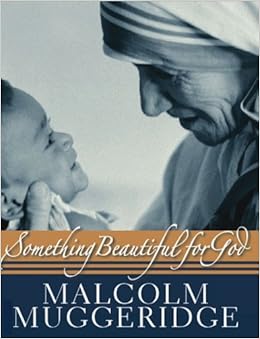
Something Beautiful for God: Mother Teresa of Calcutta by Malcolm Muggeridge, 110 pages

When television personality Malcolm Muggeridge took a documentary film crew into the slums of Calcutta to film the work of a little Albanian nun as she cared for the poorest of the poor, she reluctantly accepted the imposition with the words, "Let's do something beautiful for God."  Mother Teresa had left behind the Sisters of Loreto, with whom she had taught girls from India's growing upper class, years earlier, to toil in obscurity.  She was joined by a few disciples, most of them former students.  The sisters took in orphans, lepers, and those rejected by the local hospitals as beyond hope.  Their aim was not only to provide what material help they could, but, more importantly, to incarnate the love of God for those forgotten by society.

This book, a companion and extension of the documentary, chronicles Muggeridge's time with Bl Teresa of Calcutta.  It is very much Muggeridge's story, a merely Christian portrait of a saintly nun aimed at people who, like Muggeridge himself at the time, are attracted by her but less sympathetic towards her Church.  The author never bowdlerizes Bl Teresa's Catholicism - to the contrary, her eucharistic devotion and attitude towards suffering are presented as central to her life and work.

A vital portrait of a saint, an explanation of what her example meant for Christians in the late twentieth century, and what it means for Christianity today.

Monday, March 9, 2015

Unbroken Unity


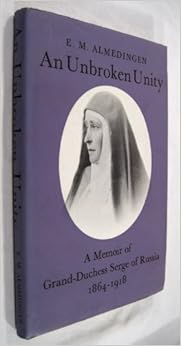
Elisabeth was born into the royal house of Hesse, and married Grand-Duke Sergei of Russia, an uncle of the future Tsar Nicholas II.  She was related in one way or another to all the royals of Europe - Queen Victoria was her grandmother - but the ties to the Romanovs were stronger than others - her aunt was the wife of Tsar Alexander II, while her sister was the Alexandra who married Nicholas II.  After several years of marriage, Elisabeth joined the Russian Orthodox Church, a move which inevitably influenced her sister, whose reluctance to convert from Lutheranism was an impediment to her proposed marriage to the Tsar.  

Elisabeth's conversion was not primarily dictated by political or family pressures - she fully embraced her new faith, without losing her own Western perspective.  After her husband was murdered by socialist terrorists in 1905, she founded an order of nuns following a rule she devised herself, modifying the Basilian rule standard in Russian convents.  The order was devoted to the service of the poor, primarily by operating a hospital, an orphanage, and outreach in the slums of Moscow.  After the Bolsheviks seized power, she chose to remain in her convent, and was ultimately arrested and brutally murdered by being savagely beaten and thrown down a mine shaft.

Almedingen has constructed a solid hagiography, writing about a time and place that she knew well.  As a hagiography, it has certain limitations, and more cynical readers will find plenty to roll their eyes at.  Yet the most compelling elements are also the most undeniable.

Wednesday, December 17, 2014

To Quell the Terror


The story of the Carmelite martyrs of Compiegne is one that has been adapted many times - most famously by Getrude von le Fort in her novel Song at the Scaffold and Francis Poulenc in his opera Dialogue of the Carmelites.  The true story, as told by Bush,  is more profound and dramatic than the fictive adaptations, even if it is somewhat less aesthetically pleasing.

In the midst of the bloody persecutions of the French Revolution, the fifteen nuns and one unprofessed novice of the Carmelite community at Compiegne were expelled from their convent with little more than the habits they were now forbidden by law to wear and a vague promise of future government pensions.  The sixteen women reformed their community in the streets of Paris, and began daily offering themselves to God as living sacrifices for the soul of France.  Arrested, tried, and convicted for the counterrevolutionary act of maintaining their religious vows, the sixteen were executed by guillotine, the novice taking her final vows in the very shadow of the scaffold.  A mere decadi (the decadi was the ten day Revolutionary replacement for the seven day Christian week) later, Robespierre was arrested, and his execution symbolically ended the Terror.

Bush is excellent at contrasting the idolatrous madness of the Revolution with the quiet piety of the Carmelites.  There are some elements that are less than successful - Bush lacks the literary gifts to smoothly handle shifting back and forth in time between the events of the Revolution and the biographies of the martyrs, although a similar technique was thrilling in Hansen's Exiles - but his sensitivity to spiritual realities and his understanding of the Carmelites' theological background make this a remarkable modern hagiography. 

Saturday, November 29, 2014

Mortal Heart


Mortal Heart by Robin LaFevers, 444 pages

Cover image for Perfect student and Death's number one fan Annith finally gets her due in Book Three of the His Fair Assassins series.  Annith, the long-suffering and unbelievably loyal friend of both Ismae and Sybella, has long felt she has been left behind as her friends go out to serve as handmaidens of Death.  No longer content to sit around waiting for her life to go the way she wants, Annith takes charge of her fate one night and flees the convent.   Disillusioned with her life there, Annith breaks free only to find herself mixed up with a very rough group of hellequins (read: traveling troop of demons hunting for souls trapped on earth who need an escort to the afterlife).   Shielded from the very start by the mysterious Balthazaar, Annith manages to hold her own among the demons.  As affection begins to grow between Annith and Balthazaar, it is clear there is more to this demon than brooding looks and an affinity for blood hounds.   Annith's realization that Balthazaar is really the one that needs rescuing makes for an unconventional romance with a happy ending relying heavily on mysticism.  

While Sybella and her story remains my favorite in the series, I found myself more intrigued by Annith's story then I originally thought I might be.  I thought I would be bored by her perfection, instead I found myself sympathizing with her quest to please everyone.  She has done everything right, and still she is punished.  She excels at every element of being an assassin, yet she is never sent out on missions.  The reasons for this are all explained in a plot twist I saw coming from Book One, but it is a YA novel, so I really cannot blame it for its predictability.  If the series held your interest through books one and two, Book Three is a must-read as it is over-all a satisfying read and ties up a lot of series loose ends.