Showing posts with label terrorists. Show all posts

Tuesday, July 13, 2021

Nothing Lasts Forever

Nothing Lasts Forever by Roderick Thorp, 188 pages

The time is the late '70s.  Joe Leland is a retired New York City detective and World War II vet visiting his big-shot corporate daughter in LA.  The Christmas party at his daughter's office, high in the skyscraper headquarters of the Klaxon corporation, is even more festive this year, thanks to a massive deal with the Chilean dictatorship that has just been finalized.  Leland isn't terribly impressed by the deal, but he is impressed by the murderous German terrorists, led by the psychopathic Anton Gruber, who expertly seize control of the building and take the partygoers, including Leland's daughter and grandchildren, hostage.  Slipping away in the confusion, he wages a one man war against the terrorists, using elevator shafts and air conditioning ducts to stay one step ahead of his enemies, his only uncertain allies the police outside.  The same police now laying plans for a frontal assault on the terrorists, plans that put Leland and his loved ones in the middle of the crossfire.

Nothing Lasts Forever is, of course, the novel that became Die Hard.  Obviously, many things changed in the adaptation - most obviously some of the names, the age of the protagonist, turning the terrorists into thieves, and switching an estranged daughter for an estranged wife.  Much is the same - the friendly police sergeant (although here a much younger man), the prickish police captain, a terrorist enraged when his brother is the first to die, extended conversations between hero and villain over the radio.  One of the greatest differences, however, is that the novel is entirely focused on Leland.  Scenes in the film featuring secondary characters greatly aided their development, but in the novel that is all missing.  This is most obvious in the case of Anton, who despite being a smart and canny adversary lacks the dangerous charm of Hans, even setting aside that he doesn't have the advantage of being portrayed by Alan Rickman.  This also adds to the second great difference, the '70s grimness of the novel, which becomes more a test of Leland's endurance than of his inventiveness.  Nor is all his suffering physical, for not only do the novel's more progressive terrorists include a number of women, but events will prove that everyone, including Leland himself, is deeply morally compromised.

On its own, Roderick Thorp's novel is a fine diversion with vague aspirations to be something more.  The connection to Die Hard adds an entire other level of interest, providing material for hours of reflections on storytelling choices, the differences between novels and film, shifting social mores, the excellence of Alan Rickman, and the patience of long-suffering wives.

Sunday, September 13, 2015

Days of Rage

Cover image for Days of Rage: America's Radical Underground, the FBI, and the Forgotten Age of Revolutionary Violence by Bryan Burrough, 548 pages

Beginning in the late sixties and continuing into the eighties, American revolutionaries waged a remorseless campaign of terror aimed at overthrowing the US government.  Motivated by radical nihilism, hundreds of men and women detonated thousands of bombs (for an eighteen month period in '71 and '72, domestic bombings averaged nearly five a day), robbed dozens of banks, and imagined themselves the heroic champions of the same people they were busy robbing, maiming, and killing.

How and why an element of the civil rights movement metastasized into terrorist cadres is the subject of Bryan Burrough's excellent history of some of the most famous (Weatherman, the Symbionese Liberation Army, FALN) and more obscure (NWLF, the Family) organizations.  Not that Burrough is an Establishment apologist - the book is also peppered with brutal cops and rights-violating FBI agents, from COINTELPRO to the murder of Fred Hampton by Chicago police.  Based largely upon extensive interviews with participants on both sides of the law, Days of Rage is a surprisingly intimate portrait of a time when idealism served as a mask for anger and ignorance, when hatred and arrogance rhymed.

Monday, March 9, 2015

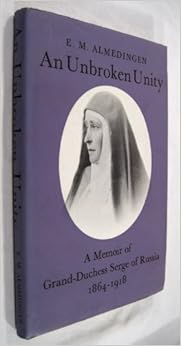
Unbroken Unity


Elisabeth was born into the royal house of Hesse, and married Grand-Duke Sergei of Russia, an uncle of the future Tsar Nicholas II.  She was related in one way or another to all the royals of Europe - Queen Victoria was her grandmother - but the ties to the Romanovs were stronger than others - her aunt was the wife of Tsar Alexander II, while her sister was the Alexandra who married Nicholas II.  After several years of marriage, Elisabeth joined the Russian Orthodox Church, a move which inevitably influenced her sister, whose reluctance to convert from Lutheranism was an impediment to her proposed marriage to the Tsar.  

Elisabeth's conversion was not primarily dictated by political or family pressures - she fully embraced her new faith, without losing her own Western perspective.  After her husband was murdered by socialist terrorists in 1905, she founded an order of nuns following a rule she devised herself, modifying the Basilian rule standard in Russian convents.  The order was devoted to the service of the poor, primarily by operating a hospital, an orphanage, and outreach in the slums of Moscow.  After the Bolsheviks seized power, she chose to remain in her convent, and was ultimately arrested and brutally murdered by being savagely beaten and thrown down a mine shaft.

Almedingen has constructed a solid hagiography, writing about a time and place that she knew well.  As a hagiography, it has certain limitations, and more cynical readers will find plenty to roll their eyes at.  Yet the most compelling elements are also the most undeniable.

Sunday, August 31, 2014

A Better World

A Better World by Marcus Sakey
380 Pages

The second book of the Brilliance saga returns with the tensions between brillants (those with special abilities) and non-brilliants rising.   When a terrorist group of brillants takes steps to hold three American cities hostage, the White House turns to agent Nick Cooper, former anti-terrorism agent and brillant himself to help come up with a solution.  However, all is not as it seems and Nick quickly finds that assumptions he made in the last book may be wrong.

This series is entertaining and well written and I can't wait for the third book to be released.