Showing posts with label 14th-Century Italy. Show all posts

Monday, April 24, 2017

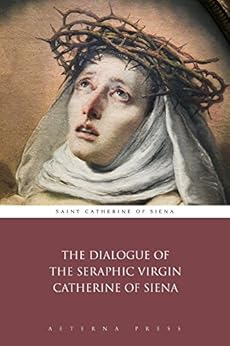
Dialogue of St Catherine of Siena

The Dialogue of the Seraphic Virgin Catherine of Siena, Dictated by Her, while in a State of Ecstasy, to Her Secretaries and Completed in the Year of Our Lord 1370, Together with an Account of Her Death by an Eyewitness by St Catherine of Siena and others, 344 pages

The full title of the Dialogue is most of the context provided in this edition - the brief introduction is primarily concerned with the spiritual state of Italy, Christendom, and the saint rather than a true biography of the author or commentary on the text.  That text is a transcription of conversations St Catherine had while in an ecstatic state with the first two Persons of the Trinity.  None of the voices - those of God or that of the saint - ever descends into the kind of babbling emotionalism popularly associated with ecstasy - they speak clearly, rationally, and, on the part of God, with a commanding authority.  There is not even a trace of self-aggrandizement - St Catherine is not interested in her status as the mouthpiece of the Almighty, but with how she - and we - can draw closer to Him.  The result is an eminently practical guide to the spiritual life, showing "clearly in each state the means of cutting away imperfection and reaching perfection, and how the soul may know by which road she is walking and of the hidden delusions of the devil and of spiritual self-love."

Monday, April 17, 2017

Selected Poems

Selected Poems by Petrarch, translated by Anthony Mortimer, 70 pages

     So here in a net I fell; here was I caught
     by the fair motions and angelic words,
     the pleasure, the desire, and the hope.

This small book collects translations of selections from Petrarch's Canzoniere, the "Songbook", which includes what are universally regarded as some of the most sublime love poems ever written, uncovering

     how Love heals and how he kills.

The subject of the poems is Laura, Petrarch's unrequited, idealized love, in the tradition of courtly romance.  The songs chart a course from infatuation through desire and longing to resignation and mourning, and ultimately beyond, to the conclusion

     that all the world loves is a passing dream.

Thursday, August 6, 2015

Alchemy's Daughter

 
Alchemy’s Daughter by Mary A. Osborne    268 pages

Santina Pietra is a seventeen-year-old living in 14th-Century Italy; San Gimignano to be exact. There aren’t many alternatives for young adult women at this time. The two best options are marriage or the convent. She can stay at home as a spinster and take care of her father; her mother having died many years ago.

Santina’s father has his eye set on a much older man for her husband. But she doesn’t even like him, much less love him. She loves Calandrino, a scholar and friend of her father’s.

Santina is no ordinary woman. She wants to follow her love of knowledge and be something more than a brood mare. She spends her day studying, looking forward to her weekly lesson with Calandrino. However, when he seemingly abandons her for studies at a far-away university, she is devastated.

Instead of capitulating to her father’s wishes that she marry like her sisters, Santina leaves home to study with the local midwife Trotula. In the small cabin, she learns how to fend for herself, how to help deliver the villages babies, and cure the population’s sicknesses. Santina thrives in this role, no matter that both she and Tortula are considered witches.

This story may be set in the 1340s, but Santina resembles a 21st –Century woman. She is fearless, modern, intelligent, and strong. I feel that the young adult women who read this will find not only inspiration, but role models in both women.

The story was rather slow in the beginning, but quickly moved into a can’t-put-it-down tale of strong women. That’s why I gave Alchemy’s Daughter four out of 5 stars.