Showing posts with label Medieval England. Show all posts

Monday, July 31, 2023

Winchester Cathedral Close

Winchester Cathedral Close: Its Historical and Literary Associations by John Vaughan, 275 pages

This is not a history of the cathedral itself, but of the monastic enclosure that surrounded it for centuries prior to the Reformation, elements of which survive to this day.  John Vaughan, a resident canon in the early years of the 20th century, follows these traces through to his own time, covering not only the buildings but also the flora and fauna of the cathedral precincts, as well as the scriptorium and the library collection.

Vaughan's intimate knowledge of his surroundings breathes a special vitality into what might otherwise be a very dry work, at times suggesting the sweet odour of contemplation that once incensed the air here.  Few, perhaps, will care about details of the alterations to the undercroft, but anyone looking for a testament of love of place will be enchanted.

Saturday, July 1, 2023

Early History of Glastonbury

The Early History of Glastonbury by William of Malmesbury, translated by John Scott, 83 pages

The Early History of Glastonbury is a translation of William of Malmesbury's 12th century history De Antiquitate Glastonie Ecclesie, accompanied by the Latin text as well as commentary and notes. William undertook this project at the behest of the monks of Glastonbury, at least partially as a supplement to four Lives of Glastonbury saints he had written (of which only the Life of Saint Dunstan survives), but the primary aim seems to have been a catalogue of the various charters and bequests associated with the monastery.  Indeed, the short book is generally more of a legal record than a conventional history, as rights and privileges awarded to the abbot and monks are thoroughly documented - in the uncertain period following the Norman conquest, this was a necessity.

For a modern reader this focus proves something of an obstacle, as it does not make for particularly entertaining reading.  To the kind of reader who is likely to even consider reading a 12th century monastic history, however, the rewards will almost certainly be worth the price.

Friday, April 6, 2018

Catherine, Called Birdy

Catherine, Called Birdy by Karen Cushman     169 pages

The thirteen-year-old daughter of an English country knight keeps a journal in which she records the events of her life, particularly her longing for adventures beyond the usual role of women and her efforts to avoid being married off.


I highly enjoyed this book. I love historical fiction and Cushman does an excellent job of capturing Medieval life. Catherine, Birdy, is now one of my favorite literary characters, and certainly in my top five of favorite female literary characters. Her insights into her life and the lives of others, her social commentary, and her overall desire to do good by others makes her such a fascinating and inspiring character. For example, when she learns that a merchant who owns a bear, who performs poorly at a fair that Birdy attends, decides to subject it to bear baiting, she observes:

"The performance I saw was so clumsy and sad and brought the bear's owner so little profit that he announced a bearbaiting, planning to set a pack of dogs against a poor bear and see who cries and bleeds and dies first, all for the amusement of those wagering money on the outcome. How can we think ourselves made in the likeness of God when we act worse than beasts?" (p. 148)

This is such a profound statement and it made me love Birdy all the more. Though she often acts rashly and selfishly, she generally reflects upon her actions and either feels ashamed or desires to make amends and, at the very least, does what she can to correct her ways.

This book is an excellent choice for anyone who loves historical fiction, especially about Medieval England. It also serves well as a book for those who love a feisty female narrator. Birdy's narrative voice injects a lot of humor and lightheartedness to the story. It's also a quick read, so for those who are looking for something short and sweet, this is the perfect bite. This is truly an enjoyable read.

Monday, July 27, 2015

Vanishing Witch


The Vanishing Witch by Karen Maitland
512 pages

The reign of Richard II is troubled, the poor are about to become poorer still and landowners are lining their pockets. It's a case of every man for himself, whatever his status or wealth. But in a world where nothing can be taken at face value, who can you trust? The dour wool merchant? His impulsive son? The stepdaughter with the hypnotic eyes? Or the raven-haired widow clutching her necklace of bloodstones? And when people start dying unnatural deaths and the peasants decide it's time to fight back, it's all too easy to spy witchcraft at every turn.

Karen Maitland has the talent to pluck you from your comfy armchair and plop you right into the middle ages with such detail you can almost smell the tanner's vats (although thankfully you can't). While I didn't enjoy this one as much as The Owl Killers or Company of Liars, it still kept me reading. I like books that have characters who are flawed - books with "perfect" characters tend to be boring. There are only a few in here that I would actually root for, but most who met their end, although they could be awful people, didn't deserve such a fate. And there were a few ARC reveals that I saw coming - but a major one I totally missed. All in all a very long book but still enjoyable, even if you've predicted the ending. 

Wednesday, March 18, 2015

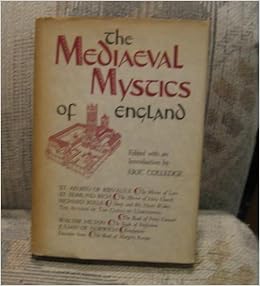
Mediaeval Mystics of England

Mediaeval Mystics of England, edited by Eric Colledge, 304 pages

This book is an anthology of works by Christian mystics resident in England between the 12th and 15th centuries.  It includes selections from the writings of St Aelred of Rievaulx, St Edmund Rich, Richard Rolle, Walter Hilton, Julian of Norwich, Margery Kempe, and the anonymous author of The Cloud of Unknowing.  Editor Colledge also authored an excellent extended introduction, covering the development of the mystic tradition of the late Middle Ages and these authors in particular.

Unfortunately, the brief selections are insufficient for more than a taste of the works chosen.  Hilton's The Scale of Perfection is the standout, perhaps because it is also the longest.  Readers seeking devotional material or theological wisdom are likely to be disappointed, although this collection may serve to encourage (or discourage) further reading.

Sunday, December 29, 2013

The Pillars of The Earth, Ken Follett

The Pillars of the Earth by Ken Follett, 973 pages

      I have spent a considerable portion of this last month obsessively getting through this epic novel- I picked it up because I watched the mini- series awhile ago and remembered it as being a show that I binge watched as well. (thank you, Netflix.) I thought the book was great, considering that Follett gives us a medieval story centered around the construction of a cathedral.  He effortlessly weaves in descriptions of the construction, design, and architecture of European cathedrals with the drama of his protagonists.  His cast of characters begins with Tom Builder, a master builder who is struggling to find steady work, who dreams of designing a cathedral of his own someday.  From there the reader is introduced to a group of people (and a couple of  tremendous villains,)  who live in a world that can only be described as alien to the contemporary person today.  The Pillars of the Earth read like Game of Thrones without the magic, which was fairly refreshing for me- Follett gave me a glimpse of what life might have been like for people of several different classes, and what the world was like when there was no such thing as a secular society.  The power struggles between the English monarchs and the church trickle down to many of the characters, who must deal with the consequences in creative ways if they wish to continue building their cathedral.  Entertaining. I have already put the sequel, A World Without End, on hold.