Showing posts with label dark ages. Show all posts

Monday, July 27, 2015

Deception's Pawn


Deception's Pawn by Esther M. Friesner
386 pages

Maeve, princess of Connacht, seems to have won her freedom. Her father, the High King, is finally allowing her to explore the world beyond his castle. But Maeve soon discovers that being the High King's daughter doesn't protect her from bullying or the attention of unwelcome suitors.

Struggling to navigate a new court, she must discourage the advances of her father's rival, who is vying with her host's son for her hand in marriage. Maeve is a pawn trapped between these two boys. Her bold defiance will bring her to the brink of disaster, but her clever gamble may also lead to her independence. Though she faces danger and intrigue, Maeve will also discover what kind of person-and queen-she's destined to become.


I didn't enjoy this as some of Esther Friesner's other Princess of Myth stories. This one, as one reviewer put it, was basically "Mean Girls of the Iron Age" - Maeve is placed in another household and her other female companions can be quite nasty. I would have preferred some serious sword slinging to mud flinging. 

Friday, May 9, 2014

Boethius


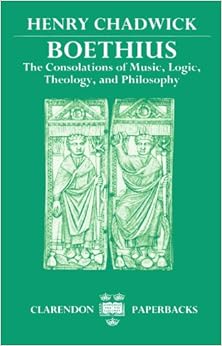
http://ecx.images-amazon.com/images/I/51QcCFN1eML._SY344_BO1,204,203,200_.jpgAccording to schoolbook historiography, St Boethius was a man of the Dark Ages.  He was born around 480 AD, four years after the deposition of Romulus Augustulus, the event which is most often chosen as the official end of the Western Roman Empire.  Italy, once the capital of the civilized world, was ruled by barbarian kings, first Odoacer and then Theodoric.  The light was extinguished, the fire died, etc.  Such a picture would have been unrecognizable to Boethius himself.  Theodoric may have been a barbarian, and an Arian as well, but he had been educated in Constantinople.  Boethius likely trained in Alexandria, still the most cosmopolitan city in the Mediterranean world.  His father-in-law, Symmachus (himself a worthy descendant of the fourth century statesman of the same name), and his theological mentor, John the Deacon (possibly St John I, Pope from 523-526), were accomplished men of letters.  Boethius' wife, Rusticiana, would live to see Theodoric's successors driven from Rome by the Emperor Justinian's general Belisarius.

The fact that Boethius' writings are themselves situated in a rich context of Neo-Platonic philosophy, and particularly in a philosophical movement that tried to reconcile Aristotle with Plato, presents one of the greatest difficulties a modern reader faces in understanding his works.  Chadwick does a tremendous job in explicating the cultural background from which Boethius drew, dealing with subjects ranging from the Pythagorean theory of music to the influence of Ovid's Letters from Pontus on The Consolation of Philosophy.  This is almost a necessary book for anyone interested in Boethius, his times, and his contribution to Western civilization.

Sunday, December 29, 2013

The Pillars of The Earth, Ken Follett

The Pillars of the Earth by Ken Follett, 973 pages

      I have spent a considerable portion of this last month obsessively getting through this epic novel- I picked it up because I watched the mini- series awhile ago and remembered it as being a show that I binge watched as well. (thank you, Netflix.) I thought the book was great, considering that Follett gives us a medieval story centered around the construction of a cathedral.  He effortlessly weaves in descriptions of the construction, design, and architecture of European cathedrals with the drama of his protagonists.  His cast of characters begins with Tom Builder, a master builder who is struggling to find steady work, who dreams of designing a cathedral of his own someday.  From there the reader is introduced to a group of people (and a couple of  tremendous villains,)  who live in a world that can only be described as alien to the contemporary person today.  The Pillars of the Earth read like Game of Thrones without the magic, which was fairly refreshing for me- Follett gave me a glimpse of what life might have been like for people of several different classes, and what the world was like when there was no such thing as a secular society.  The power struggles between the English monarchs and the church trickle down to many of the characters, who must deal with the consequences in creative ways if they wish to continue building their cathedral.  Entertaining. I have already put the sequel, A World Without End, on hold.