Showing posts with label multiple povs. Show all posts

Saturday, May 20, 2023

Beyond that, the Sea


Beyond That, the Sea by Laura Spence-Ash 368 pages


The Blitz was in high gear. Nightly the German bombs rained down upon London. Most Londoners felt as if bomb shelters were their new homes. Many families were sending their children to the English countryside or to America to keep them safe. Millie and Reginald Thompson decided to do the same for their eleven-year-old daughter Beatrix.


I can’t remember how, or if it was even mentioned in the story, but the Thompson’s chose America and a family in Boston. The voyage was hard on the girl, traveling alone. But the ship made it across the ocean and landed. Beatrix was relieved when her new family claimed her. She was welcomed with open arms.


It didn’t take long for Bea, as she was called, to make herself at home and fit into her new lifestyle. Really, the only difference was the Thompsons were upper lower class while the Gregorys were wealthy. One of the things that Bea loved most living with the Gregorys, Nancy and Ethan, and their two sons, Gerald and William, was the summers spent at their cabin in Maine. Oh, what fun they had!


When the war ended, Bea was sent back to London. While she had been gone, her father had died, her mother had remarried, and London was still in ruins. As she tried to pick up the pieces, her memories of the Gregorys lingered in the back of her mind. She had grown close to both boys. Nor did the Gregorys forget Bea.


What I really like about this story is the way it is told---in short vignettes told from seven viewpoints (those of the seven characters.) What I didn’t like was that the vignette style also allowed the author to gloss over some key moments. Regardless, I would recommend this book to others, and Beyond That, the Sea received 4 out of 5 stars in Julie’s world.


Wednesday, September 8, 2021

Sunflower Sisters

Sunflower Sisters by Martha Hall Kelly  528 pages

This is the final book in the Lilac Girls or the Woolsey-Ferriday Trilogies

I fell in love with Martha Hall Kelly’s writing when her first book, “Lilac Girls” debuted. The second book, working backwards in time, was “Lost Roses.” And now this, the final story, has come along, which takes place during the American Civil War.

One thing I like about these novels is that they are truly standalones. They are about one family across history and other than the blood connection, there is no mention of the other relatives or protagonists in the other two books. Maybe that’s why author Hall-Kelly wrote them in reverse.

The book is told from three points of view. First is the main protagonist, Georgeanna “Georgy” Woolsey, a great-aunt to “Lilac Girls” Caroline Ferriday. Georgy ultimately becomes a nurse, serving during the Civil War. Hall Kelly takes readers right to the battle front without romanticizing the events or the war. Sometimes it was hard to read. Georgy believes her destiny is to open a nursing school for women.

The second point of view is from Jemma, a slave on the Peeler Plantation. She is brutalized and beaten, often to the breaking point. As life and white people conspire to make her life as hard as possible, Jemma pulls herself up and continues.

The third point of view is from Anne-May Wilson, mistress of the Peeler Plantation. She is meaner than any man could ever be to her slaves. Anne-May is in charge of running the tobacco fields until, and if, her husband and brother, fighting on opposite sides, return home. It’s no wonder that the slaves are constantly running away. Her brutality is legendary.

The story flows well and the characters are well-developed. From reading the Author’s Notes, I learned that most of the research was done through the Woolsey family letters. Georgy had six sisters and one brother. I highly recommend reading that last section as it provides some insight into the Woolsey family.

At first I was confused about the sunflowers; I wasn’t sure what they meant. Sunflowers were used to warn runaway slave of places that weren’t safe. They pop up in the book in several places.

At 528 pages, this is a massive book to undertake. I read it in a little over a week, it was that good. It’s been a couple of weeks since I finished “Sunflower Sisters” and I find myself missing these characters.

“Sunflower Sisters receives 6 out of 5 stars in Julie’s world. 


Saturday, February 6, 2021

The Mystery of Mrs. Christie

The Mystery of Mrs. Christie by Marie Benedict  288 pages

One of the most highly reported disappearances of the 20th century is from 1926 and has largely been forgotten. That is where author Marie Benedict excels—exploring the past. In this, Benedict’s fifth novel, up and coming mystery writer Agatha Christie has seemed to vanish from the face of the earth. Her abandoned car is found near Silent Pool---“a small spring-fed lake,” that Agatha found inspiring, but no sign of her. Suicide is quickly ruled out.

She turned up eleven days later in an elegant, nearby hotel. Where she had been, and why, has, still in 2021, not been explained. Even Agatha did not address the event in her autobiography.

The Mystery of Mrs. Christie is written in two of my favorite styles---dueling timelines and multiple viewpoints---are fictionalized diary entries. The first is a section called “The Manuscript”---which I didn’t understand why---is from Agatha’s point of view from 1912 to current day, which is 1926. It revolves around her courtship and subsequent marriage and life with Archie Christie, and her budding career.

The second section is from Archie’s viewpoint and takes place in December 1926.  It revolves around his coping with his wife’s disappearance, their child, their marriage, his mistress, and the fact that he is the police’s prime suspect.

A third, overarching section, only has one entry, but it dictates Archie’s every move during those eleven days. Agatha left Archie a letter in which she states that if he doesn’t do exactly as the letter says, he will never see her again. The police only learn of the letter near the end of the eleven days, which heightens their suspicions. However, Archie had burned it, so the police have no idea what Agatha could have written, which only fueled their suspensions.

 I’m a huge fan of Benedict’s work, but I was truly disappointed in this one. There was no real tension, no sense that Agatha was in any real danger. Even Archie didn’t seem to care much about Agatha and was more worried about his reputation. The “supposed” reason Agatha left was lame. The Mystery of Mrs. Christie receives 2 out of 5 stars in Julie’s world.


Friday, September 20, 2019

There Will Come a Darkness

There Will Come a Darkness by Katy Rose Pool, 496 pages

This is a pretty solidly written action-adventure fantasy. The world is interesting and different. I felt like lots of elements of it were based on ancient history, in areas like Greece and Rome. I also liked the prophecy aspect of it, of five different characters whose stories will eventually overlap, each with their own role to play in this prophecy.

This book, while having familiar elements like good vs. evil, people with powers vs. people without, and prophetic hints for the future, it still managed to surprise me every once in a while.

The only thing that held me back from liking it was the fact that I didn’t care for any of the characters, which is usually a big bummer for me and keeps me from enjoying the book very much. But, I’d still recommend it, because I’m sure there are plenty of readers out there, especially fans of the fantasy genre, who would enjoy this book a great deal. It’s got action, it’s got supernatural elements, and it’s got a classic “end of the world” scenario on the horizon. So definitely check it out.

Tuesday, January 15, 2019

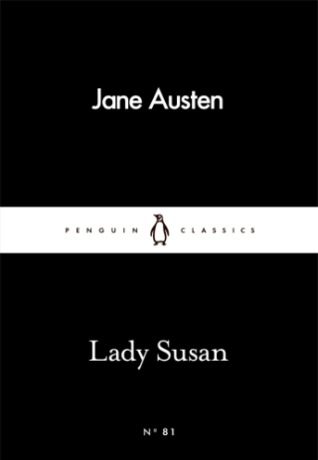
Lady Susan

Lady Susan by Jane Austen     128 pages

From Goodreads:

Of what a mistake were you guilty in marrying a Man of his age! - just old enough to be formal, ungovernable and to have the Gout - too old to be agreable, and too young to die.'

The scheming and unscrupulous Lady Susan is unlike any Austen heroine you've met in this fascinating early novella.

Review:

I highly enjoyed this book and it has so many things to recommend itself to readers: it’s short and sweet, it’s witty and humorous, and most of all the story and characters are strong. Austen is a masterful writer and this book, though not one of her most well-known works, definitely deserves attention. I definitely recommend this book. If you’re looking for a short, sweet summer read, this one definitely hits the spot.

The Water Cure

The Water Cure by Sophie Mackintosh     288 pages

From Goodreads:


King has tenderly staked out a territory for his wife and three daughters, Grace, Lia, and Sky. He has lain the barbed wire; he has anchored the buoys in the water; he has marked out a clear message: Do not enter. Or viewed from another angle: Not safe to leave. Here women are protected from the chaos and violence of men on the mainland. The cult-like rituals and therapies they endure fortify them from the spreading toxicity of a degrading world.

But when their father, the only man they’ve ever seen, disappears, they retreat further inward until the day three strange men wash ashore. Over the span of one blistering hot week, a psychological cat-and-mouse game plays out. Sexual tensions and sibling rivalries flare as the sisters confront the amorphous threat the strangers represent. Can they survive the men?

Review:

Overall, it's a stunning book, very thought provoking, and I couldn't have imagined where it would lead me. Though I'm not normally a fan of multiple points of view, here, I think, Mackintosh has utilized this tool to the greatest effect. It really shines. I will definitely be recommending this book.

Wednesday, October 3, 2018

Wide Sargasso Sea

Wide Sargasso Sea by Jean Rhys     189 pages

"Wide Sargasso Sea, a masterpiece of modern fiction, was Jean Rhys’s return to the literary center stage. She had a startling early career and was known for her extraordinary prose and haunting women characters. With Wide Sargasso Sea, her last and best-selling novel, she ingeniously brings into light one of fiction’s most fascinating characters: the madwoman in the attic from Charlotte Brontë’s Jane Eyre. This mesmerizing work introduces us to Antoinette Cosway, a sensual and protected young woman who is sold into marriage to the prideful Mr. Rochester. Rhys portrays Cosway amidst a society so driven by hatred, so skewed in its sexual relations, that it can literally drive a woman out of her mind."

Ultimately, this book was very boringly written, there was no plot, and the characters were so bizarre and weirdly written so as to make them confusing. I couldn't really say there was anything I particularly cared for in this book, so I had to give it the lowest rating because I did not enjoy reading any part of it. I had tried reading this a year ago, but could not get into it. I only attempted it again because of Book Riot's challenge. I have succeeded in reading all of it but not in liking it any better than the first time.

Thursday, September 6, 2018

Good Omens

Good Omens: The Nice and Accurate Prophecies of Agnes Nutter, Witch by Terry Pratchett and Neil Gaiman     412 pages

According to The Nice and Accurate Prophecies of Agnes NutterWitch (the world's only completely accurate book of prophecies, written in 1655, before she exploded), the world will end on a Saturday. Next Saturday, in fact. Just before dinner.

So the armies of Good and Evil are amassing, Atlantis is rising, frogs are falling, tempers are flaring. Everything appears to be going according to Divine Plan. Except a somewhat fussy angel and a fast-living demon—both of whom have lived amongst Earth's mortals since The Beginning and have grown rather fond of the lifestyle—are not actually looking forward to the coming Rapture.

And someone seems to have misplaced the Antichrist . . . 


This was an interesting read - it took me a while to get into it and get used to the format of the book. If you're not a fan of constantly switching pov, then you might want to skip this, because there is a large cast of characters and many of them get at least a little portion of the text from their perspective. In this way, it was a bit tricky remembering people as you read the book, especially if they were just a minor character and they popped up early in the book and many not again until much later.

In this way, I think the movie of this book might actually be a better format for this kind of story. It will be easier to remember characters, for one, but also the humor that Pratchett and Gaiman employ might come off better told from actual people than being read on a page.

The humor was another thing that made it difficult for me to absolutely love this book. I guess since I'm not British, some of the humor just went over my head. Also, because I'm not as familiar with certain customs or companies that were either real and mentioned or parodied, it didn't come off as funny to me, per say. There were also lots of references and playing off of Biblical subject matter, and since I did not grow up learning Biblical subject matter, a lot more might have gone over my head. However, there were some pretty funny bits and I did enjoy a good portion of the book.

All in all, it was fun read, but it didn't roll along easily for me. I definitely read it in chunks. I would recommend it, but only to people who I think this humor would go over well with.

Wednesday, August 1, 2018

The Boleyn Reckoning

The Boleyn Reckoning by Laura Andersen     416 pages

Perfect for fans of Philippa Gregory and Alison Weir, The Boleyn Reckoning heralds the triumphant conclusion of Laura Andersen's enthralling trilogy about the Tudor king who never was: the son of Henry VIII and Anne Boleyn--Henry IX--who, along with his sisters and those he holds most dear, approaches a dangerous crossroads. 

Meh. The ending of this series was overly dramatic and ultimately blah. It just solidified my dislike of love-triangles. Not only was a love-triangle the sole plot of this book, but it ends up taking over every character's actions and what you get is a sopping mess of drama, rage, revenge, grief, despair, and on and on. It gets a little tedious.

I absolutely love Tudor history, but this story makes it less interesting when it focuses on indirect Tudor characters - Minuette and Dominic are nice and all, but their love is not as interesting as the rest of this alternative history unfurling. And the ending - I don't know what to make of <spoiler> Elizabeth threatening Minuette about her child's probable lineage (as William's) to get her to do what she wants. That seems oddly out of character for this series so I don't know what Andersen was trying to do there. And she couldn't have just left it a mystery as to who the father is? I'm just dissatisfied with it ultimately being Williams.</spoiler>.

Dissatisfied and not likely to pick up Andersen's follow-up series about Elizabeth I.

Monday, July 30, 2018

A Spark of Light

A Spark of Light by Jodi Picoult     352 pages
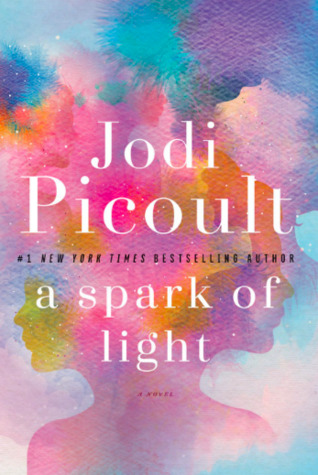
The warm fall day starts like any other at the Center—a women’s reproductive health services clinic—its staff offering care to anyone who passes through its doors. Then, in late morning, a desperate and distraught gunman bursts in and opens fire, taking all inside hostage.

After rushing to the scene, Hugh McElroy, a police hostage negotiator, sets up a perimeter and begins making a plan to communicate with the gunman. As his phone vibrates with incoming text messages he glances at it and, to his horror, finds out that his fifteen-year-old daughter, Wren, is inside the clinic.

But Wren is not alone. She will share the next and tensest few hours of her young life with a cast of unforgettable characters: A nurse who calms her own panic in order save the life of a wounded woman. A doctor who does his work not in spite of his faith but because of it, and who will find that faith tested as never before. A pro-life protester disguised as a patient, who now stands in the cross hairs of the same rage she herself has felt. A young woman who has come to terminate her pregnancy. And the disturbed individual himself, vowing to be heard.


This was a fascinating story, and well crafted, as it weaves together the stories of several lives as they intersect on one particular day at a woman's reproductive health clinic.

Some are there to get an abortion, some are there to get the pill, some are there because they work there, they are the abortion doctor, or that is where they receive they're gynecological exams. Whatever the reason, on this fateful day all their lives are thrown together when an anti-abortion activist starts shooting.

This story was a bit difficult to follow, at first, as it traces the story backwards. Immediately you're thrust into the story, amongst the hostages, the negotiator, and the gunman. It's always difficult for me when a story jumps back and forth between perspec
tives, and this story followed ten different people, and it jumped rather frequently.

The thing that Picoult is so skilled at is revealing the story, bit by bit, until all the pieces begin to come together, finally, into a whole, at the very end. And when you finally get a major reveal you've been waiting for the whole time you've been reading, often you end up making some audible sound, like a gasp, because you just didn't see it coming. At least, that's how it was for me, though not as strongly this time, as I predicted the sort-of big reveal before it happened, though not until I was at least half-way done.

The parts I loved about this story were the different character's stories and how they all fit together to tell this overarching story about abortion from all sides. Going into this story, you might just think it's a pro-live vs. pro-choice struggle. But there are so many facets that make up the abortion discussion, that aren't as often brought up. Picoult makes sure to touch them all. I learned so much just reading this book - and I highly recommend reading Picoult's "Author's Note," as well, where she speaks personally about her thoughts on abortion.

That being said, what kept this from being higher rated for me were the numerous times that this story felt less like a story and more like a "covering all the bases" blanket statement about abortion. As much as I appreciated all the information about abortion, sometimes the story element was lacking and a character became a mouth-piece to tell me a specific fact or point of view about abortion rather than me feeling link this was something heart-felt by that character. This story is definitely coming in at a time where these kinds of discussions are raging and abortion is painting a wide swath in a political landscape. This notion unfortunately colors my enjoyment of the story, a bit, as it feels like a PSA rather than a story.

But otherwise, I really felt like this was well done and is definitely up there in my list of favorite Picoult books. I would definitely recommend it to anyone because perspective is necessary when it comes to topics like these. Empathy is an amazing eye-opener, and getting an idea of what someone facing such a choice might be thinking or feeling or even knowing what their life is like is important and humanizing, a point that Picoult is emphasizing, underlining, and exclaiming with every word. So read it.

Sunday, May 17, 2015

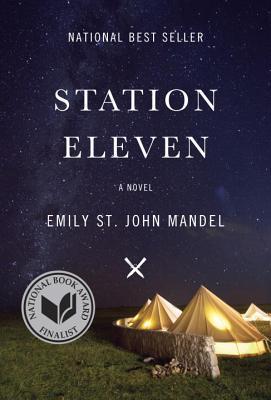
Station Eleven

Station ElevenStation Eleven, by Emily St. John Mandel, 336 pages

I remember hearing a lot of buzz about this book- and then, nothing.  But I finally got around to reading it, and I enjoyed it.  The plot is this: a super flu happens and most of the world dies; this is the interlocking stories of a few of the survivors and a few of the non-survivors.  The stories span a wide range of years and include a number of voices, so it's up to the reader to keep them all straight.  One of the voices is that of Kirsten, a young woman who was just a girl when the flu hit, and years later, she is a member of a traveling theater troupe, who offer Shakespeare to the post-apocalyptic communities.  I love the idea of art being essential- the troupe use a Star Trek line as their motto, which really sums up the whole book: "Because survival is insufficient."