Showing posts with label Tudor Era. Show all posts

Wednesday, August 1, 2018

The Boleyn Reckoning

The Boleyn Reckoning by Laura Andersen     416 pages

Perfect for fans of Philippa Gregory and Alison Weir, The Boleyn Reckoning heralds the triumphant conclusion of Laura Andersen's enthralling trilogy about the Tudor king who never was: the son of Henry VIII and Anne Boleyn--Henry IX--who, along with his sisters and those he holds most dear, approaches a dangerous crossroads. 

Meh. The ending of this series was overly dramatic and ultimately blah. It just solidified my dislike of love-triangles. Not only was a love-triangle the sole plot of this book, but it ends up taking over every character's actions and what you get is a sopping mess of drama, rage, revenge, grief, despair, and on and on. It gets a little tedious.

I absolutely love Tudor history, but this story makes it less interesting when it focuses on indirect Tudor characters - Minuette and Dominic are nice and all, but their love is not as interesting as the rest of this alternative history unfurling. And the ending - I don't know what to make of <spoiler> Elizabeth threatening Minuette about her child's probable lineage (as William's) to get her to do what she wants. That seems oddly out of character for this series so I don't know what Andersen was trying to do there. And she couldn't have just left it a mystery as to who the father is? I'm just dissatisfied with it ultimately being Williams.</spoiler>.

Dissatisfied and not likely to pick up Andersen's follow-up series about Elizabeth I.

Wednesday, June 24, 2015

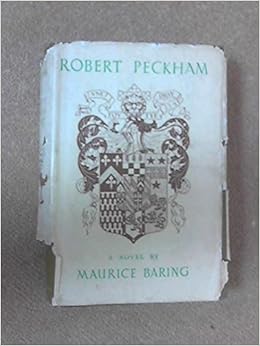
Robert Peckham

Robert Peckham by Maurice Baring, 279 pages

"Here lies Robert Peckham, Englishman and Catholic, who, after England's break with the Church, left England because he could not live in his country without the Faith and, having come to Rome, died there because he could not live apart from his country."

Reggie Balfour quoted the epitaph of Sir Robert Peckham, found in the Roman church of San Gregorio Magno, in a letter to his friend Maurice Baring in 1899.  Thirty years later, it inspired Baring to base a biographical novel around Peckham, an English aristocrat driven into reluctant, self-imposed exile by the Elizabethan settlement.

Baring did his research thoroughly, and Peckham came from an interesting family.  His father was treasurer under Henry VIII and all of his children - Edward VI, Mary, and Elizabeth.  His quiet dedication and undoubted loyalty and competence helped him weather the political and religious changes that followed each change of monarch.  Robert's brother Henry was less successful, being executed for treason under Mary.  To further spice up his narrative, Baring introduces a love pentangle involving Henry, Robert, his wife, the woman he should have married, and the man who married her.  As the book itself seems to confess, this involves "further details, which to my mind, even if they were necessary, added nothing to what had already been said."

Friday, March 28, 2014

The Tudor Rose

The Tudor Rose: Princess Mary, Henry VIII’s Sister by Jennifer Kewley Draskau, 246 pages

I’ve read several books, both fiction and non-fiction, about the Tudor era and Elizabethan England, but never knew much about either of Henry VIII’s sisters. Most books are focused on Henry, his wives, and his three children. While this book touches on that, as it would be almost impossible to write a book about the time period without mentioning what was happening with them, the book focuses directly on Mary and her interactions or reactions with and to the court. I was aware that Mary was the grandmother of the unfortunate Jane Grey and her two sisters, but didn’t realize that she had other children and grandchildren who may have had a claim to the throne. I also didn’t realize, for example, that Mary became friends with Katharine of Aragon and was against Henry’s plot to marry Anne Boleyn. I’m not sure that I even realized that Mary was considered the beauty of the court and was considered such a catch by the French king for that reason. Altogether, this was a pretty interesting biography. It continues beyond Mary’s death to explain some of what happened to her descendants, including Jane Grey, her sisters, and cousins. Anyone interested in this time period in history would probably find this an interesting read.