There Will Come a Darkness by Katy Rose Pool, 496 pages
This is a pretty solidly written action-adventure fantasy. The world is interesting and different. I felt like lots of elements of it were based on ancient history, in areas like Greece and Rome. I also liked the prophecy aspect of it, of five different characters whose stories will eventually overlap, each with their own role to play in this prophecy.
This book, while having familiar elements like good vs. evil, people with powers vs. people without, and prophetic hints for the future, it still managed to surprise me every once in a while.
The only thing that held me back from liking it was the fact that I didn’t care for any of the characters, which is usually a big bummer for me and keeps me from enjoying the book very much. But, I’d still recommend it, because I’m sure there are plenty of readers out there, especially fans of the fantasy genre, who would enjoy this book a great deal. It’s got action, it’s got supernatural elements, and it’s got a classic “end of the world” scenario on the horizon. So definitely check it out.
This blog is the home of the St. Louis Public Library team for the Missouri Book Challenge. The Missouri Book Challenge is a friendly competition between libraries around the state to see which library can read and blog about the most books each year. At the library level, the St. Louis Public Library book challenge blog is a monthly competition among SLPL staff members and branches. For the official Missouri Book Challenge description see: http://mobookchallenge.blogspot.com/p/about-challenge.h
Showing posts with label diverse reads. Show all posts
Friday, September 20, 2019
His Hideous Heart
His Hideous Heart edited by Dahlia Adler, 480 pages
Whether the stories are familiar to readers or discovered for the first time, readers will revel in Edgar Allan Poe’s classic tales, and how they’ve been brought to life in 13 unique and unforgettable ways.
Contributors include Kendare Blake (reimagining “Metzengerstein”), Rin Chupeco (“The Murders in the Rue Morge”), Lamar Giles (“The Oval Portrait”), Tessa Gratton (“Annabel Lee”), Tiffany D. Jackson (“The Cask of Amontillado”), Stephanie Kuehn (“The Tell-Tale Heart”), Emily Lloyd-Jones (“The Purloined Letter”), Hillary Monahan (“The Masque of the Red Death”), Marieke Nijkamp (“Hop-Frog”), Caleb Roehrig (“The Pit and the Pendulum”), and Fran Wilde (“The Fall of the House of Usher”)
I wish I didn’t have such high expectations for this book going in, or I might have been less disappointed by it. I love Poe’s work so much, so seeing this anthology come-up I was thrilled at the prospect of reimagined tales. Sadly, I felt like the stories included here were just okay. One or two caught my attention, but overall, the feeling was less disturbing, more mildly spooky. Some of the stories just didn’t feel well put-together.
Would I still recommend this book? Yes, because I think it’s important that Poe’s writing is still being talked about and is being brought to new readers in a contemporary way. If you are a major fan of Poe, like me, just don’t go into this book with the bar set high. Give to those who are looking for an introduction into horror and want to start off with something light.
Whether the stories are familiar to readers or discovered for the first time, readers will revel in Edgar Allan Poe’s classic tales, and how they’ve been brought to life in 13 unique and unforgettable ways.
Contributors include Kendare Blake (reimagining “Metzengerstein”), Rin Chupeco (“The Murders in the Rue Morge”), Lamar Giles (“The Oval Portrait”), Tessa Gratton (“Annabel Lee”), Tiffany D. Jackson (“The Cask of Amontillado”), Stephanie Kuehn (“The Tell-Tale Heart”), Emily Lloyd-Jones (“The Purloined Letter”), Hillary Monahan (“The Masque of the Red Death”), Marieke Nijkamp (“Hop-Frog”), Caleb Roehrig (“The Pit and the Pendulum”), and Fran Wilde (“The Fall of the House of Usher”)
I wish I didn’t have such high expectations for this book going in, or I might have been less disappointed by it. I love Poe’s work so much, so seeing this anthology come-up I was thrilled at the prospect of reimagined tales. Sadly, I felt like the stories included here were just okay. One or two caught my attention, but overall, the feeling was less disturbing, more mildly spooky. Some of the stories just didn’t feel well put-together.
Would I still recommend this book? Yes, because I think it’s important that Poe’s writing is still being talked about and is being brought to new readers in a contemporary way. If you are a major fan of Poe, like me, just don’t go into this book with the bar set high. Give to those who are looking for an introduction into horror and want to start off with something light.
Monday, April 23, 2018
Princeless: Raven, the Pirate Princess vol III
Princeless: Raven, the Pirate Princess vol III, Jeremy Whitley, 128 pages
A member of Raven’s crew has been gravely injured in the
struggle against her brothers, and the crew flees to find a healer. Crewmembers
tell stories of romance to keep each other company, and Raven attempts to
persuade the healer to help a pirate.
What a great series. Romance begins to develop, and more
awesome women join the cast. I really liked the part where Raven stops beating
up a guard to help her with an asthma attack. A worthy follow-up to the earlier
books.
Friday, April 20, 2018
Princeless: Raven, the Pirate Princess vol II
Princeless: Raven, thePirate Princess vol II, Jeremy Whitley, 128 pages
Bent on justice, Raven finally has a crew for her ship, but
now she needs a heading! They set sail for the Island of Free Women in hopes of
finding where her evil brothers have hidden themselves, but there’s trouble
brewing no one could expect. And worst of all, the crew has to deal with each other!
This is a great continuation of the first volume. There’s
action, adventure, hints of romance, and plenty of nasty men getting gloriously
beaten up. Definitely a solid read.
Tuesday, April 3, 2018
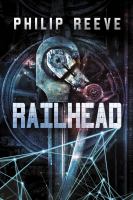
Railhead
Railhead, Philip
Reeve, 333 pages
Zen Starling is a petty thief, whose sister works overtime
at the factory and whose mother sits in paranoid delusions. He’s no one
important, spending his free time riding the K-Bahn, that quasi-mystical
railroad between planets. But when Nova, a mysterious android in a red jacket,
approaches him about stealing something from the Noon train, belonging to the
ruling family of the Network, Zen is plunged into a heist bigger than anything
he could have dreamed of, one that will shake the very foundations of the K-Bahn
and the Network.
Philip Reeve wrote one of my favorite YA series (the Mortal Engines quartet), and I’d thought I’d read everything of his. Somehow I missed
out on this gem. Zen is a very good protagonist, full of street smarts and with
a remarkably insightful mind. Nova could be a stock figure (the android who
wants to be human), but somehow she never comes off that way. The plot is full
of twists and turns, and though the climax isn’t quite satisfying, the rest of Railhead makes up for it. Reeve excels
at atmospheric descriptions, giving a feeling almost of magical realism to this
imaginative science fiction world. Railhead
is definitely worth a read.
Monday, April 2, 2018
Sound
Sound, Alexandra
Duncan, 489 pages
Miyole has finally achieved her dream of taking to the
stars, working as a research assistant on a deep space mission, and even if
things aren’t perfect, how can she complain? But when her ship intervenes in a
pirate attack on a rover ship, rescuing most of the beleaguered crew, her world
is thrown upside down. A rover girl, Cassia, convinces Miyole to help her on a
dangerous rescue mission. Will Miyole throw her lifelong dream away for this
girl she’s only just met? What dangers await them in the vast emptiness of
space?
This is a very good young adult
sci-fi book. Miyole is dealing with some repressed trauma, which informs many
of her major decisions. She felt real and complicated, although some of the
supporting characters, Cassia in particular, were less fleshed out. That being
said, Miyole is a solid enough protagonist that the book doesn’t suffer for it.
This is the companion novel to Salvage,
which I have not read, but I heard they could stand independently, and I never
felt I was missing out on some crucial piece of information.
Friday, March 30, 2018
Princeless: Raven, the Pirate Princess vol I
Princeless: Raven, thePirate Princess vol I, Jeremy Whitley, 96 pages
This is a spinoff series from Princeless, in which Raven (the Pirate Princess) embarks upon a
quest to revenge herself against her father and brothers for locking her in a
tower and stealing her throne. But first, she needs a crew!
I liked this book quite a bit. Her crew is diverse and
dynamic, with their own personalities and motives for joining. The art is good,
though at first I found the coloring style a bit flat (I quickly got used to it
and stopped feeling that way). I’m always nervous with these serially-published
graphic novels that the art style will change suddenly, so I hope the next
volume has the same artists.
Wednesday, March 28, 2018
Delilah Dirk and the Turkish Lieutenant
Delilah Dirk and theTurkish Lieutenant, Tony Cliff, 167 pages
All Selim wants is peace and quiet and a good cup of tea
(make that a great cup of tea). But
when Delilah Dirk, a swashbuckling, outrageous, exuberant
adventurer-slash-thief-slash-do-gooder, escapes from prison after he questioned
her, he is a suspected accomplice and the two must flee together. Delilah Dirk
takes him on a rip-roaring, rambunctious trip around the land (on her
scientifically unfeasible winged sailboat), and he finds himself becoming more
and more enamored of the life of a wandering adventurer.
This is a great graphic novel. Delilah Dirk and Selim make
up a classic comedy duo, full of banter, and the faces they pull at each other
are truly spectacular. Cliff’s art is stunning – the action scenes are dynamic
and visually interesting, and the panels often open up into gorgeous tableaus.
But more important than the swashbuckling action and the beautiful art is Selim’s
character development over the course of the book, and the trust and friendship
that grows between him and Dirk.
The Hate U Give
The Hate U Give,
Angie Thomas, 444 pages
Sixteen-year-old Starr
Carter moves between two worlds: the poor neighborhood where she lives and the
fancy suburban prep school she attends. The uneasy balance between these worlds
is shattered when Starr witnesses the fatal shooting of her childhood best
friend Khalil at the hands of a police officer. Khalil was unarmed.
Soon afterward, his
death is a national headline. Some are calling him a thug, maybe even a drug
dealer and a gangbanger. Protesters are taking to the streets in Khalil's name.
Some cops and the local drug lord try to intimidate Starr and her family. What
everyone wants to know is: what really went down that night? And the only
person alive who can answer that is Starr.
But what Starr
does--or does not--say could upend her community. It could also endanger her
life.
Oof. This was a hard read – I spent a lot of the book on the
edge of an anxiety attack. But it’s a critically important book, and stunningly
written. Thomas puts the reader squarely into the head of a teenager and a
community devastated by police brutality and racism. The Hate U Give grapples with all sorts of deep, complicated social
issues with honesty, care, and grace, and Starr is a wonderful heroine, full of
life and rich with emotion. The Hate U Give
is written with detail that makes her, her family, and her neighborhood feel
heartbreakingly real. It is a must-read. Content warnings for the obvious. If
you’re prone to anxiety or might have a strong emotional reaction to the
subject matter I would recommend reading this in small doses.
The Tiger's Watch
The Tiger’s Watch,
Julia Ember, 180 pages
Tashi, though meek and mild-mannered, is bonded with a rare
golden tiger – odd, since animals usually choose Inhabitors who match their personalities.
However, with the Myeiki army invading, having a tiger could come in handy.
Tashi and their friend (and longtime crush) flee to a hidden monastery and
shelter there, but a battalion of the Myeiki army is close behind, led by the
brutal, yet conflicted (and staggeringly handsome) Captain Xian. Tashi must go
against their nature to spy on Xian and learn why he’s really at the monastery,
while fighting their growing attraction for him.
Honestly, I’m not sure how I felt about this book. I thought
Tashi was a very compelling main character, even when making bad decisions, and
the nonbinary representation was very good. But the love triangle was
unnecessary at best and disturbing at worst – Xian is objectively horrible, and
his internal conflicts don’t redeem him (the best that can be said is that he’s
not as awful as he could be). Also, The
Tiger’s Watch is very short, and the worldbuilding and plot feel rushed as
a result. I can’t justifiably call it badly writing – Ember’s writing style
comes off smooth and polished in the small scale – but overall it feels like it
needs more development and expansion.
Tuesday, March 27, 2018
The Black Tides of Heaven
The Black Tides ofHeaven, JY Yang, 237 pages
Twin siblings Mokoya and Akeha, children of the Protector,
have grown up away from her tyrannical influence, in the Grand Monastery.
Mokoya has developed the ability to prophecy the future, and Akeha has always
blended into the background, keeping an eye on everything and everyone. But as
they grow, they grow apart, and the Rebellion against their mother’s rule grows
as well. Is Mokoya merely a pawn under the Protector’s influence? Should Akeha
join the Rebellion, or will that put the two twins in opposition?
I feel like this novella suffered from the same affliction
as Everfair, trying to span too great
a length of time with too low a page count. Thankfully, it’s less glaring in
this book, being shorter and only have two major characters. I thought the
worldbuilding was good, especially the magic system and how it complemented
technological advances – it reminded me of The
Legend of Korra in a way. As much as I love traditional swords-and-sorcery
fantasy, it’s nice to mix it up with some actual technological development (isn’t
it incredible how weaponry hasn’t changed in well over six thousand years in The Lord of the Rings). Generally I
liked The Black Tides of Heaven, I
just found it slightly unsatisfying.
An Accident of Stars
An Accident of Stars,
Foz Meadows, 496 pages
Sixteen-year-old Saffron is just a normal high school
student, dealing with creepy boys and an uncaring faculty. But when she
accidentally follows middle-aged Gwen through a rip in the world behind her
school, she stumbles into a strange, overwhelming new world, and is immediately
thrust into the middle of a civil war. As a new worldwalker, Saffron must deal
with the pain of leaving her family and everything she knew behind, as well as
the unexpected, awful trauma dealt by Gwen’s opponent.
It’s hard for me to get more into the plot, because there’s
a lot going on – lots of POV characters, lots of backstory and history, a rich
and only-lightly-explored magic system. The civil war plot is, by any stretch
of the means, Gwen’s story, not Saffron’s. Her error put a tyrant on the
throne, and she must bring him down. But Saffron as our protagonist and
audience surrogate allows us to enter the action in media res, learning what is important as it comes up and never
being given too much information at one time.
I feel like this is an unsatisfactory review, but again,
there’s so much in this book that I don’t know what to focus on. Regardless, I really enjoyed it – I thought the
worldbuilding was complex and fascinating, the plot was engrossing, and above
all, Meadows’s handling of the immense stress and trauma placed upon the
characters (and Saffron in particular) was masterful and above all kind. There are some lovely, gentle
sentiments expressed in elegant, simple language, and I appreciate the care
that went into it. I would definitely recommend this book.
Three Sides of a Heart
Three Sides of a Heart,
Natalie C. Parker, 448 pages
This is a collection of short stories, all having to do with
love triangles of various kinds – taken very loosely, which is a fun twist.
Many of the stories are queer, some are abstract, and some are fairly
run-of-the-mill. Most of them I enjoyed, although there was one in particular I
found completely confusing – it shifted POV-character constantly and presented
the same three characters in different settings, with little indication of a
shift. Maybe I would’ve enjoyed it more upon a second, more careful read, but
by the time I finished that story I was so relieved to be done with it I didn’t
think of going back.
This is a pretty good collection. The diverse and many-faceted
interpretations of what exactly a love triangle could be bring unexpected
pleasure to the read, and if one particular story doesn’t catch your interest,
they’re all pretty short and the next one might.
Wednesday, March 14, 2018
Everfair
It is the late 1800s. The American Civil War is over, but
racial injustice still runs rampant, and King Leopold is blazing a swath of
destruction through the Congo. African-American missionaries combine forces
with the Fabian Society, made up of utopians and socialists from Great Britain,
to set up a refuge for escapees from the Congo, as well as people of African
descent from all over the globe. Using steampunk technology and spiritual
guidance, they struggle to hold their own against the depredations of Belgian
mercenaries and build Everfair, a land where all can live in harmony.
I picked up this book hoping for a decolonialist narrative
with an emphasis on environmental harmony (for, of course, much of the history
of colonization in Africa is about stripping the land of its natural
resources). This expectation was certainly influenced by the recent film Black Panther. Unfortunately, that is
not really what I got. Most of the founders of Everfair are white, only one POV
character is native African, and the new colonists are nearly as bad as the old
ones – it’s seen as a big step forward when they invent the internal combustion
engine. Additionally, Shawl opts to tell a twenty-five-year history of the
country, concentrating neither on a character-driven story nor a plot-driven
one, but on an overly broad picture communicated in too-short vignettes,
reminiscent of the worst aspects of J.R.R. Tolkien’s The Silmarillion. I honestly think I would’ve liked Everfair much more if it had been a
ten-book series, where each book could really do these characters justice. As
it is, the pacing feels simultaneously rushed and drawn out.
Tuesday, February 6, 2018
The Long Way to a Small, Angry Planet
The Long Way to a Small, Angry Planet, Becky Chambers, 443 pages
Rosemary has begun a new job as a clerk aboard the long-haul
tunneling ship the Wayfarer, under Captain
Ashby Santoso. As the ship makes a year-long voyage to the planet Hedra Ka to
open up a new wormhole connecting the aforementioned small, angry planet to the
rest of the Galactic Commons, Rosemary and her new crew bond through assorted
adventures and misadventures.
This book is everything one could want out of a science
fiction novel. Strongly grounded in rich, varied, internally consistent
worldbuilding (that never wastes too much time focusing on specifics of how
exactly an interplanar bore, an artigrav field, or algae-based spaceship fuel
operates), The Long Way to a Small, Angry
Planet treats this drawn-out voyage not as a thrilling adventure full of swashbuckling
action (in fact, Ashby and Rosemary, like almost all humans, are committed
pacifists, which nearly ends poorly when they are boarded by space pirates),
but a measured, thoughtful, kind reflection on what it means to be a family. The
two mech-techs, Kizzy and Jenks, and their relationship with the ship’s AI,
Lovey; the pilot Sissix and her natural
Aandrisk need to express affection; even the algaeist Corbin and his distaste
for the camaraderie the rest of the crew share: every member of the ensemble
cast of this novel grows and learns and has their own character arc. Just like The Best of All Possible Worlds, each
chapter is a semi-independent episode in the life of the crew of the Wayfarer, but Chambers absolutely nails
the pacing. The Long Way to a Small,
Angry Planet never feels rushed or choppy, but builds slowly and steadily
to a deeply satisfying conclusion.
Friday, February 2, 2018
The Jumbies
The Jumbies,
Tracey Baptiste, 234 pages
Corinne La Mer grows oranges by the house where she lives with
her father on the edge of the forest, and in the forest dwell the nightmarish
jumbies, if they’re even real, of course. But after she chases an agouti into the woods one day and is
followed by a mysterious figure with glowing yellow eyes, things start to
change. A beautiful woman nobody has seen before shows up at the market to deal
with the witch, and when Corinne returns home, this woman, Severine, is making
dinner for her father. Could Severine be a jumbie? What secrets might she know
about Corinne’s mother? Corinne and her friends must save her father and the
village before Severine’s plans come to fruition.
I wanted so much to like this book – I love the idea of
bringing non-European fairytales and folklore to a wider audience (Baptiste is
from Trinidad and very loosely based the book on the fairytale “The Magic
Orange Tree”). However, the plot felt disjointed and rushed. There wasn’t
enough build to the climax, and the relationships between the characters felt
forced and ungrounded. It’s likely that this wouldn’t overly bother a younger
reader, and since The Jumbies is
aimed at a middle-grade audience, I understand why Baptiste left things fairly
simple. I still found myself wishing for a richer story and a deeper-developed
friendship between Corinne and the neighboring children. (For instance, how did
Corinne grow up on this small island and manage not to befriend or at least know
of Dru, the child of one of her neighbors? Or indeed have any friends or know anyone else at all?) I think The Jumbies is a wonderful concept,
but unfortunately not very well executed.
Thursday, February 1, 2018
The Best of All Possible Worlds
The Best of All Possible Worlds, Karen Lord, 307 pages
The planet of Sadira has been destroyed. Only a tiny
percentage of the psychically gifted Sadiri survive, and of those, the
overwhelming majority are men. Culturally and genetically adrift, the refugees
come to Cygnus Beta, a melting pot of cultures, where Terran anthropologist
Grace Delarua and Sadiri ambassador Dllenahkh cooperate to help the Sadiri reestablish
their cultural traditions – or make themselves a new place in the universe.
This is a lovely, touching novel about cultural
assimilation, the need for enduring traditions in a strange new world, and the
desire to belong, as well as a slow-paced and tender romance. However, there
are some confusing aspects to the worldbuilding (it wasn’t made clear until
near the end of the book if the Sadiri were just humans who lived on a
different planet or an alien race, and the technological level of Cygnus Beta
seems inconsistent from region to region, though I suppose one could say the
same about Earth), and the pacing feels more like a serially published set of
vignettes than one cohesive narrative (though part of that is I am sure due to
my preconceptions of what a science fiction plot should feel like – this
excellent review describes the book as having a semi-paratactic structure,
similarly to many television shows). Also, the point of view was almost always
first-person, from Delarua’s viewpoint, but occasionally switched to
third-person from Dllenahkh’s viewpoint, which was a bit jarring. Parts of Delarua’s
narration also stuck out on occasion – she makes an awful lot of references to
20th century movies considering she lives in the far distant future
on another planet.
Despite this, I found the story compelling, and never lost interest
in the disconnected scenes. In fact, I found myself wishing that each chapter
had been longer, that the book had dwelled more on the small moments when
Delarua and Dllenahkh’s lives intersected with strangers, and that the author
had more consistently fleshed out their characters. I think one more solid round
of editing and rewriting would have made The
Best of All Possible Worlds truly remarkable, instead of merely very good.
Wednesday, January 17, 2018
A Meeting at Corvallis: Emberverse Book III
A Meeting at Corvallis, S.M. Stirling, 497 pages, audiobook length 23:07:05
On March 17, 1998, at 6:15 EST, all advanced technology in the world stopped working – nuclear power, gunpowder, electricity, internal combustion engines, steam engines, all mysteriously dead, causing mass chaos and death from starvation and disease. In Dies the Fire, the first book in the Emberverse series, the Pacific Northwest began to reform into several new nations – the Bearkillers, led by the Bearlord Mike Havel, the Clan Mackenzie, led by the Witch Queen Juniper Mackenzie, and the Portland Protective Association, led by the tyrannical Lord Protector Norman Arminger. Ten years later, things have stabilized – the cannibal Eaters have mostly been wiped out, and there are no more mass dyings, but the nations are at each other’s throats. Arminger threatens the uneasy peace, and only the capture of his daughter has kept him at bay – but for how long?
Stirling’s exploration of how ordinary people react to extraordinary times is both charming and chilling in turn – the Clan Mackenzie, for example, is a neopagan utopia, where the folk live in harmony with the land and each other, whereas the Protectorate is a feudal dictatorship characterized by mistreatment and exploitation of the serfs who farm the lands. It’s difficult to tell if Stirling sees feudalism as inevitable and advantageous or merely a simple way of decentralizing government in an era without high-speed travel or communication, and in the long run the series probably suffers for this confusion – there is a strong running theme of the importance of a powerful leader to the development and improvement of a society. The books make an effort at diversity (one major and several supporting characters are gay, and there are a couple people of color, as well as a good number of powerful women), and as such probably deserves the tag of "diverse reads", but they aren’t always written with the care and tact one would hope for, something that unfortunately gets much worse as the series progresses onwards from this point.
It’s difficult to know whether to recommend this book. The concept of ancient technologies re-engineered with modern sensibilities is certainly fascinating, especially to this blogger – Arminger especially is often hampered by his devotion to purely historical methods, ignoring advances in engineering and social structuring even when they would benefit him, and the Bearkillers blend old and new with startling effect – but the frequent graphic violence (and in Dies the Fire, sexual violence) and mishandling of diversity issues certainly bear considering before starting this series.
On March 17, 1998, at 6:15 EST, all advanced technology in the world stopped working – nuclear power, gunpowder, electricity, internal combustion engines, steam engines, all mysteriously dead, causing mass chaos and death from starvation and disease. In Dies the Fire, the first book in the Emberverse series, the Pacific Northwest began to reform into several new nations – the Bearkillers, led by the Bearlord Mike Havel, the Clan Mackenzie, led by the Witch Queen Juniper Mackenzie, and the Portland Protective Association, led by the tyrannical Lord Protector Norman Arminger. Ten years later, things have stabilized – the cannibal Eaters have mostly been wiped out, and there are no more mass dyings, but the nations are at each other’s throats. Arminger threatens the uneasy peace, and only the capture of his daughter has kept him at bay – but for how long?
Stirling’s exploration of how ordinary people react to extraordinary times is both charming and chilling in turn – the Clan Mackenzie, for example, is a neopagan utopia, where the folk live in harmony with the land and each other, whereas the Protectorate is a feudal dictatorship characterized by mistreatment and exploitation of the serfs who farm the lands. It’s difficult to tell if Stirling sees feudalism as inevitable and advantageous or merely a simple way of decentralizing government in an era without high-speed travel or communication, and in the long run the series probably suffers for this confusion – there is a strong running theme of the importance of a powerful leader to the development and improvement of a society. The books make an effort at diversity (one major and several supporting characters are gay, and there are a couple people of color, as well as a good number of powerful women), and as such probably deserves the tag of "diverse reads", but they aren’t always written with the care and tact one would hope for, something that unfortunately gets much worse as the series progresses onwards from this point.
It’s difficult to know whether to recommend this book. The concept of ancient technologies re-engineered with modern sensibilities is certainly fascinating, especially to this blogger – Arminger especially is often hampered by his devotion to purely historical methods, ignoring advances in engineering and social structuring even when they would benefit him, and the Bearkillers blend old and new with startling effect – but the frequent graphic violence (and in Dies the Fire, sexual violence) and mishandling of diversity issues certainly bear considering before starting this series.
Friday, January 12, 2018
Swordspoint
Swordspoint, Ellen Kushner, 329 pages
In Swordspoint, Ellen Kushner introduces the district of Riverside, in the city that is so ubiquitously known that it is only ever called “the city”. Here, the seedy underbelly operates by its own rules and code of conduct, and Richard St Viers, the greatest swordsman in the city, lives with the scholar Alec – when St Viers is not out killing men for hire or Alec is not gambling their money away. Meanwhile, on the Hill, the Duchess Tremontaine, the young heir Michael Godwin, Lord Horn, and the Dragon Chancellor all spin plots of their own – and who better to serve as a cog than the most talented duelist the city has ever produced?
Swordspoint conjures a neatly constructed, starkly gritty cityscape, and an intricate plot to match it. Readers who love the political machinations of George R.R. Martin’s A Game of Thrones will enjoy unraveling the webs of conspiracy. Keeping the action constrained to the city allows Kushner to layer details upon details, resulting in a rich tapestry of setting that beautifully informs and shapes the plot. Readers who enjoyed Swordspoint will be excited to hear that Kushner, along with new authors, has returned to Riverside in a selection of serial stories known as Tremontaine.
In Swordspoint, Ellen Kushner introduces the district of Riverside, in the city that is so ubiquitously known that it is only ever called “the city”. Here, the seedy underbelly operates by its own rules and code of conduct, and Richard St Viers, the greatest swordsman in the city, lives with the scholar Alec – when St Viers is not out killing men for hire or Alec is not gambling their money away. Meanwhile, on the Hill, the Duchess Tremontaine, the young heir Michael Godwin, Lord Horn, and the Dragon Chancellor all spin plots of their own – and who better to serve as a cog than the most talented duelist the city has ever produced?
Swordspoint conjures a neatly constructed, starkly gritty cityscape, and an intricate plot to match it. Readers who love the political machinations of George R.R. Martin’s A Game of Thrones will enjoy unraveling the webs of conspiracy. Keeping the action constrained to the city allows Kushner to layer details upon details, resulting in a rich tapestry of setting that beautifully informs and shapes the plot. Readers who enjoyed Swordspoint will be excited to hear that Kushner, along with new authors, has returned to Riverside in a selection of serial stories known as Tremontaine.
Wednesday, January 10, 2018
The Water Castle
The Water Castle, Megan Frazer Blakemore, 344 pages
After his father’s awful stroke, Ephraim Appledore-Smith and his family have moved to their old family home in Crystal Springs, Maine, where a hundred years ago the Appledores bottled water believed to have healing properties. Mallory, a new classmate of his, is struggling to cope with her parents’ separation and has found refuge in science and skepticism of her mother’s mystical tales of the Fountain of Youth. Will, another classmate, befriends the two of them, to his father’s dismay – there are generations of bad blood between their families. As Ephraim becomes obsessed with finding the Fountain of Youth and using it to heal his father, the three of them explore the dilapidated mansion, interspersed with flashbacks to Mallory’s ancestor Nora, who helped old Dr. Appledore with his scientific discoveries.
Blakemore skillfully negotiates middle-school fears of fitting in, and balances characters learning that their parents are right about some things with characters forging their own identity against their parents’ wishes – both important, and seemingly contradictory, lessons for teenagers to learn. Of course, there are also heavy topics such as a parent’s illness (Ephraim’s father is catatonic from his stroke, and the doctors aren’t sure if he’ll ever recover) or parents separating (Mallory’s mother has moved out), painted against a backdrop of school projects and science experiments. The flashbacks are a nice touch, taking place as Admiral Robert Peary’s expedition nears the North Pole, while Ephraim, Mallory, and Will learn about Arctic exploration in the present. Blakemore never holds the reader’s hand, and several plot threads are left deliberately not wrapped up (though not too difficult to solve for the attentive reader). Though Ephraim can be a frustrating protagonist at times, very cocky and self-centered at first, The Water Castle is an excellent book for science-, history-, or fantasy-loving middle-grade readers.
After his father’s awful stroke, Ephraim Appledore-Smith and his family have moved to their old family home in Crystal Springs, Maine, where a hundred years ago the Appledores bottled water believed to have healing properties. Mallory, a new classmate of his, is struggling to cope with her parents’ separation and has found refuge in science and skepticism of her mother’s mystical tales of the Fountain of Youth. Will, another classmate, befriends the two of them, to his father’s dismay – there are generations of bad blood between their families. As Ephraim becomes obsessed with finding the Fountain of Youth and using it to heal his father, the three of them explore the dilapidated mansion, interspersed with flashbacks to Mallory’s ancestor Nora, who helped old Dr. Appledore with his scientific discoveries.
Blakemore skillfully negotiates middle-school fears of fitting in, and balances characters learning that their parents are right about some things with characters forging their own identity against their parents’ wishes – both important, and seemingly contradictory, lessons for teenagers to learn. Of course, there are also heavy topics such as a parent’s illness (Ephraim’s father is catatonic from his stroke, and the doctors aren’t sure if he’ll ever recover) or parents separating (Mallory’s mother has moved out), painted against a backdrop of school projects and science experiments. The flashbacks are a nice touch, taking place as Admiral Robert Peary’s expedition nears the North Pole, while Ephraim, Mallory, and Will learn about Arctic exploration in the present. Blakemore never holds the reader’s hand, and several plot threads are left deliberately not wrapped up (though not too difficult to solve for the attentive reader). Though Ephraim can be a frustrating protagonist at times, very cocky and self-centered at first, The Water Castle is an excellent book for science-, history-, or fantasy-loving middle-grade readers.
Subscribe to:
Posts (Atom)