Showing posts with label Ronald Knox. Show all posts

Friday, July 13, 2018

Caliban in Grub Street

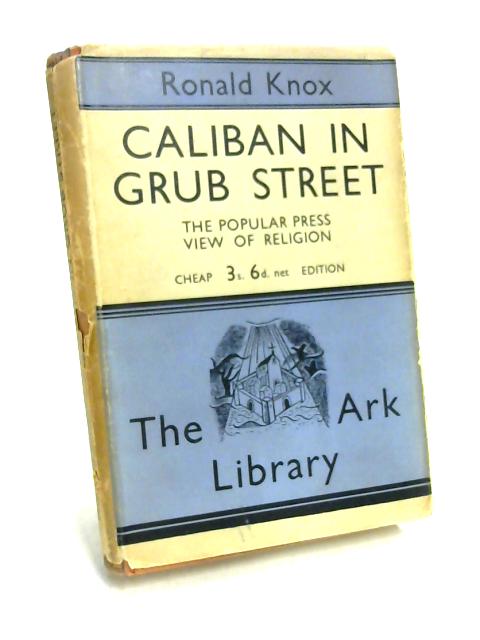
Image result for Caliban in Grub Street Knox RonaldCaliban in Grub Street by Ronald A Knox, 218 pages

In Caliban in Grub Street, the redoubtable Msgr Knox turns his attention to the religious opinions of the common Englishman of 1930, through a series of articles and essays published in the popular press, including works by such luminaries as Arthur Conan Doyle, Bertrand Russell, Hugh Walpole, and Rebecca West.  What he discovers is that most of them reject religion, but they do not do so because their reason demands it, but rather because they reject reason, or at least they deny that reason can be applied to matters of the spirit.  For Knox, this accounts for the modern preference for spiritualism over religion - spirituality being to religion what sentimentality is to emotion - and the fuzziness of thought found even among those who outwardly profess religion.  

Needless to say, Knox is emphatically not among those who reject either reason or religion, and it is a pleasure to follow him as he examines these journalistic efforts, uncovering their hidden inconsistencies, craven ambiguities, and patent nonsense.  For Knox's God is not only reasonable, but the source and ground of reason, and therefore also no lagniappe to a satisfying life, but the condition of all human fulfillment.

Friday, March 25, 2016

Life of Christ

The Life of Christ by Fulton Sheen, 658 pages

In The Life of Christ, Archbishop Sheen walks step by step through the Gospels, from the Annunciation to the Ascension.  The whole enterprise is rooted deeply in Scripture, with hardly a paragraph that does not include a corresponding passage from the Bible taken from Msgr Knox's beautiful translation.

Sheen's retelling focuses on the unity of the Gospel story, emphasizing the connections between the various events as the narrative moves forward.  In Sheen's reflections, the entire life of Christ - indeed, all of human history - is one long Way of the Cross, a continuous act of sacrifice, revelation, and redemption.  Behind the shadow of the Cross, however, the light of the Resurrection is always present.

Wednesday, December 23, 2015

Hidden Stream

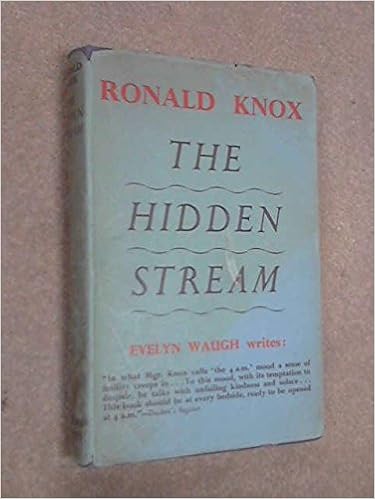
The Hidden Stream by Ronald Knox, 248 pages

There is a small watercourse at Oxford called the Trill Mill Stream which has been covered over for a few hundred yards, flowing largely unnoticed beneath the university.  TE Lawrence ("of Arabia") is among the undergraduates who defied the rules and navigated the underground portion of the stream in a canoe.  There is another "hidden stream" at Oxford, however, at least according to Knox - Catholicism.  The Trill Mill Stream once ran past the Franciscan and Dominican friaries, and although the Catholic past was covered over even more thoroughly than the Trill Mill Stream, it can still be found and navigated by the adventurous seeking an alternative to relativism and materialism.

The Hidden Stream is the written reproduction of a set of apologetical lectures delivered by Msgr Knox to Catholic undergraduates at Oxford, on subjects ranging from the nature of God and the inspiration of Scripture to the Church's teachings on marriage.  If some of the lectures, though enlivened by Knox's wit and style, repeat arguments that can be found in many other places, other passages contain startling insights, notably his lecture on divine mystery, where he explains mystery as not a theological evasion, but the familiar limits of our understanding.

Friday, April 24, 2015

Knox Brothers

Cover image for The Knox Brothers by Penelope Fitzgerald, 270 pages

The four sons of Edmund Arbuthnott Knox, Anglican Bishop of Manchester, and his first wife Ellen Penelope French, daughter of Thomas Valpy French, Anglican Bishop of Lahore, were all extraordinary.  Edmund, the eldest, was the editor of the celebrated humor magazine Punch for 17 years.  Dillwyn was a classicist who helped decrypt the Zimmermann telegram in World War I and break the Enigma code in World War II.  Wilfred became an Anglican priest of some distinction, theologically conservative but socially radical.  Ronald abandoned a promising career in the Church of England to become a Catholic, and became famous not only as a scholar, but also as a mystery writer and founding member of the Detection Club.

Fitzgerald, herself a successful novelist, has a unique insight into the lives of these men as the daughter of Edmund.  The rare combination of intimacy and literary talent would make this book a delightful read even if the subjects were not as interesting as they are, and if they had not had such interesting friends as John Maynard Keynes and Evelyn Waugh.  Fitzgerald captures perfectly what all the brothers, despite their profound differences, shared - a mutual love and respect, and an unwavering commitment to the truth.

Wednesday, March 11, 2015

St Paul's Gospel

St Paul's Gospel by Ronald Knox, 72 pages

This book compiles a series of Lenten lectures delivered by Msgr Knox in 1950.  His concern is the "Gospel according to St Paul", that is, the Christology of the Pauline epistles.  From the outset, he notes that St Paul does not spend much time dwelling on the words or miracles of Christ, but focuses on the mysteries of the Redemption and Incarnation, and their application in the life of the believer.  

Knox writes, as always, with insight and intelligence.  St Paul's Gospel is edifying reading during Lent, or at any time of year.  

Monday, February 2, 2015

Enthusiasm


The subject of this book, Msgr Knox's masterpiece, is the phenomenon of religious enthusiasm - characterized by emotional appeals, ecstatic states, millennialism, and, above all, a reliance on personal experience and inner conviction - as it has manifested in Christianity through the ages.  Although he begins with the Montanists and examines medieval and Reformation-era sects, his primary focus is on the Jansenists and Quietists among the Catholics, and the Quakers and Methodists among the Protestants.  

Knox's analysis is deep and insightful - for example, he recognizes that the radical Reformation played a far more important role than was generally believed at the time.  This is, however, an analysis, not a history, and the text can be difficult to follow without some knowledge of the history of the movements in question.  Likewise, this was written in an era when a basic knowledge of Latin and French were taken for granted, and while it is possible to understand the book without fluency in those languages, it is a frustrating experience.  Finally, this is a book about religion, not a religious book - a study, not an apologetic work - and although Knox was a firm believer in the importance of religious authority, he is not here attempting to engage in religious controversy.  Refreshingly, this frees him to treat his subjects with considerable sympathy as sincere, if misguided, believers.

A difficult but intellectually rewarding book.