Showing posts with label Russell Kirk. Show all posts

Saturday, July 6, 2019

Program for Conservatives

Image result for Program for Conservatives Kirk, RussellA Program for Conservatives by Russell Kirk, 312 pages

Had Russell Kirk's 1954 sequel to The Conservative Mind offered a political program in the narrow sense - a set of policy prescriptions and proposed legislation - it would doubtless be long obsolete.  Instead he addresses a perennial question: What is it that conservatives seek to conserve?  For Kirk, the answer lies in what Burke called "the unbought grace of life."  This is above markets and states, for it is for its sake that markets and states exist.  It can only truly exist within an ordered community of persons, and is threatened by both individualism and collectivism, the anarchy of robber barons and the tyranny of central planners.  The order true community demands is above all a moral order, perceptible to yet surpassing reason, beyond calculation and manipulation and the mere cleverness that too often substitutes for true wisdom.

Kirk maintains that although the capitalist and the socialist may exploit the seven deadly sins to gain money and power, what they cannot do is control them.  Thus, "conservatives" who focus on economy and utility rather than principles themselves forget that liberal democracy demands moral resources it is itself incapable of renewing, fostering a nation "very rich in goods" but "very poor in spirit."  Thus the first principle - the first virtue - is humility, beginning with the awareness that we have received more than we could hope to build ourselves.

Saturday, November 29, 2014

Enemies of the Permanent Things

 
In this work, Kirk argues that without a clear, agreed upon standard of morality, all morality, thus reduced to a matter of opinion, ultimately becomes the captive of ideology.  Ironically, the pursuit of radical individualism, where "every man alone thinks he hath got / To be a phoenix, and that then can be / None of that kind, of which he is, but he" produces hollow men who, lacking an anchor in a real interior life, are fully other-directed, blown about by the winds of fashion.
 
Unfortunately, merely agreeing on certain norms for pragmatic reasons will not suffice, since no such agreement can survive any but the most trivial disagreement.  Nor can consensus be achieved by unaided reason, which was the project of the Enlightenment.  Kirk locates the foundation of civilization in tradition, and the wellspring of tradition in the moral imagination, best represented in his own time by fabulists such as Tolkien, Lewis, and Bradbury.  The foes of the moral imagination are those ideologues who regard the wisdom of the past as an oppressive burden which must be overcome if some utopian future is to be realized, and those technocrats who regard humans as things to be measured, catalogued, and managed.  To the latter, Kirk objects that it is precisely in a time of greater social sophistication and complexity that knowledge of human things - humane learning - the humanities - is most needed in our leaders.  To the former, he survived to see its greatest earthly representative undone by such proponents of the moral imagination as Solzhenitsyn, Havel, and Wojtyla.  To those, more respectable if not numerous now than in his own time, who reject all forms of order and authority as inherently unjust, Kirk repeats that to believe that human life has value is to believe it has meaning, and to believe in meaning is to believe in order.
 
One might expect a book entitled Enemies of the Permanent Things to be primarily negative, but it is far more an effort at reclamation than a jeremiad.

Wednesday, October 29, 2014

Eliot and His Age

In 1953, cultural critic Russell Kirk (Redeeming the Time) informed his friend TS Eliot of his intention to write a book on "The Age of Eliot".  After eighteen years (and Eliot's death), that book appeared under the title Eliot and His Age.  Kirk traces Eliot's path from his birth in St Louis (2635 Locust St) to his burial in East Coker, but the bulk of the book is devoted to an analysis of Eliot's work, fitting for a man who believed that "there is, in all great poetry, something which must remain unaccountable however complete might be our knowledge of the poet." 

Kirk locates the heart of Eliot's work not in the ephemeral world of things that pass away, the world of "relevance" and fashion, of Lawrence's "chewers of newspapers", but in the "permanent things" that endure eternally.  In this reading, Eliot's life work, his poetry and drama but especially his criticism, aimed at the revitalization of history and tradition as the only way to bring water to the wasteland.  Change must surely come, but if it is not rooted in respect for the past and concern for the future, it will inevitably be sterile.  However, Eliot was more pessimistic than Dostoevsky, who famously wrote, "Beauty will save the world."  Literature, in the modern world, can only ever appeal to a minority.  Its purpose is not to overwhelm but to preserve.

A book by a master writing about a genius.  It does demand a certain knowledge of Eliot's creative work.

Monday, August 11, 2014

Redeeming the Time

Redeeming the Time by Russell Kirk, 321 pages
 
Cover image for Redeeming the time / Russell Kirk ; edited, with an introduction by Jeffrey O. Nelson.This is a collection of essays, adapted from a series of lectures delivered by Kirk at the Heritage Foundation between 1980 and 1994, covering topics ranging from education to the death penalty to The Life of Samuel Johnson to the differences between conservatives and libertarians.  Throughout, Kirk maintains the presence of three distinct "imaginations" - the moral, the idyllic, and the diabolic.  The first must be encouraged and the second opposed lest the third triumph.  The moral imagination, however, cannot be taught - it must be planted, nurtured, grown.  Virtue develops by admiration and imitation.  Kirk argues that virtue is worth preserving, because only virtue can connect us with what is real, lest the gods of the copybook headings with terror and slaughter return.
 
If some of the occasions for these essays are now lost in that remote age of twenty years ago, the concerns expressed are perpetually relevant.  If the world has moved on, he reminds us that what is lost can be found anew, by those who look past what is new.  Above all, this is Kirk's parting reminder to "say not the struggle naught availeth", that "it is not inevitable that we submit ourselves to a social life-in-death of boring uniformity and equality.  It is not inevitable that we indulge all our appetites to fatigued satiety.  It is not inevitable that we reduce our schooling to the lowest common denominator.  It is not inevitable that obsession with creature comforts should sweep away belief in a transcendent order.  It is not inevitable that the computer should supplant the poet."

Friday, August 1, 2014

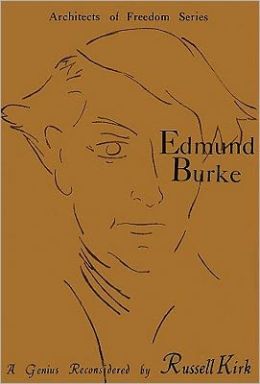
Edmund Burke

Edmund Burke: A Genius Reconsidered by Russell Kirk, 255 pages
 
http://img2.imagesbn.com/p/9780786104727_p0_v1_s260x420.JPGEdmund Burke was an eighteenth century Anglo-Irish statesman given to quixotic causes.  He tried to persuade Parliament to moderate its policies towards the American colonies.  He tried to persuade Parliament to allow religious freedom to the Irish.  He tried to prosecute the leading representative of the East India Company for corruption and abuses against the people of India.  He failed at all three, but in each case the consequences he warned against came to pass.  Due to his reputation as a champion of liberty, he was courted by Mirabeau and Paine, but he rejected the principles of the French Revolution, instead writing what author Kirk (author of Eliot and His Age and The Roots of American Order) calls "the greatest work of English political philosophy", Reflections on the French Revolution, and its sequel, Letter to a Noble Lord.
 
Kirk spends little time on Burke's private life, only making a few mentions of his perpetual financial woes and his frustrated hopes for a peerage.  Instead, the focus is on Burke's career, and Kirk makes an argument for the ideological consistency of that career - a quest to maintain the balance between freedom and order, to "conserve instead of covet", to reform rather than destroy.  Burke's role in the genesis of the modern political party is an extension, not a violation, of that consistency, following his maxim that the virtues of an organized minority are sometimes needed to check a vicious majority.  The book also argues for Burke's lasting impact, tracing his influence on the Romantic movement and twentieth century anti-totalitarianism.
 
A thorough introduction to the life and works of a seminal thinker.