
Emilie has been
homeschooled most of her life. Since she
was diagnosed with epilepsy, she has been afraid to be around people very much,
or to do anything that might trigger a seizure.
Since her father died of cancer, she has been even more reluctant to
interact with other people. Her mother
and therapist have agreed that she needs to go to be more involved so now she
is attending public high school. If she’s
being forced to try and be normal, she wants the chance to just be normal, so
she doesn’t want to tell anyone about her seizures. This becomes complicated as she starts to
make friends, and possibly even a boyfriend.
She knows she can’t keep the secret forever, but is afraid of telling
people the truth. This is a great
realistic story about growing up and navigating the emotional waters of high
school life.
Showing posts with label Teenagers. Show all posts
Showing posts with label Teenagers. Show all posts
Monday, December 31, 2018
Monday, September 26, 2016
The Most Dangerous Place on Earth

This story centers on a small, wealthy community in California, where new teacher Molly Nicoll has just joined the staff at the high school. Molly is intrigued by some of her students, and as she soon discovers, there is more to some of them than meets the eye.
The book is told through multiple viewpoints, so while you get Molly's view of things, you also see the viewpoints of several of the students. The book actually begins in middle school, where several students are involved in the bullying of a student which has tragic consequences. When Molly Nicoll meets these students, their relationships with each other have changed from middle school, although they have some connections. I found their stories compelling, even if I didn't necessarily like all of the characters. The author has an evocative writing style, so it was easy to imagine these teens, and what their lives were like. The author also does a great job of bringing their stories to life, and making it clear that for all of them, they live their lives in a balance between the real and the online world, where the smallest decisions can have large consequences.
I felt Calista was one of the most compelling characters. She is directly involved with the tragedy in middle school, and as a result of that event, changes drastically. She's introspective, which makes her perspectives in the story especially interesting. She's mature, and seems to observe many of her friends at a bit of a distance. Her viewpoint makes the story as a whole compelling, as she seems to take in a larger view of things than some of her classmates, who focus more on their immediate situations.
Monday, October 12, 2015
House of Evil
 House of Evil: The Indiana Torture Slaying by John Dean, 231 pages
In July of 1965, Gertrude Baniszewski, a 37 year old mother of seven living in Indianapolis, agreed to care for 16 year old Sylvia Likens and her 15 year old sister Jenny in exchange for 20 dollars a week. In October, police responding to an emergency call found Sylvia dead, emaciated, her body covered in bruises, burns, and open sores, the words "I'm a prostitute and proud of it!" carved into her stomach beneath a branded "3".
Horrific as it was, Sylvia's torture and death would blend into the background of child abuse if not for the identity of the perpetrators. As it came out, not only did Gertrude abuse the girl, her children were also encouraged to join in, and their friends participated, too. It became a neighborhood game to put out cigarettes on Sylvia's body or push her down the stairs. Her three oldest children were arrested along with six neighbors, Gertrude was ultimately convicted of first degree murder, her eldest daughter of second degree murder, and three boys of manslaughter.
This book tells the story poorly, although how much of this is due to a failure on Dean's part and how much the result of conflicting stories and foggy details is unclear. It seems as if, in a case with so many witnesses, a better account could have been constructed despite the obvious difficulties, but Dean seems to have relied almost exclusively on courtroom testimony - House of Evil was originally published soon after the trial and it is unclear how much it has been updated. The children are portrayed more like preteens than the teenagers they were. There is a natural reluctance to defame the victim, but Dean loses a great deal of credibility when he seemingly accepts the transparent lie that Sylvia found a set of gym clothes lying in the street - important because it ties in with claims by the tormentors that Sylvia had been caught stealing on other occasions. Worst of all, the chronology is vague and confused, making it extremely difficult to chart the escalation of abuse and the manner in which the abusers fed off each other, which is the key narrative. Instead, the story is a catalog of seemingly random horrible things that horrible people did to an almost entirely innocent girl.
Saturday, March 28, 2015
Divergent Series
Divergent, Insurgent, and Allegiant by Veronica Roth, 489, 525, and 526
 First off Yes I started reading these because of the movies, and even more so because they continued to make the series. In fact most of the young adult fiction I have read is because they made it into a movie. In fact you will see even more of it this month with my later review of City of Bone and City of Ashes.
The Divergent series is about a post apocalyptic city society that has divided itself into factions. But unlike the factions we see today the divisions are based on aptitude. Those that value knowledge go to Erudite, honesty to Candor, peace to Amity, selflessness to Abnegation and courage to Dauntless.
Each faction runs part of the city. Abnegation provides the member for the overseeing council and social work, Erudite provide researchers, teachers and scientist, Dauntless provide security, Candor provides lawyers and finally Amity grows all the food.
 People are divided up on their sixteenth year when they choose, by blood, which fraction they will join. Before the choosing they live with their parents fraction but are not members of that fraction. A change of fraction appears pretty rare and can result in that child immediately being disowned by their family. A saying used quite often is "Faction before Blood" meaning loyalty to the faction before your previous family.
 The series follows the life of Beatrice Prior as she chooses her new fraction and finds out that the fractions, and in fact the entire city is not what she has been taught. I could go into more detail but by now most everyone has seen the movie or read the book. If you are one of those few that have not done either, then I would suggest reading the book before watching the movie.
Overall this is a decently thought out and enjoyable young adult novel that I truly enjoyed. Being marketed for teens there are some questionable first romances and an ending of innocence but nothing too overdone that detracts from the story. I found that the series itself also goes though a growing up. Where the first book is about exploring who you are and accepting life, the second is certainly about how life is ever changing and at times, difficult. Finally the third book is more about accepting loss and continuing on through hardship. I would recommend this book to teens and up.
First off Yes I started reading these because of the movies, and even more so because they continued to make the series. In fact most of the young adult fiction I have read is because they made it into a movie. In fact you will see even more of it this month with my later review of City of Bone and City of Ashes. The Divergent series is about a post apocalyptic city society that has divided itself into factions. But unlike the factions we see today the divisions are based on aptitude. Those that value knowledge go to Erudite, honesty to Candor, peace to Amity, selflessness to Abnegation and courage to Dauntless.
Each faction runs part of the city. Abnegation provides the member for the overseeing council and social work, Erudite provide researchers, teachers and scientist, Dauntless provide security, Candor provides lawyers and finally Amity grows all the food.
People are divided up on their sixteenth year when they choose, by blood, which fraction they will join. Before the choosing they live with their parents fraction but are not members of that fraction. A change of fraction appears pretty rare and can result in that child immediately being disowned by their family. A saying used quite often is "Faction before Blood" meaning loyalty to the faction before your previous family. The series follows the life of Beatrice Prior as she chooses her new fraction and finds out that the fractions, and in fact the entire city is not what she has been taught. I could go into more detail but by now most everyone has seen the movie or read the book. If you are one of those few that have not done either, then I would suggest reading the book before watching the movie. Overall this is a decently thought out and enjoyable young adult novel that I truly enjoyed. Being marketed for teens there are some questionable first romances and an ending of innocence but nothing too overdone that detracts from the story. I found that the series itself also goes though a growing up. Where the first book is about exploring who you are and accepting life, the second is certainly about how life is ever changing and at times, difficult. Finally the third book is more about accepting loss and continuing on through hardship. I would recommend this book to teens and up.
Friday, March 6, 2015
I, Death
I, Death by Mark Leslie, 365 pages
 I,
Death, follows troubled teenager, Peter O’Mallick, who somehow has the ability to kill someone just by looking at them. Encouraged by his guidance counselor, Peter begins to blog about his
experiences in order to try to understand this power and himself. The
self-directed therapy helps, and strangers who follow his online story
virtually befriend him. Only
once Peter learns to control his gift he’s pulled into a scene
where his curse, might actually allow him to to do some good, except the intentions of his new found ‘family’ might not be what they seem.
I,
Death, follows troubled teenager, Peter O’Mallick, who somehow has the ability to kill someone just by looking at them. Encouraged by his guidance counselor, Peter begins to blog about his
experiences in order to try to understand this power and himself. The
self-directed therapy helps, and strangers who follow his online story
virtually befriend him. Only
once Peter learns to control his gift he’s pulled into a scene
where his curse, might actually allow him to to do some good, except the intentions of his new found ‘family’ might not be what they seem.
This was a fast paced read with thrills and a slightly comedic undertone at times. I enjoyed this book a lot, the format for most of it was set up like a blog which made it easy to get into and the twists kept me hooked wondering what was going to happen next. This is a good read for anyone who likes fast paced thrillers, or dark humor.
 I,
Death, follows troubled teenager, Peter O’Mallick, who somehow has the ability to kill someone just by looking at them. Encouraged by his guidance counselor, Peter begins to blog about his
experiences in order to try to understand this power and himself. The
self-directed therapy helps, and strangers who follow his online story
virtually befriend him. Only
once Peter learns to control his gift he’s pulled into a scene
where his curse, might actually allow him to to do some good, except the intentions of his new found ‘family’ might not be what they seem.
I,
Death, follows troubled teenager, Peter O’Mallick, who somehow has the ability to kill someone just by looking at them. Encouraged by his guidance counselor, Peter begins to blog about his
experiences in order to try to understand this power and himself. The
self-directed therapy helps, and strangers who follow his online story
virtually befriend him. Only
once Peter learns to control his gift he’s pulled into a scene
where his curse, might actually allow him to to do some good, except the intentions of his new found ‘family’ might not be what they seem. This was a fast paced read with thrills and a slightly comedic undertone at times. I enjoyed this book a lot, the format for most of it was set up like a blog which made it easy to get into and the twists kept me hooked wondering what was going to happen next. This is a good read for anyone who likes fast paced thrillers, or dark humor.
Sunday, February 22, 2015
Paper Towns
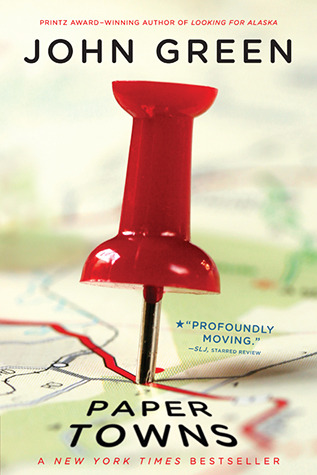 Paper Towns, by John Green, 305 pages
 Quentin has always had a crush on his neighbor, Margo- even though they drifted apart into different social circles in high school, the crush on the girl he knew as a child remained. Margo is a bit of a legend to everyone in school- a daring risk-taker who sneaks into theme parks and turns down famous bassists, and a popular girl with the looks and the cool friends. So when she shows up at Quentin's window one night to pull him into a night of mischief and adventure, he can't turn her down. And at the end of the night he feels like she just taught him how to live. So when Margo stays missing, Quentin is convinced that she has led him into a sort of scavenger hunt to find her. The rest of the book is Quentin reading Whitman's Leaves of Grass, realizing how good his friends are, and trying to live life like Margo taught him. Oh, and then realizing that he never really knew Margo, and we can never truly know another person. This was interesting, and contained quite a bit for discussion regarding YA literature, John Green, and identity.
Wednesday, July 16, 2014
Fangirl

I picked up Fangirl after reading Rowell's award-winning Eleanor and Park. E&P was a beautiful story that I really enjoyed, so naturally I wanted to see what else Rowell had to offer.
Fangirl is the story of a young woman's transition into college life, her strained relationship with her twin sister, and her first experience in a meaningful romantic relationship. Cath writes fan-fiction inspired by her favorite fantasy book series. She's a talented writer and has gained a strong following of readers -- the only problem is that the stories, characters, and settings she writes aren't her own creation. She can't seem to write her own original fiction, and only finds success building from and manipulating the existing book series. Cath is challenged by her creative writing professor to share her own story, but she can't seem to find a way to build worlds or characters that are as meaningful to her as those in her fan-fiction.

Wednesday, March 5, 2014
Ripper
 Ripper by Isabel Allende,
 478 Pages
If you read the description the book is about a group of teenagers, led by Amanda Martin trying to solve a spate of murders in the San Francisco area through an internet quorum or game know as Ripper. However it's not. The story is more about Amanda's mother Indiana and her clients and boyfriends and past and the murders are incidental to the story. But they are not. Because Indiana is targeted by the serial killer and only Amanda and her cohorts can solve the crime before she is killed.
Allende is a talented writer but her attempt at a mystery fails big time. There are too many characters and character building chapters for the book to be considered a mystery and the plot plods so slowly you'll find yourself wishing the serial killer would hurry and put everyone out of their misery.
Subscribe to:
Posts (Atom)