Showing posts with label sustainability. Show all posts

Tuesday, February 13, 2018

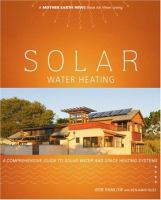
Solar Water Heating


Solar Water Heating, Bob Ramlow, 238 pages


Similarly to Radiant Floor Heating, this straddles the line between informational guide for interested homeowners and how-to handbook for contractors. However, Ramlow does a much better job explaining concepts with a minimum of technical jargon (though the end of the book does bog down a bit in the details). Just as it says on the cover, this book explains how to heat your domestic hot water or even your entire house with a solar collection system, including collector placement, system sizing, heat storage, and different collector types.

I enjoyed this book a lot – Ramlow writes clearly and concisely and includes very useful diagrams that walk a layperson through the intricacies of plumbing. There is some discussion given to pricing, though of course each system is different. Additionally, although Ramlow notes at the beginning there are only three kinds of collector types he recommends, the book covers other types (for reference when doing maintenance on existing systems) and does not note with sufficient clarity which types are not recommended. Generally though, this was a fascinating reference for an underutilized technology.

Monday, January 29, 2018

How to Solar Power Your Home

How to Solar PowerYour Home, Martha Maeda, 336 pages


This is a beginner’s guide to residential solar power. It explains each individual component of a photovoltaic system and how they all fit together, in a fairly simple, user-friendly way. However, even with my limited familiarity with electrical systems, I could tell there were several instances where Maeda contradicts herself or explains something flat-out incorrectly, typically where mathematical calculations of price or energy are involved. That made for a somewhat frustrating read – if those details are wrong, what other mistakes might have slipped past me?


That being said, this is a fairly accessible introduction to solar power. Maeda explains installation procedures and maintenance requirements, and breaks down the costs and benefits associated with photovoltaic systems. On occasion, the book bogs down in technical details perhaps better suited for an electrician’s guide, but on the other hand, it would be less useful without these details.

Thursday, January 25, 2018

Independence Days

Independence Days: A Guide to Sustainable Food Storage & Preservation, Sharon Astyk, 368 pages


A compelling guide to building a deep, robust pantry, for those who have their own garden and those who just want to spend less time or money at the grocery store. This is a beautifully written book; Astyk draws upon her own experiences and her Jewish faith to paint a picture of a society made independent from the grocery store (or at least less dependent on it) and more centered on community. Whether because of a desire for sustainability, a fear of disaster (most grocery stores have only three days’ worth of food on their shelves, leaving us only “nine meals from anarchy”), a moral opposition to the food industrial complex, or whatever motivation, Astyk believes it is a community duty to create a store of locally produced food and regularly use it and share it.

Independence Days explains how to dehydrate, can, ferment, and use a root cellar to extend the usefulness of a harvest, as well as how to procure and store a large supply of staples (unmilled wheat, corn, or whatnot), as well as a variety of recipes for incorporating these stored and preserved foods into a varied and healthy diet. More importantly, though, it is an argument for the importance of food security, thoughtfully and kindly written (Astyk repeatedly mentions that for many people even a small amount of food storage is financially or logistically impossible, an easily-omitted but much-appreciated aside). This book would be good for just about anyone to read.

Tuesday, January 16, 2018

The Human-Powered Home: Choosing Muscles Over Motors

The Human-Powered Home: Choosing Muscles Over Motors, Tamara Dean, 261 pages


An impressively detailed look at the possible applications of human power (the most renewable resource) in day-to-day life. While Pedal Power in Work, Leisure, and Transportation focused exclusively on pedal power (naturally), Dean expands her focus to other uses of muscle power where pedaling might be overkill, such as treadled sewing machines and hand-cranked grinding mills. Best of all, the book includes multiple step-by-step plans for constructing and adapting your own devices to human power.

The Human-Powered Home also spends a good deal of time discussing the realistic power output humans can produce, as well as comparing brands of ready-to-purchase tools and giving easy-to-digest tips and tricks for embarking on your own human-powered journey. This book is really the complete package, a must-read for anyone aiming for a more sustainable lifestyle.

Tuesday, January 9, 2018

Pedal Power in Work, Leisure, and Transportation

Pedal Power in Work, Leisure, and Transportation, ed. James C. McCullagh, 133 pages


Although it sounds very dry, Pedal Power is a fascinating insight into the past and future of human-powered technology. Published amid 1970s fears of peak oil & the corresponding energy crises, the book explores pedal powered solutions to problems more often solved with electrical or gas powered motors. Simply by harnessing the untapped power of the bicycle, many household tasks and tools can be powered by human effort. This is especially useful in low-income countries, where energy infrastructure is less robust and the bicycle already sees widespread use for transportation, but there are applications in higher-income countries as well, if one wants to achieve a more sustainable society. In fact, in the late 1800s and early 1900s, before the propagation of the inexpensive electric motor, a huge variety of pedal- and treadle-powered tools saw use even in the United States.

McCullagh and his collaborators (the book is a series of essays, technical drawings, and how-to guides) provide ideas for devices to wash clothes, cut wood, pump water, transport goods, plow fields, thresh grain, and more, as well as a complete construction guide to a pedal-powered primemover, a stationary-bicycle-like apparatus that can be hooked up to a variety of different tools in a home workshop. This is definitely a niche interest book; it won’t appeal to a reader who isn’t already intrigued by the possible applications of sustainable and efficient human power. However, to such a reader, especially one who is mechanically minded, Pedal Power in Work, Leisure, and Transportation is a treasure trove of ideas and schematics.