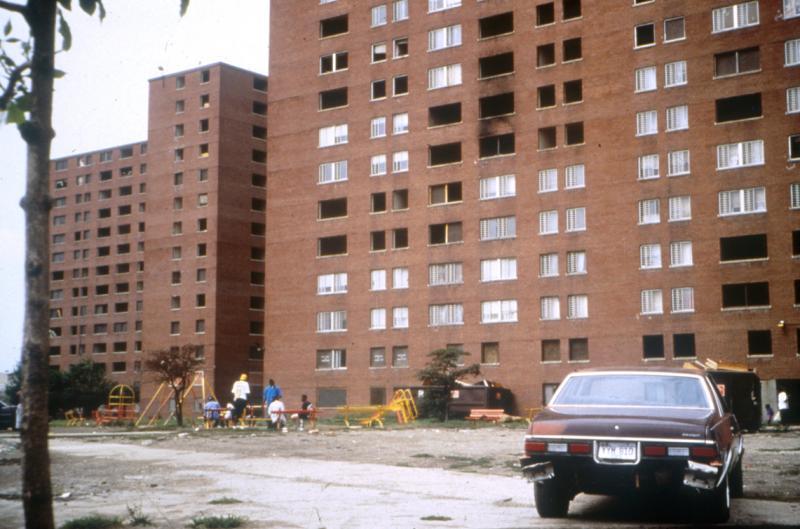
Alex Kotlowitz spent three years with Lafayette and Pharoah, and their family and friends, and wrote this book based on his numerous interviews, discussions and reflection. The boys lived with their family in the Henry Horner Homes public housing in Chicago, and this account shows how they struggled to survive in a dangerous and inhospitable environment.
Beyond the story of the two boys, this is an exploration into urban youth in society, where children as young as thirteen are engaged in violence, drug dealing and gangs. It's also a view into the horrible living conditions in the Henry Horner Homes, showing how the Chicago Housing Authority failed the families living there. The City officials were no better, corrupting the budget intended for the betterment of the building occupants. The police were also not always looking out for the welfare of building residents. All of the factors combined meant that these boys were growing up in an environment where they had almost no chance of successful futures. The near constant trauma means that children age quickly, becoming emotionally scarred and understanding that death is a near presence where they live.
However, Kotlowitz does find hope here, showing that if children are given a chance and support, that they can succeed. Pharoah in particular is an example of this, taking school seriously and studying hard.
The title of the book comes from a quote from Lafayette and Pharoah's mother, LaJoe, who said, "But you know, there are no children here. They've seen too much to be children."
I found this book to be a very moving read. As I have been reading more about the Chicago public housing projects, it has been particularly compelling to read people's accounts of their lives in these buildings. Reading this book, set over a period of time when I was in high school, made me extremely aware of just how different my life was from that of these two boys. Living in a suburb of Chicago, with parents who worked in the city, I was aware of the public housing projects. I remember reading about them in the newspaper, seeing reports of crimes, and driving past the buildings with my family on our way to somewhere in the city. However, until I started reading more recently about these buildings and about the history of public housing, I had no idea of the extent of how awful the living conditions and violence were. I appreciated that Kotlowitz gives an epilogue at the end of the book and also that he used money from the sales of this book to not only set up a trust fund for the two brothers and some of their friends, but he sent the two boys to private school.
If you'd like to know more about the Henry Horner Homes, I included a link above. There is also this sobering article from the New York Times, titled "What it's like to be in Hell." While the Henry Horner Homes were not the largest public housing project (an honor that goes to the Robert Taylor Homes, which stretched for 2 miles), it was one of the most troubled and violent projects.