Showing posts with label Gifford lectures. Show all posts

Monday, January 11, 2016

Face of God

Cover image for The Face of God by Roger Scruton, 178 pages

In his 2010 Gifford Lectures, Roger Scruton argues that the traditional rational proofs for the existence of God are fundamentally misguided.  Rather than objectify God, Scruton insists that He must be understood primarily as a person.  Just as the concept of human personhood remains mysterious, so too the nature of God.  Through an analysis of how human persons relate to one another, with a special focus on the face as the outward sign and symbol of personality, Scruton finds evidence for the divine in our relationships with ourselves, each other, and the world, most tellingly in the overlapping experiences of beauty and the sacred:  "What is revealed to me in the experience of beauty is a fundamental truth about being - the truth that being is a gift, and receiving it is a task."

Wednesday, October 21, 2015

Three Rival Versions of Moral Enquiry

Cover image for Three Rival Versions of Moral Enquiry: Encyclopaedia, Genealogy, Tradition by Alisdair MacIntyre, 236 pages

In the published edition of Alisdair MacIntyre's Gifford lectures of 1988, he identifies three primary schools of moral enquiry in the twentieth century.  The first is that which he identifies with Adam Gifford and his fellow toilers at the ninth edition of the Encyclopedia Britannica, representing a model based on that of the natural sciences, emphasizing method above all else, and proceeding out of the Enlightenment.  The second he associates with Nietzsche, particularly his On the Genealogy of Morals, and the postmodern view of morality as a mask for power and privilege.  Finally, he presents the third school, Thomism, especially as renewed after the promulgation of Leo XIII's encyclical Aeterni Patris.  This approach, more broadly representing the classical and medieval understanding of philosophical work, emphasizes that the development of virtue - particularly humility - in the philosopher is necessary for moral understanding.  The traditional mode of enquiry conceives of philosophy as a craft, pursued in and through a community.

MacIntyre attempts to demonstrate that, while the first two schools are each incapable of engaging with the other on the other's terms, it is the particular advantage of tradition that it is able to synthesize and assimilate rival philosophies, and to engage with the world in a meaningful way.  Because of this, the philosophy of the past is also the philosophy of the future.

Monday, September 21, 2015

Religion and the Rise of Western Culture

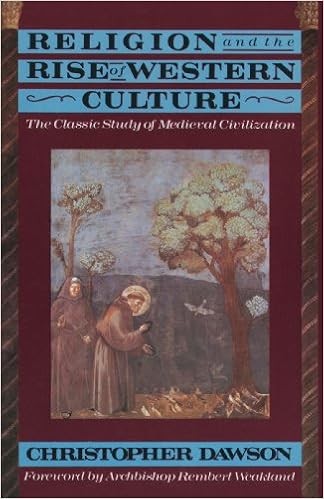
Religion and the Rise of Western Culture by Christopher Dawson, 274 pages

In the second half of his contribution to the Gifford lectures, Dawson applies the principles sketched in the first half (published separately as Religion and Culture) to Western Europe, unveiling the story of how the Church drew together disparate strands - the classical heritage of Greece and Rome, the religion of Jerusalem, the politics of the Germanic peoples - to weave the culture of Europe.  From the liturgy as the vital center of the development of Western art, to the influence of religion in the understanding of kingship, the development of the guild system, and the founding of the first universities, in clear, readable prose, Dawson illustrates the role of Christianity as the centripetal force holding together the West throughout the Middle Ages.  In the process, he reveals how the Middle Ages created the cultural capital that the West has been spending ever since.