Showing posts with label WW2. Show all posts

Thursday, October 31, 2019

The Tattooist of Auschwitz


The Tattooist of Auschwitz  by Heather Morris   288 pages

I have read many World War II-era novels, but never one set in a concentration camp with a love story at its center. And then to learn that author Morris spent years conducting interviews with the real-life Lale Sokolov added an extra layer of realism, yet the reality was overshadowed by the good side of human nature.

In April 1942, Lale Sokolov was rounded up and taken to a Auschwitz-Birkenau, a concentration camp deep inside Poland. Lale was willing to go in order to keep his family out of the Nazi-inflicted harm.

The details of Lale’s journey in a cattle car is horrendous. I can’t even imagine being crowded like that, with only the others around you holding you up.

Soon after his arrival, his captors learn that he can speak five languages, which can be helpful as more and more Jews are brought to this place. Lucky for him. He was made the camp’s tätowierer or the tattooist, the man who inked the number on the prisoners’ left arm. As the tattooist, Lale enjoyed privileges: better accomodations, better---and more---food, warmer clothing.

He soon learned that some of the other prisoners worked in a part of the camp that gathered the money and the gems they gathered from those killed in the crematormian. Lale used the money and gems to bribe guards and others so he could gathered crusts of bread to share among his fellow captives.

In July, Lale fell head over heels with Gita the moment he saw her and tattooed the number 34902. He knew that no matter what the cost, he would survive and marry this woman.

Author Morris takes readers on a journey that is both horrific and happy. I cheered when Lale was successful in helping his fellow inamtes. I cheered louder when Lale and Gita became a couple. I wept as Morris described how the Jews were forced to live, starving a but more day-by-day. Morris focused most of her energy on the love story without making the story seem like the nightmare that it was. That is why I give “The Tattooist of Auschwitz” 5 out of 5 stars in Julie’s world.


Thursday, August 1, 2019

The Spies of Shilling Lane


The Spies of Shilling Lane by Jennifer Ryan   368 pages
When I sat down to start this novel, I expected a fast-paced ride with menancing undertones. What I got instread was a rather comical cozy-mystery vibe. Not that that’s bad, it was out of left field for me.

Mrs. Braithwaite is having a rough year. Her husband has divorced her, creating quite the scandal. Couple that with her demotion as head of the local Women’s Volunteer Service in Ashcombe Village, England, well, she’s feeling kinda low and sorry for herself.

She doesn’t have a close relationship with her daughter, Betty, who left for London as soon as WWII broke out.  Although she has sent five letters, Mrs. B. has not received a single reply. So Mrs. B. decides to go visit.  During the Blitz.

When she finally arrives, Betty isn’t home and Mr. Norris, who owns the home where Betty rents a room, hasn’t seen her in quite a while. He has no idea when she could be coming back or even if she has survived the nightly Nazi air raids. Author Ryan does a great job in taking readers to the tunnels during the air raids and how Londoners coped. When Mrs. B. and Mr. N. spend one night in a church’s catacombs, it’s quite creepy

Eventually, Mrs. B., accompanied by Mr. Norris, locates Betty, tied to a chair in the basement of a garage. Then it becomes good-guys versus bad-guys. The story that follows is rather humorous, but stereotypical.  Like sluggin the bad-guys with her purse, taking turns with Betty getting captured by the bad-guys, and ultimately saving the day.

 The Spies of Shilling Lane” was okay, and that is why it receives 3 out of 5 stars in Julie’s world.

Friday, May 8, 2015

Echoes

Echoes by Danielle Steel    464 pages
From Publishers Weekly: “Europe in the throes of WWI and II serves as backdrop for this latest dose of melodrama from megabestseller Steel. Bookish, raven-haired beauty Beata Wittgenstein meets dashing French nobleman Antoine de Vallerand while on vacation in Switzerland and falls passionately in love. An affluent German Jew whose strict Orthodox parents forbid marriage outside the faith, Beata knows that a union with a Catholic from war-rival France is out of the question. But love trumps all, and shortly after returning to Germany, Beata defies her family, arranging to meet Antoine in Switzerland, where they marry. When WWI ends, the de Vallerands return to Germany and live happily with their young daughters, Amadea and Daphne. Antoine manages the stables at an old friend's castle, the perfect job for him, but just as all seems well, he's thrown from a headstrong horse. Meanwhile, Hitler's anti-Semitic sentiments spread across Europe, and Beata fears that even her half-Jewish daughters are no longer safe. Devout Catholic Amadea plans to become a Carmelite nun, but as the Third Reich's campaign of cruelty escalates, she finds a greater sense of purpose outside the convent walls. There's enough romance to keep readers going, but fans who prefer the glitz and glamour of Steel's contemporary settings may be nonplussed, and the abrupt disappearance of several major characters leaves giant holes in the narrative.”
 
Excellent read although has a few major holes.

Monday, February 16, 2015

All the LIght We Cannot See


All the Light We Cannot See by Anthony Doerr   531 pages

All the Light We Cannot See has been on the New York Times bestseller list for 37 week (as of this writing)   and was a 2014 National Book award finalist. The book jacket states it Doerr spent a decade writing this story. I can see why, it’s filled with historical details.
Marie-Laure has been blind since she was six years old.  Now fourteen, she and her father live in Paris on the eve of WWII.

Werner has a gift with radios. His “knack” leads the orphan boy to be admitted into a brutal branch Hitler’s Youth Army.
The story weaves back and forth between Marie-Laure and Werner, each chapter no more than two to three pages.

All the Light We Cannot See in not another WWII story. It’s not plot-driven, but character driven, except the small scenario of a stolen gem.
Marie-Laure and her father are forced to flee Paris as the Nazi’s march in. They escape to Saint-Malo to the home of her great-uncle and his eccentric housekeeper.

As Werner becomes a soldier and his expertise with radios and tracking signals becomes well-known, he isn’t sent to the front lines. He’s sent into France to help track the Resistance.
Eventually, and inevitably, Marie-Laure and Werner’s paths cross in Saint-Malo. The intertwined tales recreates in harrowing detail the deprivation for civilians in Nazi-occupied  France and the brutality of Hitler’s soldiers.

It almost seems that All the Light We Cannot See would be a hard book to read. However, given the magic of Doerr’s writing, it becomes a book of hope.

Tuesday, November 18, 2014

Iron Gray Sea


Iron Gray Sea by Taylor Anderson, 421 pages

 
This is the seventh book in Anderson's "Destoyermen" Series. This series takes place during World War 2 and involves ships that, by means of super typhoons, have been magically transported into a parallel earth where humans are not the dominant species. There seems to be two dominant non-human species that occur throughout the series. On is the Grik and the other are the Lemurians. The Grik are large reptilian like creatures that kind of look like bigger komodo dragons and walk on two legs. The Lemurians are more of a cross between lemurs and cats with some humanish features.

 The series itself focuses on the struggle that is going on between these two species and the influence that the transported people bring. Iron Gray Sea, like every book in the series is very engaging and presents a very likeable cast. It is very fast paced and plot focused. If you like military novels that have you hanging on every word and rushing to get the next novel then the “Destroyermen” series is for you!

Thursday, October 30, 2014

The Butterfly and the Violin


The Butterfly and the Violin by Kristy Cambron   330 pages

Present day Manhattan: Art dealer Sera James saw a beautiful painting as a young girl. She has made it her life’s work to find that painting, which has been missing for decades. The painting’s subject is that of a young female violinist with a shaved head and a number tattooed on her forearm. In my mind’s eye, I see a black-and-white painting with the girl’s eyes in color. Her assistant, Penny, gets a lead on the painting. It’s owned by a wealthy San Francisco family, and Sera rushes to try to obtain the painting. 

That’s one story in the complex novel.

1942-1945 Europe.  First in Vienna. Adele is Vienna’s Sweetheart. At sixteen, the young woman is a violin prodigy. She plays the most beautiful music Austrians have ever heard. It doesn’t hurt that Adele is also a beautiful young woman. Her father is a high-ranking Nazi, and Adele is often called upon to play for the upper echelons of the Third Reich. She has fallen in love with one of her colleagues, Vladimir Nicolai, and has embraced his mission to help a Jewish family flee the city. Once it’s know that she’s been involved with Nicolai, she is arrested at her family’s home and sent to Auschwitz. Second, Auschwitz. Adele struggles to survive the harsh realities of the concentration camp, but she is housed in a special musical group. 

That’s the other main story line.

The Butterfly and the Violin is one of those stories that weaves back and forth, which I like. The thing that struck me the most is how Adele was forced to play a violin, not only to stay alive, but as the concentration camp inmates were marched in and out of the camp, some to work, some to die.

The story lacked an overall tension, and wrapped up much too quickly. I give The Butterfly and the Violin 4 out of 5 stars

Saturday, October 25, 2014

Thief of Glory


Thief of Glory by Sigmund Brouwer  326 pages  (waiting on SLPL to get)
  
 
Prolific author Sigmun Brouwer sets this 2014 release in the Dutch East Indies (now Indonesia) during World War II.

Ten-year-old Jeremiah Prins live a luxurious life. His father is a school headmaster, his mother stays at home, and he has five siblings.  He spends his days in school and playing marbles. Jeremiah is an avid marble player and wins more often than not. He has two pouches of marbles that he carries with him at all times and that are tucked neatly below his belt and beneath his shorts.

Life is idyllic. Until the Japanese invasion of the Southeast Pacific in 1942. Jeremiah and his family are sent to an internment camp, where life is brutal. His father and two older step-brothers are sent to a work camp; while the rest of family stays together.

Houses in the camp are divided so that each family gets one room. There is no privacy. There are long, long lines for food and medicine. Brouwer’s descriptions of life in these camps seems much harsher than the accounts that I have read about the American internment camps of the same period. Jeremiah does his best to stand up to his new role in the family: protector and provider. His mother has a much weaker constitution than he imagined. Luckily for Jeremiah, he has his marbles and his friend Laura, with whom he is besotted as he takes on these new responsibilities.

At one particularly harrowing adventure, Jeremiah finds a way out of the cap. He is able to do into the nearby city and trade for the medicines and foods. On one such journey, Lara is ambushed by a python. I must admit, it gave me nightmares.

What is the most interesting of this book is style in which it’s written, and it’s also the most disconcerting. As a contemporary/historical novel, the book opens with Journal 35. That doesn’t give the reader many clues, until about halfway through the novel, the reader learns that the book is being narrated from a much later period. For me, that took some of the wind out of story. Memories are often clouded and exaggerated.  Toward the end of the novel, without notice, Brouwer shifts from a historical prospective to a contemporary one. The transition is confusing and awkward; it’s like I’m reading another story. I didn’t enjoy it as much as it the historical aspect of the story. Also, this book is labeled as Christian, but it did not feel like a Christian novel. 

I received this book for free from Blogging for Books for this review.

Sunday, October 12, 2014

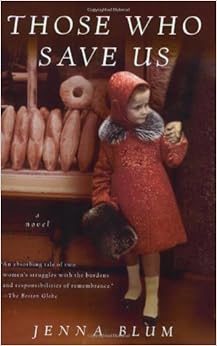
Those Who Save Us

Those Who Save Us by Jenna Blum, 482 pages

I have a fascination with anything pertaining to World War II and this was some of the best historical fiction about it I have read. Those Who Save Us tells the story of Trudy, a middle aged German history professor, herself born in Germany during the war, and her mother Anna, who has come to live with her after a fire destroys the farmhouse of Trudy's childhood, where Anna was still living. Trudy has always had a strained relationship with her mother and she has never been told the story of what led up to herself and her mother coming to live in America with an American soldier.
The book alternates between present day, which is the late 90s, and the late 30s early 40s, when Anna was around the age of 20, living in Nazi Germany.
Trudy embarks on a project for work in which she interviews Germans about their experiences during the war. Her goal in the project is to see if any Germans feel any remorse or responsibility for the tragedies of the Jews.
Trudy learns much in these interviews, including things about herself and eventually, the details from when she was young.

*One of the fun details of this story was that Anna worked in a bakery in Germany when she was young. Many delicious sounding German cakes and breads are mentioned, and the mouth waters just reading about them.

Thursday, July 3, 2014

Delicious!


Delicious! by Ruth Reichl   380 pages

Billie Breslin left her northern California home for New York to take a job at one of the most icon food magazines in the country, Delicious! She's barely settled into her position as assistant to the editor when the staff receives the startling news that the magazine is ceasing publication. 

Billie lucks out and gets to stay on, answering the phone and continuing the Delicious! Guarantee, where readers who have tried the recipes and didn’t like them can get their money back. But she isn't the only one left behind. Sammy, the travel writer, has been off on one of his jaunts and has not cleaned out his office. Upon his return, they explore the building, finding a kitchen full of rotting products and a library that has been opened in decades.

While exploring the library, Sammy stumbles upon a secret door that leads to a room full of files with a card catalog smack in the middle of the room. Upon examining the cards, Billie and Sammy discover a filing system that leads them to a series of letters written by a spunky twelve-year-old girl, Lulu Swan, to legendary chef James Beard during World War II. Together Sammy and Billie hunt go on a treasure hunt for the letters. The novel moves back and forth between Billie’s story and the letters.

Foodies rejoice!  If you love food, you’ll love learning the history of food. And, if you’ve come to love, like I have, Reichl memoirs, you’ll devour Delicious!. While set in contemporary New York, Reichl seamlessly returns readers to the war years of Lulu’s time. Reichl also gives readers a sense that they are walking the streets of contemporary New York  City.

Reichl's debut novel defies genre; it's part historical fiction, part contemporary fiction, part mystery, part romance, part World War II and all wonderful!  I simply LOVED Delicious!

Saturday, January 11, 2014

Prisoner B-3087


Prisoner B-3087 by Alan Grantz, 260 pages

Based on a true story by Ruth and Jack Gruener, the book follows young Yanek Gruener, a Jewish boy who is twelve years old when the Nazis invade Poland.  He struggles to survive while being tortured and starved through ten different concentration camps.  Although nearly all of his relatives and friends are killed during WWII, somehow Yanek manages to live.  This is an amazing story.