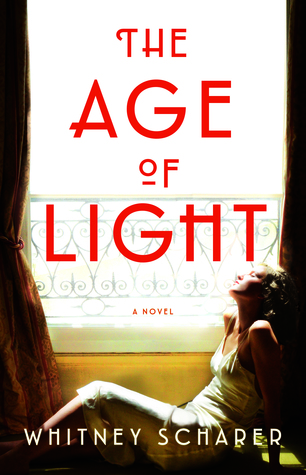
The Age of Light by Whitney Scharer 384 pages
This novel is based on the life of Lee Miller, a Vogue model turned renowned photographer and her quest to forge a new identity as an artist. Filled with accurate details about Miller's life, the author begins in the more present day and then takes the reader back to when Miller made the decision to go to Paris in 1925. Miller made a connected with the famous Surrealist artist Man Ray, who at first just wants to take her photos. However, she is determined that he teach her about photography and eventually he does. As they work together in the darkroom, their professional and personal lives become intertwined, changing the course of Lee's life forever.
The author takes us past Miller's relationship with Man Ray into her work in the battlefields of World War II Europe, and also delves into how Miller discovered new photography techniques and also how she documented the liberation of concentration camps as one of the first female war correspondents. Scharer doesn't shy away from gritty or unpleasant details, and I felt I really got a great feel for how Miller's life must have been. She's not always an easy person to understand or like, but the way she is depicted in this novel, she seems completely real. I had been familiar with Miller's work and some of her life story, so it was really interesting to read this novel. I felt the author did a great job of bringing this amazing woman's life into the spotlight (even if it wasn't always a beautiful or charmed life).
This blog is the home of the St. Louis Public Library team for the Missouri Book Challenge. The Missouri Book Challenge is a friendly competition between libraries around the state to see which library can read and blog about the most books each year. At the library level, the St. Louis Public Library book challenge blog is a monthly competition among SLPL staff members and branches. For the official Missouri Book Challenge description see: http://mobookchallenge.blogspot.com/p/about-challenge.h
Showing posts with label historical novel. Show all posts
Friday, March 22, 2019
Sunday, July 20, 2014
Belladonna
This is the sequel to Venom.
I unintentionally read the third book in this trilogy before I read this
one and I would definitely recommend reading these books in order. It took me much longer than it should have to
figure out what was happening in the third book than it would have if I had
read this one first. Cass is trying to
forget Falco, who she seems to have fallen in love with but is completely wrong
for her. They are from entirely different
upbringings and she is engaged to Luca anyway.
Unfortunately, Luca is in jail, accused of heresy and condemned to
die. Cass is determined to prove his
innocence by finding the Book Of The Eternal Rose, which may also help her take
down the Order Of The Eternal Rose, another of her goals. This involves traveling to Florence, where
the town is apparently besieged by vampires and Cass is forced to interact with
Falco once again. Surrounded by mystery
and intrigue, Cass is afraid that she will not find the book in time to save
Luca. A good sequel to the first book, I
would recommend the series to teen fans of historical mystery or drama type
books.
Monday, July 14, 2014
Forever Amber
I started reading this book to see why it was banned in New Zealand and Ireland, and was burned at ports and public libraries in England. The only reason I can see is that it was indecent for its time. While it might be true that it has, as one attorney general put it, "seventy references to sexual intercourse; thirty-nine illegitimate pregnancies; seven abortions; ten descriptions of women undressing, dressing or bathing in the presence of men; five references to incest; thirteen references ridiculing marriage; and forty-nine miscellaneous objectionable passages"(Banned Books, ALA) it certainly is no worse than stuff that is published now, like Game of Thrones.
I found Forever Amber to be a pretty typical romance novel with slight hints of political thriller. Basically Amber falls in love with Bruce and power and will do anything it takes to get both of the things she wants. I truly like how the novel ends and it may be one of the best endings I have ever read. Obviously the book is for mature audiences.
Monday, July 7, 2014
A Long, Long Way
A Long, Long Way by Sebastian Barry 304 pagesOne of the most powerful novels I have ever read about World War I is Erich Maria Remarque's classic novel, All Quiet on the Western Front. Now I can add Sebastian Barry's 2005 novel, A Long, Long Way to that very short list.
The Irish author and playwright sends barely eighteen-year-old Willie Dunne to Flanders in this harrowing account of divided loyalties and the realities of war. Willie's story begins with one of the most beautiful first lines I have ever read: He was born in the dying days. The first chapter follows a simple, short recap of Willie's young life and stops when he sees in love at first with the beautiful young Gretta Lawlor.
Next, it's 1914, and Willie finds himself on the front lines, a Dubliner fighting with the Allied forces against Germany on the Western Front. Readers experience the horrors of life in the trenches and the devastating affects of the gas attacks. Willie has never encountered such violence and such a tragic waste of life. Letters from home and his buddies help keep his spirits bolstered, but as friend after friend becomes a statistic in the wounded and dead toll, Willie struggles to understand the new world around him.
When he does get a leave and goes home, Dublin is much different than when he left. While his sisters are overjoyed he's home, his father is deeply disappointed in some of Willie's views, and his sweetheart, Gretta, has bad news for him. He rushes back to the front, more comfortable with the war and the havoc it wracks than he is at home.
While A Long, Long Way is not a page-turner, it is compulsive reading. It was short listed for the 2005 Man Booker Prize. Nobel Prize-winning author J. M. Coetzee sums up Barry's work best, A deeply moving story of courage and fidelity" that should be mandatory reading in high school.
Thursday, July 3, 2014
Delicious!
Delicious! by Ruth Reichl 380 pagesBillie Breslin left her northern California home for New York to take a job at one of the most icon food magazines in the country, Delicious! She's barely settled into her position as assistant to the editor when the staff receives the startling news that the magazine is ceasing publication.
Billie lucks out and gets to stay on, answering the phone and continuing the Delicious! Guarantee, where readers who have tried the recipes and didn’t like them can get their money back. But she isn't the only one left behind. Sammy, the travel writer, has been off on one of his jaunts and has not cleaned out his office. Upon his return, they explore the building, finding a kitchen full of rotting products and a library that has been opened in decades.
While exploring the library, Sammy stumbles upon a secret door that leads to a room full of files with a card catalog smack in the middle of the room. Upon examining the cards, Billie and Sammy discover a filing system that leads them to a series of letters written by a spunky twelve-year-old girl, Lulu Swan, to legendary chef James Beard during World War II. Together Sammy and Billie hunt go on a treasure hunt for the letters. The novel moves back and forth between Billie’s story and the letters.
Foodies rejoice! If you love food, you’ll love learning the history of food. And, if you’ve come to love, like I have, Reichl memoirs, you’ll devour Delicious!. While set in contemporary New York, Reichl seamlessly returns readers to the war years of Lulu’s time. Reichl also gives readers a sense that they are walking the streets of contemporary New York City.
Reichl's debut novel defies genre; it's part historical fiction, part contemporary fiction, part mystery, part romance, part World War II and all wonderful! I simply LOVED Delicious!
Monday, February 24, 2014
Gods' Man; Madman's Drum; Wild Pilgrimage
Gods' Man; Madman's Drum; Wild Pilgrimage by Lynd Ward, edited by Art Spiegelman, 833 pages
I hadn’t heard of Lynd Ward’s work before reading McCloud’s Understanding Comics last month. I took printmaking classes in college, had an art history prof who specialized in German Expressionism, and am a pretty avid reader of comics - perhaps I'm giving myself too much credit, but how in the world did I go so long without hearing Lynd Ward’s name?! Baffling. The two volume Library of America reprintings of Ward’s six woodcut novels are fairly recent (2010) and I suspect (?) it was difficult to locate copies of these works prior to the reprints. His children’s book illustrations (Johnny Tremain, The Biggest Bear, etc.) are easy to find, but I was totally unaware of his adult proto-graphic-novels. I hope these reprints mark a resurgence in Ward’s popularity and renown.
Art Spiegelman’s introduction is a wonderful addition to the works; he provides a context for Ward’s art in the history of literature, cinema, comics and visual art. Ward’s own essays at the end of the volume reflect the ethos of the era in which he worked. The paring of Spiegelman’s and Ward’s critical essays bookend the three wordless volumes nicely. In his intro, Spiegelman writes, “Wordless novels are filled with language, it just resides in the reader’s head rather than on the page.”
Gods’ Man was originally published the same week that the stock market crashed in 1929. Its plot follows a struggling artist and the consequences after he strikes a Faustian bargain with a mysterious hooded figure. Madman’s Drum follows the life of a slave trader’s son and the events that cause him to lose faith in every major cultural institution (including religion, love, family, law). Wild Pilgrimage depicts the outer and inner life of a man trapped in an industrial world and his attempts to return to nature. I found the storytelling in all three novels to be fairly heavy handed (in Gods’ Man the decadence of the roaring 20s is at one point depicted by a woman who is literally branded with a dollar sign), but the lack of subtlety did little to deter my enjoyment of Ward’s prints. I’m looking forward to reading Volume II, which contains Ward’s other three proto-graphic-novels.
I hadn’t heard of Lynd Ward’s work before reading McCloud’s Understanding Comics last month. I took printmaking classes in college, had an art history prof who specialized in German Expressionism, and am a pretty avid reader of comics - perhaps I'm giving myself too much credit, but how in the world did I go so long without hearing Lynd Ward’s name?! Baffling. The two volume Library of America reprintings of Ward’s six woodcut novels are fairly recent (2010) and I suspect (?) it was difficult to locate copies of these works prior to the reprints. His children’s book illustrations (Johnny Tremain, The Biggest Bear, etc.) are easy to find, but I was totally unaware of his adult proto-graphic-novels. I hope these reprints mark a resurgence in Ward’s popularity and renown.
Art Spiegelman’s introduction is a wonderful addition to the works; he provides a context for Ward’s art in the history of literature, cinema, comics and visual art. Ward’s own essays at the end of the volume reflect the ethos of the era in which he worked. The paring of Spiegelman’s and Ward’s critical essays bookend the three wordless volumes nicely. In his intro, Spiegelman writes, “Wordless novels are filled with language, it just resides in the reader’s head rather than on the page.”
Gods’ Man was originally published the same week that the stock market crashed in 1929. Its plot follows a struggling artist and the consequences after he strikes a Faustian bargain with a mysterious hooded figure. Madman’s Drum follows the life of a slave trader’s son and the events that cause him to lose faith in every major cultural institution (including religion, love, family, law). Wild Pilgrimage depicts the outer and inner life of a man trapped in an industrial world and his attempts to return to nature. I found the storytelling in all three novels to be fairly heavy handed (in Gods’ Man the decadence of the roaring 20s is at one point depicted by a woman who is literally branded with a dollar sign), but the lack of subtlety did little to deter my enjoyment of Ward’s prints. I’m looking forward to reading Volume II, which contains Ward’s other three proto-graphic-novels.
Saturday, November 30, 2013
The Signature of All Things
The Signature of All Things by Elizabeth Gilbert, 2013, 499 pp
This really well-written historical novel (by the author of Eat, Pray, Love) describes the life of a brilliant but socially awkward botanist, Alma Whittacre, the daughter of a self-made 19th-century millionaire who devotes her life to the study of moss. Moss may sound dull, but Alma is not. Gilbert so deftly describes her emotional and scientific progression thru various societies in England, Philadelphia, Tahiti and Amsterdam, as well as the colorful personalities (some actual historical figures) who enter her life with dramatic consequences, that her story seems fast-paced. The conflicts Alma faces as a woman, a scientist and a human being of her times are described in such a satisfying way that readers will find they've learned a lot about botany, scientific method and Victorian culture during the course of the book.
Subscribe to:
Posts (Atom)


