Showing posts with label illustrated. Show all posts

Thursday, August 2, 2018

The Wild Robot Escapes

The Wild Robot Escapes by Peter Brown     288 pages

After being captured by the Recons and returned to civilization for reprogramming, Roz is sent to Hilltop Farm where she befriends her owner's family and animals, but pines for her son, Brightbill.

A great follow-up to The Wild Robot! This book ties up all the loose ends and completes the story of Roz and her quest to find home.

I loved this book just a tiny bit less that the first book. But I still enjoyed it immensely. Having gone to a author event with Peter Brown, I know that he recommends considering both books as one story. I would definitely recommend reading them back-to-back, or, if you're going on a long car trip, listen to the audiobooks back to back.

I will say, they use different narrators for the books, and I preferred the reader for the first book. I am someone who despises inconsistency, and I don't know what the reasons were behind having a different voice actor read the second book, but it was one of the only things I didn't enjoy. That being said, both are well read and done well.

I would highly recommend this book - it's adventurous, it's full of great characters, and it tells a beautiful story about family and what does it mean to feel (especially if you're a robot). 

Monday, April 30, 2018

Good Night Stories for Rebel Girls

Good Night Stories for Rebel Girls: 100 Tales of Extraordinary Women by Elena Favilli and
Francesca Cavallo     212 pages

A children's book that reinvents fairy tales, inspiring girls with the stories of 100 great women from Elizabeth I to Serena Williams.

This is a great introductory book to the lives of women. The book covers historically famous female figures as well as contemporary figures, giving a brief story-like overview of their life and accomplishments. While the stories are only a page long, they are a great starting place to get any child excited about a particular figure and in this way inspire them to seek more in-depth biographies. 

I love the illustrations for this book. Each woman has a different artist's portrait of them and all are beautiful, colorful, and capture their subject very well. The book is laid out well and covers a very diverse range of women from all over the globe and a wide variety of ages. 

I would highly recommend this book to young children, but even as an adult, I highly enjoyed reading this book myself and learning about the lives of women I myself had never heard of until this book. It was a wonderful read.

Monday, December 22, 2014

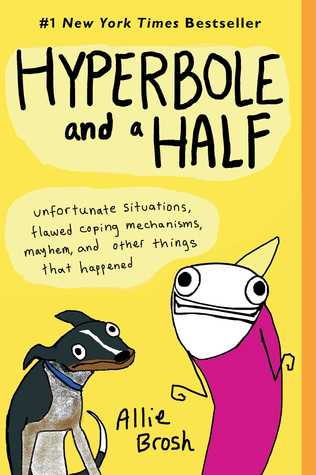
Hyperbole and a Half: Unfortunate Situations, Flawed Coping Mechanisms, Mayhem, and Other Things That Happened

Hyperbole and a Half: Unfortunate Situations, Flawed Coping Mechanisms, Mayhem, and Other Things That Happened, by Allie Brosh, 369 pages
Hyperbole and a Half: Unfortunate Situations, Flawed Coping Mechanisms, Mayhem, and Other Things That Happened
Oh my glob- have you ever read a book where once you were finished, you thought "This author GETS it" ? That's kind of how this was for me.  It was hilarious and heartwarming and just a wonderful escape.

This book is a collection of written/illustrated short pieces by Allie Brosh, most of which were featured on her blog . The topics range from her dogs and their idiosyncrasies, to depression, to her inhuman, childhood need for sugar.  This book is hilarious, but not in a cheap joke sort of way- in a way that you have to go along with her for the ride.  The illustrations may be a turn-off at first for some people, but if you stick with it, you'll realize that they are perfect.

Sort of unrelated, but the humor in here reminded me of Maria Bamford's standup, if you're a fan of either.

Thursday, December 12, 2013

Hyperbole and a Half

Hyperbole and a Half: Unfortunate Situations, Flawed Coping Mechanisms, Mayhem, and Other Things That Happened by Allie Brosh, 369 pages

Allie Brosh is not a good artist. She'll likely never win a drawing contest with any of the better-known (or even lesser-known) artists. But once you get used to her blob-with-stick-arms people and her vaguely flat-looking dogs, her artwork is endearing and awesome.

Hyperbole and a Half isn't graphic novel or comic book, though. Nor is it exactly a prose piece. Rather, this book is a highly-illustrated, very funny memoir, created journal-style and generously peppered with Brosh's quirky drawings (much like Brosh's blog of the same name). It's filled with memories like the time the goose attacked her and the time that she ate her grandfather's entire birthday cake, but it's also got some surprisingly soul-searching entries as well. I particularly enjoyed Brosh's realistic, matter-of-fact, but also unexpectedly funny take on depression; this section should be required reading for anyone who is trying to deal with a friend or family member who is depressed.

Actually, strike that. This book should simply be required reading. For everyone. It's that great.

Saturday, November 30, 2013

The Invention of Hugo Cabret

The Invention of Hugo Cabret: A Novel in Words and Pictures by Brian Selznick, 533 pages

Hugo Cabret is the orphaned son of a clockmaker, living in an apartment above a busy Paris train station and surreptitiously winding all of the station's clocks while stealing what little food he needs to stay alive. He also steals some windup toys from a shop in the station, taking apart the cogs and wheels to fix an automaton his father had been restoring when he died. Things get a bit sticky when Hugo is apprehended pilfering a windup mouse, but, in a roundabout way, getting caught opens Hugo's eyes to early French cinema and Victorian-era magicians.

The flap copy on The Invention of Hugo Cabret calls the book "a cinematic tour de force," which seems an odd descriptor for a novel. However, after reading it, I'm convinced that "cinematic" is probably the best way to describe this story. Nearly half of the book's 533 pages are wordless full-page illustrations that keep the plot moving along. None of these images are described in the surrounding pages, making them vital to Selznick's storytelling, and several are parts of series that zoom in from a wide-angle shot to focus on a small detail, such as running feet or Hugo's hands working on clockwork toy; they would almost function as rough-draft animation cells, though with much greater detail.

While Selznick's storytelling style and the focus on the cinematic works of Georges Milies makes this story seem magical, the tale itself is all entirely possible (though perhaps not entirely probable) in the real world. It's a rare book that can do that, and for that reason, The Invention of Hugo Cabret deserves the Caldecott Medal it won. An excellent story for kids, cinemaphiles, and fans of magical realism a la The Night Circus.

Thursday, October 24, 2013

Flora & Ulysses: The Illuminated Adventures

Flora & Ulysses:The Illuminated Adventures by Kate DiCamillo, illustrated by K.G. Campbell, 231 pages


Kate DiCamillo has written books in almost every kid lit format imaginable: picture books, early readers, chapter books.  For her latest work, she tackles the hybrid comic book/illustrated novel format popularized by Jeff Kinney’s Wimpy Kid series.  The result is the charming Flora & Ulysses, a tale of unexpected friendships, a superhero squirrel and the joy of poetry (and giant donuts!).  The plot is adorably absurd - Ulysses the squirrel gains his superpowers and loses most of his fur after an unfortunate encounter with a rogue vacuum cleaner - but also explores the ways that different characters cope with loneliness and feeling unwanted.

The comic book/illustrated novel format presents a great hook for reluctant readers and the short chapter length breaks the story up into easily digestible chunks.  Flora’s expansive vocabulary may present issues for some young readers, but DiCamillo assists by seamlessly sprinkling in context clues.  K.G. Campbell’s illustrations are presented in comic panels in a style that favors soft shading over the traditional bold lines of comic books.  The pictures compliment the sweetness of the story nicely; my favorite illustration comes toward the end of the book and shows Flora hugging Ulysses (it may even have caused me to tear up a bit).  

Flora & Ulysses made the National Book Award Longlist for Young People’s Literature in September and is garnering a lot of Newbery Award buzz in the kid lit blogosphere – check out some other reviews:


Wednesday, October 23, 2013

Food Rules: An Eater's Manual

Food Rules: An Eater's Manual by Michael Pollan, illustrated by Maira Kalman, 203 pages

Pollan has become something of a food guru, with his bestselling In Defense of Food and The Omnivore's Dilemma. Food Rules presents some simple suggestions culled from Pollan's books, as well as from his readers and others in the organic food, slow food, and nutrition community. Pollan presents 83 "rules," as well as simple explanations. For example, "don't eat anything your grandmother wouldn't recognize as food" (warning off the Go-gurts of the food world) or "it's OK to eat junk food, as long as you make it yourself" (the idea being that junk food takes so much work to make deep-fried Twinkies that you won't make them very often). He notes in the foreword that these are rules that he's come up with, but they're more suggestions, and he doesn't expect anyone to abide by all of them. Rather, he hopes that a handful will stick with his readers, and make them think the next time they go grocery shopping.

Pollan's rules are punctuated by some fantastic artwork by Maira Kalman. I'll admit that Kalman's work is a large reason that I picked up this short volume. I was captivated by her work in Daniel Handler's young adult novel, Why We Broke Up, (which is also worth picking up), and in this book, she doesn't disappoint. Check out this short volume, and enjoy Kalman's quirky, funny art working perfectly with Pollan's simple writing style. It's well worth the hour that you'll spend reading it.