Sunday, October 18, 2015

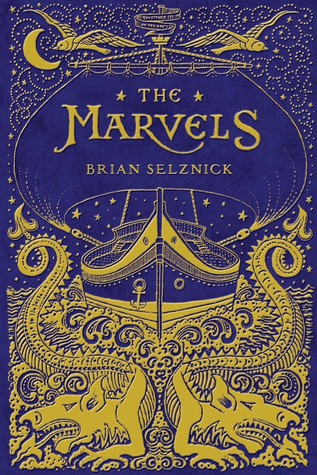
The Marvels

The MarvelsThe Marvels, by Brian Selznick, 665 pages

From the creator of The Invention of Hugo Cabret comes another book in the same style- half of the story is illustration-only, the other half is prose.  The illustrated part tells a story of a family of actors, dating back to the eighteenth century- but with an ambiguous ending.  The prose part begins in 1990, with the focus being on a young man who has run away from school to find his best friend and stay with his uncle.  Selznick does a great job of bringing the two stories together, in what turns out to be an unexpected manner.  Reality is not always what we think it is, and stories are not always true.  This particular one really resonated with me more than the previous Selznick works, both visually (the pages are gold leafed- beautiful!) and story-wise.

Saturday, October 17, 2015

The Hobbit

Cover image for The Hobbit, or, There and Back Again by JRR Tolkien, 317 pages

"In a hole in the ground there lived a hobbit..." named Bilbo Baggins, and he had a magical adventure in which he traveled with dwarves and a wizard, eluded trolls and goblins, riddled with Gollum and Smaug, found a magic ring, dined with elves and a bear-man, and persevered through sheer heroic decency.

Rereading The Hobbit, two things are remembered: the writing is approachable, plain, and unpretentious, and the book is very funny.  Neither of these qualities are possessed by The Lord of the Rings, although the trilogy has other, greater virtues.

Friday, October 16, 2015

Velvet

Velvet: Before the Living End, written by Ed Brubaker, illustrations by Steve Epting, 128 pages

Velvet Templeton is the personal secretary to the director of a super-secret spy agency.  Velvet, however, is no Miss Moneypenny; she's a former operative put on desk duty after some questionable shenanigans and now has been framed for murdering the agency's top spy.

Spy movies are a total guilty favorite of mine. I'll go see whatever the new Bond or Mission Impossible movie is and I'll enjoy it despite its misogyny and failure to pass the Bechtel test. Velvet totally hits all my favorite spy movie tropes and its about a lady spy. A MIDDLE AGED lady spy. (Though, I don't think Velvet actually passed the Bechtel test until issue 5). On top of that wonderful twist to the genre, the art and writing are really solid. Will definitely keep reading this series.

September Totals!


Congrats to Ed W, who read the most books and pages and to Jason S, who earned the most points in September!

We've decided to shake up the way that we award prizes here on the blog, each month we'll be doing one random drawing and award a prize to the winner.  However, since it's the start of a new blog-year and I'm terribly late posting these September totals EVERYBODY who blogged in September wins a prize!  Prizes for everybody!  Keep an eye on your in-boxes for a list of the currently available prizes.  Thanks for blogging!

September Stats:
BloggerBooks PagesPoints
Ed W2910,25929
Jason S378,13571
Krista R216,47922
Dennis M143,29416
Julie E-C61,9426
Jeff S31,2713
Melissa M31,0163
Karen Y25312
Molly P22083
TOTALS11733,135155

Thursday, October 15, 2015

Four to Score

Four to Score by Janet Evanovich, 294 pages


It is always a delight to read a Stephanie Plum mystery by Janet Evanovich. Such a delight, in fact, that I was laughing within the first five pages.

Just when you think things can't get any more zany or wonky in Stephanie's life, things such as using a transvestite to help her crack codes or going to Atlantic City where her ride-along grandmother, Grandma Mazur, ends up on top of a poker table to get a better view of a fleeing bounty are found within the pages. Those are just the unusual antics among the usual ones found in this series: wacky family dinners, exploding vehicles, Rex the hamster, and a gun in a cookie jar are the usual suspects.

The Stephanie Plum series is most definitely a page-turner and a satisfying read for avid mystery fans.

We All Looked Up

We All Looked Up by Tommy Wallach, 370 pages

What would you do if there was a good chance that an asteroid was on target to hit the Earth, probably with devastating results for the population?  This book explores what a group of teens in Seattle do, based on the knowledge that they may only have a couple of months to live.  This story is told from the perspective of four teens, Peter, Eliza, Andy, and Anita.  Peter is the popular athlete, slated to go to Stamford on a scholarship.  Eliza is a loner whose mother left for Hawaii and father is dying of cancer.  Andy is a stoner wannabe rock star whose parents don’t seem to care what he does.  Anita is brilliant but ruled by her parents’ wishes that she go to Princeton and study something they see as lucrative, like medicine or business and have tried to stamp out her dream to study music.  These teens are completely different but end up coming together after the news of the asteroid is released.  I really liked this book although I was disappointed in the ending, but not surprised.  Teens who like realistic fiction or apocalyptic novels may like this.

Tracked

Tracked by Jenny Martin, 389 pages

Phoebe is a racer on a world that is completely controlled by corporations.  She is racing illicitly until she is caught and offered a choice: race for Benroyal Corp or go to a prison labor camp.  Going to the camp means certain death within the year so even though she hates the corporations, she agrees, on the condition that her pacer, Bear, who was also captured, is released and added to her racing team.  Once Phee starts racing she becomes aware that there is a lot more intrigue among the corporations than she realized, and that some people may be working to bring down the corporations.  Phee wants to be involved but is worried about her adoptive family getting hurt in the process.  This was a good story.  I was sucked into it pretty quickly.  This is for teens who like realistic science fiction with a little adventure and mystery thrown in.

Old Wolf

Old Wolf by Avi, 146 pages

Nashoba is the leader of the wolf pack but a younger wolf has started challenging him for leadership.  Nashoba believes he can still lead but he is injured in the challenge.  It's winter and food is hard to come by.  When a raven, Merla, tries to help Nashoba find food, he isn't happy to accept her help but reluctantly agrees.  Casey is a boy who fascinated with bow hunting.  He plays a video game constantly.  He is just turning thirteen and hopes to get a bow for his birthday.  But Casey and Nashoba's worlds are about to collide and it could end up badly for one or both of them.  This book was realistic, except that we don't know how wolves actually communicate.  I didn't like it very much.  The whole book left me unsettled and I like my messages to be a little more subtle.  However it's well written and an elementary reluctant reader might like it for its length.

The Scam

The Scam by Janet Evanovich & Lee Goldberg, 286 pages

This is more of the usual fare from this team of setting up a scam in order to catch the crook with a few laughs and a lot of sexual tension on the way.  In this book Kate, FBI agent, and Nick, con artist and secretly working with the FBI, are setting up an operation to trap casino mogul Evan Trace in his money laundering schemes.  Along the way, they drag in a Hawaiian gang lord in an effort to take him down also.  There are several close calls along the way, with the worry that their scheme will be uncovered, and Trace setting up a scam of his own that could ruin their plans.  I'm still enjoying this series.  The characters are funny and the stories, even though somewhat predictable, are still fun.  Fans od the romantic comedy adventures should check these out.

Hit Count

Hit Count by Chris Lynch, 362 pages

Arlo is a football player.  He's really good and loves the thrill of the hit.  His older brother played too but quit his senior year because he was still on the junior varsity team.  After that his life seemed to go completely off track.  Arlo is determined that won't happen to him.  Despite his mother's fears for possible brain damage or death from all of his hits, Arlo can't give it up.  Football, especially the hit, is what he lives for.  Even though the rest of his life is pretty good, with a great girlfriend, a good family, and decent grades, Arlo needs the adrenaline rush from the hit.  Even when he starts to have problems with dizziness, double vision, memory, and losing time, Arlo refuses to admit that anything could be wrong.  This was a pretty good book about the possible effects of football head injuries.  I really think that a lot of teen boys would probably like this book.

The Rat With The Human Face

The Rat With The Human Face by Tom Angleberger, 146 pages

There are three members of the Qwikpick Adventure Society; Lyle, Marilla and Dave.  Lyle’s parents work at the Qwikpick and the three friends hang out there all of the time.  After their first adventure with a Poop Fountain they are primed for more adventure.  When they overhear someone talking about seeing a rat that had a human face the three decided they had to see this for themselves.  Despite some obstacles, the three begin to hatch a plan that will enable them to get to the place the rat lived, see and photograph the rat and get home.  But, as they say, the best laid plans…  This was a good adventurous realistic story for elementary kids.

The Sleeper and the Spindle

The Sleeper and the Spindle by Neil Gaiman, 66 pages

This was an interesting retelling of more than one fairy tale, the main one being Sleeping Beauty.  Although a lot of the major points are the same there are some interesting twists that will be surprising to people familiar with the story (and who isn’t?).  I liked it.  Half of the book is illustrations and it’s short to begin with, making it a good choice for reluctant readers.  Give this to teens who like fairy tale retellings.

Princess Academy: The Forgotten Sisters

Princess Academy: The Forgotten Sisters by Shannon Hale, 326 pages

Miri is excited to be able to return home after her year at the palace but just before she leaves she is ordered to go to Lesser Alva and tutor three sisters, cousins of Prince Steffan.  One of them is to be the bride of a rival king as part of a treaty to prevent war.  Miri reluctantly agrees but is dismayed to find three wild girls who are used to trapping caimans and hunting in the swamp who know absolutely nothing about court.  Miri isn't sure that she is capable of making these girls ready to marry anyone, especially a king, but as she gets to know them she isn't sure that she wants them to be ready.  As she becomes friends with Astrid, Felissa, and Sus, she feels it unfair that one of them will be forced into marriage with someone they don't know but if she fails, Miri could lose everything dear to her and be responsible for not preventing war.  I thought this was a good, solid addition to the Princess Academy series.  This could easily be the last book as everything is pretty well wrapped up, but there could be more books also.  Older elementary or younger teens, especially girls, who like fantasy type stories will enjoy it. 

Wednesday, October 14, 2015

Forty Days of Musa Dagh

Cover image for The Forty Days of Musa Dagh by Franz Werfel, 817 pages

This is Franz Werfel's fictionalization of the true story of a community of Armenians who, facing deportation and almost certain death, fortified a mountain called Musa Dagh and resisted the Turks for 53 days.  The shortening of the siege to the more evocative forty days is only one of many liberties Werfel takes with history, most notably the transformation of the actual leader of the resistance into a fictional character.

Werfel (best known as the author of The Song of Bernadette) intended neither a history text nor a Tom Clancy-style military thriller, though it is easy to imagine either treatment of this story being effective.  Rather, the author slowly develops themes of loyalty, sacrifice, love, honor, jealousy, pride, hope, and faith, centered around the protagonist, Gabriel Bagradian, a wealthy Armenian recently returned to his people after long years abroad, his French wife Juliette, and their son Stephan, who simultaneously struggles to find his place both as a man and as an Armenian.

The Forty Days of Musa Dagh is a long, slow novel.  Rather than providing a hollow sense of closure when even victory is a kind of defeat, the novel concludes with an anti-climax.  Instead of fast-paced action, Werfel delivers genuine surprises.  

Tuesday, October 13, 2015

Everybody rise

Everybody Rise by Stephanie Clifford
376 Pages

 "A witty tale about a high-society wannabe...Little is more delicious than watching an ambitious but tragically flawed protagonist brought down - especially in a designer cocktail dress." -The Washington Post Everyone yearns to belong, to be part of the "in crowd," but how far are you willing to go to be accepted? In the case of bright, funny and socially ambitious Evelyn Beegan, the answer is much too far... At 26, Evelyn is determined to carve her own path in life and free herself from the influence of her social-climbing mother, who propelled her through prep school and onto New York's glamorous Upper East Side. Evelyn has long felt like an outsider to her privileged peers, but when she gets a job at a social network aimed at the elite, she's forced to embrace them. Recruiting new members for the site, Evelyn steps into a promised land of Adirondack camps, Newport cottages and Southampton clubs thick with socialites and Wall Streeters. Despite herself, Evelyn finds the lure of belonging intoxicating, and starts trying to pass as old money herself. When her father, a crusading class-action lawyer, is indicted for bribery, Evelyn must contend with her own family's downfall as she keeps up appearances in her new life, grasping with increasing desperation as the ground underneath her begins to give way."

I wish I knew why I ended up with this book,  it definitely wasn't because it was a People magazine pick.  The writing was solid but the storyline hackneyed and the characters unsympathetic.  No surprises here. 


Fates and Furies

Fates and Furies by Lauren Groff
390 Pages

"At age twenty-two, Lotto and Mathilde are tall, glamorous, madly in love, and destined for greatness. A decade later, their marriage is still the envy of their friends, but with an electric thrill we understand that things are even more complicated and remarkable than they have seemed."

The book is divided into two parts, the relationship from Lotto's POV and then from Mathilde's POV.  It is interesting how their perceptions of events differ and the underlying motivations shaping those perceptions.  While at times slow,  I did enjoy Groff's writing and the love story of Lotto and Mathilde.

Monday, October 12, 2015

House of Evil

Cover image for House of Evil: The Indiana Torture Slaying by John Dean, 231 pages

In July of 1965, Gertrude Baniszewski, a 37 year old mother of seven living in Indianapolis, agreed to care for 16 year old Sylvia Likens and her 15 year old sister Jenny in exchange for 20 dollars a week.  In October, police responding to an emergency call found Sylvia dead, emaciated, her body covered in bruises, burns, and open sores, the words "I'm a prostitute and proud of it!" carved into her stomach beneath a branded "3".

Horrific as it was, Sylvia's torture and death would blend into the background of child abuse if not for the identity of the perpetrators.  As it came out, not only did Gertrude abuse the girl, her children were also encouraged to join in, and their friends participated, too.  It became a neighborhood game to put out cigarettes on Sylvia's body or push her down the stairs.  Her three oldest children were arrested along with six neighbors, Gertrude was ultimately convicted of first degree murder, her eldest daughter of second degree murder, and three boys of manslaughter.

This book tells the story poorly, although how much of this is due to a failure on Dean's part and how much the result of conflicting stories and foggy details is unclear.   It seems as if, in a case with so many witnesses, a better account could have been constructed despite the obvious difficulties, but Dean seems to have relied almost exclusively on courtroom testimony - House of Evil was originally published soon after the trial and it is unclear how much it has been updated.  The children are portrayed more like preteens than the teenagers they were.  There is a natural reluctance to defame the victim, but Dean loses a great deal of credibility when he seemingly accepts the transparent lie that Sylvia found a set of gym clothes lying in the street - important because it ties in with claims by the tormentors that Sylvia had been caught stealing on other occasions.  Worst of all, the chronology is vague and confused, making it extremely difficult to chart the escalation of abuse and the manner in which the abusers fed off each other, which is the key narrative.  Instead, the story is a catalog of seemingly random horrible things that horrible people did to an almost entirely innocent girl.

Saturday, October 10, 2015

The Opposite of Loneliness

The Opposite of Loneliness by Marina Keegan, 208 pages


Full of short fiction stories and personal essays, the premise behind this book is absolutely heartbreaking. It is so hard to put aside all knowledge of Keegan's tragic death while reading the stories that I would often find myself crying.

Long story short: Marina Keegan graduated magna cum laude from Yale, about to head into a job at The New Yorker, with a promising writing career ahead of her. Five days after graduation, she died in a car accident at 22-years old.

Her short life serves as a reminder that if a bright, successful, and promising young woman could die in a freak accident in her twenties, it could happen to any of us at any time. Her stories are also a clear illustration of what her death should be remembered as: a reminder that life is too short to be too-mired down in the complexities of the world that we completely miss the little joys that life has to offer.

No matter how cliché, that is what her life, through her writings, should be teaching us.

Friday, October 9, 2015

Troilus and Criseyde

Troilus and Criseyde by Geoffrey Chaucer, from The Complete Poetical Works of Geoffrey Chaucer, translated by John SP Tatlock and Percy MacKaye, 137 pages

Chaucer's Troilus and Criseyde is a tragic tale of lovers during wartime.  A Trojan knight, Troilus, is punished for his mockery of love by being smitten with the Criseyde, a Trojan widow whose father has defected to the Greeks.  Even as Troilus gains the assistance of Criseyde's uncle Pandarus to win his lady's love, other forces conspire to tear them apart.

The "Modern Reader's Chaucer" was translated into something approximating modern English prose, with a King James accent to give it an antique feel.  Chaucer's anachronisms have the peculiar charm of a painting of Biblical figures in Renaissance dress, or an Elizabethan play in modern dress.  While this eviscerates the poetry of the piece, it does preserve the distancing effect necessary for a "modern reader" to accept some of the story's more dated conceits.  This clears the way for a deeply moving experience, albeit not quite the one Chaucer intended.

Wednesday, October 7, 2015

Empire of Sin: A Story of Sex, Jazz, Murder, and the Battle for Modern New Orleans

 
I’ve always been fascinated with New Orleans. It’s such a contradictory city, with a touch of evil hovering over it, and an unsavory feel that often makes me nervous to visit. Yet, the foods that come from that part of the country are unparalleled.

Until I read Gary Krist’s nonfiction piece, Empire of Sin: A Story of Sex, Jazz, Murder, and the Battle for Modern New Orleans, I had come to believe that the debauchery of the 1960s through the ‘70s was at its height there. To me, and what I knew about the city, New Orleans made Las Vegas seem like a night out for nuns and priests.

Krist focuses on a scant thirty years, from 1890 to 1920. When I first realized that the book 448 and that 105 of them were the bibliography, notes, and index, I was a little overwhelmed, afraid that the writing would be too deep for me to sink my teeth into. However, Krist’s has written an easy-to-read narrative that held me attention from the beginning.

I enjoyed reading/learning about such characters and places as Storyville (where the city tried to coral its vice) and Tom Anderson (its unofficial mayor). There were the madams like Lulu White and Josie Arlington. There were the saloons and gambling houses. There was the immigrant population---Italians, whom too seemed to be in the same mess today’s illegals are in. I ws mesmerized by the corruption that ran rampart from the slums to the highest echelons of state government. Old Huey Long was a saint compared to some men back then; they make today’s politicians looks like humble old ladies.

I knew that New Orleans was a port-of-entry for many Italians, and they lived in slums and ghettos that reminded me of New York’s tenements. And I had learned of “Little Sicily” from a PBS special, The Italian-Americans.

There are three areas in the book that I really enjoyed reading: First, of course, are the jazzmen. Guys like Robert Charles, Buddy Bolden, Jellyroll Martin---how they created the music form that we now know as jazz, and how hard it was a musician wanted more than a gig in a whore house.
Second, was the Mafia or the Black-Hand. Krist could have delved into that more in my opinion, but still the rise and fall still fascinated me.

Third, the serial killer, The Axeman, seemed to target the Italians.  Brutality knows no generation.

Empire of Sin: A Story of Sex, Jazz, Murder, and the Battle for Modern New Orleans is an easy read that I highly recommend. I give it 5 out of 5 stars.

I received this book from Blogging for Books in exchange for this review.