Wednesday, October 28, 2015

Fishermen with Ploughs

Cover image for Fishermen with Ploughs by George MacKay Brown, from The Collected Poems of George MacKay Brown, 58 pages

Fishermen with Ploughs, a collection first published in 1971, is a poetical-historical tour of the Orkney Isles, where the author makes his home.  It begins with the arrival of Norse settlers fleeing trouble at home, drifts through Christianization and Reformation and Modernization, when so many native Orcadians left for greener pastures elsewhere, then concludes in the near future with new refugees fleeing some fresh disaster renewing the cycle.

If not for the introduction, however, only the keenest of readers would have unriddled that plot.  The contents vary greatly in length and style, giving brief glimpses of the isles and their inhabitants in a land where man and nature interpenetrate.  Songs of mothers and widows and graves dug in the sea, the books of the earth and the seas of corn, the plough of the boat's prow and the sea salt on the wind, hearts like stones and stones like men, the year and the week and the days going round, the great ghostly crowds of those who have gone before but are here still in wall and path and churchyard.

Tuesday, October 27, 2015

Judge Volume 1-5

Judge Volumes 1 -5 by Yoshiki Tonogai 1035 pages in five books
Cover image for

Since I am stuck riding the bus to and from work, about a thirty minute commute, I was looking for a lot more manga or short books to read. This way I could start and finish the book on the bus. I struck out on short stories but found a whole host of different manga series. Judge by Yoshiki Tonogai being one of them.

Cover image for The Judge series is about a group of strangers who are kidnapped. When they wake up they find themselves in an abandoned courthouse wearing masks. Their initial confusion about what is going on and why they are here is explained by a tape (very much like the movie Saw). In short they have all committed one of the seven deadly sins and to atone for their sins they must be judged. To survive they must vote who gets “sacrificed” or killed each day. The last four people that are alive after the “judgement” has been passed will be released.
The first volume of this series is a lot of set up and explanation so it can be a little tedious to go through. The rest of the volumes have all of the plotting and backstabbing you would expect in this situation. If you enjoyed the first couple Saw movies or the manga series Doubt by this same author, you should give this series a try.  
I debated whether or not I could post these covers or if they would be spoilers, seeing as how they show who dies on the cover.

Monday, October 26, 2015

Beauteous Truth

Cover image for Beauteous Truth: Faith, Reason, Literature, and Culture by Joseph Pearce, 320 pages

Beauteous Truth  is a collection of blog posts, book reviews, book introductions, interviews, and magazine essays, on a wide variety of subjects, ranging from history to philosophy to aesthetics to autobiography.  Author Pearce has written literary biographies of Solzehnitsyn, Tolkien, Lewis, Belloc, Wilde, Shakespeare, and Chesterton, focusing on the influence of Christianity generally, and Catholicism specifically, upon his subjects, so it is no surprise that questions about the relationship between Truth and Beauty, between faith and art, form the dominant theme.

Pearce directly targets both the modern notion of a war between faith and reason and the academic aversion to matters of morality and religion.  Following Dawson and Eliot he sees these as antithetical to the survival of culture and civilization.  The loftiness of his cause inspires a determination and combativeness that can come across as overly forceful, which is only aggravated by the inevitably somewhat repetitive (but certain things are worth repeating) nature of such a collection.  This is balanced somewhat by the structure of the book, which provides a certain thematic progression despite the components not having been initially conceived as part of a greater whole.  There is an occasional minor misstep (Weston was a renegade spiritualist in Perelandra, not a materialist as he was in Out of the Silent Planet), but on the whole Pearce's passionate arguments are strong. clear, and insightful.

In the Last Analysis

In The Last Analysis by Amanda Cross
187 Pages

I read this mystery since it the author was mentioned in the recent V.I. Warshawski book.  It originally came out in the early 60's and was extremely dated.  When a young patient is found murdered on the therapist's couch, Kate Fansler must solve the crime before her friend the therapist is found guilty. 

Friday, October 23, 2015

John Adams

Cover image for John Adams by David McCullough, 651 pages

John Adams had long been the forgotten Founder.  Always controversial, never wildly popular, defeated in a landslide in his 1800 Presidential reelection bid, he didn't write the Declaration of Independence, didn't fly a kite in a thunderstorm, didn't chop down a cherry tree.  Intellectuals remembered him as the progenitor of the dynasty that would include his son John Quincy and his great-grandson Henry, and conservatives reimagined him as an American Burke, but it was David McCullough who virtually single-handedly raised the public perception of Adams from a trivia question to his rightful place amongst the Founders.

McCullough writes with novelistic grace.  His focus is on the personalities of his subjects, rather than the interminable business of debate, diplomacy, and government - although this has the drawback of sometimes understating the difficulties and undervaluing the importance of such work.  It is emblematic of his approach that McCullough spends more time on a tour of English gardens undertaken by Jefferson and Adams in 1787 than on the drafting of the Declaration of Independence - the former brilliantly illuminates the characters of these two men and the nature of their highly significant, turbulent relationship, but the latter was obviously far more important as a single historical event, that is, the Declaration was a milestone in American and world history, but the personalities, feuds, and friendships of Jefferson and Adams would shape history in subtler but equally important ways.

Thursday, October 22, 2015

Simmer and Smoke: A Southern Tale of Grit and Spice

Simmer and Smoke: A Southern Tale of Grit and Spice by Peggy Lampman  380 pages

I hail from the South---Arkansas to be exact, and Southern Arkansas at that—and I’m always to drawn to stories that take place in that part of the U.S. And to make the pot even sweeter, it’s a story that evolves around food.

Lampman’s debut novel is the story of two women: Shelby Preston and Mallory Lakes. The story evolves over the course of one year,from December 20, 2010, to December 30, 2011.

Shelby is a young mother, living with her mother, with dreams of becoming a chef. Not only does she love to cook, but she knows that she can never make a good life in Coryville. Determined to make a better life for herself and her six-year-old daughter, Shelby takes the four-hour bus ride to Atlanta to apply for a job as a cook for in the downtown deli of Grasso’s, a supermarket chain.

Mallory Lake writes for the Life Style Section of one of Atlanta’s papers, The Sun. Like many newspapers in 2010, The Sun is facing declining advertising and readership. Rumor has it that the paper is about to close its print doors and go strictly digital. Not only does Mallory have to worry about losing her job, but she’s still trying to figure out why her lover unceremoniously dumped her without a hint of warning.

I enjoyed Simmer and Smoke. It’s a story of strong women who aren’t strong because it’s the cool thing to do. They are strong because they have no choice. It’s also a story of family---the one we’re stuck with and the one we choose to make. It’s a story of food. I wish the recipes hadn’t been regulated to the back of the book. The story would have been more effective if they had been listed in the text.  The plot was interesting and entertaining. For half the book, it was a page turner. For the other half, it bogged down.


I give Simmer and Smoke: A Southern Tale of Grit and Spice 3 out of 5 stars.

Wednesday, October 21, 2015

Three Rival Versions of Moral Enquiry

Cover image for Three Rival Versions of Moral Enquiry: Encyclopaedia, Genealogy, Tradition by Alisdair MacIntyre, 236 pages

In the published edition of Alisdair MacIntyre's Gifford lectures of 1988, he identifies three primary schools of moral enquiry in the twentieth century.  The first is that which he identifies with Adam Gifford and his fellow toilers at the ninth edition of the Encyclopedia Britannica, representing a model based on that of the natural sciences, emphasizing method above all else, and proceeding out of the Enlightenment.  The second he associates with Nietzsche, particularly his On the Genealogy of Morals, and the postmodern view of morality as a mask for power and privilege.  Finally, he presents the third school, Thomism, especially as renewed after the promulgation of Leo XIII's encyclical Aeterni Patris.  This approach, more broadly representing the classical and medieval understanding of philosophical work, emphasizes that the development of virtue - particularly humility - in the philosopher is necessary for moral understanding.  The traditional mode of enquiry conceives of philosophy as a craft, pursued in and through a community.

MacIntyre attempts to demonstrate that, while the first two schools are each incapable of engaging with the other on the other's terms, it is the particular advantage of tradition that it is able to synthesize and assimilate rival philosophies, and to engage with the world in a meaningful way.  Because of this, the philosophy of the past is also the philosophy of the future.

Tuesday, October 20, 2015

Mad Catastrophe

Cover image for A Mad Catastrophe: The Outbreak of World War I and the Collapse of the Habsburg Empire by Geoffrey Wawro, 385 pages

In 1847, the Austrian Empire stood as the foundation of the European order and the arbiter of European destiny.  In 1848 that order was shaken, in 1866 Austria was humiliated in the Austro-Prussian War and excluded from wider German affairs, and a year later power within the Habsburg realms was divided between the German Austrians and the Hungarian Magyars.  By the second decade of the twentieth century Austria-Hungary was a dysfunctional state, a patchwork of rival linguistic and ethnic groups theoretically united by their shared allegiance to the Habsburg dynasty and its octogenarian patriarch, Emperor Franz Joseph.  It was this sick man of Europe that would stumble into beginning the First World War. 

Wawro's unrelenting cynicism occasionally becomes tiring - although there is certainly enough here to warrant cynicism - and at times petty, as when he sneers at Archduke Franz Ferdinand's insistence on visiting a man who had been wounded by an attack aimed at the Archduke, a decision that led him directly into the hands of his assassin.  Unfortunately, his constant denigration of his subjects on all sides of the war creates suspicion about the value of his judgement generally, which is a shame, since his Strangelovian tale of the follies of generals on the Eastern Front is otherwise a compelling examination of a largely forgotten part of World War I.

Sunday, October 18, 2015

How to Fake a Moon Landing

Cover image for How to Fake a Moon Landing: Exposing the Myths of Science Denial, by Darryl Cunningham, 176 pages

Cunningham starts this book with a quote that really says it all: "Everyone is entitled to their own opinion; however, everyone is not entitled to their own facts."- Michael Specter

This graphic non-fiction could be really great for those middle-school age readers: it's a series of pieces addressing commonly-challenged scientific theories and how the challenges are flawed or wrong.  Cunningham begins with the moon landing, and takes down each of the theories made by conspiracy theorists; he continues with sections on homeopathy, chiropractic, the vaccination/autism "connection," evolution, fracking, and climate change.  Cunningham really simplifies the ideas enough for anyone to grasp and provides sources for further investigation.  It's just a bit frustrating reading this, because the common threads of political corruption and a general lack of journalistic ethics seem to make the power and inviolate truth of science to be rendered inconsequential.

The Secret Place

The Secret Place (Dublin Murder Squad, #5)The Secret Place, by Tana French, 464 pages

Stephen Moran is trying to get out of Cold Cases and into The Murder Squad- the group of detectives in Dublin who investigate murder cases.  It looks like he has his chance when a girl from an upscale boarding school approaches him with what may be a clue to a previously unsolved murder on the school grounds. This mystery had lots of restating of conversations and situations that had already been explained, and dialogue with teenage girls that featured so many "like"s and italicized emphases and upward inflections that it literally gave me a headache to read.  It felt very padded, and the ending was not much of a surprise.  However, if you really wanted to read a mystery that reminds you of how very mean and cruel teenage girls can be, then this may appeal. Other book club members spoke very highly of the other books by Tana French, so maybe this one was an outlier.  

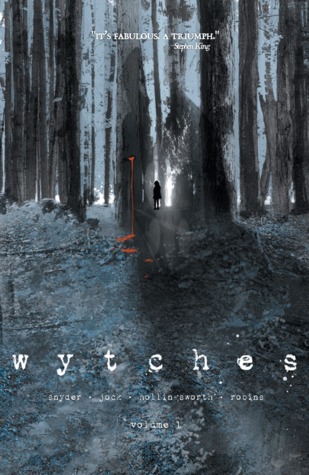
Wytches

Wytches, Vol. 1Wytches, vol. 1, by Scott Snyder, 144 pages

The Rooks family has just moved to a new, small town- seemingly to get away from some sort of "incident" that occurred in the old place.  And while it seems like the family is settling in and moving on- the daughter has made a friend at school, and dad's new graphic novel is coming along, there are a few... unsettling things that occur.  Oh, like the bald woman with prosthetic legs who breaks into the house to rave about witches and the egg-sized lump developing on the daughter's neck and the trees that eat people. Clearly, this small town life is not as simple as they thought.  As usual, the writing of Scott Snyder is solid and it reminded me of a Stephen King story (in a good way!).  That said, I am not a scary-story sort of reader, so I may pass on finishing out the series.  

Princess Mermaid

Princess MermaidPrincess Mermaid, by Junko Mizuno, 144 pages

In the absolute loosest of terms, this is a re-telling of "The Little Mermaid" story.  In less loose terms, it is about a group of mermaids who seek vengeance on humans for having murdered their mother by opening an underwater brothel where they sleep with men in order to have future mermaid babies and then eat the men for sustenance.  Until one of them begins to doubt if this is the best course, and meets a human man and... well, you get the idea.  But however you think a story like that ends, you're wrong.  Like Cinderalla before, this is one of those fairly bizarre, very adult works of graphic fiction where I wasn't totally sure where the story was going or where I was when it got there, but the art is pretty and it was so different that I think I liked it.

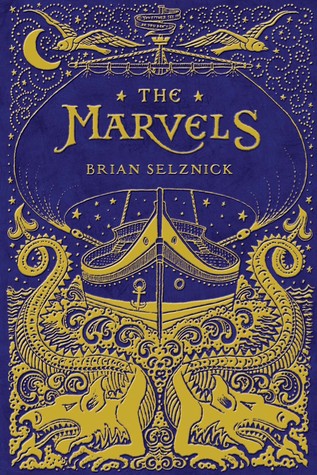
The Marvels

The MarvelsThe Marvels, by Brian Selznick, 665 pages

From the creator of The Invention of Hugo Cabret comes another book in the same style- half of the story is illustration-only, the other half is prose.  The illustrated part tells a story of a family of actors, dating back to the eighteenth century- but with an ambiguous ending.  The prose part begins in 1990, with the focus being on a young man who has run away from school to find his best friend and stay with his uncle.  Selznick does a great job of bringing the two stories together, in what turns out to be an unexpected manner.  Reality is not always what we think it is, and stories are not always true.  This particular one really resonated with me more than the previous Selznick works, both visually (the pages are gold leafed- beautiful!) and story-wise.

Saturday, October 17, 2015

The Hobbit

Cover image for The Hobbit, or, There and Back Again by JRR Tolkien, 317 pages

"In a hole in the ground there lived a hobbit..." named Bilbo Baggins, and he had a magical adventure in which he traveled with dwarves and a wizard, eluded trolls and goblins, riddled with Gollum and Smaug, found a magic ring, dined with elves and a bear-man, and persevered through sheer heroic decency.

Rereading The Hobbit, two things are remembered: the writing is approachable, plain, and unpretentious, and the book is very funny.  Neither of these qualities are possessed by The Lord of the Rings, although the trilogy has other, greater virtues.

Friday, October 16, 2015

Velvet

Velvet: Before the Living End, written by Ed Brubaker, illustrations by Steve Epting, 128 pages

Velvet Templeton is the personal secretary to the director of a super-secret spy agency.  Velvet, however, is no Miss Moneypenny; she's a former operative put on desk duty after some questionable shenanigans and now has been framed for murdering the agency's top spy.

Spy movies are a total guilty favorite of mine. I'll go see whatever the new Bond or Mission Impossible movie is and I'll enjoy it despite its misogyny and failure to pass the Bechtel test. Velvet totally hits all my favorite spy movie tropes and its about a lady spy. A MIDDLE AGED lady spy. (Though, I don't think Velvet actually passed the Bechtel test until issue 5). On top of that wonderful twist to the genre, the art and writing are really solid. Will definitely keep reading this series.

September Totals!


Congrats to Ed W, who read the most books and pages and to Jason S, who earned the most points in September!

We've decided to shake up the way that we award prizes here on the blog, each month we'll be doing one random drawing and award a prize to the winner.  However, since it's the start of a new blog-year and I'm terribly late posting these September totals EVERYBODY who blogged in September wins a prize!  Prizes for everybody!  Keep an eye on your in-boxes for a list of the currently available prizes.  Thanks for blogging!

September Stats:
BloggerBooks PagesPoints
Ed W2910,25929
Jason S378,13571
Krista R216,47922
Dennis M143,29416
Julie E-C61,9426
Jeff S31,2713
Melissa M31,0163
Karen Y25312
Molly P22083
TOTALS11733,135155

Thursday, October 15, 2015

Four to Score

Four to Score by Janet Evanovich, 294 pages


It is always a delight to read a Stephanie Plum mystery by Janet Evanovich. Such a delight, in fact, that I was laughing within the first five pages.

Just when you think things can't get any more zany or wonky in Stephanie's life, things such as using a transvestite to help her crack codes or going to Atlantic City where her ride-along grandmother, Grandma Mazur, ends up on top of a poker table to get a better view of a fleeing bounty are found within the pages. Those are just the unusual antics among the usual ones found in this series: wacky family dinners, exploding vehicles, Rex the hamster, and a gun in a cookie jar are the usual suspects.

The Stephanie Plum series is most definitely a page-turner and a satisfying read for avid mystery fans.

We All Looked Up

We All Looked Up by Tommy Wallach, 370 pages

What would you do if there was a good chance that an asteroid was on target to hit the Earth, probably with devastating results for the population?  This book explores what a group of teens in Seattle do, based on the knowledge that they may only have a couple of months to live.  This story is told from the perspective of four teens, Peter, Eliza, Andy, and Anita.  Peter is the popular athlete, slated to go to Stamford on a scholarship.  Eliza is a loner whose mother left for Hawaii and father is dying of cancer.  Andy is a stoner wannabe rock star whose parents don’t seem to care what he does.  Anita is brilliant but ruled by her parents’ wishes that she go to Princeton and study something they see as lucrative, like medicine or business and have tried to stamp out her dream to study music.  These teens are completely different but end up coming together after the news of the asteroid is released.  I really liked this book although I was disappointed in the ending, but not surprised.  Teens who like realistic fiction or apocalyptic novels may like this.

Tracked

Tracked by Jenny Martin, 389 pages

Phoebe is a racer on a world that is completely controlled by corporations.  She is racing illicitly until she is caught and offered a choice: race for Benroyal Corp or go to a prison labor camp.  Going to the camp means certain death within the year so even though she hates the corporations, she agrees, on the condition that her pacer, Bear, who was also captured, is released and added to her racing team.  Once Phee starts racing she becomes aware that there is a lot more intrigue among the corporations than she realized, and that some people may be working to bring down the corporations.  Phee wants to be involved but is worried about her adoptive family getting hurt in the process.  This was a good story.  I was sucked into it pretty quickly.  This is for teens who like realistic science fiction with a little adventure and mystery thrown in.

Old Wolf

Old Wolf by Avi, 146 pages

Nashoba is the leader of the wolf pack but a younger wolf has started challenging him for leadership.  Nashoba believes he can still lead but he is injured in the challenge.  It's winter and food is hard to come by.  When a raven, Merla, tries to help Nashoba find food, he isn't happy to accept her help but reluctantly agrees.  Casey is a boy who fascinated with bow hunting.  He plays a video game constantly.  He is just turning thirteen and hopes to get a bow for his birthday.  But Casey and Nashoba's worlds are about to collide and it could end up badly for one or both of them.  This book was realistic, except that we don't know how wolves actually communicate.  I didn't like it very much.  The whole book left me unsettled and I like my messages to be a little more subtle.  However it's well written and an elementary reluctant reader might like it for its length.