Wednesday, December 28, 2016

Out of the Silent Planet

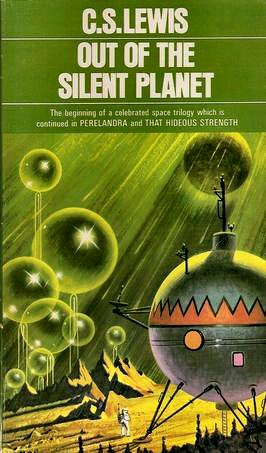
Out of the Silent Planet by CS Lewis, 174 pages

The first book in Lewis' Space Trilogy introduces Elwin Ransom, Cambridge philologist and avid walker, who finds himself kidnapped and taken to Mars as a human sacrifice for the alien gods.  His captors are Weston and Devine, the former a genius who has invented interplanetary travel, a tool which he intends to use to ensure the future of the human race no matter what - or who - gets in his way, the latter an investor who sees Weston's quest as a means to accumulate unimaginable personal wealth.  Luckily for Ransom, the universe is a far different place from what either imagines.

Out of the Silent Planet is the most conventional science fiction book in the trilogy, a planetary romance obviously inspired by Burroughs and Wells, the latter of whom is directly referenced by Ransom.  The depiction of Martian life is unique and, especially in terms of language, somewhat better developed than in most other such works.  But it is the climax, in which Ransom struggles to explain the "bent" thinking of Devine and Weston to the uncomprehending Martians, which makes the book truly unforgettable and presages the rest of the series.

Gummi Bears Should Not be Organic

Gummi Bears Should Not Be Organic: And Other Opinions I Can't Back Up With Facts by 
This parenting memoir by Stefanie Wilder-Taylor is her story of how she strives to find a balance between protective and caring . . and downright crazy.  Filled with funny stories, including why going to the park with children is awful (one of my favorite chapters, actually), and reflections on parenting, in general, the author focuses on what works for her family.

I found this book to be pretty funny, although I felt like it might have been better as a series of articles online.  About 3/4 of the way through the book, it was feeling a bit repetitive.  However, I don't have children, so maybe that's why.   I had found this on the shelf and picked it up because of the title, and because I was curious.  It made for a good read after the last two nonfiction books I finished, so while I wouldn't go back for a re-read, it was an entertaining book.

Tuesday, December 27, 2016

Fire Angels

Fire Angels by Elizabeth Kern.  320 pages

This historical fiction book focuses on the fire at Our Lady of Angels elementary school in Chicago on December 1, 1958.  A fire broke out in a stairwell and a combination of elements and errors led to one of the worst fires in Chicago's history, claiming the lives of ninety-two children and three nuns.

The author did a lot of research on the fire, including research on the children and families affected by the fire. While this is a fictional account, it has many accurate details, and if you know anything about this event, it feels very realistic.  One of the things I found was interesting was that the author has a boy who is attending the school actually be responsible for starting the fire. In reality, while there was a suspect, he was not convicted; however, there was a lot of speculation in the neighborhood that this boy was responsible.

One of the really interesting things about this book is that the author gives fire its own voice.  You get the perspective of the event from fire's viewpoint, as it first meets the boy in a church when a candle is lit, through the horrifying fire at the school, and in the years after.  The voice of fire is quite clear,  For example, it states "When I'm contained, I'm quite harmless . . . until I get unleashed.  Then I'm unpredictable as hell - and that's an understatement... I have no self-control, and even if I did, there is nothing I can do about it.  That's my nature."  p. 10   

This extra element really added something unusual to the story, which I liked.  I am very familiar with this event, but if you would like to read more:

Chicago Tribune gallery of photos

Article in Fire Engineering that explains the construction of the school, the regulations at the time, etc.

There are many more sites with information, although I feel one of the best resources to learn about this event is the book To Sleep with the Angels by David Cowan and John Kuenster.

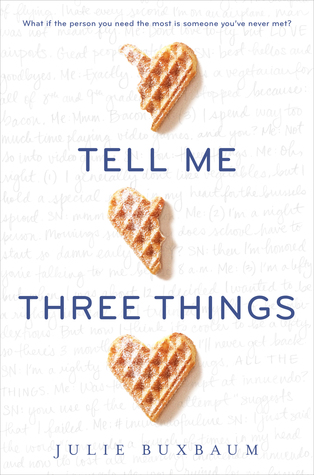
Tell Me Three Things

Tell Me Three Things by Julie Buxbaum   Audio Book:  9 hours       Hardback Book:  329 pages

Really well written characters and storyline.   Jesse the main character, lost her mother when she was 14 years of age.   Her mother had cancer and she describes so intensely what that was like and how cohesive a unit she, her mother and her father had been before cancer threw the family into turmoil.     The story will touch your heart.    You will feel Jesse’s pain vividly as the author describes everything in Jesse’s world so well it is a virtual experience seeing things through Jesse’s eyes.    The adored only child, Jesse, showered with attention until the ordeal they all went through with her mother’s terrible debilitating disease slowly stole her from  Jesse and Jesse’s father.    She takes the reader/listener on her journey through it all,  then after her mother’s death instead of her father sheltering her and talking out each other’s pain,   he withdraws into his work and begins going on business trips he  had never gone on during her mother’s life.      Jesse is trying to come to terms with her new life without her mother so she turns to her best friend and her best friend’s mother to help her cope.     All the business trips turn out not to be business trips at all, instead, her father has reached out in his pain to another woman on line who recently lost her husband.   Two years pass.   The woman her father has met online is hugely successful in the film industry and makes way more than her father’s  job would ever pay.    Sharing their sorrow in the arms of someone who understands what the other is going through, they feel they are soul mates and fall passionately in love and on one of her Dad’s “business trips,” they ELOPE.     Jesse is living in Chicago oblivious to what is going on with her Dad.    He doesn’t share it with her.     Jesse is  trying to sort out her thoughts and feelings and get through her day to day life at school  still mourning the loss of her mother and leaning on the love of her friends she has had since gradeschool.    A close group Jesse finds solace there until the day her father hits her with the news he has married someone else and they are moving to Los Angeles.     She never even knew he was talking to another woman.    She is stunned.   Then to be pulled away from the only comforters she has had during this tragedy she is in shock and cannot mentally process all the changes that are happening in her life so fast.   She tries to resist the move and clings tearfully to her friends and what she knows and can depend on as solid in her life.    Her father angrily tells her she doesn’t have a choice she is going and that is that.     He hits her with another bomb – his new wife has a son Jesse’s age!     What and whaaaaaaaaaaat?    She is freaking out.    Her father’s new wife is rich and has a glamorous home.    Her son is used to getting his way and has no use for the new parental figure in the house – he was as close to his father as Jesse was to her mother.     He makes it known Jesse and her Dad are not welcome and need to go.     You can feel that whole Amityville vibe “GET OUT!”    Jesse is thunderstruck.   New life, new location, new school with pampered princesses and princes who wear only designer everything while Jesse is used to getting her clothes from thrift stores to save money.      She tries to become as invisible as possible hardly eating anything and leaving as small a footprint in the new digs as possible.    She tries not to get into conversations with her new stepmonsters.   She is in agony and reaches out via text to her bestie in Chicago.    The girls here make fun of her and she is desperate to get back home to the familiar and leave this nightmare world she has been thrown into, when she starts getting texts from a mysterious person who calls himself, “Somebody, Nobody.”   He sees all the torture and bullying she is forced to deal with and he becomes her relief from the awful days at school.    He mentors her in who to avoid and who would make great friends for her.      He too has lost someone close to him recently so he knows the sorrow she is going through.      She feels such gratitude to be able to text with somebody who gets her.   She starts falling for this mystery man but he won’t reveal himself to her, he teases her with knowing where she is and what she is doing, his eyes are on her often, but, he prefers to remain a ghost.     They begin a strange relationship that she is always trying to figure out his identity and has a lot of wrong guesses along the way with interesting results.    Mysterious, and soulful, this book touches the reader on many different levels.    It is a story you won’t want to let go until it is completed.   Enjoy!                  

How to Survive a Plague

How to Survive a Plague: The inside story of how citizens and science tames AIDS by David France.  640 pages.

Journalist David France tells the story of the grassroots movement of activists, most in a life-or-death struggle, who seized upon scientific research to help develop the drugs that turned HIV into a death sentence to a mostly manageable disease.  France shows how this small group of people chose to fight for their lives, even when ignored by public officials, and condemned by religious leaders, and even by the nation at large.  These activists became their own lobbyists, researchers and drug smugglers, and forced reform in the nation's disease-fighting agencies.

France was an insider to this moment in American history and civil rights.  This book is sometimes difficult to read, but I found it difficult to put down, as well.  It's fascinating and filled with facts, which means that sometimes, it's awful to read.   However, France is unflinching, and that's what makes the book so compelling.  He illuminates the lives of people at the heart of the struggle, and also explains what happened from the beginning of the discovery of AIDS all through to where viable treatment options finally started to become available.  As I mentioned, at times, it's hard to read this book.  Not only is there a tremendous amount of information to digest, but it was difficult for me to read about how people with AIDS were treated, especially when the discovery of the disease was in its infancy.  Because of widespread fear and ignorance, professionals who had taken a vow of "do no harm" were, in fact, neglecting the very people who needed their care and compassion.  I found it extremely compelling that France describes these as plague years, because I feel that's very accurate.

While I have not personally known anyone with AIDS, I certainly was aware of it when I was in high school and college.  However, reading this book made me aware that I was pretty sheltered from most of it, because I didn't live in a city, and just wasn't as exposed to what was happening.  Back in the 1980s and 1990s, the Internet wasn't a thing like it is today, and AIDS wasn't as prevalent in the news at first.  However, I remember the rise of Safe Sex campaigns.  I also remember when I worked at an MRI center in college, and having patients who had HIV come in for their MRIs.  This was in the early 1990s and there was still an air of fear and caution that accompanied these people.

These days, HIV is not necessarily a death sentence, and people are able to manage their care much better.  However, this means that there are a lot of young people who might not have any idea of what happened in the early years of the disease, which is why I feel this book is so important.  It's important to the people who lived through those years, whether they were at the heart of it or not.  However, I feel it's most important for those people who are younger, and who might not be aware of what happened because there are some pretty important lessons to be learned from what happened, how the situation was handled, and that it's essential to know about this and remember the history of the plague years of AIDS.

Frazzled: Everyday Disasters and Impending Doom

Frazzled: Everyday Disasters and Impending Doom by Booki Vivat.  Audio Book 1 ½ hours; 240 pages

I so enjoyed this story.  Poor Abbie Wu is having a melt down stressing out over beginning MIDDLE SCHOOL!    I may be an adult, but, I got a kick out of the pre-teen angst she expressed,  we all get the opportunity to go through those beginning of the new school year jitters.    Will it be hard?     Will my teacher be nice or one of those grouchy ones?     Will the work be understandable or so hard I won’t get it?   Who will be in my class with me?     Arghhhhhhhhhhhhhh!    Abbie Wu is  a little like a mix of Peppermint Patty and Charlie Brown with a twist of Lucy thrown in.   Abbie has to contend with the reputations of her older sibling who is a Brainiac!   Good grades all the way through school and now he is in the 8th grade and she is going into 6th grade.    The 8th graders even get better food than she does!    Her grade gets veggie snacks!    The 8th graders get pizza and chips, burgers and fries while her grade gets limp vegetables and brown mushy glop next to dry tasteless possibly mashed potatoes.  The 8th graders have the lunch ladies all sewn up.   They even get their own window to go to.    Her brother’s teachers have always liked him.    How can she compete with that legacy?     She and her older brother are as different as is humanly possible!   And everybody seems to have something they are interested in at Middle School,  or at least something that they are good at and Abbie can’t seem to figure out her “thing” she loves to do more than any other thing or if she has any special talents or is there anything she feels she is good at?     What a sea of mixed emotions on a tide of self-doubt and low self-esteem.   That’s what going from little kid to almost tween is like.     Abbie makes some very valid points and it was fun to be reminded of those days and joyous to know I’m out of Middle School!  YEAH!  

Monday, December 26, 2016

Katharine Drexel

Katharine DrexelKatharine Drexel: The Riches-to-Rags Story of an American Catholic Saint by Cheryl CD Hughes, 259 pages

St Katharine Drexel was the second of three children - all daughters - of Francis Drexel, scion of the Drexel banking empire.  With the death of their parents, the sisters - known collectively as the "All Three" - inherited a fortune worth hundreds of millions of dollars in today's money.  In keeping with the practice of their devout parents, the Drexels contributed to a wide variety of charitable and philanthropic enterprises, but Katharine went one step further than the others, abandoning wealth and comfort for a life of poverty and hardship as the foundress of the Sisters of the Blessed Sacrament, a religious order dedicated to staffing schools for Native American and African-American children.  By the time of her death in 1955 at the age of 97, there were over five hundred SBS sisters staffing 49 elementary schools, 12 high schools, and Xavier University in New Orleans, as well as 37 missions.

In this biography, Cheryl Hughes does not detail the minutiae of the saint's struggles to found and grow her order, only briefly passing over St Katharine's struggling with floodwaters in Arizona and catching typhus in Harlem.  The focus of this book is exactly where it should be - on Katharine's inner life and motivation.  Hughes finds the center of Katharine's life and work in her devotion to the Eucharist, the sacrament of total divine surrender that inspired her own total pouring out of self for others and thus transformed her into a source of inspiration for generations to come.

The Guinea Pig Diaries

The Guinea Pig Diaries by A. J. Jacobs.   256 pages; Audio Book:  6 hours, 30 mins

Writer A. J. Jacobs decided to become a human guinea pig for a number of things in life just so he could gleen the experience and write a book about it.   We are not talking medical experimentation here – A. J., as he refers to himself, goes in other directions. One of his endeavors was to find out what it would be like to OUTSOURCE his life.  So, he found a company and paid $1,000  for the month and his life was changed for the better forever. His descriptions of all the tasks he asked his new team of assistants in India to handle for him are hilarious. He asked them not only to do research for articles he was considering writing, but to write a letter to his wife regarding an argument they had,  to talk to both his parents and his in-laws for him (so he could use his time to write rather than wasting valuable time with small talk), he even asked one of his 3 assistants to play the card game Hearts for him so he could continue to write even though he was an avid fan of the game, but, just didn’t have the time to play though he wanted to. His assistant agreed to do this after she got off work.   He even asked one of his assistants to worry for him over something in his life he just didn’t have the time for although he was very agitated over it. She agreed to would worry for him on this topic every day.   He said it was surprisingly freeing knowing he didn’t have to worry about it any longer as the worrying was being taken care of by one of his assistants.   One evening his son wanted him to read him a story but A.J. was working on a writing deadline.  So, he called the outsource line and asked the assistant who answered to read the newspaper to his son over the loudspeaker on the phone.   The man did so and his son contentedly went to sleep after listening to the smooth voice reading the days headlines.   No matter what task nor how far he pushed the envelope his team of assistants were always willing, able and totally complimentary in accepting every task and completing it to his satisfaction.   He feels outsourcing may just take over the world one day.    A.J. also experiences what it is like to do everything for his wife for a month.   He takes on all her chores, he takes care of the kids, he does the cooking, he caters to her every whim (though not always gleefully) and gives her the best month of her life and that is per his wife Julie.    There are  more guinea pig experiences he takes on all full of laughs.   A thoroughly enjoyable listen or read.   I will be checking out more of A.J. Jacobs works

Sunday, December 25, 2016

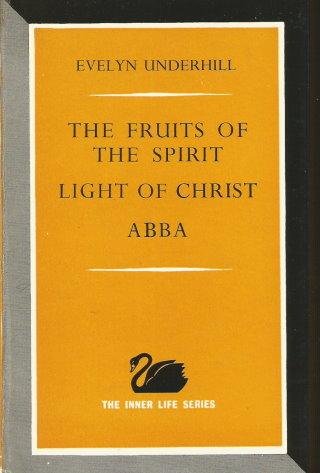
Fruits of the Spirit

The Fruits of the Spirit, Light of Christ, Abba by Evelyn Underhill, 266 pages

This is a collection of transcriptions of three conferences hosted by Underhill, along with some supplemental material.  In The Fruits of the Spirit she guides the reader along a Jacob's Ladder to holiness through the development of Joy and Peace, Long-Suffering and Gentleness, Goodness and Faithfulness, Meekness and Temperance.  Throughout she stresses patience - these fruits are the gifts of the Holy Spirit in the same way earthly fruits are the product of the Sun - they cannot be forced or hurried.  In Light of Christ she expounds on the imitation of Christ as the foundation of the Christian life, especially focusing on His roles as Teacher, Healer, and Rescuer.  In Abba she uses the seven clauses of the Lord's Prayer as a framework for her reflections

Throughout these retreats, Underhill's focus is on transformation in Christ.  Her principal aim is to draw her retreatants deeper into communion with God in the only way that can be accomplished, through complete abandonment to His Will.  Although she draws extensively on the treasures of monastic spirituality, however, her retreats are all intended for those who, like her, live in the world.  This is Underhill's greatest gift - in her reflections, the challenges of ordinary life are revealed as luminous portals of grace.

Saturday, December 24, 2016

Hope for the World

Hope for the WorldHope for the World: To Unite All Things in Christ by Raymond Leo Cardinal Burke with Guillaume d'Alancon, translated by Michael J Miller, 123 pages

"Humility and confidence" are the two attributes Cardinal Burke claims are vital to a bishop's ministry, and in this book-length interview he exhibits plenty of both.  The caricature of him as an overly formal, legalistic prig is upended by his history as the son of farmers who at the age of eight watched his father die of an extended illness, whose devotional life is centered on the Eucharist and the Sacred Heart, who describes St Therese of Lisieux's Story of a Soul as his "source book for the spiritual life", and who began his study of canon law under orders from his bishop and against his own inclination.  This personal humility does not, however, diminish his confidence in the truth he has received and has been commissioned to proclaim.

In this book-length interview with French journalist Guillaume d'Alancon the cardinal touches upon many problems facing the Church and the world, from the culture of death to the reverent celebration of the liturgy.  Burke is neither a mystic nor a profound theologian, but his singularly guileless manner combines with an unerring consistency and devotion to the Church to form a peculiarly convincing whole.

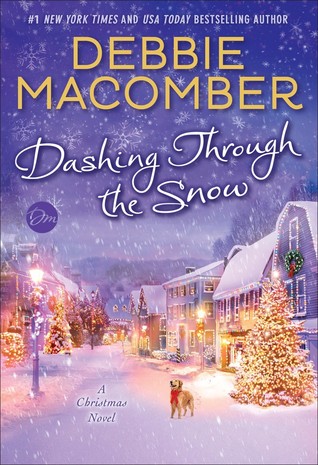
Dashing Through the Snow

Dashing Through the Snow by Debbie Macomber.  Audio Book: 4 hours, 32 minutes;  256 pages       

It’ s Christmas!  I have to indulge in Christmas reads now and then around the holidays and who better than author Debbie Macomber?    This is a really cute story about a gal who is a 24 year old graduate student trying to go home from San Francisco to Seattle to surprise her mother for Christmas.    Of course being young she hadn’t planned ahead thinking that flights might be full for the holidays and worse yet, her name is on the NO FLY LIST!    With all the hubbub of the business of the season, and short staffing, etc.  Ashley, the student ends up sharing a rental with a stranger.   We learn the stranger has a military background.   Lots of twists and turns and fun dialogue and characters. Some close calls, too.

Debbie Macomber knows how to do something really well – she knows how to add humor at just the right place when some authors might go for the more serious. It's endearing and enjoyable and that is an apt description of Christmas and what the author brings.   I won’t tell you the outcome just enjoy the ride.   It is a fun listen while baking Christmas cookies.    I will be looking for more of Ms. Macomber’s books as the holiday season progresses.    As there is comfort food, Debbie Macomber’s works are comfort reading.          

Friday, December 23, 2016

When Organizing Isn’t Enough:

When Organizing Isn’t Enough: Shed Your Stuff, Change Your Life by Julie Morenstern.  288 pages; Audio Book:  10 hours, 11 mins

Julie Morgenstern not only addresses heaving out one’s clutter but she also addresses other areas of life that can get cluttered and hold us back from the life we truly want and deserve to live.    Clearing out the loved stuff from the unloved stuff is baby stepping toward the other areas that Julie addresses.    She spends a lot of time teaching readers how to disassociate the feeling from the thing.    The washer and dryer your mother gave you is not your mother.   When they stop working, it is o.k. to let them go; they are things, they are not the person who gave them to you.   It’s o.k. to let go of the hideous photo frame Aunt Sally gave you. Take a picture of it, maybe send her a copy  of a photo of you holding it, then thank her for the gift.   Once the gift is received it leaves her hands and goes in to your hands.   Once in your hands, you can find a place in your home for it or if you really don’t want it, set it free.    It is the thought that counts not the thing and if the thing is not serving you then get rid of the thing it becomes a stumbling block if you don’t love it and then it becomes clutter in your way.   Its better to free it for someone else to love or to serve someone else and free the space you had for something you do love.    Julie Morgenstern’s idea is surround yourself with things you love she finds this also affects other areas in your life, too.    Clutter can overpower our thoughts, we can allow our schedules to be so full of clutter that it can affect us physically – stress cause you always say YES instead of No!  

Good book with lots of good ideas and some fun introspective quizzes.    Helps you understand a lot of what is behind our behaviors and our clutter.     Gives some excellent  insight into when, where, how and why things are as they are in our lives.

Thursday, December 22, 2016

Ourselves

Ourselves  by S.G. Redling      Audio Book:  11  hours,  7 minutes; 318 pages

What a concept – the Amish are alien vampire-like creatures that look like us but drink blood.   Whoa!   Okay,  S. G. Redling  never actually says it’s the Amish but her descriptions of their dress, lifestyle, customs and speech certainly spell out A-M-I-S-H to me.   And what an intriguing concept, a religious sect that excludes itself from all others have a very strict set of principles they live by so strict they don’t even associate with others of their kind who aren’t as strict as they are.    What an excellent forum for aliens from outer space to enter into earth and be invisible in full view.    Fascinating.    Just like in all sectors of society there are extremists and there are military, protectors, storytellers, and what appear to be people similar to humans that work at jobs and own businesses and go about their days as normally as do humans.    How all these groups and the humans interplay is very well done.     Lots of plot twists and you are never completely sure who the good guys and who the bad guys are until the end.   It is quite a ride.     And what an intriguing thought that vampires could have come from outerspace.     Gives that “Chariot of the Gods,” thing a whole new interpretation, huh?

Wednesday, December 21, 2016

The Bag Lady Papers

The Bag Lady Papers by Alexandra Penney.  240 pages.  Audiobook:  5 hours, 4 mins.

How do you go from being VERY wealthy to being VERY poor? Trust the wrong person. That is what happened to Alexandra Penney. She put all of her money into the hands of Bernie Madoff, the man who introduced the phrase PONZI SCHEME into the American lexicon. Going on the advice of several of her very close fabulously wealthy friends who were clients of Madoff, she, too, allowed Madoff access to her finances eventually trusting him implicitly with all of her finances. At first everyone seemed to be making money on their investments with Madoff. Life was good. Gatsby good. Then, the bottom fell out. Madoff was unmasked and all of the investors lost everything they had allowed him access to. Alexandra did not escape financial ruin. Her fear was that she would become a bag lady like she had seen on the streets when she was young. Penniless, living in a cardboard box if she could find one, begging for food, dying from exposure to the elements and lack of good hygiene she feared the worst always feeling she was one step away from being pitched out on the street.    It became a phobia of hers. Her mind first began running the horrific gamut of  worst case scenarios.    She fought hard to get help in finding Madoff – didn’t happen – getting help from the government – long time coming and she was feeling like a mouse in a maze with no cheese to be found. Alexandra’s circumstances left her penniless. Life just got an abrupt change.She didn’t get a wake up call – she got a full force body slam. Everything she knew was about to go under, that is when she shifted her thinking and decided not to let herself and her child (she was also recently divorced) drown, she was going to live and live as well as she could.  She began to think of ways to take back her life and started thinking of every way possible she could come back from this devastating loss.   She called in favors from friends and started networking with anyone and everyone that might be able to help her get a job. She explored her talents, her strengths and began going on interviews.  

This book tells how a person can rise as a phoenix from the ashes when all you have left are ashes.   She didn’t just have a can do attitude, she had a WILL DO attitude.   A good book for showing one how to truly think outside the box and come back from adversity. Her phobia made her feel it was survive or die and there was no way she was not going to be a survivor. You can almost feel the wheels turning as her ideas come rapid fire.   Guts and determination pulled her through.   Good Read.   I really enjoyed it.  

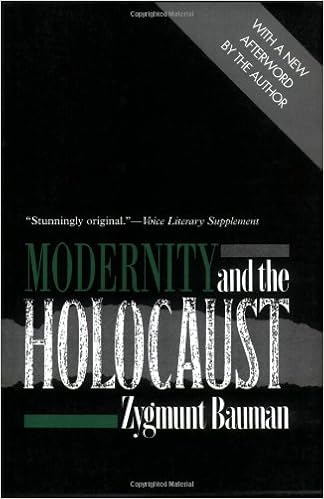
Modernity and the Holocaust

Modernity and the Holocaust by Zygmunt Bauman, 207 pages

In Modernity and the Holocaust sociologist Bauman attempts to explicate how the Holocaust, far from being the uncharacteristic irruption of atavistic drives and premodern ways of thinking it is so often reflexively (or, perhaps, defensively) characterized as, was, in fact, distinctively modern.  In Bauman's view, while modernity did not make the Holocaust inevitable, it did make it possible.  Indeed, in Bauman's account, modernity was crucial in virtually every element of the genocide.  Obviously, modern technological sophistication was necessary to manufacture the vast machinery of death that is virtually unique to the Holocaust.  But perhaps even more necessary was the organizational sophistication of the modern state, which created a distance between the actual killing and those responsible, both those giving the orders and those carrying them out.  

The most important element of the "elective affinity" between modernity and the Holocaust, Bauman maintains, is the foundation of the latter in the former's characteristic confidence in the power of man to reshape himself and his society.  The Holocaust is unthinkable without a belief in social engineering, a hygenic logic that demands the efficient removal of any threat to public health.  Modern genocide is not the spontaneous product of passion, but a planned, rational process.  The anti-ethical space in which the Holocaust took place was prepared by a technocratic outlook which "scientifically" excluded all considerations besides efficiency and technique, with moral concerns further displaced by the innate consequentialism of progressivism - the belief that history will justify any crime in the glorious future that is always aborning.  The monopolization of violence and authority by the modern state meanwhile leave society physically defenseless against injustice, but, even more importantly, the ideology of rational calculation and enlightened self-interest on which the modern state is founded leaves individuals morally unequipped for resistance.

It is these qualities which separate modern genocide from more traditional forms of mass murder - the latter was aimed at destroying communities, the former with the complete physical annihilation of a class of people, the latter was a passing disorder, the former an enduring order, the latter was a violent attack entirely from without, while the former involved the suborned collusion of the victims themselves.  In considering these characteristics of the Holocaust as a product of modernity, Bauman does more than contribute to our understanding of a specific historical event, he forces a reconsideration of the "legitimizing myth" of modernity itself.

Tuesday, December 20, 2016

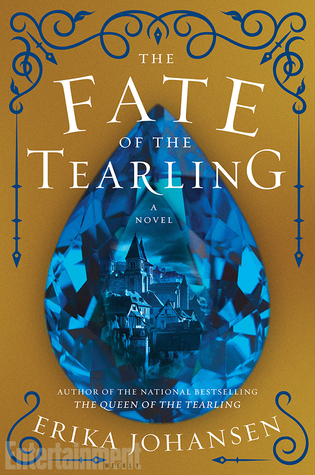
The Fate of the Tearling

The Fate of the Tearling by Erika Johansen.  497 pages.

This is the conclusion to the Tearling trilogy, a book which I have been waiting for for months.  And, it was totally worth the wait, and has convinced me that I will now be buying the three books (which is a big thing for me, since I usually don't buy many books).

This book continues where the 2nd book left off, where Kelsea Glynn has transformed from a plain teenager into a powerful monarch, and now faces off against the Red Queen, who has imprisoned Kelsea.  Faced with impossible choices, and with the Mace serving as Regent in her place, Kelsea needs to figure out how to save herself, and her people.

If you haven't read the previous two books, then my summary (and this book) won't make much sense.  It's a definitely timeline-dependent story, which flows from one book to another.  I appreciated that the author put so much effort into the worldbuilding and the storylines.  It was easy for me to pick up the story and follow it through, and I found I was just as caught up in this book as I had been in the previous books.  One of the things I really enjoy about this trilogy is that when you start the first book, it seems like a typical fantasy-esque book . . . and then as the story continues, it turns into something much more, with timelines that reveal things you wouldn't expect at all.  While I was a bit sad that the trilogy has ended (and actually got a bit choked up at the end), the author did a nice job of tying things up so there's a good resolution to things.

Monday, December 19, 2016

Loss and Gain

Loss and Gain: The Story of a Convert by Bl John Henry Newman, 432 pages

One of Newman's two novels (the other is Callista), Loss and Gain is the story of Charles Reding, the only son of an Anglican country vicar, and the personal, philosophical, and religious dilemmas he faces during his studies at Oxford.  Ultimately these struggles cost him university honors, a comfortable career, and the good opinion of his professors, friends, and family, as they lead him into the Catholic Church.

Obviously, there is a connection between the novel and Newman's own experience, although he was some twenty years older at the time of his conversion than his fictional creation.  The novel benefits greatly from this - it is not a tale of road to Damascus experiences, of which Newman was suspicious, but rather a slow, gradual, but ultimately irresistible attraction.  Newman occasionally interrupts the narrative to speak directly to the reader, a device which admirably covers some of his deficiencies as a storyteller and keeps the plot moving despite the lack of action.  Adding to the novel's charm is the author's satirical take on the varieties of Victorian religion.  The result is a quiet, convincing, beautiful portrayal of one young man's devotion to truth and corresponding willingness to lose his life in order to find it.

Season to Taste

Season to Taste by Natalie Young.  Made it to 80 pages before stopping.

"Meet Lizzie Prain. She is an ordinary housewife and lives with her lovely dog and her husband, who is a bit of a difficult fellow, in a quiet cottage in British country side...

No one has seen Lizzie's husband, Jacob, for a few days. That's because last Monday and Lizzie snapped and cracked him on the head with her garden shovel. No one quite misses Jacob though, and Lizzie surely didn't kill him on purpose. And now that she has the chance to live beyond his shadow, she won't neglect her good fortune. Over the course of the following month, with a body to get rid of and few fail-proof options at hand, Lizzie will channel her most practical instincts and do what she does best: she'll cook Jacob, and she'll eat him."


I don't usually use the Goodreads summary.  But I'm doing it here, because when I read it, I thought that I'd be getting an unusual, darkly humorous book.  However, I got to page 80 and just called it quits because 1) I didn't care about Lizzie, 2) the book wasn't funny (and I like dark humor ... but seriously, I wasn't even cracking an occasional wry smile here) and 3) I didn't really care about what was going to happen in the story. I felt like there was potential here, but there was no intrigue. I had expected the whole "eating the husband" to be a bit icky, but it felt grotesque.   This is a book with an interesting premise that isn't handled well enough to actually be a good story.

Friday, December 16, 2016

Flat Earth

Flat EarthFlat Earth: The History of an Infamous Idea by Christine Garwood, 362 pages

Once upon a time, every American schoolchild knew that Columbus sailed the ocean blue in 1492 and proved, despite the obscurantism of swarthy Inquisitors, that the earth was round.  Many are still taught this, if not as pure history, at least as part of the mythical war between Science and Faith.  Of course, by the time of Columbus the fact of the sphericity of the earth had been virtually unchallenged for two thousand years and was firmly embedded in medieval culture, as witness The Divine Comedy and the emblem of the globus cruciger, the orb topped with a cross, used as a symbol of Christ's dominion over the world.

As Christine Garwood explains, the legend of Columbus as the conqueror of flat earth superstition had its origins in the early nineteenth century and the desire to cast Science as the liberator of mankind from the slavery of religion.  Ironically, it was this same narrative that helped to generate the first genuine flat earth theorists in a millennium, as a few extreme fundamentalists, believing that science was the inveterate enemy of what they were convinced was the Biblical view of the universe, declared that the supposed roundness of the earth was, in fact, a massive deception.  Turning the tables on their opponents, they claimed that their "zetetic" mode of inquiry, which relied entirely on personal observation and experience, was more objective than conventional science.  Indeed, they even attacked the round earth "theory" as an ancient superstition with no place in a more enlightened age.

Garwood traces the history of flat earth belief from the debating societies of Victorian England to the desert of twentieth century California.  Along the way, she includes a colorful assortment of cranks and charlatans, from aristocratic dilettantes to fire-breathing faith healers to playful Canadian academics, all of whom Garwood treats with admirable sympathy.  In addition to being consistently interesting, Flat Earth reveals that, far from being a survival of "medieval superstition", flat earth belief is a form of modern pseudo-science, which not only helps to explain the fringe appeal of a flat earth, but more popular forms of pseudo-science such as "creation science".

Thursday, December 15, 2016

Bardwell's Folly

Bardwell’s Folly by Sandra Hutchison   342 pages

I’ve read Sandra Hutchison’s first two novels (The Ribs and Thigh Bones of Desire and The Awful Mess) and loved them both. Now there is a third novel for me to love and tell all my reader friends to grab a copy.

In this story, Eudora “Dori” Bardwell and her stoner brother, Salinger, are living in a small town in upper Massachusetts. The house is a replica of a southern plantation home her father, Bedford Bardwell, built as a living legacy to himself and his Pulitzer Prize-winning novel, Tea and Slavery, which was considered the most important work of fiction about slavery since Uncle Tom’s Cabin.

The house, known as Bardwell House, is a historical landmark in town, and the townspeople are very, very fond of it. A board of trustees runs the house, but thanks to her father’s will, Dori and Salinger are allowed to live there. Unfortunately they aren’t allowed to make any changes, so the summer heat is stifling. In other words, no air conditioning.

The air conditioning is only one symbol of how out-of-touch Dori is with the modern world. She doesn’t have an answering machine, a computer, or a mobile phone. Now 26, Dori had to leave college when her father flew his plane with her mother and four other siblings into the ocean (aka John Kennedy, Jr.) years earlier. She barely makes ends meet working at as a nursing home aide and a part-time grocery clerk. She may live in what seems like a mansion, but the cupboards are bare. Many nights she goes to bed hungry.

When the trustees decide to hire a service to keep up the lawn, to keep up appearances, Dori comes face-to-face with her high school sweetheart, a man whose marriage proposal she refused in front of the whole high school. Sparks fly.

Thanks to an insensitive racial joke, which blew up on social media, Dori’s family in once again in the spotlight. For years, there had been rumors of an unfinished manuscript that her father left behind. When a reporter comes snooping around, interest in finding the manuscript becomes important to the board and leads Dori’s to uncover deep family secrets.


A mixture of romance, intrigue, family secrets, past lives, and a house that is as much a character as Tara was in Gone With the Wind, create a spell-binding read that you won’t want to put down. I give Bardwell’s Folly 6 out of 5 stars.