A Man For All Seasons by Robert Bolt, 163 pages
This blog is the home of the St. Louis Public Library team for the Missouri Book Challenge. The Missouri Book Challenge is a friendly competition between libraries around the state to see which library can read and blog about the most books each year. At the library level, the St. Louis Public Library book challenge blog is a monthly competition among SLPL staff members and branches. For the official Missouri Book Challenge description see: http://mobookchallenge.blogspot.com/p/about-challenge.h
Showing posts with label Plays. Show all posts
Monday, September 26, 2022
Man For All Seasons
Sir Thomas More, councillor to King Henry VIII, stubbornly refuses to approve of the conduct of his king. In return, the ministers of that king force him first into retirement and finally to the scaffold. Sir Thomas alone, amid a crowd of vain, greedy, and ambitious men, remains true to himself and his principles, and this earns him persecution and death. The story is a familiar one, but here beautifully and movingly told.
Part of the story's familiarity is due to the classic 1966 movie version of this very play, adapted by Bolt himself. The play differs from the film primarily in the part of the Common Man, who plays various minor roles and offers sporadic commentary to the audience. If this is a stagy artifice, there is a certain value in the character precisely as he represents our own practical natures against the very impractical sanctity of Sir Thomas. Of course, Bolt hollows out that sanctity by presenting St Thomas as a martyr, not for the truth, but rather for what he believes.
Sunday, November 14, 2021
Oresteia
Oresteia by Aeschylus, translated by Richard Lattimore, 171 pages
The Oresteia is a cycle of three plays relating the tragedy of the royal house of Mycenae in the aftermath of the Trojan War. Agamemnon tells the story of the return of the king, accompanied by the captive Cassandra, and his murder by his wife Clytemnestra, who had taken his cousin Aegisthus as a lover during his decade-long absence. The Libation Bearers continues the story as the son of Agamemnon and Clytemnestra avenges his father by slaying his mother. Finally, in The Eumenides, the goddess Athena stands as judge between the titular Furies and Orestes, in the process establishing Athenian jurisprudence and domesticating the goddesses of vengeance.
Robert Lowell once admitted that it is impossible to recover the power of Aeschylus' drama, "something no doubt grander than any play we can see." Perhaps some intimation of that power is available to us in these post-Enlightenment times, for meeting it outside the cramped blood-soaked ground of the grand narrative of progressive history, what the reader is immediately struck by is its earnest religiosity. It is certainly possible for a crippled soul to dismiss Apollo, Athena, and even the Furies themselves as dramatic contrivances and ignore the atmosphere that surrounds them in favor of shallow psychologizing. It is likewise trivial to invert the tale, to turn Clytemnestra into the righteous avenger of her sacrificed daughter, inevitably ending with her liberation of Cassandra into an unconvincing sisterhood. If Aeschylus does not have true religion, it is certainly more true than any of the modern simulacra. Aeschylus' cycle is a real myth, his tragedy rooted in a legacy of crime and guilt inherited both by the sons of Atreus and the daughters of Leda, a shared fault that stretches back into remotest antiquity, where it assumes unknowable cosmic proportions, and which can only be expiated by cult and sacrifice.
Saturday, December 5, 2020
Polyeuctus
Polyeuctus, from Polyeuctus/The Liar/Nicomedes by Pierre Corneille, translated by John Cairncross, 100 pages
Paulina, the daughter of Felix, the Roman governor of Armenia, was quite in love with the gallant Severus, but his lack of distinction prevented her father from consenting to their becoming wed. Severus having been reported dead in battle after great feats of heroism, Paulina married instead her father's choice, Polyeuctus, a noble Armenian youth. As it transpired, however, Severus survived, the Persian foe having honored his valor by nursing him back to health and returning him to the Romans with offers of lasting peace. So Severus, now high in the esteem of the emperor, returns to Armenia to renew his suit, not knowing that the woman he loves is already married to another. Polyeuctus, meanwhile, has secretly converted to Christianity, and his newfound faith will inevitably bring him into conflict with pagan Rome, ultimately costing him everything he loves in this world.
The conventional view on Polyeuctus, as represented by Cairncross' introduction, is that the drama of the thwarted romance of Paulina and Severus is far more interesting than that of Polyeuctus' zeal for his newfound faith. This is sadly to be expected of conventional critics for whom such zeal is alien and frightening, of course, but even the summary above reflects it. Although it is Polyeuctus with whom the play begins and it is his decisions which drive the main conflict, his character is not where our attention naturally rests. The tale of Paulina and Severus is one of passion barely subjected to reason, that of Polyeuctus a story of the straightforward martyrdom of a fanatic. Yet it is Polyeuctus' supreme devotion to the highest Good that demonstrates the goal to which the pagan virtues of the other characters aspire, a truth that is beautifully consummated at the conclusion of the play.
Saturday, October 24, 2020
Amyntas
Amyntas: A Sylvan Fable by Torquato Tasso, translated by Frederic Whitmore, 72 pages
Amyntas, also known as Aminta, is a short verse play by the author of Jerusalem Delivered, centering on the young shepherd Amyntas and the nymph Sylvia, the object of his unrequited love.
A simple girl, heedless as she is fair,
And ignorant how hot are beauty's arms
To sear, how edged to pierce; whose smiles and tears
Slay, and slay all un'ware e'en that they wound.
Despite the efforts of the other shepherds and nymphs to convince Sylvia to submit herself to Love, she refuses, until unexpected events finally melt her hardened heart. But will it be too late?
In sooth, the laws of Love wherewith he rules
In lasting sway, are ne'er unjust and hard;
His works fulfilled with foresight, mystical,
We blindly do condemn. What skill is his!
Saturday, October 10, 2020
The Mayor of Zalamea
The Mayor of Zalamea by Pedro Calderon de la Barca, translated by William E Colford, 128 pages
A departure for Calderon, but also one of his most popular plays, The Mayor of Zalamea tells the ostensibly true story of a proud peasant whose beautiful daughter became the object of a noble-born officer's lusts. Caught between his offended sense of honor and the plain letter of the law, the virtuous Pedro Crespo takes a stand for justice in defiance of the entire Spanish army.
Unusually for Calderon, this is a historical piece; even more unusually, it features a protagonist from the lower classes. For that very reason, the language lacks the grandiosity typical of Calderon, and this may help explain its continued popularity in an era that celebrates mediocritas. Crucially, however, the play does not resolve with an assertion of equality on the basis of individual autonomy, but with a recognition of equal participation within a larger whole.
Saturday, July 21, 2018
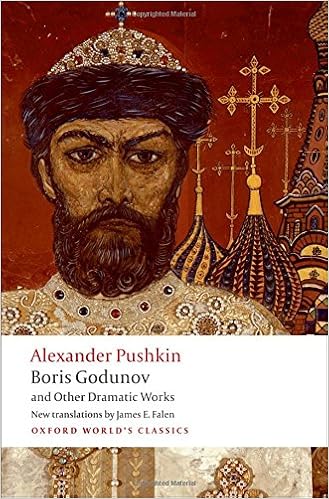
Boris Godunov
Boris Godunov by Alexander Pushkin, translated by Philip L Barbour, 80 pages
The historical Boris Godunov was an influential courtier under Ivan the Terrible, and the brother-in-law of Ivan's feeble-minded son and successor Fyodor. After Ivan's death, Godunov reigned in Fyodor's name, and was widely accused of having ordered the murder of Fyodor's half-brother and heir, Dimitri. When Fyodor died heirless several years later, Godunov was himself crowned as Tsar, but around the same time a man claiming to be Dimitri but identified by others as Grigori Otrepyev, a renegade monk, appeared in Poland, where he gained the confidence of the Polish-Lithuanian nobility and launched a war to press his claim to the Muscovite throne. After Godunov's death, the Russian boyars deserted his son in favor of the pretender, sealing the fate of the Godunov line.
In writing Boris Godunov, Pushkin was clearly influenced by Shakespeare's history plays. As in those, a few smaller moments are planted in the midst of the grand tragedy of Godunov, including scenes of romance and comedy, complete with an aloof princess and bumbling soldiers. Interestingly, Pushkin portrays both the cynical imitation of sincerity for political advantage and the cynical perception of genuine sincerity as political calculation.
Saturday, May 12, 2018
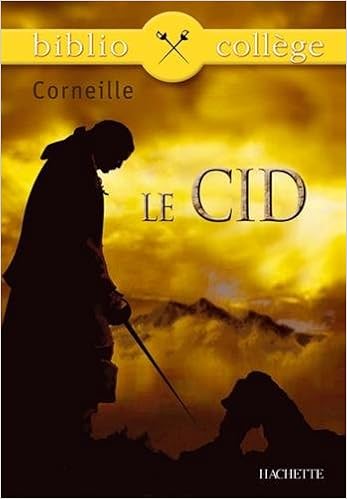
Le Cid
Le Cid by Pierre Corneille, translated by Vincent J Cheng, 196 pages
Corneille's masterpiece tells the tale of how the Cid became the Cid. Deeply in love, Rodrigue and Chimene hope to be wed. These hopes are threatened when Chimene's father insults Rodrigue's father, placing the young man on the horns of a dilemma - avenge the insult by challenging his beloved's father, or dishonor his family and himself.
It pits my honor against my love; to obey
A father, I must throw my love away.
Furthermore, to live in shame would be to prove himself unworthy of her love.
My duty is also to Chimene: this path
Of vengeance would incur her hate and wrath.
But to refrain would merit her disdain.
The seeming choice is really no choice at all, but his victory places Chimene in an analagous position, in which she must seek vengeance on the man she loves.
Although Rodrigue is very dear to me
And though he owns my heart, yet in my head
I know who I am, and that my father's dead.
Indeed, the tragedy of Chimene's position is more profound than that of Rodrigue, as she must pursue a vendetta, not against a relative of her beloved, but against the beloved himself.
Though this fine love dispels my wrath, I'll try
My best to avenge my father; yet, though I
Obey such a cruel duty's rigorousness,
My one wish is to be quite powerless.
Although these lines are Chimene's, either of the lovers could have spoken them. Both wish to be powerless, to be denied agency and therefore responsibility, but their culture denies them this escape into slavery.
Abiding by the rules of French neo-classical drama, the play moves all the physical action offstage - the results of the story's multiple battles and duels are reported to the audience rather than observed. What remains onstage are the emotional struggles of the characters as they attempt to satisfy the demands of honor and love within the narrow formal limits of their society. Meanwhile, Corneille's brilliant use of form is powerful evidence that such limitations are an advantage, not a handicap, to a true artist.
Wednesday, May 31, 2017
Murder in the Cathedral
Murder in the Cathedral is TS Eliot's dramatic retelling of the return of St Thomas Becket to Canterbury and his subsequent murder at the behest of King Henry II. In examining its protagonist and his struggles with enemies both physical and spiritual, Eliot questions the relationship between Church and state, but also and more importantly, between God and man, for "the true martyr is he who has become the instrument of God, who has lost his will in the will of God, and who no longer desires anything for himself, not even the glory of being a martyr."
Murder in the Cathedral is perhaps the best example of a modern play in the classical style, which is to say a play which uses some of the elements and techniques of classical drama without attempting to be a classical drama. This only heightens the effect when the knights break the fourth wall to appeal to, and implicate, the audience. This is, in turn, no postmodern gimmick, but the consummation of the play as liturgical drama, existing in a no-time which is neither present nor past.
We do not know very much of the future
Except that from generation to generation
The same things happen again and again.
Eliot powerfully makes the audience (or reader) and St Thomas into contemporaries - or reveals that we already were. His struggles are our struggles, his temptations our temptations, and his fate our fate, even if we are sometimes lulled by superficialities and distracted by the illusion of the merely visible.
You shall forget these things, toiling in the household,
You shall remember them, droning by the fire,
When age and forgetfulness sweeten memory
Only like a dream that has often been told
And often been changed in the telling. They will seem unreal.
Human kind cannot bear very much reality.
Thursday, March 23, 2017
Harry Potter And the Cursed Child
Harry Potter And the Cursed Child by Jack Thorne, 327 pages
“It was always difficult
being Harry Potter and it isn't much easier now that he is an overworked
employee of the Ministry of Magic, a husband and father of three school-age
children. While Harry grapples with a past that refuses to stay where it
belongs, his youngest son Albus must struggle with the weight of a family
legacy he never wanted. As past and present fuse ominously, both father and son
learn the uncomfortable truth: sometimes, darkness comes from unexpected
places.” I
definitely fall in the “liked it” camp.
Apparently, I am one of the people who like anything Harry Potter
because it’s Harry Potter. That being
said, I felt like it was a pretty good story and that kids who have read and
enjoyed the books will mostly like this also, assuming that the play format
doesn’t distract them from the story.
Six Kids And A Stuffed Cat
Six Kids And A Stuffed Cat by Gary Paulsen, 138
pages
"Six misfits get stuck together in a middle school
restroom and discover friendship. Includes playscript of the story." I really liked this short story. It would work
well for reluctant readers, especially boys, since all of the characters are
boys.
Subscribe to:
Posts (Atom)