Thursday, January 5, 2017

I Woke Up Dead at the Mall

I Woke Up Dead at the Mall by Judy Sheehan  288 pages

What happens to teenagers’ souls when they are murdered? Why they go to the Mall of America, of course! There is a special, ethereal fifth level where the teens prepare themselves to “move on,” or into the light if you’re a fan of The Ghost Whisperer.

Sarah Evans is surprised, no shocked, to find herself waking up dead, wearing the same Godawful mango chiffon bridesmaid dress that she was wearing at her father’s wedding. She is surrounded by other teens who have also been murdered. These are teens in her class that are preparing to move forward with the help of a “death coach,” Bertha. If she can’t move on, she’ll suffer a fate worse than death: she’ll become a mall walker. Think zombie.

Once sixteen-year-old Sarah figures out how she died, she is certain that her father is in grave, extremely grave danger. She believes she knows who her killer is and why that certain someone has plans to off Dad.

The story and plot are quirky. I think it’s supposed to be funny, but I didn’t find myself laughing out loud as I’d hoped when I saw the title. Ya gotta love the title. It would be ease to slip into religion, but Sheehan avoids it. Her”God” is the Boy, otherwise known as the “Boss of You.” He wasn’t well developed and came off as flat.


Sometimes languid, sometime spirited, Sarah is the most complex character in the story. I Woke Up Dead at the Mall receives 4 out of 5 stars in Julie’s world. 

The Sleepwalker

The Sleepwalker by Chris Bohjalian  304 pages

In his twentieth novel, mega-bestseller Chris Bohjalian weaves his most suspenseful not yet (and heck, I didn’t think he’d be able to surpass his previous novel, The Guest Room). This time he tackles the subject of parasomnia, a sleep disorder category that happens between dreaming and waking. I’m always amazed at the topics Bohjalian chooses for his novels. Get ready to stay up way past your bedtime as you won’t want to put this one down.

It’s the fall of 2000. That time frame is established in Chapter One’s opening paragraph is one of the most beautiful he has ever written…and I have ever read.

When Lianna Ahlberg and her sister, Paige, awake that morning, their mother Annalee has disappeared without a trace. Immediately the girls know what has happened. Their father is out of town at a poetry conference and Annalee has parasomnia. They search their home (Bohajalian always refers to it as “the red Victorian”---I loved that) and their neighborhood with no luck. They even head down to the river where years earlier Lianna saved her mother from falling off the Gale River bridge.

A search party combs the nearby woods and the girls’ father, Warren, hurries home. No luck. Liana blames herself; she knows that her mother sleepwalks when her father isn’t home, but she was sure she’d hear her if she had gotten out of bed. Although the police find a scrap of clothing, the search is called off when a body, alive or dead, cannot be located.

One of the subplots develops when the lead detective has a more-than-healthy obsession with the case. Gavin Rikert has a connection with Annalee and is now attracted to Lianna.

I wasn’t quite sure how much time passed in the novel, but that is the only drawback I can make. I do have to talk about the brief, brief passages that occur before the start of a new chapter. While the novel is narrated by Lianna, I was never clear who was narrating these passages. This added to the mystery and suspense, and it came as quite a shock (in a good way) when readers discover who is behind the voice.


The Sleepwalker receives 6 out of 5 stars in Julie’s world. 

The Fire that Will Not Die

The Fire That Will Not Die by Michele McBride

After reading Fire Angels recently, I wanted to read more about the fire at Our Lady of the Angels School.  This book is written by one of the children who survived the fire, and is an unflinching look at what happened, and also what it took for her to survive and recover.

It's one thing to read an account of the fire by researchers, and articles from the Chicago Tribune and other news sites, but to read the memoir of someone who survived the fire is pretty amazing.  I found that while McBride's writing is sometimes very stiff, her honesty about her experiences is so deliberate that it brings the disaster into focus, and also explores what it meant to be both a survivor of that event, but also to be a burn victim in 1958.  She is unflinching in how she writes about her medical treatment, recovery, and how family, friends and neighbors reacted to her, both in the hospital and once she was able to finally go home.

I was curious to know more about her, and discovered that Michele McBride died in 2001.  Her obituary mentions that she was a survivor of the fire, and also mentioned that she had tried to start a foundation to help other burn victims.  I had been wondering about this, since the book jacket mentioned that she had been working to establish a foundation, but couldn't find any information about it.  However, I did find mention of her in a June 10, 1961 article from the Saturday Evening Post, which discusses the intricacies of treating burn victims, and also how the hospitals handled the flood of children from the disaster at Our Lady of Angels.

Wednesday, January 4, 2017

The Book of Speculation

The Book of Speculation by Erika Swyler   audiobook: 11 hours, 42 mins.    Hardback:  384 pages

Go, Erika Swyler!   I really liked this story, the characters, the whole package.     You had me at Tarot.     But, of course there were so many other draws here for me, too, a travelling circus, fortune tellers, genealogy, it doesn’t matter if it is mine or someone else’s I find it fascinating to learn of a family’s history.    Not to mention the narrator of the story is a Librarian.   Come on, how could anyone not like this book?    Simon, the Librarian (almost rhymes) is such a great big brother and he has had to deal with the loss of his mother (some say suicide, some say a strange dark force at play) then the loss of his father emotionally.   His Dad just sort of mentally checked out after the loss of his wife and Simon even though he was only 6 years old ends up basically raising his 2 year old sister, Enola.    Odd coincidences come to light over the years and strange family ancestry and ties in peculiar directions are made known.    A mysterious book of a travelling circus’ history along with hand drawings of the Tarot deck arrives in the mail addressed to Simon.    This book holds an awesome power over Simon, his sister and an eccentric book purveyor.      Simon’s next door neighbor, a parental figure for Simon and Enola, has hand drawn likenesses of dark haired women with piercing eyes  out in his garage.     He tells Simon he thinks they are ancestors of his but these people look surprisingly like Simon’s mother.      Unique people abound with occult and aquatic skills throughout the story which ties present with past occurrences.   Don’t want to give too much away but trust me there are more to mermaids and horseshoe crabs than you would first think.    Kudos to Erika Swyler on her first novel.    More!  More!  

Public Library and other stories

Public Library and other stories by Ali Smith.  220 pages

This series of different stories doesn't necessarily focus on only public libraries, although they do focus on what we do with books, how they affect us, and how they make us view the world around us.  Interspersed with the stories are conversations with readers and writers reflecting on the essential role that libraries have played in their lives.

I found this to be an interesting collection of stories.  Some were stranger than others, and a few times, I found I couldn't quite follow a story.  I liked that the author added the conversations with writers and readers, and actually found some of what they said to be a bit more interesting than a few of the stories.  For example, Sophie Mayer, said (in context of Buffy, from Buffy the Vampire Slayer, citing a library card as a weapon), "Libraries save the world, a lot, but outside the narrative mode of heroism: through contemplative action, anonymously and collectively.  For me, the public library is the ideal model of society, the best possible shared space, a community of consent - an anarcho-syndacalist collective where each person is pursuing their own aim (education, entertainment, affect, rest) with respect to others, through the best possible medium of the transmission of ideas, feelings and knowledge: the book."   (p. 75)

I wouldn't usually put in such a long quote, but I really love that bit.  This is definitely an interesting book to pick up as an introduction to this author, and to some interesting ideas, as well.


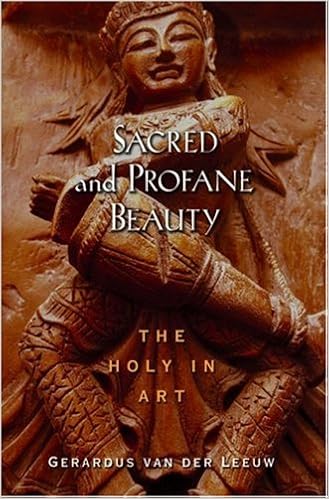
Sacred and Profane Beauty

Sacred and Profane Beauty: The Holy in Art by Gerardus van der Leeuw, translated by David E Green, 340 pages

In his masterful phenomenological analysis of the relationship between religion and art, van der Leeuw begins from the premise that religion is inherently totalizing - "Give all you have to the poor and follow me."  The religious impulse, therefore, is to subordinate everything to religion and to discard what cannot be subordinated.  The aesthetic impulse, as with the political, scientific, ethical, and philosophical impulses, demands an autonomous sphere within which it can develop and thrive on its own terms.  The result was the gradual fracturing of the primitive unity in which all aspects of human life - work, play, art, religion - were intimately intertwined.  Although modern man cannot recapture that unity, in van der Leeuw's eyes a renewed respect for the primal religious character of art will contribute to a regeneration of popular art and the end of "the idea that music must be treated as though it were meant only for connoisseurs in the concert hall and, according to which, paintings are dealt with as though they had to be preserved in a museum".

The analysis of art in Sacred and Profane Beauty begins with dance, the "art of beautiful motion", identified here as the primal art from which the other arts - drama, poetry, the visual arts, architecture, and music - emerge.  For van der Leeuw, the "path from art to theology and from theology to art" follows the sacred quest of art to make present the image of God through movement and form.

Monday, January 2, 2017

Resurrecting the Idea of a Christian Society

Resurrecting the Idea of A Christian SocietyResurrecting the Idea of a Christian Society by RR Reno, 192 pages

In Resurrecting the Idea of a Christian Society, RR Reno maintains that the current class crisis, as chronicled in books like Coming ApartOur Kids, and Life at the Bottom, is fundamentally a crisis of values.  Western elites have rejected a traditional value system while embracing a therapeutic culture that replaces "good" and "bad" with "healthy" and "unhealthy".  Unfortunately, while the well-off have the resources necessary for the treatment for vicious "unhealthy" habits and the amelioration of the consequences of "unhealthy" actions, the poor do not, and have become trapped in a failed culture.  As a result, in the twenty-first century the "preferential option for the poor" demands a renewal of traditional values.

In addition to the moral imperative, Reno argues that religion is indispensable for a healthy liberal state for a number of reasons.  By promoting community engagement, religion builds solidarity, fighting the selfishness fostered by meritocracy.  Likewise, by strengthening social ties, religion promotes localism, beginning with the family.  By asserting a source of authority higher than the state, religion serves as a guard against tyranny and complacency.  Most of all, as Chesterton observed, religion guarantees true freedom, liberating man from "the degrading slavery of being a child of his age." 

It is this last, Reno proposes, that ultimately ties religion to the drive for individual liberty which is at the heart of American culture.  Radical individualism alienates man from himself, dooms him to dissatisfaction, and leaves him defenseless against the evanescent fashions of ideology.  Only by committing himself to eternal truths can he find a living freedom that empowers him to swim against the tide.

Saturday, December 31, 2016

Silver Linings

Silver Linings by Debbie Macomber        Audio Book: 9 hours      Book: 400 pages

I really like Debbie Macomber’s holiday stories but this was not one of those. This story  was o.k.. I wasn’t thrilled with the storyline nor the characters it seemed a little flat to me, like maybe the author really wasn’t all that into it herself when she was writing it.   I was at the end of the story before I really began to like the characters at all and even then it was kind of like, meh.    There are really two stories going on throughout the book,  it begins with the owner of a bed and breakfast inn who lost her husband in the war with Iraq.  She had been a young bride not married long when her husband was missing in action then found dead later.    To take her mind off things she uses the insurance money to buy an inn.  She, Jo Marie,  is kept busy with, as she explains, living like a grandma baking cookies and working in the garden and tidying.   She hires a handyman who is grumpy but tolerable and who loves her baking and spends some evenings with her playing board games.    He is mysterious never giving out any info that would reveal his background.   She falls for him but one day he up and tells her he has to leave.   She is dealing with abandonment issues (again) and trying to convince him to stay.   He won’t say why but he has to go.    His reasoning is later told which could be a story in itself.   The second story line is about two guests who come to stay at the B&B while they are attending their 10 year highschool reunion.   Coco is coming back to wreak vengeance on an arrogant guy who used her then tossed her aside on prom night.    Coco  also dissed the class Science Club guy who shyly asked her to prom first.   She couldn’t be bothered with him.   The guy she did go to prom with took her out on a bet with his buddies.   He had his way with her then wouldn’t speak to her after.    For 10 years she has been seething over the humiliation and wants to get him back in front of everybody at the reunion.   Funny, she didn’t do any self-reflecting on how she made Hudson, the Science Club guy feel.   He was pretty much beneath her notice and someone to be ignored at the time.   Her bestie Katie is coming back to try to rekindle the flame with the love of her life she lied to and dumped as the senior school year was ending.   Katie  and James fell  madly in love when he was tutoring her in Algebra.     They planned to marry once they graduated and James’s grandparents were going to pay for him to go to college.   They had their lives mapped out until James’ mother took Katie aside and told her they shouldn’t marry until he graduated from college and that James’ grandparents would not pay his way if they got married.  Instead of Katie talking to James and discussing the truth of their situation and working out waiting until he completed his schooling, instead she lied and said she wanted to see other people, and a bunch of other crap.  Why lie if you are in love?    You should work things out, compromise and make it work, but, no she lied, told him a whole bunch of untrue stuff, dumped him and even though he wrote her every day, she wouldn’t answer him and finally sent him a letter saying don’t ever write to her again (because it was too hard on her reading his heart wrenching letters, well waaa waaa waaa for her).   I did not like either of these two gals.    Coco thought she was better than the one poor guy who mustered all of his courage just to ask her to the prom – she didn’t care about how rude she was to him – she sure cared when she was treated rudely by her prom date, Ryan, though.    Why that was too much!   She wanted revenge because her feelings were hurt.   But she couldn’t be bothered about the poor fellow she kicked to the curb.   He was just supposed to suck it up and go away and not bother her anymore.          With Katie, instead of thinking about how she just tore James’ life apart and how hard it was for him, naw, he was just supposed to get over it and come back to her once he graduated so  she could tell him, April Fool, just kidding!    All is well it’s all o.k. now things can go back to how they were before, hearts and flowers and fiddle-de-de.    What a couple of Scarlett O’Hara’s!     Being the genre it is, the story goes on and I won’t spoil the ending but, the sheer self-centeredness of these characters and the oblivious attitude of only seeing one’s own motives and disregarding the feelings of others was very off-putting for me, regardless of their motives.   Debbie Macomber, I like your writing but these characters, not so much.

Here Comes the Sun

Here Comes the Sun by Nicole Dennis-Benn.  352 pages.

Set in the small town of River Bank, Jamaica, this story focuses on three women: mother Delores, and daughters Margot and Thandie.  Delores works hard, but Margot is the one who works the hardest, providing for the three of them, especially Thandie.  Margot is determined that all of her sacrifices are for Thandie, so Thandie can do well in school and surpass the rigid societal hierarchy that keeps Delores and Margot firmly in place.   However, Thandie doesn't necessarily share the same dreams that Margot has for her, and as Margot's ambitions start to become more and more difficult to sustain, the lives of all three women are in jeopardy.

The author is from Jamaica, and her deft writing brings this story to life.  She captures the distinct dialect of the characters, as well as the setting. This story definitely illustrates how Jamaican tourists see the seaside village of River Bank as a beautiful place, but don't see at all that the native people are suffering and barely getting by.  Margot's decisions and sacrifices are especially keen, and by the end, it's clear that she hasn't chosen the easy (or right) way to do things.  The author really captures the problems of intergenerational decisions that do damage, and how the cycle just seems to continue on.

Friday, December 30, 2016

Demon in Democracy

The Demon in Democracy
The Demon in Democracy: Totalitarian Temptations in Free Societies by Ryszard Legutko, translated by Teresa Adelson, 182 pages

A prominent intellectual in the Solidarity movement during the '80s, Ryszard Legutko has served in various positions in both the Polish government and the European Union since Solidarity's triumph.  This has not been an altogether positive experience.  Even before the fall of communism, Legutko noticed the affinity between Western elites and their Warsaw Pact counterparts - a sympathetic understanding which did not extend to anti-communist dissidents.  According to Legutko, he and his fellow members of Solidarity, in common with their dissident counterparts in other countries, did not seek a primarily individual freedom, but freedom for their religion and their nation.  After 1989, however, they were instructed that religions and nations were both obsolete and must be abandoned in the name of modernity.  The functionaries in Brussels are just as hostile to tradition as the functionaries in Moscow had been, and nearly as intolerant, though far less violent.

It is Legutko's argument that, when liberal democracy ceased to view tolerance, equality, and pluralism as goods alongside other goods and began to exalt them as supreme goods, then the proponents of liberal democracy came to see dissenters as hopelessly wicked, and their repression as justified.   Liberal democracy being identified with tolerance and equality, dissenters are by definition racists, sexists, homophobes, Islamophobes, and so on.  Anything that partakes of hierarchy or absolute truth claims - patriotism, art, religion, the family - must be abolished according to the logic of this intolerant anticulturalism.  As a result of its ideological rejection of the best of the past in favor of modern mediocrity, Legutko warns, the West is marching towards the dystopia of the hollow men.

Thursday, December 29, 2016

The Other Einstein

The Other Einstein by Marie Benedict  304 pages

I don’t know much about scientist Albert Einstein except that he won a Nobel Prize for his Theory of Relativity. I even read, some time ago, Driving Mr. Albert: A Road Trip Across America with Einstein’s Brain by Michael Paterniti. All that I remember from that nonfiction piece is that Paterniti, along with the man who performed the autopsy, drove from New Jersey to California with Einstein’s brain to give to Einstein’s granddaughter. It was rather silly, if memory serves me correctly.

So one might wonder why I would be interested in this piece of historical fiction. Basically, I really, really, really enjoy the women-behind-the-men genre that is so popular right now. Other books in this genre that reads might find fascinating are The Paris Wife and The Aviator’s Wife.

In this work, we get to meet Mileva “Mitza” Maric. She is a brilliant woman, studying to be a physicist in the early 20th century. All her life, her parents have encouraged Mitza to pursue a life of the mind. Not only did they recognize her intelligence, but she had a physical deformity that they believed deemed her unmarriageable.

The story opens in 1896 as Mitza and her father are walking through the humid, “foggy, Zurich streets to the Swiss Federal Polytechnic campus.” She is the only female enrolled to study physics. There are five men in her class, one of whom is Albert Einstein.

The first 100 pages of the novel drag. It seems most of the scenes are repetitive and the science gets in the way. They are about science, Mitza’s determination and brilliance, and the two’s attraction toward each other.

When Mitza and Albert go on a romantic getaway to Lake Como in Italy, the novel takes off. Albert comes off as a royal a**hole. I wonder how much of that is really true. But, this is  biographical fiction.


The Other Einstein receives 4 out of 5 stars in Julie’s world. 

Okay For Now

OkayFor Now by Gary D. Schmidt, 360 pages

"As a fourteen-year-old who just moved to a new town, with no friends, an abusive father, and a louse for an older brother, Doug Swieteck has all the stats stacked against him until he finds an ally in Lil Spicer--a fiery young lady. Together, they find a safe haven in the local library, inspiration in learning about the plates of John James Audubon's birds, and a hilarious adventure on a Broadway stage."  I read this for the first time the year that it came out.  I re-read it recently and I think I liked it more the second time around.  I had only rated it 3 stars on Goodreads and I changed it to 4 after this time.  Definitely a good novel for teens who like realistic "problem" novels.  I read this one in the ebook version because no hard copies were available.

Wounded

Wounded by Laurel K. Hamilton, 65 pages

"Anita attends the wedding of her close friend but finds that even on the happiest of days there are wounds that need healing. She and the wereleopards Micah and Nathaniel are asked to talk to the bride's thirteen-year-old brother, Tomas, who is struggling to recover from a recent gunshot wound. Depressed and demoralized, Tomas isn't doing his physical therapy and could spend the rest of his life in a wheelchair... How can Anita, Micah, and Nathaniel convince Tomas that he can heal when he's given up? They tell him about their own scars and how they took back their own lives after they were wounded. And Anita will realize how lucky they are to have not only survived their pasts, but to now be able to make their own formal commitment to each other— and the vampire in her life..."  This is a short interlude that comes right after Dead Ice and contains serious spoilers if you haven't read that book yet.  It's basically the equivalent of a chapter or two of Hamilton's normal length books and I think it is only available as an ebook.  I liked it and fans of the series probably will too.  Because it is so specific to the series I don't really feel like it stands alone and wouldn't recommend that people who are not already fans pick this up as a starter.

Hippopotamister

Hippopotamister by John Patrick Green, 84 pages

Hippo and Red Panda live right next door in the zoo, which is terribly run down, no one is running properly, and no one comes to visit.  When Red Panda leaves to live in the human world, Hippo thinks that his life sounds fantastic and decides to try it too.  Unfortunately, it seems that the jobs Red Panda chooses for them are not as successful as they might have hoped.  This short graphic novel would be excellent for younger beginning readers, especially those not quite ready for chapter books.  I'm not a big fan of graphic novels but I really liked this one and would definitely recommend it.

Best. State. Ever.: A Florida Man Defends His Homeland


"A brilliantly funny exploration of the Sunshine State from the man who knows it best: Pulitzer Prize winner and New York Times -bestselling author Dave Barry. We never know what will happen next in Florida. We know only that, any minute now, something will. Every few months, Dave Barry gets a call from some media person wanting to know, "What the hell is wrong with Florida?" Somehow, the state's acquired an image as a subtropical festival of stupid, and as a loyal Floridian, Dave begs to differ. Sure, there was the 2000 election. And people seem to take their pants off for no good reason. And it has flying insects the size of LeBron James. But it is a great state, and Dave is going to tell you why. Join him as he celebrates Florida from Key West at the bottom to whatever it is that's at the top, from the Sunshine State's earliest history to the fun-fair of weirdness that it is today. It's the most hilarious book yet from "the funniest damn writer in the whole country" (Carl Hiaasen, and he should know). By the end, you'll have to admit that whatever else you might think about Florida--you can never say it's boring."  I always think that Barry's books are entertaining and this one was pretty funny.  This one actually made me laugh out loud a few times.  Fans of Barry's other books or people who like humor will enjoy this.

Depraved Heart

Depraved Heart by Patricia Cornwell, 466 pages

"Dr. Kay Scarpetta is working a highly suspicious death scene in a historic home in Cambridge, Massachusetts, when an emergency alert sounds on her phone. A video link lands in her text messages, immediately begins playing . . . and seems to be from her niece Lucy. But how can it be? It's clearly a surveillance film of Lucy taken almost twenty years ago.  As Scarpetta watches she comes to grips with frightening secrets about her niece, whom she loves like a daughter. That first clip and others sent soon after raise dangerous implications that increasingly isolate Scarpetta and leave her confused, alarmed, and not knowing where to turn. She doesn't know whom she can tell--not her FBI agent husband, Benton Wesley, or her investigative partner, Pete Marino. Not even Lucy.  Cornwell launches these unforgettable characters on an intensely psychological odyssey that includes the bizarre death of a Hollywood mogul's daughter, wreckage on the bottom of the sea in the Bermuda Triangle, a grisly gift left in the back of a crime scene truck, and videos from the past that threaten to destroy Scarpetta's entire world and everyone she loves. The diabolical presence and singularly "depraved heart" behind what unfolds seems obvious--but strangely, not to the FBI. Certainly that's the message they send when they start harassing Lucy and begin building a case that could send her to prison for the rest of her life.  In the latest novel in her bestselling series featuring medical examiner Dr. Kay Scarpetta, Cornwell captivates readers again with the jolting twists, high-wire tension, and cutting-edge forensic detail for which she is renowned, proving yet again why she is the world's number one bestselling crime writer."  I thought this was somewhat better than some of Cornwell's recent novels.  I've kind of felt like I was trudging through mud, reading a few of her more recent works but this moved much more quickly for me.  Fans of her work will probably like this one.

Still Life With Tornado

Still Life With Tornado by A.S. King, 295 pages

Sarah is having an existential crisis.  She hasn’t been to school for several days.  Something happened at school but she doesn’t want to explain to anyone.  She feels like nothing is original and nothing ever happens.  Sarah is a brilliant artist but lately she can’t create anything.  During her crisis several different versions of herself appear, including her 10 year old self, her 23 year old self, and her 40 year old self.  She feels like she’s going crazy and she can’t talk to her parents or any of her so-called friends.  Her brother left home several years before and she’s thinking about calling him but isn’t sure how that will work out either. King is a pretty amazing writer.  I’ve really liked almost everything she’s written and this is no exception.  This is a great book for teens who are trying to make sense of their lives, especially those who may feel like their lives are out of control.

The Dirt On The Ninth Grave

The Dirt On The Ninth Grave by Darynda Jones, 326 pages


“In a small village in New York Charley Davidson is living as Jane Doe, a girl with no memory of who she is or where she came from. So when she is working at a diner and slowly begins to realize she can see dead people, she's more than a little taken aback. Stranger still are the people entering her life. They seem to know things about her. Things they hide with lies and half-truths. Soon, she senses something far darker. A force that wants to cause her harm, she is sure of it. Her saving grace comes in the form of a new friend she feels she can confide in and the fry cook, a devastatingly handsome man whose smile is breathtaking and touch is scalding. He stays close, and she almost feels safe with him around.  But no one can outrun their past, and the more lies that swirl around her-even from her new and trusted friends-the more disoriented she becomes, until she is confronted by a man who claims to have been sent to kill her. Sent by the darkest force in the universe. A force that absolutely will not stop until she is dead. Thankfully, she has a Rottweiler. But that doesn't help in her quest to find her identity and recover what she's lost. That will take all her courage and a touch of the power she feels flowing like electricity through her veins. She almost feels sorry for him. The devil in blue jeans. The disarming fry cook who lies with every breath he takes. She will get to the bottom of what he knows if it kills her. Or him. Either way.”  I really liked this book, perhaps even more than the last few. It wasn't quite as funny as some, but the story was intriguing and moved quickly. Fans of the series will probably like it. 

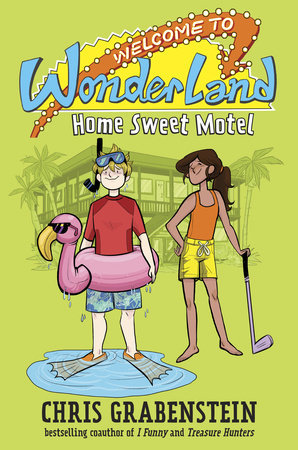
Welcome to Wonderland: Home Sweet Motel

Welcome to Wonderland: Home Sweet Motel by Chris Grabenstein    Audio Book:  5 hours;  284 pages

I liked this story about a family that lives in a motel.   The storyteller is the owner’s grandson, P.T. Wilkie (he was named after P.T. Barnum or is that another of his stories?)   P. T. Wilkie is a born storyteller.     He has not just an excuse for everything that he does or that happens, he has detailed in depth characters and plots and can go on like a politician philabustering in any given situation.   The stories he tells are wild and fun and he somehow makes them all believable even though you know some of the stuff he goes on about honestly would not be possible (ie. riding a crocodile off the second floor of the motel).    He doesn’t let people’s doubting his stories deter him, he will go on and give you all the reasons why it is plausible and so, even though it is clearly outlandish and pretty much impossible.    He is such a likeable young man (pre-teen) that most people are taken with him and his delivery, except for one particularly snarly teacher he has.   There are loads of stories and lots of action here.    His grandfather, Walt Wilkie opened the Wonderland Motel with a pirate putt-putt golf course and lots of huge 25 ft. standing figures and statuary he salvaged from outside muffler places and restaurants back in the 1970s when he opened his motel in Orlando, Florida before that other Walt with the mouse opened his place in 1973.    There was even a miniature railroad that ran on a track back in the early days of the motel that took tourists all around the grounds.   During those early days before Grandpa met Grandma he had his heart stolen by a beautiful girl who just loved to ride the train every day while she was staying there.    It comes to light under the careful eyes of P. T. and his new friend who’s father recently rented them long-term accommodations at the Wonderland, that there may have been something shady that occurred there during those early days and is a mystery to be solved, thanks to P.T.’s avid t.v. watching and amateur sleuthing.     A shady banker working with an even shadier realtor wants to get control of the property  the Wonderland sets on to make it into condos.    P.T., his friends, his Mom and his Grandpa all team up to keep the Wonderland against ominous odds and financial extremes.   More shady characters enter and a tour de force comes into play in a surprising finish.    Well written and  I kept picturing P.T. as a young Christian Slater in my mind.    Very well done.    A good story for all ages.

Wednesday, December 28, 2016

Cooking for Picasso

Cooking for Picasso by Camille Aubray  400 pages

I’m not a Picasso fan, but I am a foodie. The “Cooking” in the title is what initially drew me to this novel. When reading the back cover, I was hooked. The first sentence tells me that this novel is “for readers of Paula McLain, Nancy Horan, and Melanie Benjamin”---three of my favorite authors. Further on I learn that there are dueling timelines (1936 and present day). I adore dueling timelines. So I settled in for an awesome read and was not disappointed.

Cooking for Picasso takes place during a little-known episode in Picasso’s life in 1936. He’s not burned out or blocked; the art just isn’t coming. He sneaks away to a seaside village on the French Riviera, Juan-les-Pins. He hires one of the local cafés to provide lunch for him, provided they can keep his secret.

At the Café Paradis, seventeen-year-old Ondine works with her mother in the kitchen. Daily, her mother sends her to Picasso’s villa with the meal and strict instructions to not speak to him. Ondine is also directed to keep a notebook of what he like and doesn’t like.

Eighty years later, Celine has come from Los Angeles to spend the holiday with her mother, Julie, in Connecticut.  During their conversations, Celine learns that her grandmother had cooked for the infamous artist. Her mother also gives her the notebook that Ondine kept, and alludes to a unknown painting that Picasso had given her.  

Julie had planned to go on a cooking holiday with her sister-in-law, Matilda. Julie has a stroke and is unable to travel to France, her mother’s land, so Celine goes instead.

The plot eaves back and forth between 1936 and current time, but it is mostly Ondine’s story. Still this family saga about three generations of women was simply unputdownable! Part mystery, part treasure hunt, part love story, part travelogue, parts food and art, Cooking for Picasso is a novel that pulls in readers from the beginning and doesn’t let go until the end.
A number of plot twists left me surprised (yeah!). I was disappointed when the story ended. The only missing from this riveting tale was some of Ondine’s recipes.


Cooking for Picasso receives 6 out of 5 stars in Julie’s world. I received this novel in exchange for this review from Blogging for Books.