Showing posts with label Britain. Show all posts

Tuesday, July 21, 2020

British in India

The British in IndiaThe British in India: A Social History of the Raj by David Gilmour, 525 pages

For better than three hundred years, the British were in, and increasingly over, India, first in the form of the East India Company, later as direct representatives of the Empire.  Who they were, why they came, and how they lived are the subjects of David Gilmour's sweeping social history, a pointillist study which sketches the human face of the British presence on the subcontinent.

As a social history, this is not to be confused with a more conventional political or military history, and a basic knowledge of British and Indian history is required to make much sense out of it.  Gilmour admirably resists the natural temptation to put the more interesting oddities in the foreground while leaving the boring commonplaces in the background.  Even more remarkably, he largely abstains from value judgments, allowing the lives of his subjects to speak for themselves without authorial editorializing.  Unfortunately, this does nothing to moderate the at-times overwhelming amount of information Gilmour presents, but so many of the anecdotes he has uncovered are entertaining or enlightening that the reader is likely to find being lost amongst them a delight rather than a chore.

Thursday, February 14, 2019

Lethal White

Lethal White by Robert Galbraith, 650 pages


This is the fourth book in the Cormoran Strike series. Strike is a former military police officer who has been building up his detective agency. His less experienced partner in the agency is Robin Ellacott.

The prologue picks up where the last book left off. Strike has come to talk to Robin at her wedding reception and something she finds out leads to a rocky start to her marriage.

Skip forward a year and a man named Billy comes to Strike's office seeking his help. He is obviously suffering from mental illness and says he saw someone killed but he leaves and Strike can't find him. Something about his story has a ring of truth and Strike can't let it go.

Meanwhile, a government Minister hires Strike to try to get some dirt on a couple of people who are blackmailing him so he can get them to back off. They are close to getting the information they need when things take a turn and their investigation must go in a different direction. Throughout, Strike is trying to track Billy down and figure out if the current case is related to what Billy saw.

Parts of Robin's and Strike's personal lives and their work relationship are woven into the plot and that is part of the reason I like this series.

I felt the last two books in the series were getting a little too formulaic so I thought they were good but could have been better. I would say this one departed from the formula somewhat and rate it as very good.

Friday, August 4, 2017

The Road to Little Dribbling

The Road to Little Dribbling by Bill Bryson            Audio Book: 8 hours, 30 minutes     Hardback book: 400 pages.

I stand corrected.   I thought Bill Bryson bashed America and praised England in the last book I read by him, but, now that I have read this book – I have to say, Bill Bryson bashes everybody equally. J   I guess it would be correct to say that Bill Bryson has a LOW tolerance for what he sees as idiocy no matter where it occurs and no matter who is spewing it.   He is funny, he is witty, he can be cantankerous.   He can really cut pretty deep with some of his remarks and I could see where people would certainly take offense at some of the biting things he says.   For the most part other than his critical comebacks, I do really like his writing and do plan to read more by this author.    I think of him along the lines of the comedians Don Rickles,  Sam Kinison  John Cleese or Lewis Black.   He observes then comments on his utter incredulity at the lack of comprehension on other’s parts.    He can be so funny at times then other times I just have to cringe and think, “this might be why some folks don’t like Americans.”   But, all in all, I don’t think he actually realizes how cutting his remarks can be, I believe he sees only the funny side of what he is saying and not the scathing.   Barring some of his way too frank comments, this is a lovely book on travelling in England and such a lovely description of several off the beaten path places to see in England’s countryside that one might not hear of otherwise.    Best kept secrets are special like that.   Like a present you open and are joyously surprised to find out what is inside.    Bryson never fails to delight if you can get past his perceptions of the shortcomings in others.     There are a lot of gems here and you learn about his background which will explain a lot of why he is the way he is and says the things he does.   I see why his wife often has to get him by the elbow and trundle him off.   A good read by a good writer and a fun sounding road trip for one.

Wednesday, April 6, 2016

Treachery at Lancaster Gate

Treachery at Lancaster Gate by Anne Perry  288 pages

This book begins with an explosion in London that kills two policeman and seriously injuring three more.  At first, it seems to be the work of anarchists, but once Thomas Pitt, Commander of Special Branch, starts investigating, it seems that the motives are much more personal.  In fact, the bombing appears to be a calculated strike against the police.   As Pitt, and his former associate, Tellman, investigate, they reveal layers of corruption inside the police force, which puts them directly in the path of danger.

It's hard for me to believe that this is the 31st book in the Charlotte and Thomas Pitt series.  I read both the William Monk and the Pitt series by Anne Perry, and while I didn't enjoy the last Monk book, I did enjoy this newest Pitt.

I felt Perry did a good job with building the story, piece by piece, and increasing the pace (and sense of danger).   I wasn't sure of the explanation behind the bombings at first, and once it was revealed, that was only part of what was happening in the story.  I appreciate that Anne Perry knows her time periods quite well, and adds in real historical and political details.  I enjoy the characters, as well, and in this book (unlike in the last Monk story), Perry did not belabor the reader with too many details of backstory.  

That's actually an irritation I have with her books, now that they are well into the two series: she goes into way too much explanation and backstory for some of the characters.  For example, by the time I'm at #21 in a series, I don't need a long explanation of how Hester Monk was a nurse in the Crimean Wars (and on and on and on).   In this book, there's a long explanation of Tellman's relationship to Pitt; instead of a long paragraph, why not just a sentence that indicates that Tellman is a former colleague of Pitt?   Ugh.    I understand that if this is the first book you ever pick up, you might be curious, but even so, I feel there's too much of this backstory that happens.

But I digress.   This book was enjoyable, and a worthy addition to the series.

Monday, March 14, 2016

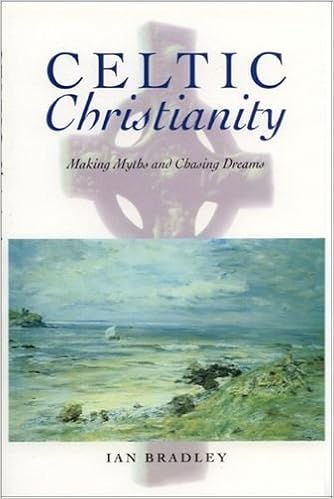
Celtic Christianity

Celtic Christianity: Making Myths and Chasing Dreams by Ian Bradley, 232 pages

This is not a book about Celtic Christianity - the form of Christianity that thrived in Ireland and evangelized Scotland in the fifth and sixth centuries - but rather a book about the many attempts that have been made to claim and shape its legacy.  Indeed, near the end the author raises the question as to whether the label refers to any genuine subject at all, or whether "Celtic Christianity" only exists as a succession of constructions made by subsequent eras.

The book begins with the hagiographers of the seventh and eighth centuries, who idealized the not-so-distant past into a golden age as a way of both condemning and inspiring their own era, as well as promoting the preeminence of certain religious and political centers.  A succeeding Celtic revival arose in the first centuries of the second millennium, following the Norman conquest, as Britons, Normans, and Anglo-Saxons all sought to claim the blessings and legacies of the indigenous saints.  It was also during this era that the Arthurian mythos took shape.  When the Reformation was brought to Britain, Protestants appealed to the Celtic saints as indigenous, erastian Anglican or Presbyterian figures, with the otherwise much-maligned monks becoming a claim for the primitive simplicity of the British Church prior to Augustine's arrival in Canterbury.  In the Romantic era, the aura of mystery surrounding the Celts provided fertile ground for an idealized myth of the Druids, who in turn, it was imagined, transitioned into an equally idealized non-Roman Christian priesthood.  The syncretism of the Romantic approach - holding some legendary Druids as the pinnacle of natural religion awaiting only the Christian revelation to be perfected - has characterized "Celtic Christianity" in the popular imagination ever since.  The twentieth century saw some sober criticism by historians and an increasing tendency to view the subject in terms of contemporary social issues such as feminism and environmentalism.

Bradley is not only the author, but is himself one of the mythmaking dreamers, and as a result he tends to treat his subjects with considerable affection - perhaps too much, as he seems unwilling to actually judge any factual claims once he leaves the Middle Ages.  It is possible to question the discontinuity Bradley evidently sees between the "golden age" and his first two, medieval groups of mythmakers, a discontinuity which excises a considerable amount of traditional "Celtic" material but is necessary in order to provide room for certain alternative interpretations of what remains.  He especially perceives a contradiction between the popular image of St Patrick as the fearless evangelist of Ireland and the self-doubting figure revealed in the Confessio, the only writing of Patrick's which survives, but history is filled with individuals (and especially missionary saints, beginning with St Paul, who is clearly Patrick's model in the Confessio) who are both confident and self-effacing.  The sons of St Bernard used the Celtic tradition in the same manner as St Bede had centuries earlier, to urge a return to a stricter, simpler, "purer" form of monasticism.  Likewise, he asserts that the Arthurian legends are essentially non-Christian, which seems like a highly debatable claim.

Celtic Christianity gains energy and coherence when it begins its discussion of the Victorian fad for all things Celtic and the simultaneous Celtic Twilight movement, and the book might have been stronger if it had begun there (or shortly before) and focused exclusively on the modern era.  This, in turn, might have facilitated a clearer presentation of the different distinctive (though interacting) strains within the contemporary Celtic Christian movement - charismatics, New Agers, Western Orthodox, Anglicans, Welsh nationalists, etc.  Bradley is clearly passionate about his subject and an active participant in its development, but his unsuccessful efforts to shed light on the long-ago only serve to confuse matters in the here-and-now.  In the end, he concludes that enlisting the legends of Celtic Christianity in the service of social justice is preferable to medieval relic-collecting contests, which seems to suggest that politics is more important than the quest for holiness, a conclusion which the great saints of the past would surely have denied.  The true conflict is between seeing those saints as models to be imitated or as brand names to be exploited.

Wednesday, June 17, 2015

Literary Converts


Literary Converts is a somewhat vague title, but it is simpler than Literary British Men and Women of the Twentieth Century Who Converted to the Catholic Church (or Very High Church Anglicanism, If Your Name is Eliot, Lewis, or Sayers).  While this latter title is more descriptive, it still fails to convey the breadth of the stream of literary Britishers to Rome chronicled here, flowing through the twilight of the Empire, beginning on the deathbed of Oscar Wilde in Paris and continuing through to the burial of George Mackay Brown at Stromness in the Orkneys.

Pearce, himself a convert (Race With the Devil), has written at length on the lives of Roy Campbell, Wilde, Lewis, Tolkien, and Schumacher, and this book sometimes resembles background notes to more focused biographies, or even one of Tolkien's appendices.  What it lacks in focus, however, is more than compensated for by the skill with which Pearce manages to illuminate the lives of the better known subjects, while simultaneously calling the readers attention to a galaxy of intriguing lesser talents, mostly forgotten today.

Sunday, August 31, 2014

One Plus One

One Plus One by JoJo Moyes
368 Pages


Let me begin with a confession... I like chick lit.  I don't know if we are still calling it that but I liked the Bridget Jones and Sex In the City books as well as movies like Pretty Woman.  While critics say it is about covers with shoes, I think it is more about women, and sometimes men, coming to a realization or growth that leaves their lives better.  In short, books with happy endings.

One plus One falls squarely in this description.  A single mom, 2 kids, a farting dog and a stranger all come together for a road trip that leaves all their lives changed.  The characters are engaging and the story fun to read.  Literature? No, but all books don't have to be literature, some just have to entertain.

Wednesday, August 27, 2014

The Girl with All The Gifts

The Girl With All The Gifts - M.R. Carey
407 Pages

Yet another zombie book in the overdeveloped genre attempts to chisel out an unique niche.  The story takes place in Great Britain, 40 years after the collapse of society when the population became zombified.  The army base is conducting experiments on a group of children who although infected, still show signs of higher intellect.  The main character is the girl Melanie, one of the test subjects

I will admit, that although the book is about zombies it is well written and more about the development of its characters than the eating of brains.  It examines the social philosophy of the survivors versus the children and their humanity.