Thursday, January 19, 2017

The Floating Lady Murder: A Harry Houdini Mystery (Book 2 of 3)

The Floating Lady Murder: A Harry Houdini Mystery (Book 2 of 3) by Daniel Stashower  256 pages

I wasn’t impressed with Book 1 in The Harry Houdini Mysteries, but this one is much, much better. The Floating Lady is a magic trick that is at the heart of this wonderful novel.

Again, the story is narrated by Harry’s younger brother, Dash, and is set a few years around the turn-of-the-century New York City. The book starts out in the same manner as Book 1: Harry has been dead for many years and Dash is an old man. On the anniversary of Harry’s death, reporters show up at his door, wanting to glean insight into the infamous magician. Dash vacillates between each story to tell, which will garner the biggest story, and which is the freshest. He decides on the Floating Lady murder. He’s never talked about it before and as all the players, except himself, are dead, Dash feels he can finally tell the story.

Harry hasn’t quite made a name for himself---yet. He and his wife, Bess, are struggling financially and live with his mother on East 69th Street. Dash is somewhat better economically, but barely.

A world re-known magician, Harry Kellar (not a fictional person), is hiring for his show. He’s working on a new illusion in which a woman floats through the air, high into the dome of Belasco Theater. It is to be the highlight of his career, as this illusion has never been successfully performed.  

Kellar is worried about spies from other magic shows and hires the brothers as they would be able to spot a would-be theft more than someone who does not know the art of illusion. Lots of intrigue follows, most notably the escape of Boris the Lion.

The illusion really goes by two names in the novel, The Levitation of Princess Karnac or the Floating Lady. That doesn’t cause any confusion. On opening night, before a packed house, high-wire artist Francesca Moore falls seventy feet from the top of the dome. Seemingly a tragic accident, the coroner soon discovers that Miss Moore did not die on impact. In fact she had water in her lungs and had drowned.


Harry and Dash take it upon themselves to find the real killer. The two have several adventures that make for a great read. Stashower makes one faux pas that jumped off the page at me. On Page 10, he mentions magic performed on television shows. Even if Dash’s narration is near the end of his life in 1945, magic on television would be commonplace.

The Floating Lady Murder is much better than Book One, The Dime Museum Murders. It’s more of a page-turner than its predecessor.  I give Book Two 5 out of 5 stars in Julie’s world.


Today Will be Different

Today Will be Different by Maria Semple  259 pages

Eleanor knows she's disorganized (and that's putting it nicely), but today, she vows, it will be different.  Today, she'll tackle the little things. She won't swear. She will follow up on yoga lessons.

However, today is the day her son, Timby, has chosen to fake sick to leave school and spend the day in his mother's company.  It's also the day that Eleanor discovers that her husband has been telling his office (but not Eleanor) that he's on vacation.  What else could happen?  Actually, quite a lot.

I enjoyed the author's previous book, Where'd You Go, Bernadette, so I had been hoping to enjoy this one, as well.  It started out well enough, although part-way through, I started getting really annoyed with Eleanor.  Annoyed enough that I thought about closing the book and returning it to the library.  However, I stuck with it, and then, all of a sudden, it seemed like everything changed.  Once you get to a certain point in the story, you learn more about Eleanor's background, and, especially, her relationship with her family.  Things about Eleanor start to make a little more sense, and although she's still scattered (and kind of annoying), I had more insight, and thus more compassion.  

There are a lot of things that this book has in common with the author's previous book, and there was a definite sense of deja vu for me.  I also didn't find the book as funny as the previous book, and chalked that up to how I found the main character in this story to be frustrating and annoying.  While I wouldn't mind reading another book from Maria Semple, I'm hoping that her next effort will be different from this book and her previous book.    This was an enjoyable enough read on a gloomy day, but I won't be buying it to read over and over again.

Everything I never told you

Everything I never told you by Celeste Ng    304 pages

I was convinced I knew exactly what was going on the entire way through this book, until the last chapter where I realized how wrong I was. The story follows a mixed Chinese American family after the loss of their daughter. Each character has their own version of the events that led to the final few chapters. The story takes place in 1977 and has themes relating to women’s rights, homosexuality, un-wanted pregnancy, peer pressure, and death and suicide. I felt completely engrossed in this book though my expectations weren’t very high jumping from one genre to another whilst beginning this book. As I said before there are many topics that are touched upon during this novel. I caution young adults to read with care.

Wednesday, January 18, 2017

Ideas Have Consequences

Ideas Have ConsequencesIdeas Have Consequences by Richard M Weaver, 192 pages

Written and published in the wake of the Second World War, Ideas Have Consequences takes as its first premise, admirably summarized by the title forced upon Richard Weaver by his publisher, the claim that ideas have an existence independent of those who think them, and events will follow the logic of ideas whether their proponents will it or not.  Weaver traces the origins of modernity to medieval Aristotelianism, which meliorated the early medieval and patristic rigorous ascetism of Christianity, to the nominalism of William of Ockham, which denied the independent existence of universals, and to eighteenth century Whiggism, which represents the negation of history, memory, and tradition.  

Of these, Weaver finds the second to be the most significant, as the denial of universals is tantamount to a denial of form and therefore a rejection of any kind of definition, limitation, or discrimination.  This leads to a shift from a belief that learning ought to be humbling to one in which knowledge is empowering, and a social system under which "manipulation is a greater source of reward than is production".  In Weaver's view, man did not discard the concept of essences because it was disproven, but because it was an obstacle to his own ambitions.  For Weaver, the flight to the city which characterizes the modern age is a flight from nature, and therefore also a flight from reality.  In the new, artificial order, enlightened self-interest dissolves the spiritual basis of true community, while the parallel cult of sincerity gives rise to a never-ending quest for sensation which actively attacks personal and historical memory.  This produces a population of spoiled children who believe happiness to be their natural right but lack the resources to attain to true happiness.  Incapable of understanding this, they become resentful and prone to blaming any scapegoat, whether the one percent or illegal immigrants, for their unhappiness.  Inevitably, treating men as mere bundles of egotism leads to statism and an obsession with "privilege".

Ideas Have Consequences is a cri de coeur, not a systematic work.  Weaver never resolves the question of whether metaphysics reveals deeper truths or covers reality with necessary illusions.  Meanwhile, his critique of Romanticism is a simplification of a complex movement and neglects the restorative aims of some of its leading figures.  Yet if Ideas Have Consequences does not present a fully developed analysis of modernity, what "it offers is a challenge.  And the challenge is to save the human spirit by re-creating a non-materialist society.  Only this can rescue us from a future of nihilism, urged on by the demoniacal force of technology and by our own moral defeatism."

Twelve Days of Christmas

Twelve Days of Christmas by Debbie Macomber     Audio Book:  5 and ½ hours  Book:  400 pages  

  What a crabby neighbor Julia has.     She tries to be so happy and bright for folks all the time and this guy next door, Cain, is a real Grinch.     She tells her best friend about him and about the blog she is going to write to try to get a job as a social media person.      Her friend suggests she kill two birds with one stone.    Kill the Grinch with kindness over the next twelve days (of Christmas) and blog about her progress in being nice to someone to see if it changes their attitude.     Over the course of the next 12 days she gets shot down at first.    The guy doesn’t trust her motives.    He’s been burnt bad by a woman so he’s a little shy of females bearing chocolate chip cookies or trying to buy him coffee in the morning at Starbucks.     Plus she is incessantly chipper and constantly talking.    At first it annoys him but the one day she has had a bad day and doesn’t say anything to him makes him ask if she is o.k.    Tough day at her day job at Macy’s and her volunteering that night at a Senior Citizen’s home playing piano.   Just so happens this guy’s grandfather is a resident at that home and they run into each other there.    She sort of stalks him a little.   Finds out who his grandfather is and starts visiting and talking out what she is up to.     His grandfather becomes a good friend and ally in her quest to sweeten Cain’s disposition.     Funny enough they end up falling in love and out of love but have faith dear readers this is a Debbie Macomber romance!    And the ups and downs make for great blogging and thousands of responses!     Looks terrific on her resume, too!      Don’t know if it’s a Hallmark Channel movie, yet, but, I pictured Candace Cameron Burre as Julia in my mind the whole way through.    Just sayin’ Hallmark, I think she would be perfect for the role.           I liked this one a lot.

Ghosts of the Fireground

Ghosts of the Fireground by Peter Leschak   288 pages.

In April, 2000, author Peter Leschak discovered the diary of Father Pernin, one of the survivors of the Peshtigo disaster in 1871. Throughout that summer, when Leschak was fighting fires, himself, he takes us through Pernin's experiences with the Great Peshtigo Fire, along with his own reflections on his journey from the ministry to fireground leader.

I had originally picked up this book because I was looking for something on the Peshtigo Fire, which I'm quite familiar with. I found this to be an interesting read, and not quite what I had expected. Leschak's own background and experiences with fighting wildland fires is really interesting, and to have the additional reflections that he has upon reading Pernin's diary gives the book an extra layer of information.  Understanding the realities of fighting wildland fires, Leschak's insights into what happened in Peshtigo lends to that history, as well.

I did find that this book sometimes had some slow parts, and feel that better pacing (or editing) would help with this.  I also don't know if I would have found it as interesting if I didn't know anything about the Peshtigo fire, so my advice to another reader would be: if wildland firefighting is something you find interesting, you might like this book.  If you know about the Peshtigo fire and are interested in current-day practices for fighting wildland fires, you might like this book.  However, I think that those are two types of readers who would like this book; to someone just picking it up out of curiosity, the book might be too dry.

Tuesday, January 17, 2017

Incarceron

Incarceron by Catherine Fisher     458 pages

Dystopian flair with a hint of steam-punk carries this young adult novel through a hidden prison. From the perspective of a young man who was born in the prison to a young woman who was born to the ward of the prison. The main characters are both struggling with their beliefs regarding the expectations their elders and peers have on them, as well as the mystery of how the prince of the kingdom disappeared and the legend behind the only person known to have escaped the prison. I enjoyed this novel for a few reasons. One was the switching of perspectives between our two main characters. I was able to see their viewpoints clearly and to understand why they had developed into the people they were. Their motivations began to intertwine and led into a great sequel. I was impressed by the descriptions of the prison and the kingdom. It was clearly another way to see two different perspectives. I would recommend this book to anyone from 10 years old to 99 years old.

The Sun Is Also a Star

The Sun Is Also a Star by Nicola Yoon    Audio Book:  8 Hours    book: 384 pages

What a great day!   Good and bad it all was an amazing day for both Natasha and Daniel.    Two people brought together by a number of signs and odd circumstances to both be in the exact place they were at the same time and who would ever believe two people from extremely diverse backgrounds and life situations could find the answers they needed in one another?    The universe will bring soulmates together no matter how far apart they might begin their journeys.    And happily love never dies.     A poet who speaks of love among the stars and an existentialist who notes that the sun is also a star and far too many poets put far too much emphasis on the moon and the stars.     Who would have thought two people with such different attitudes toward life and love could find compatibility and complete each other.    Opposites attract it’s said, but, these two lovers are not so far apart in their thinking as they would like to believe they are.    I loved the way this book progresses from the mind of one character to the other.   It is such a rich blend.   This is a most excellent story told realistically with joy, sorrow, despair, hope, tragedy and triumph.    Love is an awesome thing that time cannot contain.    Beautifully done.      A modern day Romeo and Juliet.     I think the Bard would definitely approve.

Monday, January 16, 2017

Difficult Women

Difficult Women by Roxane Gay.  260 pages

This book of short stories features a variety of characters, from women who are poor, to those who are wealthy, in good marriages, or difficult marriages, with children, without children - the whole gamut.  In one of the stories, there is a pair of sisters, who have been inseparable ever since they were abducted as children.  In another, a woman who is married to a man with a twin brother pretends not to realize when he and the brother periodically change places.

These are just a few examples of the stories here. I found that some of the stories really stuck with me, while others were forgettable (and one or two were pretty strange).  One of the ones I liked is "North County," about a woman who moves to Upper Michigan for a job and has difficulty leaving her past behind. I also liked the story about the woman married to the man with a twin brother.  Some of the stories are strange, like "I Am a Knife," and "Baby Arm," but the one thing that really ties all of the stories together is that these women all feel very real, even though they are all so different.  And many of them are difficult, in one way or another, even if "difficult" means "hard to like" or "hard to understand."   I had been waiting weeks to get this book from the library, since I have read other books and stories by Roxane Gay and had enjoyed them.  I don't know if I'd want to re-read this entire book of stories again, but I can see revisiting some of the stories at some point.

IA: Initiate

IA: Initiate by John Darryl Winston   218 pages

IA: Initiate is a young adult novel touted to be a supernatural thriller. Taking place in a dystopian America seemingly not far into the future, IA: Initiate is the story of thirteen-year-old “Naz” Anderson. He’s lucky. He and his little sister, Meri, have been fostered by the same parents, but the urban area, the Exclave,  in which they reside seems something out of the Kurt Russell movie, Escape from New York or any of the inner cities of the country’s largest cities.

The setup for the story opens in the past, which is written in present tense. Winston does a good job with this. Then, beginning with Chapter One, the timeframe moves to the present, told in past tense. Interesting concept.

Naz does his best to keep a low profile. It’s rather difficult. His foster parents are awful. He sleepwalks. He hears voices. All that makes a great composite for a character, but that’s the extent of the supernatural powers he has. He tried to stay off the streets if at all possible for fear of the gangs. 

One day he sees some of the gang members while he and Meri are going to school. He manages to dodge them long enough to get Meri to school, but on his way to a different school, there is a confrontation. Luckily, his best and only fried, Ham, is there to help him. Ham gets stabbed, but Naz escapes. It seems as if Naz drops Ham like a hot potato. He never goes to check on him or even worries about him.

I must have missed a lot in my reading. First, I didn’t see any supernatural powers. I read on Amazon that Naz has telekinetic and telepathic abilities.  I don’t recall any, other than the hearing of voices. Then there is the IA. I thought, until I finished the book and read it on Amazon, that IA stood for International Academy. On Amazon, I learn that is one of the Exclave’s most infamous gangs, Incubus Apostles. Third, I’m assuming that the chapters were about Naz andMeri’s biological parents, but I was never sure.


There is a sequel to IA: Initiate. Hopefully, it’s better than this one. IA: Initiate. gets 2 out of 5 stars in Julie’s world.

The Clancys of Queens

The Clancys of Queens  by Tara Clancy 256 pages

When I chose this book, I understood I was picking up nonfiction. I like nonfiction when it’s told as a narrative. Maybe that’s one of the reasons why I love historical fiction so much. Based on the dust jacket cover, even though “A Memoir” is printed right below the title, I thought I was picking up a biography of the Clancy family from maybe the 1930s through the 1950s. I was surprised to learn the timeframe is late 20th-century into early 21st century. I will admit that I didn’t’ read much past the first sentence of the book’s description. “Fifth-generation New Yorker, third-generation bartender, and first generation author…” sealed the deal for me. What I thought I was getting and what I got was a pleasant surprise, and an excellent read.

We first meet Tara Clancy when she is seven years old. She divides her time between four homes: Her father’s converted boat shed (talk about open-layout), her mother’s dingy apartment and her mother’s boyfriend’s Hampton estate, and that special place in Queens: her grandparents’ home in a geriatric area filled with Brooklyn-born Italians.

Clancy does an excellent job is depicting her family, the area, her friends, and her lifestyle. I won’t say it was addictive reading, but each evening I looked forward to seeing what Clancy was up to next. I was surprised to learn that all of character’s names had not been changed to protect the innocent, but there is nothing horrible about each one. They are who they are, and I found this refreshing.

The person who most rubbed me the wrong way was Clancy’s grandmother. She was rough. A no-nonsense, foul-mouth Italian immigrant, she was a force to be dealt with. That’s one of the things that make The Clancy’s of Queens such a fascinating read. It’s the real story of real people, not some sugar-coated adaptation of the mild mannered immigrant grateful for the opportunities American provided.

Readers get to experience life in a real way, in Clancy’s way, and those real-life stories are often hard to come by. I have several favorite episodes, but the ones that stand out are:
·        Making her rounds through the neighborhood after being dropped off at her grandmother’s. This sounded like fun and reminded me of my dad making his rounds after he retired.
·        Her mother taking her to Los Angeles to introduce her to her sexuality
·        Weekends spent on Mark’s (her mother boyfriend) Hampton estate, where there was croquette, no television, and hours and hours of philosophical discussion between Clancy and Mark.

The Clancys of Queens gets 5 out of 5 stars in Julie’s world.

I received this book from Blogging for Books in exchange for this review.


Crisis of Western Education

https://images-na.ssl-images-amazon.com/images/I/51W6W2Q8%2BkL._SX322_BO1,204,203,200_.jpgThe Crisis of Western Education by Christopher Dawson, 246 pages

According to the esteemed cultural historian Christopher Dawson, Western education in the middle of the twentieth century was in the throes of a crisis of a type that has occurred before - in late Scholasticism, in Alexandria in late antiquity, and in Constantinople near the end of the first millennium, amongst other times and climes.  The difficulty lies in a shift in the academy towards a focus on techniques rather than the handing down of a humanistic tradition, a concentration on the manipulation of things rather than an understanding of things, of cleverness rather than wisdom.  The danger he perceives is the supremacy of the technocrat who (in the words of John Murray) "knows everything... about the organization of all the instruments and techniques of power that are available in the contemporary world - and who, at the same time, understands nothing about the nature of man or about the nature of true civilization."  The cure he prescribes is the introduction of courses of study engaging with the Western tradition, unified as the study of Christendom.

Saturday, January 14, 2017

Holding Up the Universe

Holding Up the Universe by Jennifer Niven     Audio Book:  9 hours   Book: 400 pages

Teenager, Libby Strout,  had a hard time dealing with her mother’s sudden death from a cerebral hemorrhage.    She began to soothe her anxiety and sorrow by medicating with food.    The utter despair at losing her mother who was also her best friend began an obsessive compulsive reaction within Libby’s psyche and the less she could talk about her feelings, the more she internalized her grief.   Like a pressure cooker, the more she stuffed her feelings down inside her the more she tried to fill that gaping hole in her life with comfort food but still she found no comfort.    As her size grew larger and larger, her father took her to doctors and finally a therapist to try to help her out of the abyss of self-abuse she was in.     Libby tried to put up an, “I’m fine,” face for her father.   She knew he was dealing with his own grief and she didn’t want to add to his worries.   She never talked about her Mom to her Dad, she never let on she was battling mental demons until finally after her weight ballooned to 650lbs.    One day laying in her bed, because it had become too painful to try to get up, she had an anxiety attack and couldn’t breath.  She thought she was having a heart attack.     Because the paramedics were unable to get her out of her room due to her size, she had to be cut out of her house and lifted down with a crane.    She endured this humiliation and media circus but finally was assigned a case worker who got through to her.    Finally someone who understood her and let her say what she hadn’t been able to say and someone who was open minded enough to go to the park and twirl in a circle with her when she felt the need, because it brought up a happy memory of skirts she and her mother had when she was little and taking dancing lessons.    They would twirl  in circles so that their skirts would billow out around them.    Her social worker understood just how important this was to Libby and joined her every time Libby wanted to twirl.    It became a running joke for them.    Through this support and friendship, Libby was able to get on a diet and exercise regime where she lost over 190lbs.    Feeling great and sassy and fully alive in her skin, she decided to go back to public school.    Her father was not so keen on the idea knowing how cruel life can be and wanting to protect his little girl.    As expected highschool was no piece of cake nor celery for that matter.   She was hassled by boys pranking her with a “Fat Girl Rodeo,” where the guy who could grab her and hold on the longest won.    The girls were no better, talking about how disgusting her weight was, etc.   The good news was Libby had a power base now.    She was sure enough of herself and comfortable enough with who she was whether other people accepted her or not that she did not let anyone stop her nor did she let their hateful remarks nor notes stuffed into her locker (so many they avalanched one day when she opened her locker door) hold her back from anything she wanted to do, not that it didn’t hurt, but, she felt like after the humiliation of the media dubbing her the world’s fattest teen, if she could get through that, highschool bullies were not going to stop her from being who she was and she was not going to go hide and be quiet.     Things heat up for her in lots of ways when one of the finest looking cool guys in school begins paying her attention.    And it seems they have more in common than they know, they are each struggling with issues in their lives.    I love Libby Strout, she is fierce like the Tracy Turnblad character in Hairspray!      Good story, good book.  

Friday, January 13, 2017

Perelandra

Perelandra by CS Lewis, 238 pages

In Perelandra, the second book in CS Lewis' Space Trilogy, Elwin Ransom is summoned by the eldils to travel to Perelandra, the world men call Venus, for unknown reasons.  Where Malacandra (Mars) boasted a civilization older than that of Thulcandra (Earth), Perelandra is younger - indeed, intelligent life is just beginning.  Ransom recognizes his purpose after he meets the Lady - the Venusian Eve - and the pair are joined by his old enemy Weston, there to play the role of the Tempter.  Or, at least, to be the host for the true Tempter.

Perelandra is less interesting as science fiction than Out of the Silent Planet.  There are some memorable creations - Venus' floating islands of vegetation primary among them - but the focus is now on the philosophical and religious elements of the story.  Lewis' real triumph is in the character of the Tempter.  There is none of the operatic grandeur of Milton's Satan in the thing possessing Weston, but only petty baseness and senseless - worse, passionless - cruelty.  Its arguments are the arguments its kind have made throughout human history, distilled into a few days of subversion, while the final battle between Ransom and not-Weston is one of the most epic fights in all of literature.

Thursday, January 12, 2017

Follow the River Home

Follow the River Home  by Corran Harrington  220 pages

At the heart of the beautifully, beautifully written novel, set along the Rio Grande River in New Mexico, is the sandhill crane. When Daniel Arroyo is eight year old, his neighbor, Helen Sedillo, teaches him about the sandhill cranes: “They’re heading to their winter home, Daniel, The river is like their road, only it’s called a flyway….If you save a place in the sky between April and November, they’ll come back again in the springtime.”

From the time he is eight, Daniel is searching for that road back home. It’s when he is eight that  his little sister, Carmen, dies. He suffers a form of PTSD from her death and believes it to be his fault.  As his family falls apart following her death, Daniel dabbles a bit with homosexuality with his best friend and neighbor across the street, Jeff.

Both boys are drafted and are sent to Vietnam. Daniel comes home, suffering from the most common form of PTSD, but Jeff does not. Daniel tries to live a normal life. He marries his high school sweetheart. Laura, and has a family. He still wrestles with unresolved homosexual tendencies. However, the one thing that gives him peace and helps him home is his work on the Rio Grande.

The river flowed in the irrigation ditch in front of his childhood home, and now he works collecting the water samples. It brings him peace and contentment that he cannot seem to find otherwise.

The book is broken into two parts. The first part, “The River Reader,” is a novella encompassing the events above. The second part, “The River Flyway” is an abrupt change. It’s mostly short stories which focus on other characters, like Jeff’s kid sister, Emily, and her battles with mental illness. I didn’t know who all the characters were and it was weird when the furniture in Daniels childhood home spoke. Still, the stories are beautifully written. Daniel is part of most of them and it’s near the end when readers learn what happened to cause Carmen’s death.


This book is so lyrical, moving and skillfully written I would give it 6 out of 5 stars, But because of the brusque change in voice, Follow the River Home gets 5 stars in Julie’s world.

Still Life with Tornado

Still Life with Tornado by A. S. King     Audio Book:  9 hours    Hardback Book: 304 pages

This is one of those books you just go WOW when you finish it.     Life is art.   All is art.   Even painful things can be art.    The story revolves around 16 year old Sarah who has so much on her plate to deal with in so many directions not to mention the suppressed mental baggage that it all begins to express itself in unusual ways.    Excellently told, A. S. King is truly one of the masters in Youth writing today.   It is not a story the reader will easily figure out.    Many things come in to play in this tale of a teenager in Philadelphia.    The past, the present, injustice, talent, abuse, love, loathing, familial bonds that are stronger than a rat in a hole can gnaw through.    Read it, listen to it, appreciate it.     Fantasy and reality have no real delineations like art they blend, their borders and boundaries blur, the colors and textures create new visions of what is, what was, what shall be.     The state of things as they exist lose their hold on contemporary reality and become something new.     The artist becomes one with all the different phases in her life just as a piece of art takes shape from a single stroke, a single angle, a bit of clay.    This story is so many things wrapped into one delectable tale of a young artist literally meeting herself coming and going.   It’s like biting into an apple.    And it will make you wax philosophic.    You won’t be able to put it down till you finish it.    Excellent book.

Wednesday, January 11, 2017

All Fall Down

All Fall Down by Jennifer Weiner Audiobook: 13 hours Hardback: 388 pages


Allison Weiss is a wife, mother, and daughter trying to do it all. How does she do it all? Prescription pain pills. And it's fine because they're prescription, it's not like she gets drugs off the street. She doesn't have a problem right? This book is about a woman whose life gets out of control because of her habit. While she may not have killed anyone, gone to Family Court, or been arrested, she still loses control. Will she be able to pull her life back together or will her addiction keep her broken?


I enjoyed this book. I liked the realness of the characters. I like that the author made the main character so flawed. She had a problem and still wasn't willing to admit it, the denial was strong with this one. Since I did the audiobook, I should also mention I thought the narrator did a great job voicing, Eloise, the protagonist's daughter. This story took me on an emotional journey, I felt like I was friend being told a story and in which I couldn't intervene, which was maddening in a good way. I would recommend this book, it's worth the read.

Filthy Rich

Filthy RichFilthy Rich by James Patterson and John Connolly with Tim Malloy, 287 pages

In June of 2008, Jeffrey Epstein plead guilty to a single charge of soliciting a minor for prostitution, and was sentenced to spend 18 months in jail, of which he served 13.  It is doubtful whether such a minor case would have garnered any attention beyond an article in the local newspaper, except that Jeffrey Epstein was a billionaire who counted among his friends both Bill Clinton and Donald Trump.  And Epstein had not been accused of having sex with a single teenage prostitute, but paying dozens of underage girls hundreds of dollars each for "massages" and similar sums for recruiting new girls into the network.  The generous plea deal, negotiated by a legal team that included Alan Dershowitz and Ken Starr, is a stark reminder of the extent to which great wealth and political connections can shield an individual from the full legal consequences of even the most appalling crimes.

Overall, Filthy Rich is about what you'd expect from the Patterson firm.  There is no real insight into Epstein - the authors all but admit that he remains a cipher to them.  Nor can the book get too close to his victims, who are, after all, minor victims of sex crimes.  Despite a considerable amount of innuendo, there are no grand revelations about sex parties in which underage girls mingled with American politicians and British royals.  The story of the actual investigation which resulted in Epstein's exposure, however, is somewhat compelling, and the narrative never drags or becomes dull.

The Talisman

The Talisman by Stephen King and Peter Straub.   652 pages.

A twelve year-old boy stands on the shores of the Atlantic Ocean, near a silent amusement park and a a near-empty ocean resort called the Alhambra.  His father is gone, his mother seems to be dying, and the world makes no sense.  However, everything is about to change, as he discovers that he has been chosen to make a journey to save his mother.  The twist is that this journey will not only take him across America, but into another realm entirely.  

This is a quest story, but also a story about friendship and loyalty, filled with wonderful people, and terrifying monsters, and epic landscapes.  Jack, the main character, is faced with danger at every turn, and is mostly on his own to figure out if he can make it through his journey alive.

This is one of the books I picked up instead of continuing to slog through "Be Frank with Me."  I think it's my tenth or eleventh re-read of the book, although this was only the second time I've cracked it in hardcover (I wore out my original paperback to the point where chunks were coming out).  I enjoy many of Stephen King's books (although not really his earlier books) and also like Peter Struab, so when I discovered this book years ago, I had high hopes.  I feel like the two authors brought their strongest storytelling to this book, which has an even pace which steadily increases as the story continues.  There are wonderful characters here, and not just the main character, but many of the supporting characters.  It's easy to envision these people, and the settings, even when you're in the realm of the Territories.

So, a bit of a spoiler here, but this may help explain a little more about what this book is about.  In this story, we have the world we know, but there is also an alternate world, called the Territories.  It's not as large as our world, and there are some similarities, but there's also more magic, and creatures that don't exist in our own world.  Most people exist in our world, and some also exist in the Territories (and that person in the Territories is called a Twinner).  However, Jack is unique because there is only one Jack.  In this world and in the Territories.  Jack also has some special connections, and a special purpose.  So, when he's on his journey to save his mother, he's also on a journey to save someone in the Territories (and basically, save the world).

As mentioned, I've read this book many times.  Even though I know the story, and know what's going to happen, I still love revisiting it, and I still have an emotional reaction to parts in the book.  To me, that's what makes a great story.

Another Use For 101 Common Household Items

Another Use For 101 Common Household Items by Vicki Lansky  159 pages

I love learning new ways to repurpose things.     It’s like recycling at its best.      This book goes from A-Z offering several ideas per topic for other ways you can use the item mentioned in ridiculously clever ways.    Cases in point – shoulder pads cans be used as strategic diaper additives for a baby boy;  use an empty coffee can as a waterproof toilet paper dispenser when camping;  to water hanging plants without spilling water, put a few ice cubes in the pot and let them melt;  use a toothpick to apply glue to sequins or beads;   to make an indoor sandbox fill a wading pool with birdseed and add sand toys.   You will learn so many cool tricks to impress your family and friends with and yourself, too.      It’s amazing.        

Tuesday, January 10, 2017

Truly Madly Guilty

Truly Madly Guilty by Liane Moriarty - Hardback: 418 pages       


This book is about a group of people and an incident that changed all their lives forever. 6 adults, 3 kids and a barbecue. Something terrible happens and now life is different. A marriage is strained, interactions are avoided, friendships are tainted and much more. I can't tell you what happened because the author goes to a great deal of trouble to keep you in suspense.


I enjoyed this book in that it kept me turning the pages. I had to find out what happened at the barbecue and when I did find out I was shocked. The characters were not necessarily endearing and I don't think they were supposed to be. A couple of the characters were written to be a bit strange but it didn't interfere with the story and instead added to it, which I liked. There was no lull in the middle, as a reader I continued to care about the plot even if I didn't care for all the characters. The author had me committed to the story and I love that because I'm a picky reader. I definitely recommend it, but be warned it is only for the patient reader.

Be Frank With Me

Be Frank With Me by Julia Claiborne Johnson   read 200 pages (book is 287 pages)

Alice Whitley takes a job to assist reclusive literary legend M.M. Banning, who has been holed up in her Bel Air mansion for years.  When Alice arrives, she's put to work immediately, but as a full-time companion to Frank, the writer's eccentric (and kind of high maintenance) little boy.  As Alice gets to know Frank, and feel her way around actually assisting the writer in finishing her book, she starts to become consumed with finding out who Frank's father is.

Frankly, this just wasn't my book.  I found I didn't find the characters to be interesting enough, and especially didn't find Frank to be charming (which I think I was supposed to).  Frank annoyed me more than he intrigued me, and after a short time, Alice did, too.  I kept trying, but reached a point where I closed the book for good and didn't look back.  I'm happy to stick with a book, but if I find I'm choosing other books over finishing the one I'm slogging through, I just return it.  That's one of the benefits of getting things from the library: no commitment (and no offense if you don't want to commit).

A Girl's Guide To Moving On

A Girl's Guide to Moving On (New Beginnings #2) by Debbie Macomber
Audio Book: 11 hours   Hardback Book:  352 pages


This has been my favorite book so far by Debbie Macomber.      Strong and devoted female characters (mother-in-law and daughter-in-law) are taken for granted by their philandering husbands and finally get enough of the humiliation and pain they are forced to endure and both end up leaving their husbands.    The ladies are friends as well as relatives by marriage and support each other’s decisions to go on with their life, finding apartments near one another and coming up with strategies together to get their lives back on track by agreeing to try new things, agreeing to try to meet new people and giving back to the community by volunteering.  Through these endeavors each meets a whole host of new people who enrich their lives with new friendships and they each find new romance or maybe it finds them.    The mother-in-law plays games with her admirer and puts him off to play the field since she hasn’t dated in 35 years.      The daughter-in-law is a little more direct with her guy.    There are bitter fights,  accusations by ex-husbands,  love and loss and love again.    It was a really good story.

Monday, January 9, 2017

Architecture of Silence

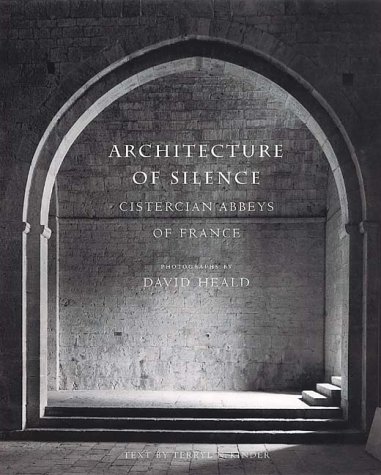
Architecture of Silence: Cistercian Abbeys of France, text by Terryl N Kinder, photographs by David Heald, 137 pages

The Abbey of Citeaux was founded at the end of the 11th century by a group of Benedictine monks attempting to live according to a strict interpretation of the Rule.  Within a hundred years over 500 new monasteries had been founded across Europe in imitation of it.  With the Cistercian way of life came a distinct approach to art and architecture, its simplicity highlighted by the contrast with the contemporary splendor of Gothic.

Architecture of Silence is primarily an album showcasing David Heald's striking photographs of French Cistercian abbeys, with a brief but informative introduction by Terryl Kinder providing background and context.  The beautiful black and white photographs of the abbeys in varying stages of repair and disrepair perfectly capture the stillness that both produced Cistercian architecture and was produced by it.  Although nothing in this world lasts forever, these buildings were designed for eternity and even in ruins seem so naturally part of the landscape that it is possible to believe that they were always there and will always be there.

Saturday, January 7, 2017

Benedict XV

Benedict XV: The Pope of Peace by Henry EG Rope, 320 pages

Benedict XV is the forgotten pope of the twentieth century - the Pope of the Lost Generation, the Pope of the War.  The aristocratic Giacomo della Chiesa succeeded the saintly commoner Pius X on the Throne of Peter after the latter died on August 20, 1914 - mere weeks after the outbreak of World War I - and died himself in 1922, three years after Versailles.  While his predecessor was the only twentieth century pope canonized before the dual canonizations of St John XXIII and St John Paul II in 2014, and his successor settled the half-century-long conflict between the Holy See and the Kingdom of Italy, Benedict is primarily notable for failing to stop what he himself called "the suicide of Christendom". 

Fr Rope did not write a disinterested biography, but an aggressive justification of Benedict's actions during the War, attacking claims made both at the time and later that the Pope failed in his sacred duty, doing nothing while Europe destroyed itself.  To this purpose, Rope catalogues Benedict's extensive efforts to negotiate peace and, failing that, to arrange for temporary truces, prisoner exchanges, and aid to civilian refugees.  He is far less interested in his subject's life before becoming Pope, or in his actions which did not relate to the war, although he touches on them.  His occasional allusions to Masonic plots are somewhat jarring to the less conspiratorially minded reader, and entirely unnecessary to explain events.  Where the book shines is in its thorough defense of Benedict's wartime record, the criticisms of which are uncannily similar to those leveled against Pius XII.  Fr Rope's greatest advantage is chronological - writing in the first years of the Second World War, he has little difficulty demonstrating how the realignment of Europe according to supposedly entirely rational, enlightened principles - in total disregard for the higher justice insisted upon by Benedict XV - led directly to moral disaster.

Remembrances of the Angels

Remembrances of the Angels: 50th Anniversary Reminiscences of the Fire No One Can Forget
by John Kuenster     179 pages

I am still reading what I can find about the Our Lady of Angels fire that occurred on December 1, 1958 in Chicago.  This book, put together by John Kuenster, one of the authors of To Sleep with the Angels, is his collection of stories from fireman, parents, children, reporters, and other people who were in some way connected with the disaster.  Published on the fiftieth anniversary of the fire, this book clearly shows that their thoughts and feelings about their experiences are still vivid.

I always think it's interesting to get viewpoints from people involved with an event, rather than just a news story or "after" story.  By bringing together so many different perspectives, you get a unique view of this disaster.  As the author states in the preface, the purpose of this book is not to give an account of the fire (which he did with David Cowan in their previous book), but to recapture some of the memories of this event.  While these are colored by fifty years of memory, to read these accounts is to gain a deeper understanding of this horrific event that forever changed lived (and actually impacted fire safety from that point on).

Note: There is no link to this book in our catalog, as I obtained this book via inter-library loan.

Friday, January 6, 2017

The Inquisitor’s Tale

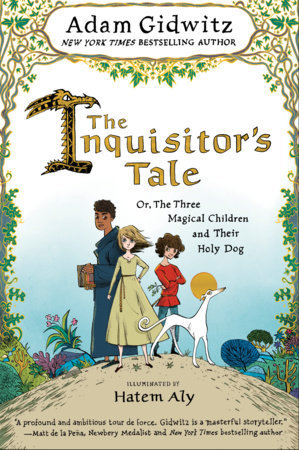
The Inquisitor’s Tale Or The Three Magical Children and Their Magical Dog by Adam Gidwitz                   Audio Book: 10 hours    Book: 384 pages                

My first impression of this book is if the Canterbury Tales were told in modern English rather than Olde English this would be it.     I love the whole flavor of the story and certainly the characters, who wouldn’t love a holy dog who is a hero saving a baby from a snake?    Young people, who you know from their later reputations are going on to greater things and greater martyrdoms.    It is a beautiful mix of historical fact blended liberally with a dash of folk lore and a bit of whimsy to make this wonderful tale told by many people in an evening at an inn where the ale flows and everyone is caught up by this enchanting tale.    I loved it.    I was as enthralled as the folks listening at the inn.    It’s a great story full of action, adventure, friendship, familial bonding, animals, scary stuff, bad guys and good guys, ponderous religious points from Hebrew and Christian theology.    Well done, Adam Gidwitz!    

Thursday, January 5, 2017

I Woke Up Dead at the Mall

I Woke Up Dead at the Mall by Judy Sheehan  288 pages

What happens to teenagers’ souls when they are murdered? Why they go to the Mall of America, of course! There is a special, ethereal fifth level where the teens prepare themselves to “move on,” or into the light if you’re a fan of The Ghost Whisperer.

Sarah Evans is surprised, no shocked, to find herself waking up dead, wearing the same Godawful mango chiffon bridesmaid dress that she was wearing at her father’s wedding. She is surrounded by other teens who have also been murdered. These are teens in her class that are preparing to move forward with the help of a “death coach,” Bertha. If she can’t move on, she’ll suffer a fate worse than death: she’ll become a mall walker. Think zombie.

Once sixteen-year-old Sarah figures out how she died, she is certain that her father is in grave, extremely grave danger. She believes she knows who her killer is and why that certain someone has plans to off Dad.

The story and plot are quirky. I think it’s supposed to be funny, but I didn’t find myself laughing out loud as I’d hoped when I saw the title. Ya gotta love the title. It would be ease to slip into religion, but Sheehan avoids it. Her”God” is the Boy, otherwise known as the “Boss of You.” He wasn’t well developed and came off as flat.


Sometimes languid, sometime spirited, Sarah is the most complex character in the story. I Woke Up Dead at the Mall receives 4 out of 5 stars in Julie’s world. 

The Sleepwalker

The Sleepwalker by Chris Bohjalian  304 pages

In his twentieth novel, mega-bestseller Chris Bohjalian weaves his most suspenseful not yet (and heck, I didn’t think he’d be able to surpass his previous novel, The Guest Room). This time he tackles the subject of parasomnia, a sleep disorder category that happens between dreaming and waking. I’m always amazed at the topics Bohjalian chooses for his novels. Get ready to stay up way past your bedtime as you won’t want to put this one down.

It’s the fall of 2000. That time frame is established in Chapter One’s opening paragraph is one of the most beautiful he has ever written…and I have ever read.

When Lianna Ahlberg and her sister, Paige, awake that morning, their mother Annalee has disappeared without a trace. Immediately the girls know what has happened. Their father is out of town at a poetry conference and Annalee has parasomnia. They search their home (Bohajalian always refers to it as “the red Victorian”---I loved that) and their neighborhood with no luck. They even head down to the river where years earlier Lianna saved her mother from falling off the Gale River bridge.

A search party combs the nearby woods and the girls’ father, Warren, hurries home. No luck. Liana blames herself; she knows that her mother sleepwalks when her father isn’t home, but she was sure she’d hear her if she had gotten out of bed. Although the police find a scrap of clothing, the search is called off when a body, alive or dead, cannot be located.

One of the subplots develops when the lead detective has a more-than-healthy obsession with the case. Gavin Rikert has a connection with Annalee and is now attracted to Lianna.

I wasn’t quite sure how much time passed in the novel, but that is the only drawback I can make. I do have to talk about the brief, brief passages that occur before the start of a new chapter. While the novel is narrated by Lianna, I was never clear who was narrating these passages. This added to the mystery and suspense, and it came as quite a shock (in a good way) when readers discover who is behind the voice.


The Sleepwalker receives 6 out of 5 stars in Julie’s world. 

The Fire that Will Not Die

The Fire That Will Not Die by Michele McBride

After reading Fire Angels recently, I wanted to read more about the fire at Our Lady of the Angels School.  This book is written by one of the children who survived the fire, and is an unflinching look at what happened, and also what it took for her to survive and recover.

It's one thing to read an account of the fire by researchers, and articles from the Chicago Tribune and other news sites, but to read the memoir of someone who survived the fire is pretty amazing.  I found that while McBride's writing is sometimes very stiff, her honesty about her experiences is so deliberate that it brings the disaster into focus, and also explores what it meant to be both a survivor of that event, but also to be a burn victim in 1958.  She is unflinching in how she writes about her medical treatment, recovery, and how family, friends and neighbors reacted to her, both in the hospital and once she was able to finally go home.

I was curious to know more about her, and discovered that Michele McBride died in 2001.  Her obituary mentions that she was a survivor of the fire, and also mentioned that she had tried to start a foundation to help other burn victims.  I had been wondering about this, since the book jacket mentioned that she had been working to establish a foundation, but couldn't find any information about it.  However, I did find mention of her in a June 10, 1961 article from the Saturday Evening Post, which discusses the intricacies of treating burn victims, and also how the hospitals handled the flood of children from the disaster at Our Lady of Angels.

Wednesday, January 4, 2017

The Book of Speculation

The Book of Speculation by Erika Swyler   audiobook: 11 hours, 42 mins.    Hardback:  384 pages

Go, Erika Swyler!   I really liked this story, the characters, the whole package.     You had me at Tarot.     But, of course there were so many other draws here for me, too, a travelling circus, fortune tellers, genealogy, it doesn’t matter if it is mine or someone else’s I find it fascinating to learn of a family’s history.    Not to mention the narrator of the story is a Librarian.   Come on, how could anyone not like this book?    Simon, the Librarian (almost rhymes) is such a great big brother and he has had to deal with the loss of his mother (some say suicide, some say a strange dark force at play) then the loss of his father emotionally.   His Dad just sort of mentally checked out after the loss of his wife and Simon even though he was only 6 years old ends up basically raising his 2 year old sister, Enola.    Odd coincidences come to light over the years and strange family ancestry and ties in peculiar directions are made known.    A mysterious book of a travelling circus’ history along with hand drawings of the Tarot deck arrives in the mail addressed to Simon.    This book holds an awesome power over Simon, his sister and an eccentric book purveyor.      Simon’s next door neighbor, a parental figure for Simon and Enola, has hand drawn likenesses of dark haired women with piercing eyes  out in his garage.     He tells Simon he thinks they are ancestors of his but these people look surprisingly like Simon’s mother.      Unique people abound with occult and aquatic skills throughout the story which ties present with past occurrences.   Don’t want to give too much away but trust me there are more to mermaids and horseshoe crabs than you would first think.    Kudos to Erika Swyler on her first novel.    More!  More!  

Public Library and other stories

Public Library and other stories by Ali Smith.  220 pages

This series of different stories doesn't necessarily focus on only public libraries, although they do focus on what we do with books, how they affect us, and how they make us view the world around us.  Interspersed with the stories are conversations with readers and writers reflecting on the essential role that libraries have played in their lives.

I found this to be an interesting collection of stories.  Some were stranger than others, and a few times, I found I couldn't quite follow a story.  I liked that the author added the conversations with writers and readers, and actually found some of what they said to be a bit more interesting than a few of the stories.  For example, Sophie Mayer, said (in context of Buffy, from Buffy the Vampire Slayer, citing a library card as a weapon), "Libraries save the world, a lot, but outside the narrative mode of heroism: through contemplative action, anonymously and collectively.  For me, the public library is the ideal model of society, the best possible shared space, a community of consent - an anarcho-syndacalist collective where each person is pursuing their own aim (education, entertainment, affect, rest) with respect to others, through the best possible medium of the transmission of ideas, feelings and knowledge: the book."   (p. 75)

I wouldn't usually put in such a long quote, but I really love that bit.  This is definitely an interesting book to pick up as an introduction to this author, and to some interesting ideas, as well.


Sacred and Profane Beauty

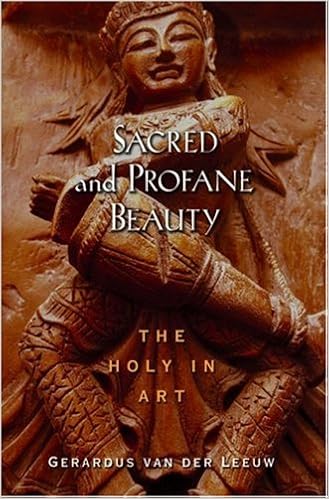
Sacred and Profane Beauty: The Holy in Art by Gerardus van der Leeuw, translated by David E Green, 340 pages

In his masterful phenomenological analysis of the relationship between religion and art, van der Leeuw begins from the premise that religion is inherently totalizing - "Give all you have to the poor and follow me."  The religious impulse, therefore, is to subordinate everything to religion and to discard what cannot be subordinated.  The aesthetic impulse, as with the political, scientific, ethical, and philosophical impulses, demands an autonomous sphere within which it can develop and thrive on its own terms.  The result was the gradual fracturing of the primitive unity in which all aspects of human life - work, play, art, religion - were intimately intertwined.  Although modern man cannot recapture that unity, in van der Leeuw's eyes a renewed respect for the primal religious character of art will contribute to a regeneration of popular art and the end of "the idea that music must be treated as though it were meant only for connoisseurs in the concert hall and, according to which, paintings are dealt with as though they had to be preserved in a museum".

The analysis of art in Sacred and Profane Beauty begins with dance, the "art of beautiful motion", identified here as the primal art from which the other arts - drama, poetry, the visual arts, architecture, and music - emerge.  For van der Leeuw, the "path from art to theology and from theology to art" follows the sacred quest of art to make present the image of God through movement and form.

Monday, January 2, 2017

Resurrecting the Idea of a Christian Society

Resurrecting the Idea of A Christian SocietyResurrecting the Idea of a Christian Society by RR Reno, 192 pages

In Resurrecting the Idea of a Christian Society, RR Reno maintains that the current class crisis, as chronicled in books like Coming ApartOur Kids, and Life at the Bottom, is fundamentally a crisis of values.  Western elites have rejected a traditional value system while embracing a therapeutic culture that replaces "good" and "bad" with "healthy" and "unhealthy".  Unfortunately, while the well-off have the resources necessary for the treatment for vicious "unhealthy" habits and the amelioration of the consequences of "unhealthy" actions, the poor do not, and have become trapped in a failed culture.  As a result, in the twenty-first century the "preferential option for the poor" demands a renewal of traditional values.

In addition to the moral imperative, Reno argues that religion is indispensable for a healthy liberal state for a number of reasons.  By promoting community engagement, religion builds solidarity, fighting the selfishness fostered by meritocracy.  Likewise, by strengthening social ties, religion promotes localism, beginning with the family.  By asserting a source of authority higher than the state, religion serves as a guard against tyranny and complacency.  Most of all, as Chesterton observed, religion guarantees true freedom, liberating man from "the degrading slavery of being a child of his age." 

It is this last, Reno proposes, that ultimately ties religion to the drive for individual liberty which is at the heart of American culture.  Radical individualism alienates man from himself, dooms him to dissatisfaction, and leaves him defenseless against the evanescent fashions of ideology.  Only by committing himself to eternal truths can he find a living freedom that empowers him to swim against the tide.