Thursday, December 15, 2016

Counted with the Stars


Counted with the Stars (Book 1: Out of Egypt series) by Connilyn Cossette      352 pages

The sub-genre of Biblical fiction is, surprisingly, new to me. I have never encountered it prior to reading Connilyn Cossette’s Counted with the Stars. I enjoy Christian fiction and cannot get enough historical fiction so I eagerly delved into this novel.

This is the story of the Exodus of the Hebrews from Egypt. I didn’t understand the terminology of the timeframes (i.e.: 1st Day of Akhet, Season of inundation), but that didn’t interfere with the story at all. The timeline for the novel is basically 1447-8 BC. That was enough for me to place the story.

A thirteen-year-old Egyptian girl, Kiya, is sold into slavery to settle the debts her father incurred from his failed business. She is sold to his friend, Shefu, as a handmaiden for his wife, Tekurah. Tekurah lives to humiliate her slaves, and the fact that Kiya is a favorite of her husband’s infuriates her. She treats Kiya worse, if that is possible, than the Hebrew slaves.

Kiya befriends another slave, Shira, and the girls become best friends. Together they endure their indentured life. As Kiya does her best to satisfy her mistress, the ten plagues are visited upon Egypt. Author Cossette does an amazing job in making reader’s skin crawl with the lizards, lice, frogs, grasshoppers, etc. that invade the desert country. They came a little too close together in my mind. It was like one day for each of the plagues.

As the Hebrews are forced to flee Egypt to escape the deaths of first-born sons, Kiya decides to follow them. As the review from Publisher’s Weekly stated, “Readers will smell the fear on Passover night, feel the wonder of the Red Sea crossing, and sympathize with the starving and thirsting of those escaping in the wilderness.”

Attention of detail and well-developed characters make this a stand-out novel. As I read in “A Note From the Author,” I learned that names in Ancient Egyptian culture are extremely important. I wish Cossette had given us more information about that, but since I didn’t know that while I was reading, that is really an afterthought.

One of thhe things that I liked was the blue Cloud that seemed to follow  Moses. It was like a biblical version of the Northen Lights.

There is one area where the names were an issue, especially in the beginning. Many of the characters names began with “s,” which was confusing. Sometimes I had to flip back to remember who was who, especially in regards to the secondary characters. It is for this reason, I give Counted with the Stars (Book 1: Out of Egypt series) 4 out 5 stars.

The Little House Books - Volume 2

The Little House Books, Volume 2 by Laura Ingalls Wilder.  856 pages.

This volume includes: By the Shores of Silver Lake, The Long Winter, Little Town on the Prairie, These Happy Golden Years and The First Four Years.

I had picked up this volume at the same time as Volume 1, and it was interesting to just read them straight through, one book after another.  Like the previous volume, this edition has a chronology and notes section, which gives additional information.  I had forgotten parts of the stories, since it had been so long since I had read them, but other parts came back to me pretty clearly.  Like with the other books, it's interesting to read these stories with the knowledge of history I have as an adult.  Some of the comments that characters make become a bit more vivid, as does some of what happens.  For example, at one point, Laura's family loses crops to a grasshopper invasion.  This was pretty awful to read about when I was a child, but it was hard for me to envision.  Now, with my knowledge of that kind of event, as well as events like the Dust Bowl, this kind of thing felt even more awful.  When Laura's family is caught in a long winter, they almost starve, and this felt especially vivid and compelling to me reading the story now.

It's been an interesting experience to read these books, especially with the additional notes at the back because it's more like reading a memoir dressed up as stories.

Sleepwalkers

The Sleepwalkers: A Trilogy by Hermann Broch, translated by Willa and Edwin Muir, 648 pages

The Sleepwalkers consists of three interrelated novels spanning thirty years - The Romantic, set in 1888, The Anarchist, set in 1903, and The Realist, set in 1918.  Although featuring different characters, plots, and settings, the three form parts of a single work and are meant to be read together, the cycle tracing the disintegration of values from the delusions of fin de siecle Germany to the crass materialism of the Great War.  The Romantic is Joachim von Pasenow, a military officer struggling to understand the nature of love and honor, torn between his love for his Czech mistress and his idealized dream of a woman of his own social class.  The Anarchist is August Esch, an accountant who longs for freedom and justice but does not know where to even begin looking for either.  The Realist is Huguenau, an army deserter and hustler for whom everything has a price.  He is a wholly new kind of man, entirely different from Major von Pasenow and Herr Esch, who are utterly incapable of preventing his ascendancy.

The Romantic and The Anarchist are fine novels that, with their satirical take on the Romantic Bildungsroman, resemble nothing as much as the existential novels of Sartre and Camus.  The Realist, however, elevates the whole into a work of genius greater than anything the two Frenchmen ever managed to accomplish.  This is true not so much as a result of Broch's deft manipulation of diverse literary genres - the chapters in the final novel shift between poetry, prose, and drama - as the scope and unity of his vision.  The Sleepwalkers is not light reading, but it is a literary masterpiece.

Wednesday, December 14, 2016

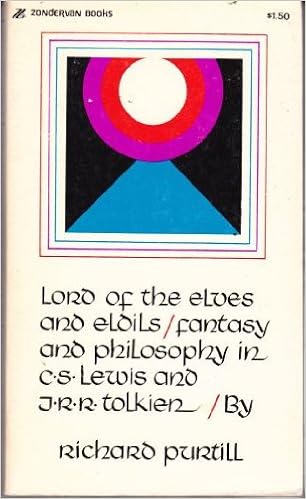
Lord of the Elves and Eldils

Lord of the Elves and Eldils: Fantasy and Philosophy in CS Lewis and JRR Tolkien by Richard Purtill, 211 pages

In this essay on the philosophical dimensions of the fiction of CS Lewis and JRR Tolkien, Purtill busies himself contradicting certain common misconceptions about the works of both authors - foremost among them that Lewis' fiction consists primarily of arguments for Christianity while Tolkien's saga is essentially non-Christian.  He accomplishes this by exploring the underappreciated subtlety of Lewis and the overarching presuppositions of Tolkien.

Lord of the Elves and Eldils was written while Tolkien was still alive, but not only does the author not seem to fear (outside of a few explicitly speculative sections) that Tolkien will contradict him, but some of his arguments are confirmed by the then-unpublished material collected in The Silmarillion, as well as biographical research carried out in subsequent decades.  If this consistency with facts then unknown is testament to the perspicuity of Purtill's observations, the greatest compliment the book can be paid is that it considerably deepens the understanding, and correspondingly heightens the appreciation, of the works of its subjects.

Saturday, December 10, 2016

My Journey Through War and Peace: Explorations of a Young Filmmaker, Feminist, and Spiritual Seeker

My Journey Through War and Peace: Explorations of a Young Filmmaker, Feminist, and Spiritual Seeker by Melissa Burch   208 Pages

Melissa Burch’s story is based on her experiences as a freelance journalist during the Afghan War. When she was only 21 years old, Burch, and her cameraman, was on her to become the first journalist to capture the mujahedeen rebellion against Soviet invaders on tape.

The book opens with Burch sleeping a dirt floor with seven heavily armed Afghan soldiers, ranging from 19 to 20 years old. The tales of journey through Afghanistan will cause the hair on your arms to stand on end. The relentless heat, hunger and fear never left her. The hiding from the Russian soldiers was perilous and terrifying.  She must have covered the entire country either on horseback, motorbike or foot.  I felt her pain as she described a march through the rocky, mountains with Afghan soldiers

There was on anecdote where she and he soldiers were hiding when the Soviets were passing by. They had no sooner left the safety of the deserted compound, than it was blown up. 

One of the things that surprised me about Burch’s time is Afghanistan was that she was never raped. A lone woman traveling with many men had to be vulnerable. Not to say that she didn’t take up with one of the leaders, but it seemed more mutual consent.

My favorite parts of the book were after her return to the States. Maybe it was because I could relate more to that experience.

I approached Burch’s memoir with a bit of negativity. Earlier this year I had tried to read Malala Yousfzai’s I am Malala. I was prepared to be pulled into to that story, but I didn’t past page 50. I was a little afraid that I might experience the same issue with My Journey Through War and Peace: Explorations of a Young Filmmaker, Feminist, and Spiritual Seeker. But from the opening scene that I described earlier, I was hooked. Although places were a little choppy, but it is riveting.


I give My Journey Through War and Peace: Explorations of a Young Filmmaker, Feminist, and Spiritual Seeker 5 out of 5 stars.

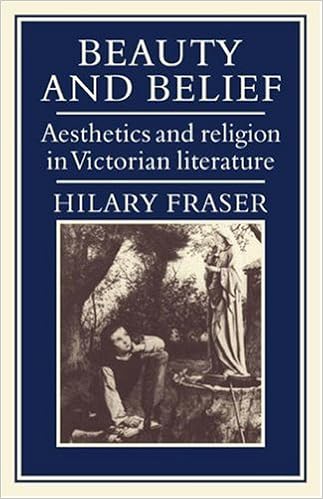
Beauty and Belief

Beauty and Belief: Aesthetics and Religion in Victorian Literature by Hilary Fraser, 233 pages

During the nineteenth century, and particularly in England during the reign of Queen Victoria, traditional religion came under pressure from many sides, especially developments in science, criticism, and philosophy.  Partially as a response, religious believers sought an "alignment of imagination and the transcendent" - finding a new appreciation of beauty as a pathway to God.  This emerged out of the Romantic movement, particularly Wordsworth and Coleridge, and proceeded to be reconceived in turn by the theologizing Romantics Newman and Keble, the moralising Romantics Ruskin and Arnold, and finally the decadent Romantics Pater and Wilde.  Hopkins occupies a unique place, chronologically last, recapitulating many of the views and preoccupations of the others while remaining distinctly himself.

For the Tractarians, poetry was necessary to express the mysteries of God - poetry spoke truth because reality itself is somehow poetic, and the means by which we recognize beauty is intimately related to the means by which we recognize truth.  As Fraser guides us through the Victorian period, art shifts from being a handmaid of religion to religion being a form of art to art being the highest form of religion.  Art likewise revealed truth for Ruskin and Arnold, but for them the relevant truth was primarily ethical and therefore political rather than theological, while Pater and Wilde were more interested in the truth of beauty than the beauty of truth.  Fraser explores this development, and other related matters, in detail, with considerable care and apparent sympathy for his subjects.  The reader is left not only wishing that the book reached back to properly cover Wordsworth and Coleridge, but also that it continued on to consider twentieth century figures such as Chesterton and the Inklings.

Friday, December 9, 2016

Unmentionable

Unmentionable: The Victorian Lady's Guide to Sex, Marriage, and Manners by Therese Oneill.  307 pages.

So you think that the Victorian era is romantic?  Aren't those clothes just dreamy and swoon-tastic?

Well, there are lot of things that are swoon-tastic.  As the book says, "Ladies, welcome to the 19th century, where there's arsenic in your face cream, a pot of cold pee sits under your bed, and all of your underwear is crotchless. (Why? Shush, dear. A lady doesn't question.) "

Never crass, this book completely explains what it would be like to live as a woman in the Victorian era.  Completely with images from Victorian publications, this is an eye-opening look at topic such as "what to wear," "where to relieve yourself," and "what to expect on your wedding night."

This is one of those books where you find yourself laughing, even while you're learning some pretty interesting information.  It's also the kind of nonfiction where you find yourself feeling grateful that you live in the current age.  There were some things that I knew, but many that I didn't, and which actually gave me a lot of insight on just how tough the women in this era were.  The illustrations are funny, although some are a bit sobering, as well. The author has a great writing style which makes some of the things quite funny, but she's got a sharp wit and doesn't shy away from uncomfortable topics. Lest you think the author made up some of the things in the book, it's very well-researched (so there's no avoiding the facts of some of the, well, facts of life in the Victorian age).

Thursday, December 8, 2016


From September 11, 1967, to March 29, 1978, comedienne Carol Burnett along with her regular cast of Harvey Korman, Vicki Lawrence, and Lyle Waggoner (Tim Conway, although a frequent guest star, didn’t become a regular until Season 9 [1975]), beamed into homes across America, causing howls of laughter.

Carol’s new book, In Such Good Company: Eleven Years of Laughter, Mayhem, and Fun in the Sandbox, takes readers back to those days, when comedy---and the variety show format---reigned supreme. In order to write this memoir, Carol re-watched ass 276 episodes of the Carol Burnett Show.

She explains how the show came to be, how it was bounced around through three different time slots, how the character skits developed.  She didn’t leave out anything. She discusses those who worked diligently and tirelessly behind the scenes, the reoccurring sketches, the movie parodies, the guest stars, the Q&As, and the list goes on.

This is an easy read and fun read. It can be read at any point. Say you couldn’t wait to read about Jim Nabors or how Mama’s Family came about. It’s easy to ski ahead and indulge yourself.

Reliving favorite memories with Carol about a favorite guest star, a hilarious sketch, or, my personal favorite, the Went With the Wind parody of the movie Gone With the Wind  is like watching old home movies. You savor the moments, relish the laughter, smile at the disappointments, and generally just feel good when you flip the pages and take a turn down memory lane.  

Carol, thanks for letting us relive the memories with you; it was a hoot!  I give In Such Good Company: Eleven Years of Laughter, Mayhem, and Fun in the Sandbox 5 out of 5 stars.


Crooked Heart

Crooked Heart by Lissa Evans  Audio Book – 8 1/3 hours  Book 284 pages


When 10 year-old Noel is evacuated from London to escape the Blitz, he ends up living in St. Albans with Vera Sedge, a women drowning in debts and dependents.  Noel's got no family left, and no real connection with Vera. However, Vera, always looking for new opportunities to make money, sees a gem in Noel. Together, they cook up an idea, and as Vera starts to make a profit, Noel regains his interest in life. However, it's a dangerous way of life.

There is nothing like a war to bring out the entrepreneurial spirit in people.   Shameful profiteering made funny by two unlikely bilkers, a brilliant 10 year old orphan named Noel Bostock and a 36 year old gal, named Vee Sedge,  who is down on her luck and up to her eyeballs in debt and not above doing whatever con it takes to get by,  .     Noel was raised by his eccentric former suffragette godmother Mattie, who despised authority and found education to be an embraceable concept to experience rather than observe.   Hence, Noel grew up very worldly, socialized and well informed as opposed to other children his age who tended to have a more street-wise grasp and disdain for education in any form.   We know already with these characters good things are coming.    Bombs keep dropping, WWII England is undergoing Hitler’s Blitzkrieg and poor Noel is evacuated with a bunch of other children to the suburbs to keep them safe from the bombs in London.    Bullies abound,  it’s so hard to be understood when you are 10 years old, speak fluent Latin and find the behavior of other children your age uninteresting and vulgar.   Noel is smarter than most of the adults he comes in to contact with in the story.   Vee is trying to support herself, her grown son Donald, and her mother, who became an invalid when at 17 Vee told her mother she was pregnant by a married man.   Her mother who was standing at the stove cooking at the time, fainted hitting her head and concussing at the news.    She was rendered an invalid (or just gave up doing anything anyway after that) and Vee feeling it her fault takes care of her mother out of guilt waiting on her hand and foot.   Enter an evacuee (Noel) and an opportunity to make a little something from taking the poor lad in for Vee.    Always seeing dollar signs Vee sets the example when she sees possibilities in the tragedy of the war to make a little money by going door to door in neighborhoods a bus ride away, collecting financial donations for the war effort to build Spitfires, or for Widows, or for orphans and needless to say putting the money into her own pocket.    Vee goes for the better con taking Noel along having him limp and look shell shocked.    Together they come up with more lucrative cons but as hard times continue roguish brutes come out to prey.  It seems everyone is running some type of scam or just being scandalous as food is rationed, people are hiding in bomb shelters and dodging destruction.   Rats aren’t the only vermin on the streets.   A good read, I enjoyed it.   A sweet treat to find humor in WWII.

The Little House Books - Volume One

The Little House Books - Volume One by Laura Ingalls Wilder.  648 pages.

This is the first volume of books by Laura Ingalls Wilder and includes Little House in the Big Woods, Farmer Boy, Little House on the Prairie and On the Banks of Plum Creek (in publishing order).  I found this book on the shelves in Fiction and realized that while I had read and re-read all of the books when I was growing up, it had been a really long time since I had revisited them.

It's interesting to read the books as an adult, with the knowledge of American history.  When I was a child, I was fascinated by the stories and the people, and all of the descriptions of Laura's life.  I didn't think too much about her parents' homesteading, or what they thought of the Indians they encountered.

However, reading these stories now has a different flavor.  Understanding how much hard work it took to homestead, and the amount of just hard, grinding work it could be, makes me see these stories a little differently.  It's still easy for me to envision the people and places (even without any illustrations) and I enjoy the stories.  However, it's interesting to read, for example, about Laura's Pa's feeling about going out West and how it's land for the white men to settle (and the Indians to move off of).  It's sobering to read the stories now, with my knowledge of American history and the shameful treatment of the native people here.  Laura's Pa is more tolerant of the Indians, although Laura's Ma is less so, and it's a little cringeworthy to read some of that now.

However, I can appreciate the stories for what they are, and for when they were written.  This edition, published by The Library of America, has a great Appendix which contains the text of a few speeches Laura Ingalls Wilder gave, along with a chronology of the family, which contains a lot of details.

Wednesday, December 7, 2016

A Monster Calls

A Monster Calls by Patrick Ness  Audio Book:  4 hours, 1 min.   Book: 216 pages

"The monster showed up after midnight.  As they do." However, this isn't the monster that Conor has been expecting and is, instead, something ancient and wild. And, it was something very dangerous from Conor.

What a haunting story!   I don’t mean haunting in the sense that something scary is going to jump out at you,(although it kind of does)  but, haunting in the sense that once you start the story you continue to think about it even when you are not reading it.  The story takes place in the United Kingdom.     Conor O’Malley, a teenager dealing with his mother’s deteriorating health due to cancer has a full-on hard life.    He’s in denial of just how sick his mother really is and the bullies at school tease him relentlessly about his mother’s condition (she has lost all of her hair from the chemo treatments) and beat him up so often he just comes to accept it as part of getting through his school day.   His grandmother has such an overbearing manner he hates her visits to help out and loathes staying at her house when his mother has  to go in for treatments at the hospital because his grandmother doesn’t allow him to touch any of her things and she is anal about keeping things neat and clean.   His father left Conor and his mother six years prior to marry another woman with whom he now has a baby, also they  moved to America.   Conor’s father’s new wife is very possessive and tries to keep him from Conor and his Mom.   His Dad has a very blasé attitude toward Conor, he doesn’t really get him.   Conor asked his Dad if he could live with him and his new wife but his father won’t take him.    The poor kid has all this stuff going on in his life to deal with and then the giant Yew tree outside in the cemetery they live by starts walking over to talk to him.   The Mystic Isles have stories of the Green Man in their culture (and fairies, leprechauns, etc) .     So is the Green Man there to help?    Why is a giant Yew tree walking around and talking to Conor O’Malley?    Has he finally got a little muscle on his side against all the bullies?    Wait till you find out.    You won’t forget this story.

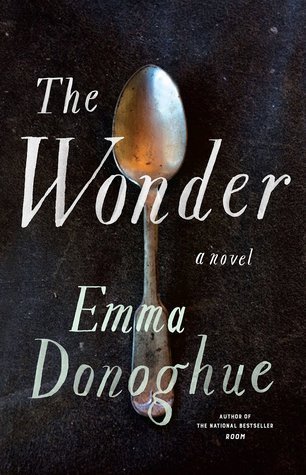
The Wonder

The Wonder by Emma Donoghue.  304 pages.

Tourists flock to the cabin of 11 year-old Anna O'Donnell, who believes herself to be fed on manna from heaven, existing for weeks on only a few sips of water.  Lib Wright, a veteran nurse off of Florence Nightingale's Crimea campaign, is employed to watch this girl and observe if she is, indeed, a miracle.  Lib doesn't observe Anna partaking of any food -- but how much longer can that last?

I have enjoyed other books by this author, and was happy to (finally) get my hands on this newest book of hers.  I really enjoyed the first-person perspective because I felt I was learning things and experiencing them right along with the main character.  It's interesting to read along as she goes from having assumptions about the people around her to her unfolding awareness of what is really happening.  This book has a steady pace that's akin to a thriller, where keep turning the pages because you aren't sure what's going to happen (and can't wait to find out). The story is also an insight into faith, and how faith can compel people to make impossible choices.

Covenant and Communion

Covenant and CommunionCovenant and Communion: The Biblical Theology of Pope Benedict XVI by Scott Hahn, 196 pages

In Covenant and Communion, Scott Hahn seeks to explicate key features of Joseph Ratzinger's lifetime of theological work, both before and after becoming Pope.  Hahn's essay has three primary areas of investigation - his view of theology, his approach to Scripture, and his understanding of the nature of the Church.  These three are, of course, interrelated - indeed, it is Hahn's theme that, for Benedict, the three are, or should be, entirely interdependent.  Theology must begin, and constantly refer back to, the deposit of faith.  Scripture cannot be properly appreciated or understood separate from the creeds and liturgy of the Church.  The Church is rooted in and renewed by her encounter with the Word in Scripture and sacrament, her understanding formed by the contributions of her faithful theologians.

Hahn stresses that Benedict's work does not represent a retreat from modernity.  To the contrary, Benedict's work flows out of the Second Vatican Council.  Far from being an obscurantist flight from the world, it is Benedict's claim that his emphasis on continuity rather than rupture, faith instead of suspicion, communion rather than private interpretation, possesses greater explanatory power than the alternatives.

Monday, December 5, 2016

The Bronx Is Burning

Ladies and Gentlemen, the Bronx Is BurningLadies and Gentlemen, the Bronx Is Burning: 1977, Baseball, Politics, and the Battle for the Soul of a City by Jonathan Mahler, 339 pages

In 1975, New York City, in many ways the capital of the modern world, teetered on the brink of collapse.  The bankrupt city government was refused a federal government bailout, sanitation workers held a ten day strike during which garbage piled up on the sidewalks, and laid off policemen rioted, shutting down the Brooklyn Bridge during rush hour.  The city bounced back in '76, serving as the focal point for the nation's bicentennial celebrations, hosting a successful Democratic National Convention, and cheering the Yankees into the World Series.  The subsequent sweep of the Yankees by the unstoppable Big Red Machine might have served as an omen for '77.  

As author Mahler chronicles, the momentous events of 1977 represented the convergence of a series of trends.  Rupert Murdoch's New York Post continued to change New York's media landscape.  Disco broke big, while punk grew in the East Village and hip hop conquered the Bronx.  Pudgy postman David Berkowitz terrorized the city as the ".44 Caliber Killer" and then as the "Son of Sam", killing 6 and wounding 7 in a series of random shootings that lasted twelve months.  A cascading series of failures in the city's power grid led to a blackout in mid-July that plunged the entire city into darkness, triggering widespread looting and arson.  Most obviously, the future of the city was weighed in the Democratic primary for mayor, which pitted incumbent technocrat Abe Beame against irrepressible radical Bella Abzug, opinionated loudmouth Ed Koch, and political Hamlet Mario Cuomo.  Yet for Mahler, the great story of '77 is the Yankees' championship season, throughout which manager Billy Martin fought his own personal demons as well as team owner George Steinbrenner and brash slugger Reggie Jackson. 

Mahler's account is written in a readable, straightforward documentary style, but the material is loaded with a symbolic importance far greater than the bare facts.  It is to the author's credit that he does not force interpretations onto these facts.  The Martin-Jackson feud can be seen as representative of an insecure, unhinged white establishment trying desperately to deny the legitimate achievements of rising blacks, or as locally-rooted working class ballplayers being eclipsed by mercenary free agent superstars, or neither, or both.  The Son of Sam murders certainly evoked the horror of urban anonymity (even as the discotheques promised the pleasures of that same anonymity), but also involved the hype of sensationalistic journalism.  The result is genuinely poetic, both a revelatory history and a love song to the city and its legendarily outsized personalities.

Friday, December 2, 2016

Pilgrim's Gait

Pilgrim's GaitPilgrim's Gait by David Craig, 121 pages

The bulk of David Craig's awkward and beautiful book Pilgrim's Gait is taken up by a presumably autobiographical tale, "The Madonna's House", and "From the Assidua of St Anthony", a series of fifteen poems inspired by St Anthony of Padua.  A dedication of sorts that appears after the latter work gives an idea of Craig's influences and aims:

     The Beat Catholic Line
        -for Kerouac, Merton, Everson,
        Levertov, Dylan, Berrigan, Cohen,
        Springsteen, Mariani, Waits, Wright,
        Daniels, and Karr

If Craig does not quite manage to place his own name amongst this beatific company, he does show that there is life in the tradition.  James, the main character in "The Madonna's House", is a startlingly honest image of a young man thirsty for experience, desperate to appear more experienced than he is, defensively cynical as a protection against seeming to care, who finds himself drifting into a strange place where care is a way of life.  "From the Assidua of St Anthony", meanwhile, manages to introduce the 13th century Franciscan as a figure who feels contemporary without removing him from his own time.   After this, Craig's return to more conventional beat-down content and style for the last few pages is somewhat jarring, until the contrasts begin to highlight the continuities and all is grace.

Wednesday, November 30, 2016

The Singing Bones

The Singing Bones by Shaun Tan, 185 pages

This is a compilation of sculptures, done by Tan, to illustrate several of Grimm's fairy tales.  Each tale just uses an excerpt of the story paired with a photo of the sculpture.  The sculptures are sometimes strange but always seemed fitting.  Overall, I thought it was well done.  This is also in adult non-fiction but could have some teen appeal since some of Tan's work has been for teens.  Adults who like fairy tales will like this book as will fans of tan's other books.

Leviathan

Leviathan by Scott Westerfeld, 440 pages

"In an alternate 1914 Europe, fifteen-year-old Austrian Prince Alek, on the run from the Clanker Powers who are attempting to take over the globe using mechanical machinery, forms an uneasy alliance with Deryn who, disguised as a boy to join the British Air Service, is learning to fly genetically-engineered beasts."  I'm a relative newcomer to Westerfeld's books but I really liked the first book in this series.  I'm sorry it took me so long to get to it.  I liked this a lot better than the Pretties series, which was good but not great.  This was much better and I'm looking forward to the rest of the series.

And One Last Thing

AndOne Last Thing by Molly Harper, 310 pages

"Lacey Terwilliger's shock and humiliation over her husband's philandering prompt her to add some bonus material to Mike's company newsletter: stunning Technicolor descriptions of the special brand of "administrative support" his receptionist gives him. The detailed mass e-mail to Mike's family, friends, and clients blows up in her face, and before one can say "instant urban legend," Lacey has become the pariah of her small Kentucky town, a media punch line, and the defendant in Mike's defamation lawsuit.  Her seemingly perfect life up in flames, Lacey retreats to her family's lakeside cabin, only to encounter an aggravating neighbor named Monroe. A hunky crime novelist with a low tolerance for drama, Monroe is not thrilled about a newly divorced woman moving in next door. But with time, beer, and a screen door to the nose, a cautious friendship develops into something infinitely more satisfying.  Lacey has to make a decision about her long-term living arrangements, though. Should she take a job writing caustic divorce newsletters for paying clients, or move on with her own life, pursuing more literary aspirations? Can she find happiness with a man who tells her what he thinks and not what she wants to hear? And will she ever be able to resist saying one . . . last . . . thing?"  I've really enjoyed all of Harper's supernatural romances.  They're all funny and this book is too.  Anyone who's liked her other books will probably like this also despite its lack of supernatural characters.  Fans of the romantic comedy will also like this book.

The Boys Who Challenged Hitler: Knud Pedersen And The Churchill Club


"At the outset of World War II, Denmark did not resist German occupation. Deeply ashamed of his nation's leaders, fifteen-year-old Knud Pedersen resolved with his brother and a handful of schoolmates to take action against the Nazis if the adults would not. Naming their secret club after the fiery British leader, the young patriots in the Churchill Club committed countless acts of sabotage, infuriating the Germans, who eventually had the boys tracked down and arrested. But their efforts were not in vain: the boys' exploits and eventual imprisonment helped spark a full-blown Danish resistance. Interweaving his own narrative with the recollections of Knud himself, here is Phillip Hoose's inspiring story of these young war heroes."  This was a well written and well researched book.  I like books about WWII and this was no exception.  I think it would be a great book for teens and adults looking for more information on this topic.

Malcolm Under The Stars

MalcolmUnder The Stars by W.H. Beck, 257 pages

This is the sequel to Malcolm at Midnight, which I liked a lot.  In this adventure, Malcolm, the rat in Mr. Binney's fifth grade classroom, discovers more problems at his beloved McKenna School.  This time the problem facing the Midnight Academy, the group of classroom animals from the school whose mission it is to protect the teachers and students, is larger than any they have ever seen before.  The school has significant problems that will cost a lot of money to fix and the board is discussing the possibility of closing the school.  This is devastating to the animals and to several of the kids and teachers as well.  There is one hope for the Midnight Academy; the promise of a legendary treasury hidden by Ernie Bowman, a former employee of the school.  If the Academy can find it, it may be enough money to save the school.  I really enjoyed this, maybe even more than the first book.  I would definitely recommend it to anyone who likes animals, especially with a fantastical bent.  This is probably best for fourth through sixth grade.