Friday, August 29, 2025

Hell or Connaught!


Catholic Ireland revolted against the Protestant rule of Charles I in 1641.  By 1644 the Irish were supporting the King against Parliament, and after the execution of the King in 1649 the Roundhead army arrived in Ireland to end resistance by fire and sword and, most deadly of all, starvation.  Hundreds of thousands of Irish, perhaps as much as a quarter of the population, perished and thousands more were enslaved and transported to the New World.  In Ireland itself, the decision was made to isolate the native Catholic population in the province of Connaught, the northwestern quarter of the island, with the lands thus depopulated to be given as pay for the Commonwealth soldiery and the London investors who backed the campaign.

The story of this decision, the effort made trying to put it into effect, and the pain it engendered are the primary themes of Ellis' history of the period.  There are other important narratives here, too, including the impact of land speculation, the religious sectarian divides among the colonists, the internal politics of the Commonwealth, ultimately resulting in its end, and the disappointments of the Restoration.  Ellis tells these stories, and more, including the long running personal feud over the survey of Ireland, in a straightforward manner that nevertheless manages to incorporate primary sources and contemporary poetry to provide a complete picture of a crucial moment in Irish history.

Wednesday, August 20, 2025

Leonie Martin

Leonie Martin: A Difficult Life by Marie Baudouin-Croix, translated by Mary Frances Mooney, 157 pages

Leonie was born in 1863 to Ss Louis and Zelie Martin, the third of their six children, all daughters, who survived into adulthood.  All six eventually became nuns, with five joining the Carmelite monastery at Lisieux.  Leonie alone entered the Visitandine order at Caen, finally persevering on her third attempt.  Then again, Leonie had always been the difficult one, a sickly child, struggling with disobedience at home and failing in her studies at school, a trial and a worry to the mother who died when she was 14.  How she overcame these shortcomings, not alone but through the grace of God and her saintly intercessors, is the great theme of this short book.

Although Leonie Martin has not been canonized, Marie Baudouin-Croix's biography is unmistakably a hagiography.  It elides difficult, complex issues, notably the mental illness that afflicted Louis Martin in his later days, simplifying them into hardships to be overcome with the holy serenity of faith.  The problems this presents are more than compensated for by the author's evident understanding of, and sympathy with, the religion and religious life of the Martin family.  This is undoubtedly her story as Leonie herself would have liked it told.

Thursday, August 14, 2025

Emperor of Japan

Emperor of Japan: Meiji and His World, 1852-1912 by Donald Keene, 723 pages

When the 122nd Emperor of Japan ascended the Chrysanthemum throne in 1867 at the age of 14, no Japanese emperor had exercised real power for nearly seven centuries.  A year later, the last shogun resigned his position and the man who would be known as Meiji became the actual as well as symbolic ruler of Japan.  The country was dominated by a feudal aristocracy, educated according to Confucian principles, and threatened by the greed of the Western powers.  When Meiji died 45 years later, Japan had rapidly Westernized, adopted a parliamentary system, defeated China and Russia in successive wars, annexed Korea, and established itself as a major power on the global stage.  It had, however, lost something which is less tangible.

It is unclear how much influence the Meiji emperor actually exercised over the seismic changes that occurred in Japanese culture and politics during his reign.  Indeed, it is difficult to say much of anything about the personality of the emperor, given the reverential protectiveness of all those in a position to know him.  The few candid accounts of the man were provided by foreign dignitaries whose access was necessarily limited.  Understandably, then, Donald Keene's biography is as much a portrait of the era as of the emperor who gave the era its name, although discerning readers may sense the spirit of the man moving throughout.  Keene himself seems devoted to the fashionable cult of "progress", but his devotion does not become fanaticism, indeed, some of the most memorable passages concern Ulysses Grant's role in the preservation of No drama and the European derision of Western-style dance halls in Tokyo.  The result is a compelling, rich tale of an era of momentous change, both for better and for worse, told through the refracted image of the man who was its symbol.

Thursday, August 7, 2025

Leopard

The Leopard by Giuseppe Tomasi di Lampedusa, translated by Archibald Colquhoun, 320 pages

Don Fabrizio, Prince of Salinas, would be perfectly content ruling over his large family, amusing himself with his mistress, indulging in his passion for astronomy, playing with his dog, and watching over his hereditary estates with benevolent indifference.  Unfortunately for him, history has other plans, as Garibaldi's revolutionaries lay siege to Palermo, with Fabrizio's own nephew, the dashing Tancredi, joining them in their effort to overthrow the monarchy.  Even in the security of his country estate at Donnafugata, the prince has to reckon with his eldest daughter Concetta's love for Tancredi and his nephew's growing affection for the bourgeois beauty Angelica.

The Leopard is a masterpiece.  It is not a dramatic novel - most of the major external conflicts are resolved without struggle or comment.  The real drama is social, historical, psychological, and, in the end, metaphysical.  Despite the sentimentality of its characters, it is a remarkably unsentimental work.  There is much to attract us in the passing world of the Sicilian nobility, but the novel does not romanticize them.  CS Lewis famously remarked that there is no "magic about the past.  People were no cleverer then than they are now; they made as many mistakes as we.  But not the same mistakes.  They will not flatter us in the errors we are already committing; and their own errors, being now open and palpable, will not endanger us."  So it is with The Leopard - the novel unfolds for the reader a universe of values which overlaps but significantly diverges from those of liberal modernity and allows him to judge between them.

Sunday, November 10, 2024

March-October 2024 Totals


March-October 2024 Totals

Julie was the clear reader of the group of three reviewers with a total of 22 books and 7513 pages, followed by Shirley who had 11 books with 3073 pages.  The group read a grand total of 35 books and 11,158 pages during this time period.  Great job everyone!!


Wednesday, September 25, 2024

Vincent Price: The Art of Fear


 Shirley J.   Adult Non-Fiction       A less than complimentary look at actor Vincent Price's horror films

Vincent Price: The Art of Fear by David Meikle     248 pages

I love Vincent Price but this was a grueling book to force myself to read.    I have never read a more scathing, bitter account of this brilliant actor which is not any where near where this author described his talent.   According to David Meikle, (who is this guy anyway?)  Vincent Price merely offered a one-dimensional performance and basically had 3 reactions he executed in every performance always playing the same character in every horror film he starred in.   Have I said yet how much I dislike this author?   He uses Vincent Price's name to sell his caustic account of the actor and may I add that he alludes to every thing but Vincent Price who seems a minor character in this raunchy bit of literature.   I find this book an offense and an affront to Vincent Price's character and acting ability and this twit needs to go back to whatever hackery he came from.  What a jerk!   David Meikle mocks everything about Vincent Price throughout and I would not recommend this piece of drivel to anyone.  I do love the photos and there are a handful of interesting bits to be gleaned here but the author's nasty attitude prevails throughout so I cannot in full conscience recommend it though in Vincent Price's name I wish it had been as good as it could and should have been.  

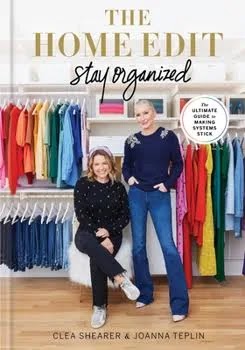
The Home Edit: Stay Organized: The Ultimate Guide to Making Systems Stick


Shirley J.        Adult Non-Fiction       How to go from dis-organized to organized while making your space look like a beautiful rainbow showplace!

The Home Edit: Stay Organized: The Ultimate Guide to Making Systems Stick by Clea Shearer & Joanna Teplin     256 pages

First of all the illustrations throughout this book are gorgeous.  Now, these ladies are hugely pro using bins.   They don't like the look of boxes regardless if they be the boxes of cereal, macaroni or any food that comes in boxes nor the boxes appliances or anything we buy come in.   They just think food is better stored and displayed in see through containers and once you know you are keeping something you bought that came in a box or especially boxes that items are shipped in said boxes must be recycled and gone from the home.   They are big proponents of colorfully displaying clothes on racks and in closets thus making items easier to see and match for quicker dressing and getting out the door in the morning or evening.    They offer really good tips and their methods are beautiful to behold.  Their labeling of containers and bins are flawless.   They definetly believe in downsizing upholding the philosophy of less is more and that folks tend to use only 20% of the clothes in their closet (creatures of habit we grab the clothes we like and ignore the rest).   A good book, I enjoyed it.   Not sure if while I agree with the beauty and simplicity of see through bins, I would actually follow through and keep up with them but that is my own laziness and not a lack on the book's part.   I recommend this book to all who want to get a handle on organizing their stuff but if you are looking for a deeper purge of clutter this tends to be for those needing organizing skills more so than purging heaps of items.   


Huda F Are You?

Shirley J.              Young Adult Memoir  Graphic Novel              Huda Fahmy's first year of highschool    

Huda F Are You? by Huda Fahmy   192 pages

Huda Fahmy is a Muslim and in this book she has written a memoir about her first year of highschool being a Muslim, a teenager and a hijabi girl living in Dearborn, Michigan.   The book talks about how she is trying to understand who she is growing up in a society where in the Muslim community she still wants to define herself.  Is she a hijabi fashionista?  A hijabi gamer?  She tries becoming a member of many different cliques at highschool trying to see just where she fits in but none of the groups she attempts to become a part of really speak to her of feeling included nor ever really finding that spark of this is who she is and what she wants to be.   It takes trying on the various different interests to bring her to where she gets a better understanding of herself and where she fits.    A really good coming of age story relateable to all teens who are going through the feeling different stage to find their identity in life.    I recommend this book to middleschoolers on up Muslim and non-Muslim alike.  We all search to find our place and our role in life and this book is very user-friendly in showing how to navigate that difficult journey.    


Tidy the F*ck Up:The American Art of Organizing Your Sh*t


Shirley J.           Adult Non-Fiction                 Straight talk on decluttering your home, office and life

Tidy the F*ck Up:The American Art of Organizing Your Sh*t by Messie Condo    192 pages    

In homage to Marie Condo, organizing and cleaning Queen, Messie Condo is a tongue in cheek calls 'em as Messie sees them straight talk complete with expletives for emphasis look at how to see our sh*t for what it is and tidy it the f*ck up.     While looking around our homes we might be so overwhelmed we are unable to move from in front of the t.v. to actually confront our clutter but Messie verbally shakes us into reality and motivational mode to get the f*ck up and do something!  I love this book for its ability to get you up off the couch and get you to not just think about your stuff which it does but more so to want to tackle it and get it in order and to quit letting it be the boss of you like an unwanted guest that moves in and doesn't want to leave.  Messie Condo begins by quoting the late comedian, George Carlin, who said, "Our house is just a place to keep our stuff so we can go out and get more stuff."  I love this book.  I am re-reading it now that I have finished it just to remind myself all the good tips in gives and they are legion.   Adults, do yourself a favor and check this book out especially if you like laughing because while being totally real this book will also make you chuckle and see yourself in many of the scenarios.  Due to the language maybe young children should not be exposed but teenagers as soon as you are mature enough to hear advice from an adult who peppers their language generously with expletives but who will tell you the factual truth while doing so on how to clean up after yourself and keep on the organized non-hoarder road, or if you have grown up with messy ways, this will be a clear map for how to get your sh*t together in life, literally.  5 stars out of 5!


Friday, August 30, 2024

The Power of Fun: How to Feel Alive Again


Shirley J.                                  Adult Non-Fiction                     Fun is critical to a human's well-being    

The Power of Fun:How to Feel Alive Again by Catherine Price    352 pages

Catherine Price says that fun is essential to all people.  Her daughter describes it as "sunshine," which is accurate.   Fun is essential because without it how sad and boring would life be?   Fun is laughter and commarderie.  It is experiencing new things in new ways.   It is adventure and making memories.  It is the thing or things in all of our lives that make us happy.  One person's joy may not be the same for the next guy/gal but it is the thing that bring joy and makes the heart palputate a little faster, brings a smile to the lips and sparkle to the eye.   It can be seen most notably in children but adults are just as good at experiencing fun when they open themselves to it.   Price discusses the meaning and explores ways to have fun and incorporate fun into all aspects of life.  Fun is not immature, it is not selfish nor self-indulgent it is living the dream of how beautiful and happy life can be.  She explores the psychology of fun, her idea that fake fun is watching television, or reading and how she doesn't feel introverts are really getting the concept of fun by doing solo activities.  In her interpretation, fun is sharing experiences with others.  Posting things to social media she says is not "fun".     It is trying to fill an emptiness within but not her definition of fun.   True fun is playfulness, connection and flow that which fulfills us.  Gives us energy, community and purpose.  Fun makes us flourish.   And in the end you will enjoy the process.   

Friday, August 23, 2024

The Civil War: An Illustrated History


 Shirley J.            Adult Non-Fiction              The Civil War explained in detail, the battles, the generals,       the times, the strategies, the sentiment, the north, the south, slavery, correspondence, life during war at home.

The Civil War: An Illustrated History by Geoffrey C. Ward, with Ric Burns and Ken Burns   425 pages         

What a truly wonderful work.  So many eye-opening things you will learn here from the first hand accounts of those who were in the midst.  From Lincoln to Jefferson Davis, politicians, abolitionists, generals, soldiers, slaves this book brings to life a time long passed as if it were taking place right in front of you.   It will make you laugh at times but it will also make you cry.   The photos are all of actual people and places significant during the war.   I kept thinking of the years and the ages of my parents and great-grandparents to place where they might be on the timeline and what they might have been experiencing in the areas of the United States they were in.   I found the answer to some questions I had when doing genealogy I came across terms I did not understand but was enlightened on while reading.   WOW!   This book really made the Civil War a reality to me not just something you read about in history class.   I highly recommend this book and the accompanying 9 episode documentary film (PBS) that goes with it.   It is beyond words.  It literally takes you right there.   It is spellbinding.  I recommend this to anyone with an interest in the 1860s in America and the Civil War in particular.  So moving, you will never think about the Civil War without associating certain faces and acts with it.

Tuesday, July 23, 2024

Between Two Worlds: Lessons from the Other Side


 Shirley J.           Adult Non-Fiction                    The life story of Hollywood Medium, Tyler Henry

Between Two Worlds: Lessons from the Other Side by Tyler Henry    224 pages

Hollywood Medium, Tyler Henry shares in this memoir how he experienced his "knowing" at an early age and how he came into the fullness of his psychic senses when he was 10 years old and he told his mother that his grandmother had just passed away.   He had always had psychic experiences even as a toddler, he just didn't understand what they were.   The revelation of his grandmother's death led him to study and research to find out what was going on with him.  He grew up in a religious home after all and no talk of ghosts or anything of that nature had ever come up.   His family were church goers every Sunday.  He grew up in a small town in California no type of supernatural talk around town till one day a man and woman opened a shop with incense, books on all sorts of topics new to him, herbal cures, auras, divination, developing your third eye, chakras, reiki, crystal healing, etc. and the couple offered tarot readings.  Tyler became a voracious reader learning as much as he could.  He eventually started doing Tarot readings himself then realized he was more in tune with his psychic abilities than he knew.  The owners of the shop allowed him to do readings and his intuitive talents had people coming from all over eventually as word spread about his uncanny abilities.  He soon found that just like when he was a young child and saw "people" in his room that he wasn't afraid of but didn't understand why they were there, he began to be able to intuit messages from the beyond for people he was doing readings for.  Soon messages started coming to him for people he would come in contact with out in the world at random.  He was eventually asked to do Hollywood parties and gained a following of prominent celebrities requesting him to come do readings for their parties which grew into the cable t.v. show Hollywood Medium with Tyler Henry.   If anyone has an interest in divination of any kind Tyler Henry's book would definetly be of interest.   His show is very interesting to watch to see his process for revealing things to friends and family of the dearly departed.   I would recommend this book to mature highschoolers on up.  I think younger might not be able to discern without being impressionable.


Who Will Take Care of Me When I'm Old?: Plan Now to Safeguard Your Health and Happiness in Old Age

Shirley J.                      Adult Non-Fiction                     Tips for Senior Adults living alone

Who Will Take Care of Me When I'm Old?: Plan Now to Safeguard Your Health and Happiness in Old Age by Joy Loverde    681 pages

Advice and tips to stay healthy, financially secure and happy to the end of your days.    Lots of good recommendations for those who have no plan in place for their well-being as they age.   Goes into depth of what is to come as we age.   Teaches seniors to be proactive to plan for their own lives rather than rolling over and letting family, neighbors, lawyers, caregivers, etc. decide their fate.   Shows how to put plans in place to cover all eventualities.   Good book.   I highly recommend this to middle-agers up through seniors, lots of good information, ted talks, reading and websites, etc. listed  Goes way beyond estate planning and wills.   Discusses what to do if diagnosed with dementia/Alzheimers, immobility, etc.  Great resource.
 

Monday, July 22, 2024

Necessary Endings: The Employees, Businesses, and Relationships That All of Us Have To Give Up in Order to Move Forward


Shirley J.                   Adult Non-Fiction            How to tell when it is time to end things and move on    

Necessary Endings: The Employees, Businesses, and Relationships That All of Us Have To Give Up In Order To Move Forward by Dr. Henry Cloud       238 pages

Excellent book on identifying problem areas in life, how to assess when it is time to sever toxic relationships (red flags), how to identify volatile work relationships and how to cope or fix issues or end employment (them or you).  So much good information here.   Things we see and deal with every day that can make life difficult, stressful and miserable then the good doctor offers situational ethics to get out of said situations.   He offers scenarios we definitely are familiar with and answers that are so understandable and doable you will wonder what took you so long to apply them.   High praise for Dr. Cloud and his clearing the fog on those gray areas.   I recommend this one to mature teens on up.  Everyone could do with his dose of reality and benefit from his advice.


Saturday, July 20, 2024

We Were the Lucky Ones

We Were the Lucky Ones by Georgia Hunter 416 pages


In another review (for The Sunflower House), I mentioned that I was always surprised by the stories still left to be of World War II---and we’re still 20 years this side of the end of the war. While the former was about the baby factories, this one is the tale of a Jewish family’s struggle to survive, and to reunite.


I’m glad that author Georgia Hunter put a family tree at the beginning. I had to refer to it several times because of all the family members, the spouses, and the grandchild. Sol and Nechuma had five children, ranging from 31-year-old Genek to 21-year-old Halina. Without going back to look, each of the children has a chapter or more to tell their part of the story.


The Kruc family was a happy one, living their lives in the Jewish traditions of 1938 Poland. They were well aware of the rhetoric spewing from Germany and the possibilities of another war. This time with Adoplh Hitler leading the charge.


One thing that really sets this novel apart from the others is that it focuses on one family, and the piece de resistance (no pun intended) of the provided timeline. Between each chapter, Huner provides historical facts about major news events. These factoids are no more than a page in length, most no more than half a page.


Given what each individual experiences, the stories, which flow well and in a chronological manner, can be intense, so it is nice to have that small break.


As the family breaks apart, they scatter to various other countries like France, Siberia, Persia, Argentina to escape the Nazis and find a safe place to live until the war was over. Still each and every one of the characters has two goals: to survive Hitler and to reunite. Is that too much to ask? Sometimes, it seems so, and almost impossible to achieve.


I understand that this novel has already been made into a series on a streaming channel, but I don’t have that so I’ll probably never see it.  I’m sure the book is better anyway. We Were the Lucky Ones receives 6 out of 5 stars in Julie’s world.


The Sunflower House

The Sunflower House by Adriana Allegri 336 pages


I’m always surprised by the topics or slant writers use when I pick up a new World War II novel. There are so many stories left to be told, and so many atrocities that need to be brought to light, even all these years later.


The Sunflower House tackles the baby factories. I have not come across a book about this aspect of the Nazi debauchery before but found it fascinating, sweet and horrific. I learned a bit about the factories and the experiments Himmler enjoyed conducting on adults in Martha Hall Kelly’s fabulous novel, The Lilac Girls. If you haven’t read it, I highly recommend it.


Katrine is the contemporary voice (2006-2010) who is caring for, or trying to care for, her mother after she fell and wound up in the hospital. Katrine discovers a wooden box beneath her mother’s closet floorboards. Pulling it to light, Katrine is shocked to see that is marked with a swastika.


Now let’s time travel back to a sleepy German village in 1938. Allina Strauss lives with aunt and uncle after the parents are murdered. They are hiding a secret; a secret no one can ever, ever, ever uncover. All three of their lives depend on it. After her uncle dies from cancer, the Nazis brutally murder her aunt. They arrest Allina, but her Aaryn features and blond hair save her from beatings and a bullet.


Allina is sent to Hochland Home to serve the Führer as a nurse. Hochland is one of the “Lebensborn homes for the sole purpose of perpetuating the Aryan population…The women of “pure” blood stayed in Lebensborn homes for the sole purpose of perpetuating the Aryan population, giving birth to thousands of babies who were adopted out to “good” Nazi families.” 


Allina is shocked at what she learns, but even more shocked when a high-ranking SS Officer, Karl, wants to become her patron. However, he has secrets of his own that must never be revealed. Eventually Allina and Karl have a sweet romance.


This novel at times repulsed me with the mere thought of the baby factories and made me smile when Allina and Karl fell in love.


The Sunflower House receives 6 out of 5 stars in Julie’s world.

The Remarkable Rescue at Milkweed Meadow

The Remarkable Rescue at Milkweed Meadow by Elaine Dimopoulos; illustrated by Doug Salati 192 pages


I’ll admit it; I’m a sucker for books about animals. Especially rabbits. That love has nothing to do with that five pounds of fluff I have at home (And she’ll never forgive me if I don’t mention that her name is Gracie.).


Butternut is the main protagonist of this little tale of friendship and bravery---and storytelling. She lives in a burrow with her mother, grandmother and nine siblings. Every day Mother gives lessons to her babies and every night one of the bunnies takes a turn telling a story. But the most important lessons Mother teaches are the ones that will keep them alive.


The rabbit family seldom ventures too far from its burrow on the edge of the meadow, where the bunnies fill their stomachs with the variety of grasses growing there. One day, Butternut witnesses Blue, a bully of blue jay, steal an egg from Mother and Father FirstFledge Robin’s nest.


After the remainder of the eggs hatch, Butternut becomes fast friends with a spunky little guy named Piper. Piper encourages Butternut to become braver, to not worry so much about keeping to herself as Mother taught her, and the two of them begin to help other forest animals.


The story is fast-paced and fun. Doug Salati’s illustration help bring the story to life. I cannot wait to get copies for the granddaughters! The Remarkable Rescue at Milkweed Meadow receives 5 out of 5 stars in Julie’s world.


Saturday, July 13, 2024

The Museum of Ordinary People

The Museum of Ordinary People by Mike Gayle 336 pages


What do you do with your mom’s stuff after she is gone? It’s a predicament that many find themselves in these days. Or maybe I feel that way because my own mom cannot live at home anymore. But what the heck am I going to do with all that stuff! Sixty years worth of life!


That’s the issue Jess is facing.  Her mother dies suddenly. Jess is an only child so the entire burden passes to her.


From the book’s back cover:

“Still reeling from the sudden death of her mother, Jess is about to do the hardest thing she's ever done: empty her childhood home so that it can be sold.  As she sorts through a lifetime of memories, everything comes to a halt when she comes across something she just can’t part with: an old set of encyclopedias.  To the world, the books are outdated and ready to be recycled.  To Jess, they represent love and the future that her mother always wanted her to have. 

In the process of finding the books a new home, Jess discovers an unusual archive of letters, photographs, and curious housed in a warehouse and known as the Museum of Ordinary People.  Irresistibly drawn, she becomes the museum's unofficial custodian, along with the warehouse’s mysterious owner.  As they delve into the history of objects in their care, they not only unravel heart-stirring stories that span generations and continents, but also unearth long-buried secrets that lie closer to home.

Inspired by an abandoned box of mementos, 
The Museum of Ordinary People is a poignant novel about memory and loss, the things we leave behind, and the future we create for ourselves.  

I really enjoyed this book and was intrigued by it. It takes place in a London suburb, but it could have taken place anywhere. I found the story rather sad and heartbreaking, but there are shining moments. This is a tough book to review as it is hard, for me, to articulate my feelings. Still, I encourage everyone to read it and give this challenge: Think about your home. What would donate to The Museum of Ordinary People and why. The Museum of Ordinary People receives 4 out of 5 stars in Julie’s world.


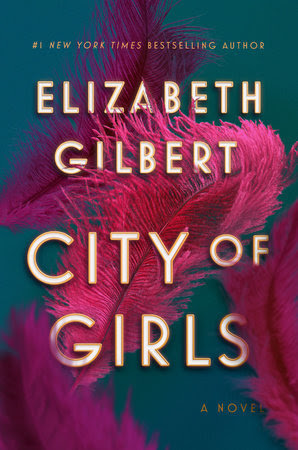
City of Girls


City of Girls by Elizabeth Gilbert 496 pages


Before author Elzabeth Gilbert took the literary world by storm with her mega-hit, “Eat Pray Love,” she penned a most charming and fictional tale of a group of eccentric theater people who lived and worked at the Lily Playhouse. The story takes place in the 1940s.


When the narrator of the story, Vivian Morris, was nineteen, she flunked out of Vassar. Her parents didn’t know what to do with her. So, they sent her to live with her Aunt Peg in Manhattan. Aunt Peg owned the Lily, which put on shows twice a day. They weren’t particularly good, but the local audience loved them and bought tickets. I would call it off-off-off-off Broadway.


Gilbert uses the epistolary structure to tell this story. Vivian, now eighty-nine years old, is answering a letter to the daughter of a friend after her mother passes, wanting to know what Vivian was to her father. That’s a little complicated, but Gilbert pulls it off.


The Lily was as much a character as any of the humans. It was rambling. It was rundown. It was magical. And the people who lived there were much the same. Olive was the general manager and Peg’s best friend. They served together during World War I. Also inhabiting the theater are the actors, the showgirls, the playwright and the composer. Vivian finds her place in this cast as a costume designer; her grandmother had taught her to sew, and she was excellent at it.


Vivian becomes BFFs with Celia, one of the showgirls. Together, they nightly paint the town. Every night. Stumbling through the doors in the wee hours of the morning, smelling of booze and sex. Those two slept with a LOT of men. Warning: there are a couple of scenes that are X-rated.


During one of those nights on the town, Vivian makes a horrible mistake and is banished back to her hometown and life with her parents in upstate New York. But it is just foreshadowing for what it so come---the soldier who served on the same battleship as her late brother becoming her best friend after she returns to Manhattan.


Gilberts writes about Manhattan as if she too had lived in the 1940s---one of my favorite time periods. It was a helluva time and a helluva town. I wish I could visit, but then again, I have through Gilbert’s words.


I loved these characters and this time. And to be honest, I miss them. City of Girls received 6 out of 5 stars in Julie’s world.


Saturday, July 6, 2024

Dinner with Edward: A Story of an Unexpected Friendship

Dinner with Edward: A Story of an Unexpected Friendship by Isabel Vincent 240 pages


For fans of Ruth Reichl and Mitch Albom.


One of Isabel Vincent’s oldest and dearest friends, Valerie, mother has recently passed away. Valerie is worried about her father, Edward, who wants to follow her into the grave. Understandably, as Valerie lives in Toronto, her sister in Greece and Edward in New York City. She asks Isabel to check on her father, maybe have dinner. Valerie told her that Edward was a wonderful cook. Isabel was reluctant at first, but eventually she acquiesced. And thus began one a beautiful friendship.


Edward is ninety-three and learning to live without the love of his life, Paula. Isabel is much, much younger, with a young daughter, who is terribly unhappy in her marriage. They hit it off spectacularly during that first meal.


I liked that Isabel put the menu as each chapter’s heading but disappointed that no recipes were included. But then they were Edward’s recipes, and he never followed a recipe. Still, he wrote out one occasionally if Isabel asked.


I also liked that at his advanced age, Edward still traveled the city to get the freshest and best ingredients when he was planning a dinner. No big box grocery store for him! When Isabel arrived for their meal, I swear I could smell the fabulous aromas wafting from Edward’s apartment. Ther was always music playing in the background, usually jazz, and often Ella Fitzgerald, whose voice created a relaxed atmosphere. Perfect for conversation.


I also like that Edward wrote poetry and would, on occasion, send some to Isabel through the mail.


I read this short book in two evenings. Edward departed his knowledge of the world to Isable in a manner that was subtle and interesting. I hate to entertain but reading this I want to call my friends and have them over for dinner. Knowing me, though, that isn’t likely to happen.


Dinner with Edward: A Story of an Unexpected Friendship received 6 out of 5 stars in Julie’s world.