
This is a sequel to Burned.
I read the first book, but it was a while ago and I had no trouble
reading this one even though I didn’t remember a lot of the first book, so I
would say that these books would not have to be read in order. Hopkins’s books always deal with difficult
situations that can come up in teens’ lives and are written in verse form. This means that there is a lot of white space
in her books and the topics are of interest to many teens which makes them good
for reluctant readers. In this story,
Pattyn is on the run after having shot and killed her father who had been
abusing, her, her sister and her mother.
Her father was beating on her sister, Jackie, when she discovered them. The story is told alternately between Jackie
and Pattyn, so we get to see what is happening to Pattyn as she runs from the
law and Jackie, who is left at home to deal with the aftermath of their
father’s death, and the rape that she suffered that brought on the beating from
her father. Hopkins’s stories are always
very real, and this is no exception.
This story should appeal to a lot of teens.
Monday, September 15, 2014

The Marvelous Land of Oz
 The Marvelous Land of Oz by L. Frank Baum, 319 pages
In this second book of the Oz series, we leave Dorothy back in Kansas and instead focus on Tip, a boy who is forced to work for the evil witch Mombi. Stealing some of Mombi's magic powder to bring a pumpkin-headed stick man to life, Tip runs away, embarking on a journey that involves an all-girl army taking over the Emerald City, a Highly Magnified insect, a flying creation made out of couches, and the involvement of the Scarecrow, Tin Woodman, and Glinda the Good.
While there is a bit of a plot running through this story, it's quite episodic, which makes it ideal for reading aloud, which is what I've been doing. My six-year-old son and I are slowly working our way through this series, and while I had a few issues with this volume (the all-girl army overthrows the Emerald City because they want the pretty jewels? Seriously???), all in all it was a fun experience for both of us and we're looking forward to book three, Ozma of Oz.
The Unwritten: The Unwritten Fables
 The Unwritten: The Unwritten Fables [vol. 9] by Mike Carey and Bill Willingham, art by Peter Gross and Mark Buckingham,144 pages
OK, so this is when things get weird (but in a good way). The enigmatic Tom/Tommy Taylor has been summoned into the world of Fables by the 13th Floor witches, in the hopes that he can help save their bacon from a returned foe. Much fighting ensues, leaving the storylines of both The Unwritten and Fables in cliffhangers.
It is ridiculously hard to discuss this volume because, even though it was published as part of The Unwritten, this reads like a Fables volume. That's where it's set, and it seems to be a diversion from what Taylor is ultimately trying to accomplish, which is simply understanding what the heck is going on. Hey, join the club, dude. It has been speculated (with quite a bit to back it up) that this crossover happened simply to inject some of Fables' popularity into The Unwritten's meager following; the focus of this volume on the Fables storyline certainly adds credence to that suggestion.
As a fan of both series, I enjoyed this volume, but my biggest complaint is that it's hard to figure out where it fits in the Fables series. I read it after volume 19 (Snow White), as that's where it fit chronologically according to volume publication. However, it picks up at a weird spot; I honestly did not know what was going on when the Fables stuff picked up. (Perhaps this would have been better if I'd read the individual volumes?) I'm also a bit concerned for anyone who reads just Fables and not The Unwritten: will missing this volume leave them confused about the end of Fables? Who knows!
Verdict: tread carefully with this one. It's not bad, but if read at the wrong time, could leave readers even more confused.
Sunday, September 14, 2014
Index of slightly horrifying knowledge
 My Index of Slightly Horrifying Knowledge by Paul Guest, 81 pages
I found this book while looking for a missing item. This wasn't the book I was looking for but with a title like that I thought I would give it a chance.
I don't normally read poetry of any kind as it's not something that interests me. This is namely because a book of poetry will only have one or two poems that I find to be good. This book was no exception, but I will say it was better than most. While Guest still only had a couple poems that I liked, the rest were disturbing/horrifying/weird enough to make them an interesting read. A lot of the poems have some what adult themes to them so older teens and up only.
The 100-year-old man
 The 100-Year-Old Man who Climbed out the Window and Disappeared by Jonas Jonasson, 384 pages
When this book was recommend to me I was expecting an interesting drama about a 100 year old man who disappeared and the hunt for him. But this book is actually a comedy/historical fiction work.
It starts off much like you would expect, a 100 year old man climbs out a window and walks away. But after that it quickly turns into a history of the atom bomb with a mafia plot. Along the way we meet Truman, Stalin, Mao, Churchill and a cast of other notables. There are also bible salesmen, an elephant, and a missing 50 million.
I would highly recommend to anyone that can appreciate a bit of sarcasm and dry humor.
Saturday, September 13, 2014
Mundo Cruel
Mundo Cruel: Stories, by Luis Negron, trans. by Suzanne Jill Levine, 96 pages
 In this Lamda Literary Award winning collection of short stories, the setting is Puerto Rico and the storylines vary greatly. From writing a letter to an old lover for money to get his dog stuffed, to committing a series of horrible crimes in order to cover up a suicide, the only unifying theme here is that of queer culture and identity in Puerto Rico. The stories range from amusing to heart-breaking. It's worth a read if you enjoy literary fiction, short stories, or it's the only thing on your e-reader and you are in a doctor's office without wi-fi.
In this Lamda Literary Award winning collection of short stories, the setting is Puerto Rico and the storylines vary greatly. From writing a letter to an old lover for money to get his dog stuffed, to committing a series of horrible crimes in order to cover up a suicide, the only unifying theme here is that of queer culture and identity in Puerto Rico. The stories range from amusing to heart-breaking. It's worth a read if you enjoy literary fiction, short stories, or it's the only thing on your e-reader and you are in a doctor's office without wi-fi. If You Could Be Mine
If You Could Be Mine, by Sara Farizan, 247 pages
 This is an impressive first work of young adult fiction by Sara Farizan, and touches on a subject rarely discussed. Sahar and Nasrin are two young women in love, but it's an especially dangerous enterprise since they live in Iran, where their love is illegal. When Nasrin becomes engaged to a young doctor, Sahar sees her world spinning out of control. By chance, Sahar discovers that even though homosexuality is illegal in Iran, transsexuality is seen by the government as a flaw that they will pay to fix with surgery. Sahar decides that to keep Nasrin, she should become a man.
I found the premise suspect, but according to the flawless Wikipedia, this is actually true- Iran offers more gender reassignment surgeries than almost any other country in the world. It's refreshing to read LGBT fiction for young adults that addresses the "T"- you don't see that too often. I felt that it was addressed responsibly and with sensitivity.
This is an impressive first work of young adult fiction by Sara Farizan, and touches on a subject rarely discussed. Sahar and Nasrin are two young women in love, but it's an especially dangerous enterprise since they live in Iran, where their love is illegal. When Nasrin becomes engaged to a young doctor, Sahar sees her world spinning out of control. By chance, Sahar discovers that even though homosexuality is illegal in Iran, transsexuality is seen by the government as a flaw that they will pay to fix with surgery. Sahar decides that to keep Nasrin, she should become a man. I found the premise suspect, but according to the flawless Wikipedia, this is actually true- Iran offers more gender reassignment surgeries than almost any other country in the world. It's refreshing to read LGBT fiction for young adults that addresses the "T"- you don't see that too often. I felt that it was addressed responsibly and with sensitivity.
Garden Spells
Garden Spells, by Sarah Addison Allen, 304 pages
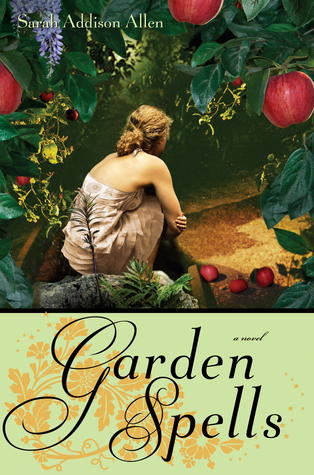 In this work of magical realism meets romance, Practical Magic meets Chocolat, Claire Waverley has the gift of making food that has magical effects on those who eat or imbibe them. But Claire lives a lonely life, afraid to let in love or strangers or anything that may go away. Things change when Claire's sister, the lively Sydney, returns to town with her daughter and a shady past in her wake. Both sisters are forced by circumstances to come to terms with their pasts and their futures. This is a fairly tame romance with a happy ending.
In this work of magical realism meets romance, Practical Magic meets Chocolat, Claire Waverley has the gift of making food that has magical effects on those who eat or imbibe them. But Claire lives a lonely life, afraid to let in love or strangers or anything that may go away. Things change when Claire's sister, the lively Sydney, returns to town with her daughter and a shady past in her wake. Both sisters are forced by circumstances to come to terms with their pasts and their futures. This is a fairly tame romance with a happy ending. All You Need is Kill
 All You Need is Kill, by Hiroshi Sakurazaka, trans. Alexander O. Smith, 230 pages
Keiji Kiriya is a Japanese soldier fighting in a global war against aliens called the Gitai who have attempted to conquer Earth. Sent to fight in his first battle, Kiriya dies a gory death, cradled in his last moments by an infamous, American, female soldier of great renown. But the next morning, Kiriya wakes up, just as he did the previous morning, to find that the same day and battle is occurring again. Kiriya relives the same day, in a Groundhog Day meets Independence Day sort of storyline, with the reader guessing as to why and what the secret is to ending this seemingly never-ending loop. This is the basis for the movie Edge of Tomorrow.
Friday, September 12, 2014
The Unwritten: Orpheus in the Underworld
 The Unwritten: Orpheus in the Underworld [vol. 8] by Mike Carey, art by Peter Gross, 176 pages
Tom/Tommy Taylor is the confusing (and confused) protagonist in The Unwritten. Is he real or fictitious? There are arguments that go both ways, and it probably doesn't help that the barrier between reality and fantasy is increasingly porous. This eighth volume finds Taylor on a quest to retrieve one of his friends from the underworld, as the rest of his compatriots wrestle with some mysterious murders on the Earth's surface.
This series took a while to coalesce, but it's pretty understandable these days, especially compared to some of the first volumes, which... holy cow were they confusing. Good, but confusing. Anyway, Carey continues to raise some intriguing questions about the power of story, and the role it should play in our lives, whether as fiction, as journalism, or as the age-old fables that we grew up with. (Speaking of fables, this volume is the lead-in to the Unwritten-Fables crossover that I've been so looking forward to reading, and is currently on my nightstand. Look for that review in the coming days.)
Library Journal described The Unwritten as "Jasper Fforde's Thursday Next books with teeth," and I don't know that I've ever heard a better description. So if you like Fforde's brand of genre-jumping fiction, but would rather deal with brutal violence than puns, give this series a try.
The Country of Marriage
 The Country of Marriage by Wendell Berry, 53 pages
This
short collection of poems has the usual Wendell Berry hallmarks - sense
of place, reverence for man and nature, concern for the connections
between people and places and sadness at their disappearance. The
quality of the poems is uneven, but there are a few genuine gems,
especially "Manifesto: The Mad Farmer Liberation Front" and "The
Gathering". None of the poems seem labored or overstay their welcome.
At turns wise, moving, and occasionally even beautiful, Berry's poetry is definitely worth reading.
Marriage and Civilization
Marriage and Civilization: How Monogamy Made Us Human by William Tucker, 238 pages
 The
central argument of this book is simple: monogamy evolved in humans
because it is necessary for equitable, peaceful societies. Polygamous
cultures tend to be more internally unstable and externally aggressive,
due to the large surplus male population and the corresponding need to
acquire females. Innate human viciousness, however, and specifically
the desire of high-status men to have multiple mates, tends to erode
monogamy unless it is protected by strong cultural prohibitions,
especially by the refusal of women to enter into such relationships.
The
central argument of this book is simple: monogamy evolved in humans
because it is necessary for equitable, peaceful societies. Polygamous
cultures tend to be more internally unstable and externally aggressive,
due to the large surplus male population and the corresponding need to
acquire females. Innate human viciousness, however, and specifically
the desire of high-status men to have multiple mates, tends to erode
monogamy unless it is protected by strong cultural prohibitions,
especially by the refusal of women to enter into such relationships.
Tucker makes a few clumsy mistakes - confusion
between the Restoration and the Glorious Revolution, a claim that
Genghis Khan converted to Islam - which highlight the shallowness of his
analysis. More troubling, he draws a narrative line between early
Mormon polygamy and the Mountain Meadows Massacre, which glosses over
the complete lack of a causal link. On the other hand, his
conversational style makes the book a pleasure to read.
Well-written and thought-provoking but not entirely convincing in its argument.
Thursday, September 11, 2014
The Magician's Land
 The Magician's Land by Lev Grossman
401 Pages
This is the conclusion of Grossman's Magicians trilogy. Quentin Coldwater is no longer a ruler of Fillory, a secret magical land. Now he must figure out his path back in the mundane life on Earth. He ends up teaching at Brakebill's Preparatory College of Magic. He becomes embroiled in a plot to find the missing volume of one of the children that the Fillory series of books was based upon. At the same time the magical barriers of Fillory are failing and the end of that world is near.
Part Harry Potter, part Narnia, this series also deals with the magical worlds of childhood fading away as adulthood is reached. Through the eyes of Quentin, we have gone full circle in the trilogy. Lev's snarky style and wit provides an adult version of the Chronicles of Narnia without the heavy handed sentimentality that persists in that series.
Hyde

As you might guess, this is a retelling of the classic tale, "The Strange Case of Dr. Jekyll & Mr. Hyde". It is told from the perspective of the Hyde personality, both when he is simply inside Henry Jekyll's mind and when he has taken over the body. Also included at the end is the original story, which I'm not sure I had actually read. If I had, it was over 20 years ago. The original story is really just a novella, and doesn't go into a lot of detail with what happens when Hyde has taken over, so Levine did a lot of imagining and filling in with what happens with each personality when it is in control of the body. There is a rather detailed back story that is given in bits and pieces which involves their father abusing them as a child and forcing them to do heinous acts.
This story isn't necessarily about sympathizing with either character, although the author does somewhat portray a "softer side" for Hyde.
All in all, this was an enjoyable read and quite atmospheric.
Lucky Us
 Lucky Us by Amy Bloom
240 Pages
Half-sisters Iris and Eva bond and survive during the 1940's in Bloom's latest work. Throw in a reprobate father, a couple of lesbians, a blues singer, a gay hispanic makeup artist and a jewish orphan and you begin to get the cast of characters in the book.
However, I should have known that if the critics were gushing I wouldn't care for the book. The characters are unsympathetic and fall flat to me. I could write more on this but I don't have anything nice to say about it.
Fables: Snow White
 Fables: Snow White by Bill Willingham, 165 pages
OK, since I know that there are some who read and contribute to this blog who are starting this series, I'm going to be as spoiler-free as possible. That said, I can't really say much about this 19th volume in the series without giving something away. Let's just say that as this series winds down (and it IS doing that, albeit slowly), Willingham is beginning to wrap up some of the many storylines in play. This volume manages to bring an end to one of those stories (that of Bufkin, one of the flying monkeys of Oz). The end seems a bit hasty, almost as if Willingham suddenly got tired of Bufkin and wanted to just get his story over with. This book also picks up where Cubs in Toyland (volume 18) left off, focusing on what's going on in Fabletown and Haven while the aforementioned cubs are away. Gah, I wish I could say more without giving something away...
Despite the Bufkin brush-off, this is a solid volume, with a good villian, some cunning deceptions, and one heck of a mess left for volume 20. Which I suppose I'll have to track down now. Eh, no complaints here.
I really can't recommend this series enough. Great characters, fun premise, awesome storylines. Read it!
Grave Peril
 Grave Peril by Jim Butcher, 378 pages
Wizard-for-hire Harry Dresden is at it again, trying to help people but managing to get himself stuck in a horrible supernatural situation. This time around, he's fighting some super-powered ghosts (which sounds much lamer than it really was), including one that seems dead set on taking out Dresden and his pals.
This is the third book in Butcher's Dresden Files series, and it recovers nicely from the absolutely horrible second book in the series, which is nice and bodes well for the rest of this REALLY. LONG. SERIES. The plot, while still a bit heavy on the action sequences, is much easier to follow, despite the menagerie of supernatural beings that pop up in Dresden's path. My biggest complaint with this series is that it is SO OBVIOUSLY written by a man, for a male audience. Many of the female characters are simply cardboard stereotypes of women, generally either as generic sex objects or as hormonal control freaks. I get that I'm not the target audience for this series, but would it kill Butcher to add a bit more dimension to these female characters? My only hope is that this happens over the course of the series, since some of them seem destined to stick around a while.
Wednesday, September 10, 2014
Teutonic Knights
The Teutonic Knights: A Military History by William Urban, 278 pages
 The
Teutonic Knights - also known as "the Order of the Hospital of St Mary
of the Germans in Jerusalem" or "the German Order" - were a religious
order founded by some of the German participants in the Third Crusade.
Similar to the Knights Templar and the Knights Hospitaler, the Teutonic
Knights were soldiers who swore the three monastic vows - poverty,
chastity, and obedience - and lived a common life marked by regular
liturgical prayer. Originally focused on the fight in the Holy Land, as
the Crusades waned they redirected their attentions to Prussia and
the Baltic states, where they had been involved in struggles against the
pagan Balts, and erected a state that survived until the sixteenth
century.
The
Teutonic Knights - also known as "the Order of the Hospital of St Mary
of the Germans in Jerusalem" or "the German Order" - were a religious
order founded by some of the German participants in the Third Crusade.
Similar to the Knights Templar and the Knights Hospitaler, the Teutonic
Knights were soldiers who swore the three monastic vows - poverty,
chastity, and obedience - and lived a common life marked by regular
liturgical prayer. Originally focused on the fight in the Holy Land, as
the Crusades waned they redirected their attentions to Prussia and
the Baltic states, where they had been involved in struggles against the
pagan Balts, and erected a state that survived until the sixteenth
century.
As a military history, this book spends little time on the
non-martial work of the order, while noting that "[h]ardly a
middle-sized town in Germany was without a hospital, church, or convent
which street names commemorate today." Urban resists the dominant
narrative which sees the Knights as a German
spearhead into the Slavic East, foreshadowing later German expansion
(and especially the Second World War). He does not shy away from the
more grisly moments in the history of the Order, but he doesn't
romanticize their enemies, either. The result is an objective, balanced
account. The lack of a strong narrative flow does mean that the book
sometimes seems like a barrage of names and dates.
An informative work about that shadowy corner of Europe where Catholicism, Orthodoxy, and paganism met, often bloodily.
Oh, Snap!
Oh, Snap! by Walter Dean Myers, 120 pages
 The Cruisers are back in their fourth book. These books don’t have to be read in order to understand them. Zander, Kambui, LaShonda, and Bobbi are the Cruisers. They run an underground newspaper at their school. They also like to shake things up. In this story they are worried because another kid at school was accused of holding up a store at the mall with his friends. The boy, Phat Tony, claims he wasn’t at the mall that day but the Cruisers were at the mall and Kambui snapped a candid photo of him. The Cruisers don’t believe he actually committed any crime so they don’t want to offer the photo to the police and get him into more trouble. Plus, if he did hold up a store at gunpoint, they are a little afraid of what he might do if the narc on him and he finds out. On the other hand, they don’t want to get in trouble with the police for withholding information. The group has a real dilemma. Great for reluctant readers, these basic real life stories about school and friendship will appeal to a wide variety of older elementary or young teen readers.
Tuesday, September 9, 2014
What The Witch Left
What The Witch Left by Ruth Chew, 131 pages
 When Katy’s friend Louise came over to play she started asking Katy about the chest of drawers in her room, especially the bottom drawer, which was locked. Katy explained that her mother kept things in the drawers and didn’t want Katy to play in them. The bottom drawer, however, had things in it that belonged to Katy’s Aunt Martha. Katy knew where her mother kept the key and the two girls found several items that seemed to be an odd collection of junk: and old mirror, a bathrobe, red boots, and flesh colored gloves, for example. They soon discovered that this odd assortment of things might be more than they seem and have some interesting adventures, including a magical trip to Mexico! This is a short book that will probably appeal to reluctant readers, especially kids who like magic and fantasy.
Royal Assassin
Royal Assassin by Robin Hobb, 581 pages
 The second book in a trilogy, this series is better read in order than as stand-alone books. Fitz, bastard son of the now dead Prince Chivalry, took a lot of time to recover from being poisoned in the new Queen-In-Waiting Kettricken’s homeland. It is some time before he is able to travel back to Buckkeep. But he is a King’s Man, and eventually he does make it back. There he finds that intrigue is rife. Queen Kettricken is not very well accepted by the people because she is too foreign. King-In-Waiting Verity spends most of his time Skilling to try to help keep the Kingdom safe from the Red- Ship Raiders so his people and his Queen don’t see enough of him. King Shrewd is very ill and rarely makes public appearances because he isn’t strong enough. Prince Royal seems to be scheming to find a way to take the throne, although his father is still alive and his brother stands in his way. Among all of these other problems, Fitz realizes that he is in love with his childhood friend, Molly. But he doesn’t know how to reconcile his life of devotion to the King with the life he wants with her. Fans of fantasy will like this series.
Sisters
Sisters by Raina Telgemeier, 197 pages
 Telgemeier’s graphic novels are based loosely on her own life growing up. This particular book focuses on a road trip made by her family from California to Colorado and back again for a family reunion. Raina and her sister, Amara, don’t get along at all, and never have. This is shown vividly through flashbacks scenes from their lives, starting when Raina was very young and begging for a sister to play with. She has the usual reactions when Amara is still a baby about her being no fun but as they get older, despite the fact that they both love to draw, they never click and often have screaming matches about almost anything. One major bone of contention is that Amara loves nature and animals and Raina doesn’t. When Raina’s parents decide that Raina should get her own room, they also allow Amara to get a snake. The snake becomes a major part of the story, because Raina hates even having it in the house. This is actually a really good story about a realistic sister relationship. Almost any kid with siblings would find something to relate to in the book and even kids without siblings would probably find a lot of humor in the story.
Fiendish
 Fiendish by Brenna Yovanoff, 341 pages
Back when I read Paper Valentine, Yovanoff's previous book, I said that if she kept improving at the rate she was going, her next book would be a real killer. Well, Fiendish is a marked improvement over both Paper Valentine and The Replacement, but it's still not... quite there. I guess there was more room to grow that I thought.
With each book, Yovanoff gets better at storytelling, and better at presenting her imagery. Her setups and payoffs keep improving. Each story she writes feels more interesting than the last. After the first two or three chapters of Fiendish, I was sure she'd finally nailed it - it was so strange and interesting, so unlike anything she'd done before, so legitimately grim as opposed to "Halloween Sale at the Hallmark Store" grim. But as it proceeded, a lot of the same old flaws cropped up. Even the flawed parts are less flawed, but there are still areas that need work.
I'm not sure if Yovanoff has an attachment to stories where the male lead and the female lead are "soulmates" or "fall in love at first sight" or "were meant for each other," or if she just consistently struggles to make the romances in her stories feel valid, but it's still an issue here. Clementine and Fisher don't so much fall in love as they are told that they're in love by the author. It's the best-justified so far of her romance plotlines, but the justification comes too late in the book to seem relevant. It's like Yovanoff wants to break out of the typical YA romance trappings - all of her books could stand on their own without the love stories, and might be better off without them - but somewhere got the impression (or was told) that she couldn't be successful without them. She certainly has the skill to do better, one way or the other.
All that said, this is a solid book. I still stand by that if Yovanoff keeps improving, one of her books will become a favorite of mine. This one was on track to be that book, but it faltered just a bit.
Monday, September 8, 2014
Integral Humanism
Integral Humanism: Temporal and Spiritual Problems of a New Christendom by Jacques Maritain, translated by Joseph W Evans, 308 pages
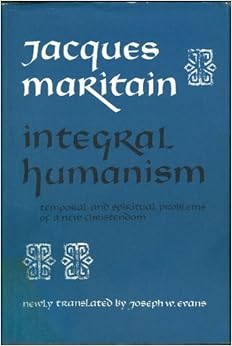 In
this classic work, Maritain considers the prospects for the emergence
of a new Catholic engagement with society. The old Christendom of the
Middle Ages having fallen apart, this new Christendom must grow in the
context of a post-Marxist, post-capitalist society. It must avoid the
danger of clericalization, instead trusting to the lay faithful to carry
on the work of Christ in the temporal sphere. It must be tolerant of
differences in prudential judgement, and willing to work with those who
reject or are openly hostile to Catholicism, without ignoring the
dangers of such collaboration. Above all, the new Christendom must
arise from the metaphysical reality of man as taught by the Church, an
integral humanism that understands human dignity in the light of the
ordination to eternity of the human person.
In
this classic work, Maritain considers the prospects for the emergence
of a new Catholic engagement with society. The old Christendom of the
Middle Ages having fallen apart, this new Christendom must grow in the
context of a post-Marxist, post-capitalist society. It must avoid the
danger of clericalization, instead trusting to the lay faithful to carry
on the work of Christ in the temporal sphere. It must be tolerant of
differences in prudential judgement, and willing to work with those who
reject or are openly hostile to Catholicism, without ignoring the
dangers of such collaboration. Above all, the new Christendom must
arise from the metaphysical reality of man as taught by the Church, an
integral humanism that understands human dignity in the light of the
ordination to eternity of the human person.
With Maritain only sketching out a broad outline for future
development, rather than making concrete, prudential proposals, the book
remains relevant eighty years after its initial publication. He did
underestimate the vitality of capitalism, viewing it as already on its
last legs, but given the view from France in the '30s, this is wholly
understandable and does not touch on his central arguments.
This is a work of major significance which had a substantial impact on the fathers of the Second Vatican Council.
Victoria Rebels
Victoria Rebels by Carolyn Meyer, 265 pages
 This historical fiction is about Victoria, Queen of England through the later 1800’s. She reigned for almost 64 years. This teen novel chronicles her life from eight years old through the first few years of her reign in her early twenties. Victoria was raised to be a queen. Although at her birth, she was several steps away from the throne, all of the people who were between her and the throne were her father’s older brothers, none of whom had legitimate children and were unlikely to have any, so everyone knew that Victoria was likely to inherit. Her mother raised her strictly and rarely allowed her to do anything on her own, for fear that she would injure herself. In fact, Victoria slept in her mother’s bedroom until she became Queen, at age eighteen. On the advice of John Conroy, the man her mother most trusted, Victoria’s mother made many decisions during her upbringing that Victoria resented which resulted in a strained relationship, such that Victoria and her mother barely spoke by the time that she became Queen. The book is written completely from Victoria’s perspective and is based on her own journals written from the time she was thirteen. Teen fans of historical fiction, especially of this time period, will enjoy this book.
The Sweet Revenge of Celia Door
The Sweet Revenge of Celia Door by Karen Finneyfrock, 259 pages
 Celia is starting high school and over the summer she went Dark. She is now Celia the Dark and she refuses to let any of the horrible people at school hurt her anymore. She wears black clothes and combat books and always a hoodie. Unfortunately, the horrible people are still there and possibly more horrible than they used to be. Her one place of refuge, English class, is being taught by a teacher who doesn’t seem to get her at all so is miserable instead of wonderful. Her parents, who decided to have a trial separation this summer have been making no moves towards reconciling. The only good thing that has happened is that a new boy started school this year. Drake, from New York, is beautiful and wonderful and Celia feels like she’s found a kindred spirit. But she is afraid to tell Drake her biggest secret, the one that has her seeking revenge, even though Drake has told her his biggest secret. I thought this was a really good book about bullying and friendship that a lot of teens would like.
Illusion
Illusion by Sherrilyn Kenyon, 448 pages
 The newest book in The Chronicles of Nick has Nick switching bodies with a different Nick in a parallel universe. Perhaps because his powers were just bound, or maybe because he’s not in the right body, Nick is unable to access any of his powers. This is really bad, because it seems like, even in this dimension, his enemies have found him and they have ways to use him even without his powers. Unless Nick can figure out who his friends are, or better yet, either get his friends to this dimension or get his soul back in its rightful body, this could be the end. A nice addition to the series, I wouldn’t recommend reading these books out of order. There are parts of the book that won’t make as much sense unless the earlier books in the series have been read. However fans of the series will like it. People, especially teens, who are interested in fantasy would probably like the series.
Circle of Wives
 Circle of Wives by Alice LaPlante
311 Pages
When Dr John Taylor turns up dead in a hotel room at first it seems as if he just had a heart attack. However, investigators notice a small puncture wound on his back making his death suspicious. As Detective Sam Adams investigates this pillar of the community she uncovers a startling secret. He has three wives.
This would be best categorized as a literary mystery. As the book progresses we learn how each wife interacted with the doctor and their motives, desires and histories. Written with deft style, you don't find out until the end what happened.
Saturday, September 6, 2014
Eifelheim
Eifelheim by Michael Flynn, 481 pages

In
the twenty-first century, historian Thomas searches for answers to two
questions. Why was the Black Forest town of Oberhochwald abandoned in
the fourteenth century and never resettled? And why was its name
changed to Eifelheim?
In the fourteenth century, Dietrich, the local priest, has
questions of his own. Who are the strange visitors who claim to come
from beyond the spheres? And why, despite their incredible command over
the forces of nature, do they know nothing of the soul?
Flynn writes with an easy competence, whether the subject is
quantum physics or scholastic philosophy, but the novel's greatest
strength is his considerable wit. He is also confident enough to leave
certain things ambiguous, so this is definitely not a novel for those
who demand closure. On the other hand, those who like books set in the
Middle Ages and those who like books about alien encounters will both
love this book.
Friday, September 5, 2014
Thursday, September 4, 2014
Haunted Hollywood: Tinseltown Terrors, Filmdom Phantoms, and Movieland Mayhem
Tom Ogden 273 pages

The narrative is divided into three sections, as indicated
by the title. Odgen repeats stories that he’s heard/researched from the silent
film stars like Mary Pickford; Douglas Fairbanks, Sr.; and Thelma Todd through
modern day where some the studios and actors’ hangouts are reportedly haunted.
There is nothing creepy or interesting about these stories.
My first clue should have been “retold by Tom Odgen.” They aren’t even well
enough written to provide a narrative arc.
BUT I did learn a lot of Old Hollywood history, which is why I give it 2 out of 5 stars.
The Pull of the Moon

Elizabeth Berg has written a total of 24 books. The Pull of the Moon was her fourth. With a couple of nonfiction titles here and there, she mostly writes contemporary fiction for women.
Nan and her husband, Martin, are well-off, some would say rich, and their daughter has gone off to college. But as Nan turns 50-years old, something is missing. It’s more than that her periods have stopped. She feels as if life as passed her by.
Leaving a note off Martin, she takes off on a road trip. Following wherever the road takes her, she drifts along, trying to sort out what she truly feels. Every day, as promised, she send a letter to Martin to let him know that she is safe.
I like the way this book is written. It opens with her first letter to Martin, then is followed by her diary entries (it’s not stream of consciousness). The reader never hears from Martin. This is only Nan’s story.
Personally I thought the plot was a silly. There’s not much of a story arc and, for me, no reason, to turn the page. Yet I read every one of them, hoping to some real insight. Nan might have fit the stereotypical 1950s woman, but in 2014, it misses the mark.
I give The Pull of the Moon 3 out of 5 stars.
Dance With Dragons
 A Dance With Dragons by George R.R. Martin, 1016 pages
With this fifth volume in Martin's Song of Ice and Fire series, I'm now caught up with the story. As I mentioned in my review for the fourth book, A Feast for Crows, these two books happen concurrently, each focusing on a different group of characters. This one is the better of the two, most likely because we know more of the characters from the outset. (A Feast for Crows suffers from a lot of oddly named chapters and brand new characters in a world that is already filled to capacity with them.) Also, A Dance With Dragons is aided by the fact that the stories of books 4 and 5 converge toward the end of this most recent volume, allowing us to get a little bit more information about those characters we did care about in A Feast for Crows.
I am constantly amazed by the depth of the writing, the strength and nuance of the characters (particularly the female characters), and the well-realized cultural elements in this series. There are so many different locations, each with its own climate, religion, language, food, style of dress, and more; while it is occasionally difficult to keep the multitude of characters straight (especially the minor ones and the new ones), Martin can never be faulted for confusing his readers on where they are. It's an impressive feat, and makes the long time between books understandable. Doesn't mean I'm excited about the LONG wait before book 6, but it is at least understandable. I'd hate for Martin to rush himself and give us something that's not worthy of the series he's created so far.
Wednesday, September 3, 2014
Bach Among the Theologians
Bach Among the Theologians by Jaroslav Pelikan, 140 pages
 Jaroslav
Pelikan was undoubtedly one of the most important American theologians
of the twentieth century. As a young man, however, he had seriously
considered pursuing a career as a concert pianist. His love of music
and theology combine to make this short study of the religious context
and content of the work of JS Bach both lively and enlightening.
Jaroslav
Pelikan was undoubtedly one of the most important American theologians
of the twentieth century. As a young man, however, he had seriously
considered pursuing a career as a concert pianist. His love of music
and theology combine to make this short study of the religious context
and content of the work of JS Bach both lively and enlightening.
Pelikan carefully explicates Bach's position in the
struggles between the Pietist and Orthodox factions within eighteenth
century Lutheranism, and how the composer managed to reflect the best
characteristics of each theological approach through his unique musical
genius. Furthermore, Pelikan demonstrates how Bach reached back through
Luther to embrace and transfigure centuries of Christian faith and
music.
A wonderful portrait of Bach, his life, his faith, his music, and his world.
Tuesday, September 2, 2014
August Totals!

(Please don't stop blogging though - the 2013/2014 season may be over, but the 2014/2015 season began yesterday!)
Congratulations to Jason S who read the most pages, Krista R who won the points category and Terra S who won the random drawing! On to the results!
August Stats:
TOTALS
| Blogger | Books | Pages | Points |
| Jason S | 25 | 10,567 | 33 |
| Krista R | 36 | 10,526 | 43 |
| Ed W | 22 | 8,125 | 29 |
| Dennis M | 14 | 4,428 | 14 |
| Kara K | 9 | 3,012 | 15 |
| Julie E-C | 9 | 2,556 | 9 |
| Terra S | 4 | 1,374 | 9 |
| Sarah P | 5 | 1,319 | 5 |
| TOTALS | 124 | 41,907 | 157 |
Subscribe to:
Posts (Atom)