Friday, November 27, 2015

Girl in the Spider's Web

Girl in the Spider's Web by David Lagercrantz, 400 pages

Cover image for Girl in the Spider's Web is listed as the fourth book or the continuation of the "Millennium" series, you know the one with Lisbeth Salander, Girl with the Dragon Tattoo. I was, when picking up this book very leery about reading it. To often I have see series destroyed and made unreadable with a change of authors, Yes I am looking at you Lustbader. But that is not the case here. Lagercrantz beautifully continued not only the characters that we know and love, but his writing style is so similar to Larsson's that at times I forgot that this was not by Stieg.

Girl in the Spider's Web like the rest of the series focuses on Lisbeth and Mikael. Mikael has been living off the fame generated by the events previously, but Millennium, his newspaper company, is slowly sinking. So when a person calls with a story of vital importance Mikael jumps at the chance. He soon learns that Lisbeth has been investigating the same story and turns to her for help. But what they uncover are secrets that people are willing to kill to protect.

I would highly recommend this book to anyone who enjoyed the previous volumes in the Millennium series. I would, however, caution that this book does not work as a stand alone, it needs the series and the backstory to fill out the plot.

The Millennium series, often called the Girl with the Dragon Tattoo series, ranks among my all-time favorite books/series, and I think is the only series of which I have a complete set. I look forward to eventually adding Girl in the Spider's Web to my shelves.

Wednesday, November 25, 2015

Secondhand Souls

Secondhand Souls by Christopher Moore
335 Pages

"It seems like only yesterday that Charlie Asher took on a very dirty job--collecting souls and keeping the Forces of Darkness at bay. The new gig came with the Big Book of the Dead and a host of other oddities: creatures under the streets, an evil trinity of ravenlike Celtic death goddesses, and one very bad Underworld dude attempting to conquer humanity. Along with a cohort of other oddballs, Charlie faced off against these denizens of darkness--and met his own end. But thanks to Audrey, his Buddhist-nun boo, his soul is still alive . . . inside a fourteen-inch-high body made from lunchmeat and spare animal parts. Waiting for Audrey to find him a suitable new body to play host, Charlie has squirreled himself away from everyone, including his adorable seven-year-old daughter, Sophie, who enjoys dressing up like a princess, playing with her glitter ponies, and--being the Luminatus--spouting off about her power over the Underworld and her dominion over Death. Just when Charlie and company thought the world was safe, some really freaky stuff hits San Francisco. People are dying, but their souls are not being collected. Someone--or something--is stealing them and no one knows where they are going, or why, but it has something to do with that big orange bridge. Then there's the Taser-wielding banshee keening about doom who's suddenly appeared while Sophie's guardian hellhounds, Alvin and Mohammed, have mysteriously vanished. Charlie is just as flummoxed as everyone else. To get to the bottom of this abomination, he and a motley crew of heroes will band together: the seven-foot-tall, two-hundred-and-seventy-five-pounds-of-lean-heartache Death Merchant Minty Fresh; the retired policeman-turned-bookseller Alphonse Rivera; the lunatic Emperor of San Francisco and his dogs, Bummer and Lazarus; Mike Sullivan, a bridge painter in love with a ghost; a gentle French-speaking janitor named Jean-Pierre Baptiste; and former Goth girl Lily Darquewillow Elventhing Severo, now a part-time suicide hotline counselor. With little Sophie babbling about the coming battle for the very soul of humankind, time is definitely not on their side. . . . Irresistibly zany, rich in humor, heart, and spirit, Secondhand Souls is vintage Christopher Moore. "

It was Moore's first book  of the Grim Reaper series "A Dirty Job" that made me read other books by him.  This entry continue the irrelevancy he embraced in the first book, with a little girl who is the Ultimate Death.  I enjoyed this novel much more than Moore's previous 2 books.  

Updraft

Updraft by Fran Wilde
364 Pages

 "Welcome to a world of wind and bone, songs and silence, betrayal and courage. Kirit Densira cannot wait to pass her wing test and begin flying as a trader by her mother's side, being in service to her beloved home tower and exploring the skies beyond. When Kirit inadvertently breaks Tower Law, the city's secretive governing body, the Singers, demand that she become one of them instead. In an attempt to save her family from greater censure, Kirit must give up her dreams to throw herself into the dangerous training at the Spire, the tallest, most forbidding tower, deep at the heart of the City. As she grows in knowledge and power, she starts to uncover the depths of Spire secrets. Kirit begins to doubt her world and its unassailable Laws, setting in motion a chain of events that will lead to a haunting choice, and may well change the city forever-if it isn't destroyed outright."

An original fantasy novel, Wilde creates a world where we never really learn the back story of the civilization that is being portrayed.   I did enjoy the book. 

Try Not to Breathe

Try Not to Breathe by Holly Seddon
368 Pages
Out February 2016


"Amy Stevenson was the biggest news story of 1995. Only fifteen years old, Amy disappeared walking home from school one day and was found in a coma three days later. Her attacker was never identified and her angelic face was plastered across every paper and nightly news segment.

Fifteen years later, Amy lies in the hospital, surrounded by 90’s Britpop posters, forgotten by the world until reporter Alex Dale stumbles across her while researching a routine story on vegetative patients.

Remembering Amy’s story like it was yesterday, she feels compelled to solve the long-cold case.

The only problem is, Alex is just as lost as Amy—her alcoholism has cost her everything including her marriage and her professional reputation.

In the hopes that finding Amy’s attacker will be her own salvation as well, Alex embarks on a dangerous investigation, suspecting someone close to Amy.

Told in the present by an increasingly fragile Alex and in dream-like flashbacks by Amy as she floats in a fog of memories, dreams, and music from 1995, Try Not to Breathe unfolds layer by layer to a breathtaking conclusion."

I liked how the narrative switched among the characters without losing the reader and maintains the mystery through at least half the book for me.  

House of Thieves

The House of Thieves by Charles Belfoure
 412 Pages

"In 1886 New York, a respectable architect shouldn't have any connection to the notorious gang of thieves and killers that rules the underbelly of the city. But when John Cross's son racks up an unfathomable gambling debt to Kent's Gents, Cross must pay it back himself. All he has to do is use his inside knowledge of high society mansions and museums to craft a robbery even the smartest detectives won't solve. The take better include some cash too --the bigger the payout, the faster this will be over.
With a newfound talent for sniffing out vulnerable and lucrative targets, Cross becomes invaluable to the gang. But Cross's entire life has become a balancing act, and it will only take one mistake for it all to come crashing down --and for his family to go down too."

The historical parts of this book are very interesting and Belfoure sprinkles architectural information throughout the novel.  It is a little farfetched to think an entire family will readily turn to a life of crime because they are bored.   

The Knockoff

The Knockoff by Lucy Sykes and Jo Piazza
338 Pages

"An outrageously stylish, wickedly funny novel of fashion in the digital age, The Knockoff is the story of Imogen Tate, editor in chief of Glossy magazine, who finds her twentysomething former assistant Eve Morton plotting to knock Imogen off her pedestal, take over her job, and reduce the magazine, famous for its lavish 768-page September issue, into an app. When Imogen returns to work at Glossy after six months away, she can barely recognize her own magazine. Eve, fresh out of Harvard Business School, has fired "the gray hairs," put the managing editor in a supply closet, stopped using the landlines, and hired a bevy of manicured and questionably attired underlings who text and tweet their way through meetings. Imogen, darling of the fashion world, may have Alexander Wang and Diane von Furstenberg on speed dial, but she can't tell Facebook from Foursquare and once got her iPhone stuck in Japanese for two days. Under Eve's reign, Glossy is rapidly becoming a digital sweatshop--hackathons rage all night, girls who sleep get fired, and "fun" means mandatory, company-wide coordinated dances to Beyoncé. Wildly out of her depth, Imogen faces a choice--pack up her Smythson notebooks and quit, or channel her inner geek and take on Eve to save both the magazine and her career. A glittering, uproarious, sharply drawn story filled with thinly veiled fashion personalities, The Knockoff is an insider's look at the ever-changing world of fashion and a fabulous romp for our Internet-addicted age."

I did enjoy this book despite the unbelievable premise that Imogen Tate is so technologically backwards she can't even handle email at the grand old age of 42.    A modern retelling of "All About Eve"

Miss Ruffles Inherits Everything

Miss Ruffles Inherits Everything by Nancy Martin
307 Pages

"Rich and flamboyant Honeybelle Hensley, the most colorful character in Mule Stop, Texas, dies a suspicious death and enrages the whole town by leaving her worldly fortune to the most undeserving recipient-her dog. The incorrigible Miss Ruffles is a Texas Cattle Cur, not a cuddly lapdog, and when Honeybelle was alive, Miss Ruffles liked nothing better than digging up Honeybelle's famous rose garden after breakfast, chasing off the UPS man before lunch and terrorizing the many gentleman callerswho came knocking at cocktail hour. But now Miss Ruffles is in danger, and it's up to Sunny McKillip, the unwilling dogsitter, to keep her safe. Sunny is new to Texas, and sometimes she feels as if she's fallen into an alien world. If it isn't the pistol-packing football fans and the sweet-talking, yet ruthless ladies of the garden club who confound her, it's the rowdy rodeo hounds and the tobacco-spitting curmudgeon at Critter Control who have her buffaloed. With a killer on the loose and a cowboy lawyer keeping a suspicious eye on her every move, Sunny needs all the help she can get understanding how Texans think. There's more to Honeybelle's death than meets this Yankee's eye, and Sunny has Miss Ruffles to protect, too. It's a bucking bull ride of an adventure for Sunny, and if she's not careful she might just get killed . . . or her heart lassoed."

It was obvious by the cover that this was not going to be a deep book but I was disappointed that it wasn't more engaging.  I think Martin attempted to created too many colorful characters, so that no one character stood out and engaged the reader.  There were moments I really enjoyed but Martin had trouble with the overall plot moving along and presenting the reader with a mystery.  

Career of Evil

Career of Evil by Robert Galbraith
497 Pages

"When a mysterious package is delivered to Robin Ellacott, she is horrified to discover that it contains a woman's severed leg. Her boss, private detective Cormoran Strike, is less surprised but no less alarmed. There are four people from his past who he thinks could be responsible--and Strike knows that any one of them is capable of sustained and unspeakable brutality. With the police focusing on the one suspect Strike is increasingly sure is not the perpetrator, he and Robin take matters into their own hands, and delve into the dark and twisted worlds of the other three men. But as more horrendous acts occur, time is running out for the two of them... Career of Evil is the third in the highly acclaimed series featuring private detective Cormoran Strike and his assistant Robin Ellacott. A fiendishly clever mystery with unexpected twists around every corner, it is also a gripping story of a man and a woman at a crossroads in their personal and professional lives."

The series continues to develop the characters of Robin and Cormoran as well as tell a mystery story that is engaging.  I enjoyed the book and look forward to the next one.  

Resurrection Science

Resurrection Science: Conservation De-Extinction and the precarious future of wild things by M.R  O'Connor

266 Pages

" In a world dominated by people and rapid climate change, species large and small are increasingly vulnerable to extinction. In Resurrection Science , journalist M. R. O'Connor explores the extreme measures scientists are taking to try and save them, from captive breeding and genetic management to de-extinction. Paradoxically, the more we intervene to save species, the less wild they often become. In stories of sixteenth-century galleon excavations, panther-tracking in Florida swamps, ancient African rainforests, Neanderthal tool-making, and cryogenic DNA banks, O'Connor investigates the philosophical questions of an age in which we "play god" with earth's biodiversity. Each chapter in this beautifully written book focuses on a unique species--from the charismatic northern white rhinoceros to the infamous passenger pigeon--and the people entwined in the animals' fates. Incorporating natural history and evolutionary biology with conversations with eminent ethicists, O'Connor's narrative goes to the heart of the human enterprise: What should we preserve of wilderness as we hurtle toward a future in which technology is present in nearly every aspect of our lives? How can we co-exist with species when our existence and their survival appear to be pitted against one another?"

After reading this novel you can't help but have despair that mankind will ever be able to stop the mass extinction of all large mammals in the world with our impact on the environment.  Each chapter explores possible solutions and illustrates the drawbacks to each solution.  

Our Endless Numbered Days

Our Endless Numbered Days by Claire Fuller
386 Pages

"Peggy Hillcoat is eight years old when her survivalist father, James, takes her from their home in London to a remote hut in the woods and tells her that the rest of the world has been destroyed. Deep in the wilderness, Peggy and James make a life for themselves. They repair the hut, bathe in water from the river, hunt and gather food in the summers and almost starve in the harsh winters. They mark their days only by the sun and the seasons. When Peggy finds a pair of boots in the forest and begins a search for their owner, she unwittingly unravels the series of events that brought her to the woods and, in doing so, discovers the strength she needs to go back to the home and mother she thought she'd lost. After Peggy's return to civilization, her mother begins to learn the truth of her escape, of what happened to James on the last night out in the woods, and of the secret that Peggy has carried with her ever since."
A captivating novel with a twist.  It certainly puts into perspective any desire to become a survivalist.  

Heart Goes Last

The Heart Goes Last by Margaret Atwood
308 Pages

"Stan and Charmaine are a married couple trying to stay afloat in the midst of an economic and social collapse. Job loss has forced them to live in their car, leaving them vulnerable to roving gangs. They desperately need to turn their situation around--and fast. The Positron Project in the town of Consilience seems to be the answer to their prayers. No one is unemployed and everyone gets a comfortable, clean house to live in . . . for six months out of the year. On alternating months, residents of Consilience must leave their homes and function as inmates in the Positron prison system. Once their month of service in the prison is completed, they can return to their "civilian" homes. At first, this doesn't seem like too much of a sacrifice to make in order to have a roof over one's head and food to eat. But when Charmaine becomes romantically involved with the man who lives in their house during the months when she and Stan are in the prison, a series of troubling events unfolds, putting Stan's life in danger. With each passing day, Positron looks less like a prayer answered and more like a chilling prophecy fulfilled."

 As a whole I found this to be an odd novel.  I never got the sense of desperation implied in the description and instead found the end chapters to be almost comedic. 

Affinities

Affinities by Robert C. Wilson, 304 pages

Cover image for The AffinitiesAffinities was recommended to me by our librarian in the Teen room, Carrie. While she hasn’t joined us in our blogging quest to reclaim a trophy, she does recommend good books. Affinities is about a futuristic society in which people, if they choose to, can get sorted into niche groups based on their personalities. It that regard it is very Divergent like, but a lot less strict.

The story follows one Adam Fisk. A man who can no longer afford college and is adrift in life. With nothing else to lose he takes the affinity test and gets matched with one in his area. Suddenly his life has meaning again, he is meeting new friends, has a steady job and everything is coming up roses. But a dark truth is lurking just under the surface that could bring everything he has come to know and love to a bitter end.
Affinities is very good and I really enjoyed it. I would have to go back and check copy write dates but I think this book came out before Divergent and in my opinion should be read instead. It doesn’t have the explosions and teenage love, but it has some crucial life lessons and a hard hitting message. I think everyone should read this book, as it might only be a matter of time before society heads this direction.

London Steampunk

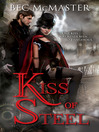
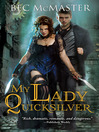
Kiss of Steel, Heart of Iron, and My Lady Quicksilver by Bec McMaster, 437, 423, and 425 pages

Cover image for Kiss of SteelAll three of these titles are part of McMaster’s “London Steampunk” series. The series was recommended by Goodreads based on the fact that I liked the “Parasol Protectorate” series by Gail Carriger. While I can certainly see some similarities, both being steampunk, taking place in London, and with supernatural elements like vampires and werewolves, there is none of the silliness and lightheartedness that I was initially expecting.

Cover image for Heart of IronHowever, this series was still worth reading on its own merits. I enjoyed the detailed portrayal of a subjugated human population always on the brink of a losing war with the vampires, the rich description of a Victorian London, and of course the fantastic steam inventions that somewhat define the steampunk genre.
Throughout the series we follow various people with the majority of them being strong willed women who are trying to make a better life for themselves without selling out their dignity or blood. Somewhat like a romance novel, they are always wooed by a strong vampiric figure who is not like the rest. Together they strive to change society’s ingrained mentality and struggle for equal rights. The books tend to contain wisps of erotica, and can get kind of heavy, but it is not as bad as Kenyon’s books.

Cover image for My Lady Quicksilver
I would encourage people who like the steampunk genre to give this series a try, but while it has those elements it is more of a supernatural/vampire series.
A quick after review note: My Lady Quicksilver was read online through Ovedrive, the page count was taken from Goodreads.

Enthusiasm and Divine Madness

Enthusiasm and Divine Madness: On the Platonic Dialogue Phaedrus by Joseph Pieper, 103 pages

It is true that Phaedrus is sometimes regarded as one of Plato's lesser dialogues, but Joseph Pieper (Leisure: The Basis of Culture) did not share in that view.  In Enthusiasm and Divine Madness he guides the reader through the dialogue step by step.

In Pieper's interpretation, the central theme of Phaedrus is in the conflict between a reductionist sophism which seeks to manage life according to purely rational principles and a recognition of the divine nature of some of the rapturous passions which transcend reason and rational control.  Beauty, even the imperfect beauty of the physical world, can draw the soul involuntarily upwards to higher realities.

Ironically, it is the superficial beauty of the sophists' rhetoric that sways the clever young men, while the deeper beauty of truth offered by Socrates can only be perceived by the wise.

Phaedrus

Phaedrus by Plato, from The Dialogues of Plato, translated by Benjamin Jowett, 96 pages

Phaedrus begins with the title character enthusiastically describing to Socrates a speech he has heard from a great rhetor, Lysias.  The speech was intended to persuade a young man to take a disinterested older man as his lover rather than a passionate suitor, denigrating romantic love as irrational and undependable.  Socrates responds with a speech of his own in the same vein, which leads into a dialogue on the nature of love, reincarnation, rhetoric, and the shortcomings of the written word.

This is sometimes regarded as one of Plato's lesser dialogues, and it is easy to see why.  It lacks a strong focus, and the great metaphor for the soul which Socrates presents is muddled and hard to grasp.  Phaedrus is not much of an interlocutor - after initiating the dialogue he does little except agree with Socrates or encourage him to continue.  Still, Plato is laying out great ideas here, from the explication of love as a madness given by the gods, akin to poetry and prophecy, to the fable of the judgement of Thamus.

This edition was translated with commentary by the great Oxford don Benjamin Jowett, the prime mover of the 19th century English Platonic revival.

Tuesday, November 24, 2015

The Lake House

The Lake House by Kate Morton
495 Pages

 " Living on her family's idyllic lakeside estate in Cornwall, England, Alice Edevane is a bright, inquisitive, innocent, and precociously talented sixteen-year-old who loves to write stories. But the mysteries she pens are no match for the one her family is about to endure... One midsummer's eve, after a beautiful party drawing hundreds of guests to the estate has ended, the Edevanes discover that their youngest child, eleven-month-old Theo, has vanished without a trace. What follows is a tragedy that tears the family apart in ways they never imagined. Decades later, Alice is living in London, having enjoyed a long successful career as an author. Theo's case has never been solved, though Alice still harbors a suspicion as to the culprit. Miles away, Sadie Sparrow, a young detective in the London police force, is staying at her grandfather's house in Cornwall. While out walking one day, she stumbles upon the old estate--now crumbling and covered with vines, clearly abandoned long ago. Her curiosity is sparked, setting off a series of events that will bring her and Alice together and reveal shocking truths about a past long gone...yet more present than ever."

Kate Morton doesn't disappoint in her latest book.  The reader is transported between the past and present and it kept guessing at an ages old mystery.  Of course if you read a lot of Morton's book you would be led to believe that England is chock full of old, abandoned manor  houses (with all their furnishings of course).

Japanese Lover

The Japanese Lover by Isabel Allende
321 Pages

"In 1939, as Poland falls under the shadow of the Nazis, young Alma Belasco's parents send her away to live in safety with an aunt and uncle in their opulent mansion in San Francisco. There, as the rest of the world goes to war, she encounters Ichimei Fukuda, the quiet and gentle son of the family's Japanese gardener. Unnoticed by those around them, a tender love affair begins to blossom. Following the Japanese attack on Pearl Harbor, the two are cruelly pulled apart as Ichimei and his family--like thousands of other Japanese Americans--are declared enemies and forcibly relocated to internment camps run by the United States government. Throughout their lifetimes, Alma and Ichimei reunite again and again, but theirs is a love that they are forever forced to hide from the world. Decades later, Alma is nearing the end of her long and eventful life. Irina Bazili, a care worker struggling to come to terms with her own troubled past, meets the elderly woman and her grandson, Seth, at San Francisco's charmingly eccentric Lark House nursing home. As Irina and Seth forge a friendship, they become intrigued by a series of mysterious gifts and letters sent to Alma, eventually learning about Ichimei and this extraordinary secret passion that has endured for nearly seventy years. "

Certainly a greatly hyped book, Allende fails to deliver memorable charactersThe quality of her writing is such that you will finish the book but it is definitely not something you would buy friends to read or make any best books ever list. 

Monday, November 23, 2015

Spirit of Early Christian Thought

Cover image for The Spirit of Early Christian Thought: Seeking the Face of God by Robert Louis Wilken, 321 pages

It is highly significant that this book is titled The Spirit of Early Christian Thought and not The History of Early Christian Thought or A Compendium of Early Christian Thought.  Through the writings of the Church Fathers, returning most frequently to Origen, St Gregory of Nyssa, St Augustine, and St Maximus the Confessor, Wilken attempts to enter into the minds and hearts of the early Christians, to hear them as still living voices.

Wilken succeeds admirably in bringing the moral, ritual, and intellectual world of early Christianity to life.  He convincingly demonstrates how the early Church, far from paganizing Christianity, baptized elements of classical culture, offering the world something authentically new and still vital two thousand years later.

Sunday, November 22, 2015

The Bird Sisters

The Bird SistersThe Bird Sisters, by Rebecca Rasmussen, 304 pages

Milly and Twiss are elderly sisters living in a small town, who don't see many other people unless someone stops by with an injured bird. But when they were young, they had dreams of something more; one pivotal summer and a visit from their cousin changed everything.  This was a tough book to get into- the story alternates time periods and there are some family dynamics that were hard for me to get past; but around the half-way mark, the story picks up and the ending is a very emotional one.  This was the author's first novel.

Lumberjanes, vol 1: Beware the Kitten Holy

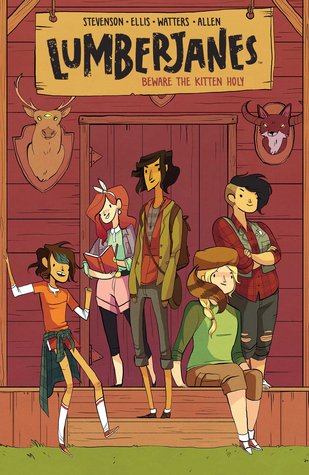
Lumberjanes, Vol. 1: Beware the Kitten Holy (Lumberjanes, #1-4)Lumberjanes, vol 1: Beware the Kitten Holy, by Noelle Stevenson, Grace Ellis, Brooke A. Allen (Illustrator), Maarta Laiho, 128 pages

Five gal pals at a summer camp for "hardcore lady types" encounter foxes with three eyes, a river monster, and a boys' camp full of weirdly well-behaved young men.  Oh man, I loved this! It had the charm and innocence of Adventure Time, mixed with humor and friendship and hardcore lady types.  And I love seeing female talent in the graphic novel world! And there's a Pungeon Master badge! You can't beat that!

The Uncommon Reader

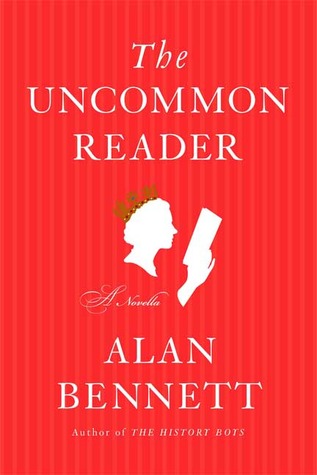
The Uncommon ReaderThe Uncommon Reader, by Alan Bennett,  120 pages

The Queen of England is out for a walk, runs across a bookmobile, and realizes she has never really read.  So begins her discovery of books and literature, but can the world handle a Queen who is learning to think for herself?  I don't know about this book- novella, really; maybe it's witty, in a British way?  But it just felt like an endless string of name-dropping authors that sound good on paper to have read.  The ratio of corgis to pages was also dismally low.

Fangirl

FangirlFangirl, by Rainbow Rowell, 438 pages

Cath is having a rough introduction to college.  Her twin and only friend, Wren, has decided that they need to have some space; her roommate barely talks to her and has a boyfriend who never leaves; and school is sort of getting in the way of her writing her epic work of fanfiction for a sort of Harry Potter knockoff that will soon be ending.  I don't think this was very story-driven, but just a sweet and occasionally funny work of fiction about growing up.  Personally, Cath was a (sometimes painfully) relatable character for me.  It did make me super excited about Carry On, the newest Rainbow Rowell book, because it's basically the work of fanfiction that Cath is writing during Fangirl.

Friday, November 20, 2015

Odes of Horace

Cover image for The Odes of Horace by Horace (Quintus Horatius Flaccus), translated by David Ferry, 160 pages 

In the sixth ode of the first book, dedicated to Augustus' general Agrippa, the victor of Actium, Horace protests that to sing his subject's virtues properly would require an epic poet in the manner of Homer and Virgil, whereas

     It falls to me to make up easygoing
     Songs about such battlefields as parties,
     Epic encounters between young men and women.

So David Ferry renders it.  Contrast this with John Conington's Victorian era translation:

     Feasts are my theme, my warrior maidens fair,
     Who with pared nails encounter youths in fight.

Or A.S. Kline's more contemporary translation:

     I sing of banquets, of girls fierce in battle
     With closely-trimmed nails, attacking young men.

Obviously Ferry's translation is more equivalent than literal here, and on that level he succeeds admirably.  His rendition of Horace's poetry has an ease and a confidence that makes it seem effortless without being superficial, to the point where it is easy to imagine the odes being performed or even composed at one of the poet's dinner parties.  Unfortunately, it also misses some of Horace's gems, like the girls fighting with their nails in amorous combat, an image, so striking in itself, that also echoes his earlier references to "the wrath that filled Pelides' breast" and "crafty Ulysses' long sea-wanderings" better than "epic encounters between young men and women".

On the other hand, Ferry translates the thirteenth ode of the fourth book more literally

     ...your graying hair and yellowing teeth

while Conington transformed that description

     The white has left your teeth
     And settled on your brow.

Ferry is not deaf to metaphor, but he clearly prizes accessibility over ornament.  Whether the readers' values agree will determine their reception of this translation.

Thursday, November 19, 2015

The Marauders


The Marauders by Tom Cooper        320 pages

A little over five years has passed since Hurricane Katrina devastated New Orleans and lower Louisiana. Bayou residents are feeling the effects of the BP Deepwater Horizon Explosion and Oil Spill. BP says the oil hasn’t hurt the environment, but the shrimpers and the other fisherman know better. They are barely, barely eeking out a living.

Author Tom Cooper’s first novel centers around seven characters with a setting in the bayous and swamps of Barataria and the small town of Jeanette, basically suburbs of New Orleans. First there are the Toup brothers. Identical twins Reginald and Victor are drug dealers with a rather large field of marijuana growing on of the remote islands in the swamp. They do whatever they need to do keep their secret safe, even if it involves murder and stealing a man’s prosthetic arm to keep in him line.

Then readers are introduced to Gus Lindquist. A one-armed, OxyContin-dependent shrimper, he is about to give up on shrimping. As the shrimp dwindle in the oil-soaked waters, Lindquist re-focuses his attention on a boyhood dream: searching the swamp for pirate Jean Lafitte’s long-lost treasure.
Next come Cosgrove and Hanson, two petty criminals who meet doing community service. They desperately seeking any get-rich, half-brained idea they come across.  There’s the teenager Wes Trench, eighteen years-old and still reeling from his mother’s death during Katrina. Finally, there is the BP middleman, Brady Grimes, who is trying to get the residents of the area to take BP’s meager settlement offer. Until he has to face his own mother.

Cooper weaves the stories; each character or set of characters acting out a mini-novel of their own, but as the stories merge, something more sinister and dangerous begins to appear. At times hilarious and at others deeply profound, the novel is compulsive reading. I was eager to learn what kind of mess(es) these good ol’ boys could get themselves into.

I received this novel for free from Blogging for Books in exchange for this review. 
        
I give The Marauders 5 out of 5 stars.


Wednesday, November 18, 2015

World Restored

A World Restored: Metternich, Castlereagh, and the Problems of Peace 1812-1822 by Henry Kissinger, 332 pages

This was future Secretary of State Kissinger's first book, an expansion of his doctoral dissertation, explicating the restoration of some concept of legitimacy after an age of revolution had cast all such claims into doubt.  It centers on the vital cooperation of Metternich, representing Austria, and Castlereagh, representing Britain, as the two statesmen undertook the delicate juggling act of competing demands: Austrian concentration on political harmony against British focus on territorial equilibrium, Napoleon's personal outlook against the Habsburgs' dynastic view, Tsar Alexander's idealism against British pragmatism, British insularity against Austrian cosmopolitanism.

It is easy to see the appeal of this study of the Congress system at the time of its publication in 1957, when the East and the West each sought security in the midst of the Cold War.  Without an established set of common assumptions governing international relations, Kissinger asserts, diplomatic solutions to conflicts are impossible and force becomes the only law.  The quest for absolute security by any party renders overall stability impossible.  Only through the acceptance of limits can a lasting peace be attained, as opposed to an uneasy truce.

Monday, November 16, 2015

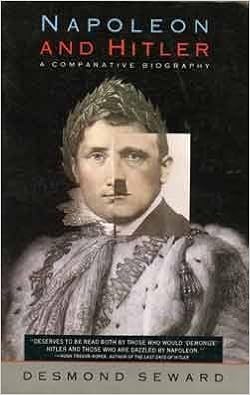
Napoleon and Hitler

Napoleon and Hitler: A Comparative Biography by Desmond Seward, 303 pages

Napoleon Bonaparte and Adolf Hitler are the two great "men from nowhere" in modern European history.  The parallels are obvious: born into obscurity, foreigners in the nations they ruled, they inherited states reeling from war and civil strife, conquered Europe, met disaster in Russia, and were ultimately defeated by a combination of all the other great powers against them.  There are glaring differences, too - Napoleon was an officer who won glory as a general which he then parleyed into dictatorship, Hitler an enlisted man who gained power through a later political career; Napoleon was a military genius, Hitler was not; Napoleon attempted to start a dynasty, Hitler did not; Napoleon survived to help shape his legacy, Hitler did not.  Most obviously, though millions died in the Napoleonic Wars, Bonaparte never targeted whole peoples for extermination.

According to Desmond Seward, both the differences and similarities run deeper than is generally appreciated.  Napoleon's use of military backing to seize power is paralleled by Hitler's paramilitary support.  Both leaders professed a jingoistic nationalism, but both were also deeply ambivalent about the people they ruled.  Most importantly - and damningly - both men "were incapable of rational compromise, an incapacity which meant their doom" and that of so many of their followers and foes.

Refuge Denied: The St. Louis Passengers and the Holocaust


Refuge Denied: The St. Louis Passengers and the Holocaust by Sarah A. Ogilvie and Scott Miller   224 pages

 On May 13, 1939, the German passenger ship, MS St. Louis sailed from Hamburg for Havana. Aboard were 937 German Jews trying to escape the rise of Hitler’s Third Reich. All had landing permits for Cuba and many had waiting numbers for the United States. Before this voyage, the St. Louis had been a luxury liner. Captain Gustav Schroeder insisted that the passengers was no different than any other passengers.

Fifteen days later, the St. Louis reached Havana. Much to their surprise, the Cuban government denied the passengers entry. Negotiations lasted several days. Cuba continued to refuse, and Schroeder set sail for America. Pleas were submitted to President Roosevelt. Without hearing from him, the ship anchored in the waters off the coast of Miami. They were so close that the passengers could see Miami’s lights. With no word from Roosevelt, Schroeder has no choice but to return to Germany. I can’t imagine the fear the passengers experienced.

When the ship returned, the passengers were dispersed to four countries: England, France, Belgium, and the Netherlands.

The years passed. In the United States, the Holocaust Memorial Museum was constructed. Two employees, Sarah Ogilvie and Scott Miller began to wonder what happened to those 937 German Jews. Were they swept up in Hitler’s determination to rid the world of Jewish people? Did any survive the concentration camps? Did any make it to America?

So began the research project that became this book. In 1996, Ogilvie and Miller began the arduous task of tracking down 937 people. It was a daunting task considering WWII had been over for more than 50 years.

Ten years in the making (that’s how long it took to track down all 937), this book is filled with tales of death, survivorship, research, dogged determination and sometimes just plain ol’ luck. What affected me the most was the passenger list and the photographs from the boat. Pictures of people without names makes them less personal. When you sit down to read this book, be sure to have a box of tissues handy.


Saturday, November 14, 2015

Spectacular Rubens

Cover image for Spectacular Rubens: The Triumph of the Eucharist edited by Alejandro Vergara and Anne T Woollett, 81 pages

This is not, as some might think, a cookbook about constructing the most spectacular Ruben sandwiches, but rather an analysis of a series of tapestries designed by Peter Paul Rubens for the Monasterio de las Descalzas Reales, the Poor Clare "Convent of the Barefoot Royals" in Madrid.  It was to this convent that Rubens' patroness, the Infanta Isabel Clara Eugenia, half-sister of Phillip III of Spain and ruler of the Spanish Netherlands, intended to retire after the death of her husband, although political necessity required that she remain in the Low Countries.

The exhibition which occasioned this book reunited six of Rubens' painted models with four of the finished tapestries.  The tapestries were primarily designed for use as hangings in the convent chapel on the feast of Corpus Christi, the annual celebration of the mystery of the Real Presence of Christ in the Eucharist, a feast with great political and devotional significance to the Habsburgs particularly and to the Church in general during the Reformation.  Rubens crafted a masterwork of baroque illusion, integrating a sense of movement mirroring that of the Corpus Christi procession, framing his scenes with exotic pillars suggesting a fantastic architecture within the real chapel walls, and creating fictive tapestries within the real tapestries. implying multiple layers of reality like those of substance and accident.

As with any art book, it is the illustrations that matter most, and these are spectacular.  The text is neither overly dull nor uninformative, detailing the commission, preparation, construction, and arrangement of the tapestries, and it does not sneer at the religious beliefs of the artists and their patron.

Thursday, November 12, 2015

Memoirs of a Happy Failure

Cover image for Memoirs of a Happy Failure by Alice von Hildebrand with John Henry Crosby, 184 pages

As a teenager, Alice Jourdain and her sister fled Belgium for America, just ahead of the German invasion.  The experience helped to convince her of the reality of evil and the necessity of an uncompromising defense of objective truth.  While working as a shelver at a library, she discovered the works of her future husband, Dietrich von Hildebrand, a brilliant philosopher who had fled Germany after the Nazi takeover and Austria after the Anschluss and was now teaching in New York.  She began teaching at Hunter College, and remained there for decades, confronting entrenched ignorance, malicious persecution, and a succession of intellectual fashions, joyfully fighting the long defeat.

At its heart, Dame von Hildebrand's memoir, like her life, is a testament to the idea that education does not - can not - have any purpose without the foundation of a belief in objective truth.

Tuesday, November 10, 2015

Catching Fire

Catching Fire by Suzanne Collins, 391 page


Catching Fire, as I'm sure it is very well known, is the second book in the Hunger Games trilogy by Suzanne Collins. It picks up roughly where the first book left off: the months following Katniss and Peeta's victory in the Hunger Games arena. The book quickly picks up steam as less of a dystopian novel and more of a revolutionary story. I am still quite amazed as to what passes as young adult subject matter, and I am increasingly anxious as to what the third book will bring in terms of tumultuous emotions.

I am still way behind the times as I finished Catching Fire. Nevertheless, I finished it, and I will finish the trilogy...once I get through a few books with an upbeat edge first.

The Torment of Rachel Ames

 The Torment of Rachel Ames by Jeff Gunhus  180 pages

Author Jeff Gunhus scared the ^%)* out of me with his book, Night Chill. So much in fact that I’m kinda scared to read the sequel. In fact, I think I’ll wait until Daylight Savings Time resumes. When he offered to send me a copy of his new novella, The Torment of Rachel Ames, I, of course, said, “YES!”. After all, how scary can a novella be? Then….OMG! Another night of no sleeping.

Rachel Ames suffers from writer’s block. With her two best friends, Underwood and Daniels strapped into the passenger seat, she heads to an isolated cabin. As she gets closer and closer, something feels off. Not just right. But there’s nothing she can put her finger on. 

The landlord, John, seems nice, and may be interested. He keeps bringing food and checking on her. The idea of messing around soon skittles out of her mind---she’s a married woman after all. There is another cabin across the lake, a gnarly old codger named Granger, who is ticked off at the world. Then there are the sounds…every time she lets her mind go quiet, the sounds of an intense fire and sirens can almost be heard. Is she near a forest fire?

One night, the cabin is attacked by a large bird and a wolf. But when Rachel finally gets up the courage to go outside and investigate, there are no bodies, no blood, no broken glass, nothing.

Soon she begins to question her sanity…yet something tells her it isn’t her.
 
Don’t want to give anymore away, but the last scene had me gasping. I feel lucky I didn’t have nightmares!


Monday, November 9, 2015

Idea of the Holy

The Idea of the Holy: An Inquiry into the Non-rational Factor in the Idea of the Divine and Its Relation to the Rational by Rudolf Otto, translated by John W Harvey, 229 pages 

In this classic work, Otto attempts an analysis of the concept of "the holy" while simultaneously avoiding both the Kantian reduction of religion to ethics and the emotivist reduction of religion to feelings.  His task, therefore, is a rational exploration of the non-rational (not irrational) component of religion - the numinous, the "spooky", the "mysterium tremendum" or mystery which can only be approached with Pauline "fear and trembling".  For Otto, this represents the given object of the religious experience, with rational and moral content following later, filling out the concept.  The numinous is apprehended by use of a sense analogous to the aesthetic sense.

Unfortunately, despite Otto's insights into the nature of the experience of the numinous, he neglects to consider the manner in which a Numen which he acknowledges as personal might choose to disclose Itself, or, indeed, that a Numen which is supra-personal must disclose Itself.  The result is a purely naturalistic account prone to the same psychological reductionism Otto strove to avoid.

Friday, November 6, 2015

October Totals!

Congrats to
Jason S, who read the most books and earned the most points, and to Dennis M, who read the most pages in October!  The winner of October's random drawing is Dennis M -- we'll be contacting you shortly about your prize.  Thanks for blogging!


October Stats:
BloggerBooks PagesPoints
Dennis M134,86115
Ed W114,48511
Jason S153,01930
Krista R82,0918
Molly P81,94911
Julie E-C41,1804
Melissa M25022
Karen Y11281
TOTALS6218,21582

Elgin Affair

Cover image for The Elgin Affair: The Abduction of Antiquity's Greatest Treasures and the Passions It Aroused by Theodore Vrettos, 220 pages

In the midst of the Napoleonic Wars, the British ambassador to the Sublime Porte, Lord Elgin, acquired permission from the Ottoman Turks to conduct excavations on the Athenian Acropolis and to take various antiquities back to Britain.  In perhaps the most extensive act of vandalism in history, Lord Elgin used this permission as a blank check to strip the Parthenon of every piece of decoration his team could pry from the structure, including much of the sculpture from the pediments and roughly half of the internal frieze, as well as a column capital and a caryatid from the Erechtheum, both of which were literally sawn off in order to remove them.  Elgin answered protests with the claim that modern Greeks were unworthy of their heritage.

In Vrettos' account, all this is secondary to the Elgins' domestic woes, culminating in a high profile divorce and a lawsuit by the aggrieved husband against Lady Elgin's lover.  Aside from the identity of the actors and the suggestion that Lord Elgin's preoccupation with the marbles may have contributed to his wife's estrangement, there is no connection between the archaeological and the personal dramas.  Exasperatingly, Vrettos includes a 13 page excerpt from a letter by Lady Elgin and a 24 page trial transcript, both of which merely repeat information which is present elsewhere in the narrative.  The incorporation of this filler is sadly consistent with the superficiality of the work as a whole, which reduces "the abduction of antiquity's greatest treasures" to a subplot in favor of a not particularly passionate tale of adultery.

Thursday, November 5, 2015

The Witch of Lime Street: Séance, Seduction, and Houdini in the Spirit World


The title of this book is what immediately captured by attention---anything with Houdini and sĂ©ances can’t be bad. The top of the inside dust jacket stirred my imagination: History comes alive in this textured account of the rivalry between Harry Houdini and the so-called Witch of Lime street…” Not to mention the dust jacket glows in the dark which is really cool.

Before I even started reading, I was disappointed. Having been initially classified as fiction, I was bummed to learn that this was nonfiction. But I was intrigued, so I didn’t let a little thing like that stop me. I was ready to be whisked away to the 1920s: back to jazz, spiritualism, Prohibition, and the fascination with the occult.

I want to say upfront that this book is well-written. It’s not hard to follow and is not merely fact stacked upon fact, as many historical books are. It pulled me in, but I kept reading and reading, waiting for Houdini and Margery to go head-to-head.  It took more than half the book to get there.
The book’s first half was about the rise in spiritualism in the United States and the role Sir Arthur Conan Doyle (of Sherlock Holmes fame) played. 

Fascinating background that a reader not well schooled in its complex history needs to know. Houdini was more like a bit player; he showed up near the end, and the biggest scene he played was his own death. I have to admit, that I felt cheated. And too, the book does not present conclusive evidence as to whether Margery was a fake or truly had a gift to communicate with her brother, who happened to be on the other side.


I received this book for free from Blogging for Books in exchange for this review.

Play for Me

Play for Me by Celine Keating   217 pages

Lily’s story opens with Lily and her husband, Stephen, dropping their only son, Colby, off at college. Lily isn’t ready for an empty nest; Stephen is. Stephen has his work as a planner for the city of Manhattan. Lily creates educational and business videos for a small Manhattan firm. She struggles with her newly empty life.

Colby invites his mother to a James Taylor concert. Lily jumps at the chance to be with her son. However, it’s the opening band that changes Lily’s life forever. The guitarist is able to reach down to the bottom of her soul and reawaken her passions and her desires for more creative outlets. I can’t remember the name of the duo, but lead singer Blaise and guitarist JJ, especially the way JJ plays, opens her heart and soul as they haven’t been opened in years.

Lily finds herself seduced by JJ’s playing; she begins to follow the band and catch their shows wherever they are appearing. She feels stupid for her desire to hear JJ play as much as she possible can. Then she gets the idea of creating a documentary about the pair. One she gets Blaise to agree, Lily goes on the road with them. Although it’s only for a week, Lily knows this is the most important thing she has ever done.

As they travel through New England and into Canada, Lily realizes she is endangering her marriage. At first, Stephen thinks it’s a fantastic opportunity, but as the phone calls home become less and the conversations strained, he begins to wonder what is really happening.

Keating does a wonderful job in exploring what many women go through: the re-identification of herself after the kids are grown and gone. The story built both slowly and quickly. Blaise’s initial outburst when she discovered Lily taping one of their concerts seems over-the-top, but as the story progresses, readers understand her action. A fast read, the story grabbed hold of me from Page 1 and never let up until I reached the conclusion. Keating left enough wiggle room at the end for a sequel, and I hope she is writing it.


I give Play for Me 5 out of 5 stars.

Wednesday, November 4, 2015

God's Forever Family

Cover image for God's Forever Family: The Jesus People Movement in America by Larry Eskridge, 284 pages

It was inevitable, in hindsight, that the rising tide of Evangelical Christianity, which surged in the '50s and '60s, should encounter the counterculture explosion of the late '60s.  It was equally inevitable that some of the spiritual seekers of the counterculture would find their search leading to Christianity, particularly in some of its more enthusiastic, experiential forms.  At the time, however, to the long-hairs on the streets of Haight-Ashbury and the Sunday-best faithful listening to Billy Graham on the radio equally, it seemed unthinkable.  How it happened, how drug culture casualties seeking a fresh start and square missionaries seeking to connect with disaffected youth came together to become the "Jesus Freaks" or "Jesus People", is the subject of God's Forever Family.

The Jesus People are generally understood as either a footnote of evangelical history or a footnote of countercultural history, one of the many ephemeral phenomena of the '60s and '70s.  In addition to chronicling the movement's brief peak in the early '70s and its rapid disappearance from American cultural consciousness in the late '70s, Eskridge emphasizes its lasting aftereffects, on individuals as much as on the wider society, especially in the creation of a vibrant evangelical subculture and the rise of the seeker-oriented megachurch.

Monday, November 2, 2015

Sigurd the Volsung

The Story of Sigurd the Volsung and the Fall of the Nibelungs by William Morris, 345 pages

Now famed more for his contribution to the visual arts than for his poetry, among the notable literary works of William Morris is this adaption of the Volsunga saga into English verse.  Morris was fascinated by Norse myth and legend and had already completed translations of a number of Icelandic sagas before beginning this work, which was contemporaneous with but independent of Wagner's operas.

The poetry is deliberately archaic, not only in language, but in rhyme and meter - it is often easy to forget that it is an original work based on classical sources, and not a direct attempt at translation.  The obvious comparison is with Tennyson's Idylls of the King, and the fact that Morris' work can hold up to that comparison is testament to its quality and power.

     Ye have heard of Sigurd aforetime, how the foes of God he slew;
     How forth from the darksome desert the Gold of the Waters he drew;
     How he wakened Love on the Mountain, and wakened Brynhild the Bright;
     And dwelt upon Earth for a season, and shone in all men's sight.
     Ye have heard of the Cloudy People, and the dimming of the day,
     And the latter world's confusion, and Sigurd gone away;
     Now ye know of the Need of the Niblungs and the end of broken troth,
     All the death of kings and of kindreds and the sorrow of Odin the Goth.