Thursday, March 24, 2016

The Never-Open Desert Diner

The Never-Open Desert Diner by James Anderson  304 pages

How can anyone resist a novel with a title like The Never-Open Desert Diner? I couldn’t and for the readers who pick it up, they are in for a wonderful trip through the Utah desert. I’m not one much for series, but I hope that author James Anderson is contemplating writing more stories featuring his protagonist, Ben Jones.

Ben is a self-employed delivery driver. It’s amazing that he hasn’t been put out of business by FedEx, DHL, or UPS. He almost is, as the bills are piling up faster than the noonday desert heat. He doesn’t think he’s going to make it to the end of the month.
He’s a quiet sort of guy, self-deprecating almost to a fault. He runs his truck up and down Utah’s Route 117, delivering all sorts of packages to some quirky characters. Three stand out.

First is Walt Butterfield who owns the Well-Known Desert Diner, famous for being in a number of movies.Walt keeps the place spotless and in tip-top shape. However, the diner has been closed since 1987. Walt fixes Ben a meal once in a while, but mostly his tinkers with his extensive collection of rare motorcycles. Second, is John, but most call him Preach. He runs a church in an abandoned hardware store and spends the majority of his time carrying a solid oak cross up and down the shoulder of Route 117. Last, and certainly not least, is Ginny, a very pregnant seventeen-year old Ben befriends one middle of the night in a Wal-Mart. She’s not alone and expecting, she is homeless, often living in her car. As we learn about the lies of these characters, it reminds of me of lives lived in quiet desperation.

One day as Ben is cruising down 117, he notices a glimmer in the desert that blinks and winks at him. Intrigued and having to take a piss like there is no tomorrow, he pulls onto the shoulder and walks up a small incline. On the other side, is an abandoned housing development. He heads down to check out the one house, and as looks in the window, he sees a naked woman sitting on a green chair playing the cello. Relieving himself against the side of the house, the woman come out to investigate. Her name is Claire.

As Ben and Claire begin to fall in love, some rather unsavory people show up along Route 117. Don’t want to say anything more that will spoil the amazing adventures Ben has, falling in love, trying to help Claire, trying to save his rig and his business. It’s a wonderful story.
I was surprised to learn that author Anderson grew up in the Pacific Northwest, but he must have spent some time in Utah to understand the desert as he does.

I give The Never-Open Desert Diner 6 out of 5 stars.


I received this book from Blogging for Books  in exchange for this review.

Wednesday, March 23, 2016

Deus Caritas Est

Cover image for Deus Caritas Est by Pope Benedict XVI, 108 pages

Deus Caritas Est - "God is Love" - was Pope Benedict XVI's first encyclical, released on Christmas Day 2005.  It is the first of a trilogy on the theme of the three theological virtues - Spes Salvi ("Saved in Hope") was issued in 2007 and Benedict's successor Francis released Lumen Fidei ("The Light of Faith") in 2013.

Pope Benedict begins with the familiar distinction between eros (desiring love) and agape (selfless love).  He attempts to establish that, contrary to popular misconceptions, the two are complementary rather than competing.  Eros draws lovers out of themselves and towards the beloved - it is, as Plato demonstrated, both a form of ecstatic divine madness and a longing for fulfillment - but it also easily turns possessive and destructive.  As grace perfects nature, so agape purifies eros in the love of the God who is Love.

Key to this purification is the role of the Church.  Love, by its very nature, cannot exist in a vacuum - it creates and sustains communities.  To thrive, then, it requires order and direction.  The Church exists both as the ordinary channel of divine love through the sacraments and a nexus of the neighborly charity which is the only genuine response to an encounter with that divine love.  Benedict distinguishes this charity from impersonal philanthropy by stressing that it seeks the good of the entire human person.  The struggle for social justice, while vital for a healthy society, can never replace charity precisely because it can never minister to spiritual needs, primary among which is the need to love and be loved.

Tuesday, March 22, 2016

The Guest Room

The Guest Room by Chris Bohjalian.  318 pages

This story focuses on multiple viewpoints after a horrific event.   We have Richard Chapman, who has decided to host his younger brother's bachelor party, complete with Russian strippers.   We also have the viewpoint of Alexandra, one of the strippers.  Finally, there is Kristin, Richard's wife.

The bachelor party has all of the correct elements for something bad to happen: a bunch of drunk men, two young strippers, alcohol . . . and when one of the young women stabs their Russian bodyguards to death and then flees the house, life will never be the same for anyone involved.  Now, Richard's job puts him on indefinite leave and his wife finds himself unable to forgive him for the intimate moment he shared with one of the girls.   However, the person in the most danger is Alexandra, on the run trying to escape both the police and her gangster captors.

Typical of this author, I found this story to be compelling, fast-paced, and with a few twists.  I felt he really did a good job of capturing the three different voices of the characters, so that their viewpoints felt authentic.  Alexandra's story, in particular, is heartbreaking, and I appreciated that the author didn't shy away from any of the ugliness.   It is a fact that young women are trapped into sexual slavery all over the world, and it's not a pretty situation.

The front of the book has a quote from author Geraldine Brooks which says this book" Couples the urgency of a compulsively readable crime thriller with a quiet meditation on the meaning of family."  I think this is true, and that the author does a great job of making a story which is a page-turner, but then which sticks in your mind long after you've closed the book.

Monday, March 21, 2016

Moonlight Over Paris

Moonlight Over Paris by Jennifer Robson    352 pages
           
December 1923.  Lady Helena Montagu-Douglas-Parr is near death in her London home. Doctors have told her parents to start planning for the worse. I believe that her illness was scarlet fever, but that didn’t come out until about halfway through the story. Robson would have readers believe that her broken engagement has caused her illness.
She feels the shame and shun or her relatives, friends, and strangers. Her five-year engagement to Edward is over. The Great War changed him, but it wasn’t her who broke off the relationship; it was Edward. Now Helena is 28, and her prospects are few.
A letter arrives from her bohemian, free-spirited Aunt Agnes in Paris. She invites Helena to come and visit her. Helena quickly agrees, despite her parents’ concerns.
Helena has always been drawn to art and enrolls in an art school under the tutelage of Maitre Czerny. She drops her title and simply becomes Helena Parr.
Although Robson is an excellent writer and researcher, the story becomes predictable. She does her best at art but is never noticed by Czerny. She becomes fast friends with three of her classmates and, together, they rent a studio. She meets a handsome American, Sam Howard, to whom she is attracted. They hit it off and are smitten with each other, yet…
There are a lot of wonderful details in the work. I enjoyed watching Helena become an artist and gain self-confidence that he broken engagement destroyed.
Although it’s predictable, Moonlight Over Paris has strong characters and character development. Since I didn’t expect anything different, I really enjoyed this read.
I give Moonlight Over Paris  4 out of 5 stars.


What Happened, Miss Simone?

What Happened, Miss Simone? by Alan Light.  260 pages (not including discography and notes)

This is a biography of artist Nina Simone, who wasn't just a singer, but a classically trained pianist and civil rights activist.  Alan Light is a former music journalist, and brings that writing style to this book.  Using rare archival footage, audio recordings, interviews and personal diaries, Light puts together a nuanced portrait of a complex and compelling woman.

I had been familiar with Simone's work for a while, but I didn't really know that much about her before reading this book.  It was interesting to read about her personally, but admittedly, I found some of the writing about her musicianship to be fascinating.   A classically trained pianist, Simone brought that deep understanding of classical music into her performances.  At the time she was first performing, this was very unusual, and unexpected.   Unfortunately, Ms. Simone's personal life often overshadowed her artistic life.   However, reading about her personal struggles and how they influenced her music made me want to pull up more recordings and listen to them.   Very interesting reading.

Acedia and Its Discontents

Cover image for Acedia and Its Discontents: Metaphysical Boredom in an Empire of Desire by RJ Snell, 127 pages

The diabolically active Judge Holden (from Cormac McCarthy's Blood Meridian) may seem like a strange figure to use as a representative of acedia, the "deadly sin" usually translated as "sloth", but that is exactly what RJ Snell does in the first pages of Acedia and Its Discontents.  His purpose is plain - acedia is not what we think it is.  Sloth is not laziness, but aimlessness, not a lack of energy, but a lack of purpose, a denial of purpose, and ultimately the hatred of any purpose, order, or discipline.

Snell's solution to this empire of depression lies in a renewed understanding of the nature of work.  Good work, as opposed to mere busy-ness, is more than the manipulation of resources in an attempt to satisfy one's desires - it engages with the world, respecting both creation and the exalted human role of co-creator, accepting responsibility instead of fleeing from it.  Good work, as Snell defines it, is essentially contemplative, directed towards transcendental values, focused on the good of creation rather than its usefulness.

Sunday, March 20, 2016

The Old Man and The Sea

The Old Man and The Sea by Ernest Hemingway  128 pages

I haven’t read this novella since I was in junior high school (I think it’s called middle school now). I didn’t care for it then. I have never been a Hemingway fan. But I had three reasons for picking it up again.
First, it was my turn to pick the book for my writing group. I knew I wanted something short, as one of our members isn’t a big reader. Second, March’s topic for the On the Same Page with Central Library Goodreads challenged its readers to re-read a hated book from high school. Third, is I’m a big fan of Paula McLain’s The Paris Wife.
The copy I checked out at the Library has an introduction by Charles Scribner, Jr. Interesting I thought as his father was one of the two men to whom Hemingway dedicated this book. If you pick up this copy, DON’T read the introduction; it gives the whole story away. I remembered how it ended, but I didn’t need to be reminded of the details.
The Old Man has been without a catch for 84 days. Everyone in his Cuban village claims he is unlucky and begins to shun him. NOTE: Hemingway went to Cuba and fished as part of his research. Still he goes out, sure that today would be his lucky day.  He hooks the fish of a lifetime and spends the next four days, barely eating, drinking, or sleeping, reeling it in.
I so enjoyed this story; it was unputdownable. It did take me two evenings to read, but I tried to read slow and enjoy the adventure. I have to admit that I wanted to read fast, but Scribner’s spoiler spoiled some of the fun.
After finishing this story of the old man who has hooked the fish of a lifetime, I may go back and try to read some more Hemingway.
I give The Old Man and The Sea 6 out of 5 stars.


Daring to Date Again

Daring to Date Again by Ann Anderson Evans   290 pages

Having just turned 60 myself and only married (this time) for almost five years, I was intrigued by the idea of Ann’s memoir. After 12 celibate years, she is ready for anything that will appease the hunger. To put it bluntly, she’s as horny as an 18-year-old boy
How does a woman of our age go about dating in the early years of the 21st century? It’s a whole different world out there (I knew my newish husband from work). And what about sex? Is it as available as television, movies, etc. make it out to be? Where do women of certain ages go to meet men? Is Internet dating as scary as it seems? Ann’s memoir seems to answer all these questions, but the answers are not rules or guides for single women; the book is Ann telling the reader her experiences. I would never classify this book as self-help (unless it’s to gain confidence that there is sex available.)
Get ready to laugh, cry and enjoy all the emotions in between. Ann’s first adventure to conquer the sexual gnawing is with a guy Larry, who turns out to be a transvestite. Ann doesn’t care about that, but she is looking for a male with male longings.
Ann dates many, many men. So many, by the end of the book, I couldn’t keep them all straight. I’ve been so worried about stalkers I would never allow a virtual stranger into my home, much less my bed. Maybe it’s because Ann is a confident woman. I loved Chapter 13, Strategy. She makes a chart that will help guide her through the e-mails and flirts from the Internet. There are three columns: Indispensable, pro, and con. That list serves her well, until she meets Guy.
I was starting to get a little bored with the whole dating/sleeping around when Ann and Guy connect. I was astounded that Ann went to Zimbabwe to spend some time Guy. But that put the zip back into the story.
I enjoyed Ann’s voice; it was like a best friend/sister talking to me, telling me her adventures. I felt as if I was dating again vicariously through Ann, and all I can say, is please God, never let me single and horny again.

I give Daring to Date Again 5 out of 5 stars.

Saturday, March 19, 2016

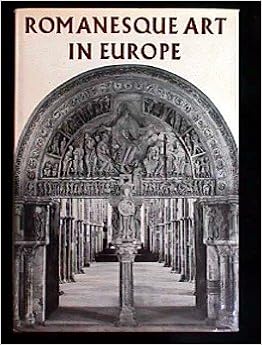
Romanesque Art in Europe

Romanesque Art in Europe, edited by Gustav Kuenstler, 322 pages

The Romanesque style of art and architecture flourished during the eleventh and twelfth centuries.  As illustrated in Romanesque Art in Europe, its reach extended from Sicily to Scandinavia, with corresponding local variations, from Byzantine influences in Italy to the "insular style" of Britain.  The versatility of the Romanesque embraces both the ornate exuberance of the Cluniac monasteries and the severe plainness of the Cistercians.  

Often dismissed as artless and clumsy, particularly when contrasted with the Gothic style which it birthed, this book demonstrates the power of Romanesque, from impressively detailed stone portals to soaring interior spaces to wonderfully expressive sculptures.  The book is filled with fantastic full-page photographs, but, sadly, none are in color, which rather reinforces the popular image of medieval art as grey and monotonous.  The captions manage to compensate for this shortcoming, providing each image with a paragraph of commentary and context.

Thursday, March 17, 2016

Fun Home

Fun Home: A Family Tragicomic by Alison Bechdel.  232 pages

This is a graphic memoir by Alison Bechdel that focuses on her relationship with her late father.  Bruce Bechdel was an English teacher and also director of the town funeral home (which the family referred to as the Fun Home).   After college, Alison, who had recently come out as a lesbian, discovered that her father was also gay.

I was familiar with Alison Bechdel's long-running comic, Dykes to Watch Out For, but I didn't know much about her.   In this graphic novel, it was interesting to learn about Alison's family, especially her relationship with her father.   And, it is an interesting read, although I found it kind of depressing.  Her father was a complex person, and his relationship with her wasn't at all warm.   Her parents seem at odds with each other, and not that interested in their children, either.   But, this memoir is about the author putting together the pieces of what she has learned about her father, and the book actually ends in a way that makes it seem that she is not finished.

I enjoy her writing style and her art, so I think I enjoyed this graphic memoir more because it was graphic.  I'm not sure if it would have been as interesting if it had been a memoir with no pictures, and no art.  Combining her writing with her drawings really brought the story to life with a great deal of emotion that I think would be hard to portray in any other way.

This book was made into a Broadway musical, so if this book sounds like your kind of read, there's now a musical adaptation.

Wednesday, March 16, 2016

Erasmus of Rotterdam

Erasmus of Rotterdam by Stefan Zweig, translated by Eden and Cedar Paul, 247 pages

Desiderius Erasmus was a giant of his time, the center of the republic of letters, a friend of St Thomas More and Martin Luther, the man whose Greek edition of the New Testament became the basis for the Textus Receptus recognized as authoritative for three centuries.  A master scholar and master ironist, Erasmus managed to simultaneously fulfill the roles of Europe's leading intellectual and her leading fool.

Stefan Zweig was one of the most celebrated biographers of the early twentieth century, and it is easy to see why - rather than attempting to construct a detailed photograph of his subject's life, he paints an engrossing word-portrait.  In his estimation, Erasmus was the first of a new type - the man of the book, set apart equally from the man of war, the man of the land, and the man of the Church.  He lived his life, it seems, in the pages of books, either reading or, far more often, writing.  Indeed, Zweig provides a rare example of the term "ivory tower" being used in a positive sense, although even he expresses a little frustration at a subject who often "lighted up a problem" but "never solved one."  An Austrian writing in 1934, like Zweig, might view a lifelong refusal to commit to a cause - any cause - as an admirable trait, but readers in other times and places might not.  If it is true that his is an "essentially modern spirit", an evaluation of Erasmus as a brilliant but ultimately hollow man has a much broader application than the historical figure himself.

The Past

The Past by Tessa Hadley.  310 pages.

This story focuses on three adult sisters and their brother, who meet up at their grandparents' country home for their annual holiday of three weeks.  This may the last summer they all have together in this house, as they may need to sell it.  Naturally, with even the closest of siblings, there are bound to be tensions.  

The summary of the book via Goodreads says, "With uncanny precision and extraordinary sympathy, Tessa Hadley charts the squalls of lust and envy disrupting this ill-assorted house party, as well as the consolations of memory and affection, the beauty of the natural world, the shifting of history under the social surface. From the first page the reader is absorbed and enthralled, watching a superb craftsperson unfold the lives of these unforgettable siblings."

Admittedly, I didn't love this book.  I kept turning the pages because I was curious if anything was really going to happen in the story (perhaps a startling revelation from one of the characters? A tragic secret?), but it was hard for me to care about any of the characters.  The writing style is interesting, but for me, the characters . . . weren't.   The sister who seems to have some kind of inner turmoil and secrets isn't that compelling, and the one sister who seems to always be dramatically saying this and that wasn't compelling to me, either.    There isn't much of a plot, so the book is basically just these people interacting with each other (although there is a middle section that is set in the past).

I can see where some readers really respond to this author's writing style, but I'm not one of them.


What Alice Forgot

What Alice Forgot by Liane Moriarty.  459 pages

Alice Love is 29 years old, crazy about her husband, and eagerly expecting their first child. Or is she?   When she falls and hits her head in spin class, Alice comes to with the firm belief that she is 29 years old.  However, after her visit to the hospital, she learns the truth: she is 39 years old, is in the middle of an ugly divorce, and has 3 children.   With the past 10 years a complete blank, Alice now has to piece together her life and find out just how she's gotten to where she is . . . and if there is any way to go back.

I have read other books by this author, and had anticipated the same kind of fast-paced read as before.   I thought the story here was interesting, where Alice has to use what she learns from other people to piece together what has happened in the last ten years.  Because what other people tell her can be subjective, it's especially tricky.   But, like her other books, Moriarty does a nice job of weaving together characters' lives, with ups and downs.   And, it's interesting to picture yourself in Alice's position.   At times, it felt a little too unreal, but this was a good Sunday afternoon read.

Monday, March 14, 2016

Once Upon a Flock

Once Upon a Flock: Life with my soulful chickens by Lauren Scheuer.  241 pages (with loads of illustrations).

When illustrator Lauren Scheuer was looking for a new project, she got the idea to raise backyard chickens.  Her family was skeptical, but soon fell in love with the chicks.   This book focuses on the three chickens: "Hatsy, the little dynamo; Lil’White, the deranged and twisted Buff Orpington; Pigeon, the fixer-upper chicken; and Lucy, the special-needs hen who bonds with Lauren and becomes a fast friend."

This is a charming book, filled with photos and illustrations of Scheuer's chickens.  I had been expecting an entertaining read, but found I was learning more about chickens than I had expected. Scheuer's illustrations are wonderful, and you really get the different personalities of the chickens.  And, it's not a worry-free life: there are definite bumps in the road, and a few sad spots in this book. But, overall, it's light-hearted.  And did I say charming?  Definitely.

Celtic Christianity

Celtic Christianity: Making Myths and Chasing Dreams by Ian Bradley, 232 pages

This is not a book about Celtic Christianity - the form of Christianity that thrived in Ireland and evangelized Scotland in the fifth and sixth centuries - but rather a book about the many attempts that have been made to claim and shape its legacy.  Indeed, near the end the author raises the question as to whether the label refers to any genuine subject at all, or whether "Celtic Christianity" only exists as a succession of constructions made by subsequent eras.

The book begins with the hagiographers of the seventh and eighth centuries, who idealized the not-so-distant past into a golden age as a way of both condemning and inspiring their own era, as well as promoting the preeminence of certain religious and political centers.  A succeeding Celtic revival arose in the first centuries of the second millennium, following the Norman conquest, as Britons, Normans, and Anglo-Saxons all sought to claim the blessings and legacies of the indigenous saints.  It was also during this era that the Arthurian mythos took shape.  When the Reformation was brought to Britain, Protestants appealed to the Celtic saints as indigenous, erastian Anglican or Presbyterian figures, with the otherwise much-maligned monks becoming a claim for the primitive simplicity of the British Church prior to Augustine's arrival in Canterbury.  In the Romantic era, the aura of mystery surrounding the Celts provided fertile ground for an idealized myth of the Druids, who in turn, it was imagined, transitioned into an equally idealized non-Roman Christian priesthood.  The syncretism of the Romantic approach - holding some legendary Druids as the pinnacle of natural religion awaiting only the Christian revelation to be perfected - has characterized "Celtic Christianity" in the popular imagination ever since.  The twentieth century saw some sober criticism by historians and an increasing tendency to view the subject in terms of contemporary social issues such as feminism and environmentalism.

Bradley is not only the author, but is himself one of the mythmaking dreamers, and as a result he tends to treat his subjects with considerable affection - perhaps too much, as he seems unwilling to actually judge any factual claims once he leaves the Middle Ages.  It is possible to question the discontinuity Bradley evidently sees between the "golden age" and his first two, medieval groups of mythmakers, a discontinuity which excises a considerable amount of traditional "Celtic" material but is necessary in order to provide room for certain alternative interpretations of what remains.  He especially perceives a contradiction between the popular image of St Patrick as the fearless evangelist of Ireland and the self-doubting figure revealed in the Confessio, the only writing of Patrick's which survives, but history is filled with individuals (and especially missionary saints, beginning with St Paul, who is clearly Patrick's model in the Confessio) who are both confident and self-effacing.  The sons of St Bernard used the Celtic tradition in the same manner as St Bede had centuries earlier, to urge a return to a stricter, simpler, "purer" form of monasticism.  Likewise, he asserts that the Arthurian legends are essentially non-Christian, which seems like a highly debatable claim.

Celtic Christianity gains energy and coherence when it begins its discussion of the Victorian fad for all things Celtic and the simultaneous Celtic Twilight movement, and the book might have been stronger if it had begun there (or shortly before) and focused exclusively on the modern era.  This, in turn, might have facilitated a clearer presentation of the different distinctive (though interacting) strains within the contemporary Celtic Christian movement - charismatics, New Agers, Western Orthodox, Anglicans, Welsh nationalists, etc.  Bradley is clearly passionate about his subject and an active participant in its development, but his unsuccessful efforts to shed light on the long-ago only serve to confuse matters in the here-and-now.  In the end, he concludes that enlisting the legends of Celtic Christianity in the service of social justice is preferable to medieval relic-collecting contests, which seems to suggest that politics is more important than the quest for holiness, a conclusion which the great saints of the past would surely have denied.  The true conflict is between seeing those saints as models to be imitated or as brand names to be exploited.

Sunday, March 13, 2016

The Green Road

The Green Road by Anne Enright   304 pages

Longlisted for the 2015 Man Booker Prize
I wasn’t familiar with Anne Enright’s work before I was given The Green Road as a gift. The synopsis sounds wonderful:

From internationally acclaimed author Anne Enright comes a shattering novel set in a small town on Ireland's Atlantic coast. The Green Road is a tale of family and fracture, compassion and selfishness―a book about the gaps in the human heart and how we strive to fill them.
Spanning thirty years, The Green Road tells the story of Rosaleen, matriarch of the Madigans, a family on the cusp of either coming together or falling irreparably apart. As they grow up, Rosaleen's four children leave the west of Ireland for lives they could have never imagined in Dublin, New York, and Mali, West Africa. In her early old age their difficult, wonderful mother announces that she’s decided to sell the house and divide the proceeds. Her adult children come back for a last Christmas, with the feeling that their childhoods are being erased, their personal history bought and sold.
A profoundly moving work about a family's desperate attempt to recover the relationships they've lost and forge the ones they never had, The Green Road is Enright's most mature, accomplished, and unforgettable novel to date.

I even saved it until I had to spend some time in an airport. It starts out pretty good, but quickly goes downhill in my opinion. The beginning and the ending are the best parts.

The story starts in 1980 with Hanna, seemingly the youngest of the Madigan brood. Mom Rosaleen has taken to her bed after the oldest, Dan, announces he wants to become a priest. The story then shifts to focus on Dan. It is 1991. He is living in New York. Not sure what his occupation is as the story is more about his life as a gay man and the AIDS epidemic more than anything. The next section focuses on Constance, stilling living in Ireland, in 1997. She is at a hospital to determine if the lump in her breast is cancer. The next shift is on Emmet, who is, I think, a missionary in Mali in 2002. As I read these sections, I felt that Enright kept the reader at arm’s length. Then the story jumps back to the Madigan home for Christmas 2005.

The father, who we don’t see much of, died ten years (I think) earlier. Rosaleen is the same melodramatic matriarch that she was in Hanna’s section. There are no explanations of how the four ended up like they did, which made me feel disconnected to the character’s problems.


I give The Green Road 2 out of 5 stars.

The History Major by Michael Phillip Cash

The History Major by Michael Phillip Cash   152 pages

It’s the beginning of a new school year. Amanda Green is rooming with friends. However, the night before classes are to start, Amanda has a heated argument with her boyfriend; his demands seem completely out-of-line. She crosses to the other side of the local watering hole and commences to tie one on.

The next morning she has a monster of a headache, and there is a strange female in her room who is insisting that she is late for class and that they are roommates. In addition, something menacing is hanging around, just outside her peripheral vision.

By the time Amanda gets it together enough to head for class, she’s not only late, but there seems to be a mix-up in her schedule. She would never, ever take a history course. Receiving no help from the college, she goes to class.

Things there are just a little weird. It seems the entire student body is taking the class. The professor is a wacko, that weird vision is beating on the closed doors, and the only person who seems to notice her is the guy in the next seat, Nick Fortune.

This is an odd little story that is compulsively readable. I had had to know what the heck was going on, yet in my wildest dreams, I hadn’t thought of the answer that Cash provides. I wish I could talk more about the ending, but no spoilers allowed.

I give The History Major 4 out of 5 stars. It gets knocked down a star for the format; that line space between each paragraph is not necessary and drove me nuts.


Little Rice: Smartphones, Xiaomi and the Chinese Dream

Little Rice: Smartphones, Xiaomi and the Chinese Dream by Clay Shirky.  128 pages.

I found this small book to be entertaining, as well as quite informative.  Xiaomi has become the world's third-largest mobile phone carrier, with products tailored to the Chinese and emerging Markets (and yes, it even outsells Samsung).    Xiaomi (or "little rice") is more than a startup company that has risen to be a titan, but it's also representative of how mobile phones offer the kind of freedom and connectivity that autocratic countries fear.

Cover image for It was really interesting to read about how this company started, and how they handle their business, especially in light of the fact that they are in China, a country notorious for clamping down on Internet access and the sharing of information.   Shirky has an engaging writing style, and is very well versed in the ins-and-outs of the Chinese market.    For example, on page 23, he writes, "China, remarkably, has managed to create an alternate path, building a country where information moves like people, in highly identified and constrained ways, with the government always reserving the right to refuse entry from elsewhere, along with the ability to apprehend rogue information locally."  The fact that Xiaomi has been able to thrive is really quite a feat and a demonstration of the fascinating balance between the company and the Chinese government.

Saturday, March 12, 2016

The Red Room

The Red Room by Ridley Pearson.  399 pages.

This is the third in the Risk Agent series, and finds John Knox again dealing with David Dulwich, his contact at Rutherford Risk.  When he's handed a photo of a transaction he recently facilitated in the Middle East, Knox is a bit disturbed, especially since he is shown the photo in the Red Room, Rutherford's high-security underground bunker.    Pressed into accepting a job as an art broker in Istanbul, Knox is paired (again) with Grace Chu to navigate a risky deal.

I would say the same thing about this book that I did about the previous Pearson book: reading this story is like watching a Jason Bourne movie.   It's a fast-paced thriller with steady catch-and-release tension and complex characters.   Generally, I thought the book was okay, and felt like Pearson does a good job of making the setting feel real, along with the action.   However, there were times when it started to feel a bit far-fetched and thinly stretched, plot-wise.  The action is good, but at the same time, it feels like it's being used to distract me from the places where the plot isn't holding together.    I liked Choke Point better, and I'm not sure if I'll be eager to grab White Bone (Risk Agent, #4) when it comes out in July.

Friday, March 11, 2016

Mind of the Oxford Movement

The Mind of the Oxford Movement, edited by Owen Chadwick, 233 pages

First published in 1960 as part of the Library of Modern Religious Thought series, The Mind of the Oxford Movement brings together an array of typical writings highlighting the nature and aims of the Movement.

In his long introduction, editor Chadwick stresses the affinities between the Oxford Movement and its contemporaries Romanticism and Evangelicalism, primary among them a stress on lived experience which differentiated the Movement from its high church forebears going back to Hooker, Donne, and Laud.  This brings with it an appreciation of the role of poetry in the Movement, which Chadwick understands as congruent with the liturgical concerns which were its most visible aspect.

The selection and organization of material is excellent, minimizing redundancy while allowing for a relatively full presentation of the authors' positions.  Although pre-conversion Newman is certainly well represented, Keble and Pusey are not overshadowed, and lesser lights are allowed their opportunity to shine as well.