Dare Me by Megan Abbott. 304 pages.
Aren't cheerleaders sweet? If you read that and thought, "not so much, actually," then this might be the book for you. Addy Hanlon, our main character, has always been Beth's best friend. Beth calls the shots and Addy carries them out, on the squad and off. Now that they're seniors, they rule the school, right?
When a new coach arrives, things start to turn in a different direction. Coach French seems to be from a cool, adult world, and starts to draw Addy and the others into her personal circle of friendship. However, her expectations for the girls are pretty high and Beth, unsettled by Coach's new regime, starts to wage a vicious campaign against her. When a suicide rocks the community, the police focus on Coach French and the cheerleading squad. Question is: just who is really involved, and why?
I found this book to be a taut pageturner. I didn't really like Addy too much, or Beth, but it's like watching a car wreck on tv: you're repulsed, but at the same time, you can't look away. I don't have any personal experience with cheerleaders; my high school had a pretty small squad and they were no big deal. However, I know that cheerleading has become a seriously competitive sport, so it was interesting to read the descriptions of how the girls in this book were learning the different skills, and how dangerous some of the moves were. I think that's the thing that makes the book really interesting: the underlying sense of danger and unease that runs beneath the surface of the story.
I picked this up because I'm curious about Megan Abbott's newest book, You Will Know Me, which has been getting a lot of advance praise. I don't know if I would have picked it up, otherwise, but it made for an entertaining read.
This blog is the home of the St. Louis Public Library team for the Missouri Book Challenge. The Missouri Book Challenge is a friendly competition between libraries around the state to see which library can read and blog about the most books each year. At the library level, the St. Louis Public Library book challenge blog is a monthly competition among SLPL staff members and branches. For the official Missouri Book Challenge description see: http://mobookchallenge.blogspot.com/p/about-challenge.h
Monday, July 25, 2016
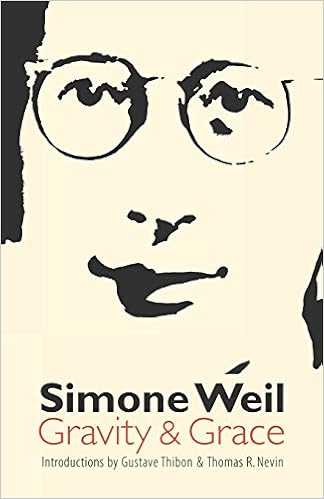
Gravity and Grace
Gravity and Grace by Simone Weil, translated by Arthur Wills, 236 pages
Simone Weil was born into a French Jewish family in 1909, but renounced the faith in which she was raised to live her life on the periphery of Christianity, while rejecting nothing she came across which seemed of value to her in her studies, pulling in sources ranging from Virgil to Racine to the Upanishads. Her relentless search for Truth was a search driven, above all, by her conviction that only an understanding that made suffering make sense could make the universe bearable. The result is a via negativa so dark that it resembles Buddhism by way of Plotinus, regarding the cosmic void as the self-giving of God, and the object of the spiritual quest. She died in exile in England in 1943, her death hastened by her fasting in solidarity with her countrymen living under German occupation.
Gravity and Grace collects items from her notebooks as fragments towards a never-finished work in the tradition of Pascal. In another writer, it might be possible to blame the approach for decontextualizing her more unconventional beliefs - especially her Marcionite separation of the "God of the Christians" and "Jehovah" and her deep antagonism towards society and the political community (understandably exaggerated given the times in which she lived) - but with Weil those views become even more pronounced in her more developed work. The presentation does have the effect of emphasizing the mystical aspects of her life and thought - in addition to some solid aphorisms, the best of Weil's fragments possess an uncanny Sibylline quality, promising wisdom to those who explore their mysteries.
Saturday, July 23, 2016
The Woman in Cabin Ten
The Woman in Cabin Ten by Ruth Ware. 352 pages.
Lo Blacklock, a travel journalist, has landed a great assignment: a week on a luxury cruise on a small boat. At first, it seems absolutely lovely. However, as the week continues, some of the guests seem less than friendly and then Lo thinks she witnesses a woman being thrown overboard. However, all of the guests, as well as the staff, are accounted for and none of them seem to be the woman that Lo met in Cabin 10, who has vanished. Or did the woman in Cabin 10 ever exist? As Lo continues her pursuit of the truth, it's clear that something has gone terribly wrong on this boat . . . and now her own life is in danger.
I had gobbled up Ruth Ware's last book, In a Dark, Dark Wood, and had been eagerly anticipating this newest story. I wasn't disappointed, and found this book to be just as dark as the previous one. Like the previous story, as well, we have a main character who doesn't seem like she has all of her s__t together, and thus is a somewhat unreliable narrator. Right before Lo goes on this cruise, she encounters a burglar in her house. Suffering anxiety, and self-medicating with alcohol, Lo isn't sleeping well. In her first evening on the cruise, she's also drinking heavily and suffering from lack of sleep, so by the time she thinks she seems a woman go over the side of the boat, you aren't sure if it's real or not. Compounding this is the revelation that she also takes anti-anxiety medication. While Lo is quite sure that she met a woman in Cabin 10, she only has tiny pieces of evidence of this mysterious woman, and when those vanish, it's hard to know if Lo really is telling the truth.
However, I trusted my gut and sure enough, there was a big twist partway through the book.
That's all I'll say --- but if you're looking for a nice pageturner to settle in with over a weekend, this might be the book for you.
Lo Blacklock, a travel journalist, has landed a great assignment: a week on a luxury cruise on a small boat. At first, it seems absolutely lovely. However, as the week continues, some of the guests seem less than friendly and then Lo thinks she witnesses a woman being thrown overboard. However, all of the guests, as well as the staff, are accounted for and none of them seem to be the woman that Lo met in Cabin 10, who has vanished. Or did the woman in Cabin 10 ever exist? As Lo continues her pursuit of the truth, it's clear that something has gone terribly wrong on this boat . . . and now her own life is in danger.
I had gobbled up Ruth Ware's last book, In a Dark, Dark Wood, and had been eagerly anticipating this newest story. I wasn't disappointed, and found this book to be just as dark as the previous one. Like the previous story, as well, we have a main character who doesn't seem like she has all of her s__t together, and thus is a somewhat unreliable narrator. Right before Lo goes on this cruise, she encounters a burglar in her house. Suffering anxiety, and self-medicating with alcohol, Lo isn't sleeping well. In her first evening on the cruise, she's also drinking heavily and suffering from lack of sleep, so by the time she thinks she seems a woman go over the side of the boat, you aren't sure if it's real or not. Compounding this is the revelation that she also takes anti-anxiety medication. While Lo is quite sure that she met a woman in Cabin 10, she only has tiny pieces of evidence of this mysterious woman, and when those vanish, it's hard to know if Lo really is telling the truth.
However, I trusted my gut and sure enough, there was a big twist partway through the book.
That's all I'll say --- but if you're looking for a nice pageturner to settle in with over a weekend, this might be the book for you.
Deep State
According to former congressional staffer Lofgren, the elected government of the US is only the visible tip of the proverbial iceberg - the bulk of which is invisible, unaccountable, and actually responsible for the direction of policy. This "deep state" is made up of dense networks of lobbyists, consultants, contractors, bureaucrats, senior military officers, and lawmakers, all of whom move so easily between the public and private spheres that the boundary has effectively ceased to exist. Far from moving into the much-feared era of the "imperial presidency", there has been a slide into a "ceremonial presidency", where a figurehead president acts as a lightning rod for controversy while real policy is made elsewhere.
It is expected that any book of this sort is going to be cynical - cynicism and its sibling, wounded idealism, are the former insider's stock in trade. It is a fine line, however, between cynicism, with its claim to cold realism, and bitterness, which suggests the settling of personal scores. Lofgren zigzags back and forth across that line through the book. The book is further handicapped by its Beltway provincialism, which tends to regard everything as ultimately caused by action from Washington, and important only insofar as it affects Washington. The limitations this imposes become clear when it comes time for Lofgren to offer some positive solutions to the systemic problems he has vaguely outlined, and all he can recommend is measures that would only strengthen the same system.
Thursday, July 21, 2016
The Year of Fog
The Year of Fog
by Michelle Richmond 432 pages
When I go on vacation, I like to read books that
place in that locale. This year my destination was San Francisco, and I
happened upon this wonderful novel about memory, obsession, and one woman’s
search for a missing child.
I don’t know about you, but when I hear about a
child who has gone missing without a single trace, I shake my head, say a quick
prayer, and tell others that I cannot imagine what the parents are feeling. Michelle
Richmond did an amazing job in keep the character in one place yet moving
forward at the same time, all the while letting readers be voyeurs of this
horrific happening.
Freelance photographer Abby Mason is the
step-mother-to-be to six-year-old Emma. Abby loves her new role as fiancée and
as friend and mom. Abby and Emma go to the foggy Ocean Beach almost every day.
Today it may be summer, but it’s almost always cold and foggy at this remote
beach. Emma twists her tiny hand from Abby’s and runs ahead. Momentarily
distracted by a dead seal pup, when Abby turns back to Emma, she has disappeared
in the fog. Literally, she is gone.
Readers will get a behind-the-scenes look at a
search for a missing child. The police and volunteers who comb the area, the
flyers, the reward posting, the sleepless nights, the inability to choke down
more than a few morsels of food, the fear that grips Abby and Jake, Emma’s
father.
Police at first believe she has drowned. Then they
look at the Jake and Abby as possible suspects. Jake goes on national
television to plead with anyone who may have seen Emma, especially her mother,
Lisbeth, who abandoned Jake and Emma three years earlier.
As the minutes turn to hours to days to weeks to
months, the police give up as new, more solvable cases capture their attention.
After months, Jake wants to hold a memorial service and move on with life. But
not Abby, she refuses to believe that Emma cannot be found.
Readers go with her on her travels through the Bay
area, shoving flyers into strangers’ hands, practically begging for help.
Readers go with Abby on her quest to locate any memory of their surroundings on
the beach that day.
I don’t often have a need to peek at a novel’s
ending, but the tension is so great that it was all I could do not to peep at
the ending.
I give The
Year of Fog 6 out of 5 stars.
Lilac Girls
Debut
novelist Martha Hall Kelly spent 10 years researching and five years writing
this haunting novel of three women as Hitler begins his mad march across
Europe. It is based on the true story of an American philanthropist; a Polish
woman incarcerated at Ravensbruck, the female-only Nazi concentration camp; and
the only female doctor in that hellhole. “The story is told from three points of view: the victim, the
hero, and the villain, together creating a complex picture of an unimaginable
time in history” I cannot remember what review I read this sentence in, but it
was powerful enough to warrant my writing it down. The novel begins in 1939 and ends in 1959.
We
first meet the heroine. Hundreds, thousands, of people are fleeing France in
advance of what they fear will happen: Hitler. Former actress and Broadway
start Caroline Ferriday is now a humanitarian, doing her best to help as a
volunteer at the French consulate in New York. One of the people who needs her
help is French actor Paul Rodierre. Caroline spends her own money sending care
packages to French children.
Next
we meet the victim, Polish teenager Kasia Kuzmerick. Kasia works with
underground, delivering messages. It’s very dangerous work. She is caught and
sent to Ravenbruck, where she become one of the “Ravenbruck Rabbits,” women who
were subjected to the Nazi SS leader Goerring’s medical experiments. The author
was candid about what happened to these women, but did not go into such depth
as to make this reader give up on the story. I had a basic knowledge of the
experiments happening, but didn’t know any of the details.
Herta
Oberheuser is the villain. An ambitious young doctor, she answer an ad in the
paper for a government medical position and winds up performing horrendous
atrocities on the Ravensbruck ladies. Herta is the most difficult character to
understand. In 1939, she is eager to work in medicine, but as the war drags on,
she seems almost eager to perform the experiments.
I
found the shifting of point of view easy to follow. Well, except that the
author did a great job leaving this reader hanging at the end of each section.
I was sad to reach the conclusion of Lilac
Girls. I wanted to keep reading
about Caroline, Kasia, and Herta. I did, however, read somewhere that Hall
Kelly is writing a prequel to this story. I personally can’t wait to get my
hands on it. I literally flew through all 496 pages of this book in two days.
I
give Lilac Girls 6 out of 5 stars;
the highest rating in Julie’s world.
Wednesday, July 20, 2016
Dialogues with Silence
This collection pairs prayers drawn from Merton's journal with drawings now held by Bellarmine College. Most of the prayers have a poetic quality, and while Merton's drawings - quick black and white sketches of monks and saints and landscapes - are not by any means great art, they evoke the same quiet stillness that is sought in the prayers. Merton again and again struggles with the Benedictine charism of stability. Unlike his rebel cousins Dean Moriarty and Sal Paradise who perpetually "gotta go", Merton seeks his fulfillment in the inky silence of the Kentucky night, confident that the One he seeks is also seeking him.
Monday, July 18, 2016
Little Deaths
Little Deaths by Emma Flint. 304 pages. due out in January, 2017; read the print galley. Will be on order for the Library.
Ruth Malone, a single mother in 1965 Queens, New York, probably isn't the best mother. Or the nicest woman. However, is she a murderer?
Working long hours as a cocktail waitress, Ruth wakes early one morning to discover that her two small children have gone missing from their apartments. Later that day, her daughter's body is discovered and ten days later, her son's body. As police investigate the murders, Ruth's life becomes exposed, piece by piece. Seen through the eyes of others, her alcoholism and tendency to date a lot of men make her seem like she's a loose woman and bad mother. Believing the worst of her, she's tried for the murders. However, did she really kill them?
I found this book to be a pageturner. Despite the fact that Ruth isn't really a likeable character, it's easy to see that she doesn't really seem to love herself too much. Her life's a bit of a mess, and she's not the best person, but she doesn't seem like a killer. The police seem determined to find her at fault, some of them seeming to make it a personal vendetta. However, a rookie reporter covering the murders soon starts digging into the case, and develops an obsession with Ruth. He becomes convinced that she didn't murder her children, and that instead, something more sinister is going on.
You get Ruth's perspective here, both in real time, and looking back at what happened. You also get perspectives from the reporter, as well as a few other characters. Despite that, it's hard to tell if you're getting the true, real picture of Ruth's life and what may have happened to the children (and I found this is what kept me engrossed in the story).
No spoilers here, but there is a reveal towards the very end of the book that I totally didn't see coming. This book is apparently inspired by a true story.
Ruth Malone, a single mother in 1965 Queens, New York, probably isn't the best mother. Or the nicest woman. However, is she a murderer?
Working long hours as a cocktail waitress, Ruth wakes early one morning to discover that her two small children have gone missing from their apartments. Later that day, her daughter's body is discovered and ten days later, her son's body. As police investigate the murders, Ruth's life becomes exposed, piece by piece. Seen through the eyes of others, her alcoholism and tendency to date a lot of men make her seem like she's a loose woman and bad mother. Believing the worst of her, she's tried for the murders. However, did she really kill them?
I found this book to be a pageturner. Despite the fact that Ruth isn't really a likeable character, it's easy to see that she doesn't really seem to love herself too much. Her life's a bit of a mess, and she's not the best person, but she doesn't seem like a killer. The police seem determined to find her at fault, some of them seeming to make it a personal vendetta. However, a rookie reporter covering the murders soon starts digging into the case, and develops an obsession with Ruth. He becomes convinced that she didn't murder her children, and that instead, something more sinister is going on.
You get Ruth's perspective here, both in real time, and looking back at what happened. You also get perspectives from the reporter, as well as a few other characters. Despite that, it's hard to tell if you're getting the true, real picture of Ruth's life and what may have happened to the children (and I found this is what kept me engrossed in the story).
No spoilers here, but there is a reveal towards the very end of the book that I totally didn't see coming. This book is apparently inspired by a true story.
Sunday, July 17, 2016
Dark Age Ahead
For Jane Jacobs, a "dark age" is a form of cultural amnesia where the knowledge and practices that sustained a civilization are forgotten. Much of the book is taken up with a continuation of the themes Jacobs has expounded throughout her celebrated career - the breakdown of community exacerbated by an urban planning orthodoxy that demands homogeneity and an inhuman scale. This orthodoxy has, in her experience, become impervious to correction due to a breakdown of accountability - not only isolated from the empirical reality it seeks to manipulate, but also from self-policing mechanisms that have become increasingly reduced to face-saving. These factors she attributes in turn to a decline in the kind of mentoring relationships which once instilled in young professionals not only the skills and knowledge needed to practice their trade, but also pride in their vocation and an accompanying sense of standards. Those who care about their local communities, meanwhile, find themselves caught in a vice between technocratic leftists and miserly conservatives, between one-size-fits-all dictation and malign neglect, a dilemma as destructive in the Third World as it is in North American cities.
This explication of Jacobs' core ideas may rest on solid ground, but problems arise in the framing of those ideas. Jacobs' theory, evidently borrowed from Karen Armstrong, that cultural collapse is primarily caused by xenophobia and fundamentalism, the triumph of mythos over logos, demonstrates its weaknesses in her own examples. Chinese culture is said to have stagnated due to Confucian "fundamentalism", with the cancellation of the voyages begun by Zheng He, but the quote Jacobs provides justifies the decision purely in terms of costs against benefits, and Jacobs herself admits in an endnote that "'no one really knows' why the Chinese halted ocean voyaging." Likewise, the explanation she provides for the stagnation of medieval Islam is the expulsion of Muslims from Spain, which by her theory would seem to indicate the beginning of Spanish decline rather than the beginnings of Muslim stagnation and the golden age of Spanish culture. Fatally, her theory embraces the modern secularist mythos which considers mythos and logos mortal enemies - the error of which becomes glaringly apparent when she includes Renaissance humanism among her "fundamentalisms".
Late in the book, Jacobs quotes Armstrong's description of medieval Islam, where "[t]here was no idea... of allowing the... opposing positions to build a new synthesis." It never seems to occur to her that this is exactly the situation of the West, not only recently but for the last two centuries, dominated by a mythos masquerading as logos, and therefore incapable of seriously engaging with any opposing position. This would explain why modernism, with its supposed "ideals of democracy, pluralism, toleration, human rights and secularism", has produced oppression, ideological warfare, and genocide on a scale unimaginable in previous eras. Jacobs concludes that "[a]ny culture that jettisons the values that have given it competence, adaptability, and identity becomes weak and hollow," but the values of autonomy and efficiency (the only values the modern "fundamentalism" accepts) cannot support a culture - indeed, are incompatible even with one another, pulling on the one hand towards anarchy and on the other towards tyranny.
Jacobs expertly diagnoses one part of the material crisis of late modernity - the decline of the city as the center of civilization - and has interesting ideas as to how to overcome this problem. Unfortunately, she is blind to other material aspects of the crisis, and completely unaware that it is not, at its heart, a material crisis at all.
Cakewalk
Cakewalk by Rita Mae Brown. 336 pages. e-galley read, courtesy of Edelweiss. Book due to be published in October, 2016
In this story, we return to Runnymede, at the end of the Great War and the start of a new era. Filled with memorable characters and Brown’s signature humor and storytelling, we have the story of two sisters, Louise and Julia. Taking place day by day, Brown takes us into their lives and how they fit into the small town of Runnymede, where people can be divided on issues, but a good scotch can smooth out all kinds of differences.
I did have to make notes on who was who in the book, because I would put it down, come back to it, and then lose track of who I was reading about. The day-by-day pace is an interesting way to tell the story, although this book just didn't capture my attention as a continuous pageturner kind of read.
This is a story filled with humor, but I was most struck by Brown’s “Dear Reader” notes at the back, which state, “Sex is interesting. Sexuality is not. Or as Celeste says to Fannie, ‘Only a fool refuses love.’” True and thoughtful words, to be sure.
In this story, we return to Runnymede, at the end of the Great War and the start of a new era. Filled with memorable characters and Brown’s signature humor and storytelling, we have the story of two sisters, Louise and Julia. Taking place day by day, Brown takes us into their lives and how they fit into the small town of Runnymede, where people can be divided on issues, but a good scotch can smooth out all kinds of differences.
I did have to make notes on who was who in the book, because I would put it down, come back to it, and then lose track of who I was reading about. The day-by-day pace is an interesting way to tell the story, although this book just didn't capture my attention as a continuous pageturner kind of read.
This is a story filled with humor, but I was most struck by Brown’s “Dear Reader” notes at the back, which state, “Sex is interesting. Sexuality is not. Or as Celeste says to Fannie, ‘Only a fool refuses love.’” True and thoughtful words, to be sure.
Saturday, July 16, 2016
The Mothers
The Mothers by Brit Bennett. 288 pages. e-galley read, courtesy of Edelweiss; book is due out in October, 2016
The Mothers know a good secret from a bad one, and notice
what goes on in the lives of others. In
this contemporary Black community in California, it all begins with a
secret. Nadia is a high school senior,
mourning her mother’s recent death, and smitten with the local pastor’s son,
Luke. It’s not a serious romance, but
then takes a turn when a pregnancy (and subsequent cover-up) happen. The impact sends ripples through the
community, reaching beyond their youth and into adulthood. What if they had made different choices? The Mothers ask us to contemplate this
question, as well as how our decisions shape our lives.
There are multiple viewpoints in the story, which can be at
times tricky to keep track of. The
collective voice of the Mothers in the community is a voice unto itself,
narrating and guiding the reader through the story. I found this to be a thoughtful book, and liked how there were differences in the feel between voices in the story.
Friday, July 15, 2016
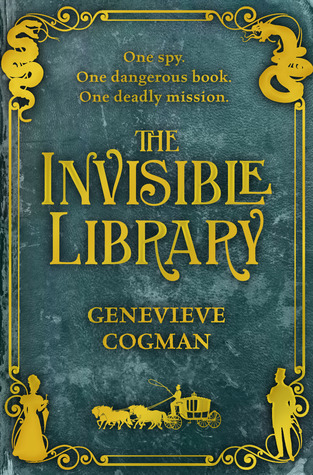
The Invisible Library
The Invisible Library by Genevieve Cogman. 329 pages.
Secret agents, forbidden societies, stolen books . . . and mechanized alligators! Okay, the alligators aren't integral to the story, but they do show up. Irene is a professional spy for the Library, which has their members go and retrieve (well, steal) books from different realities. Irene is sent with a new assistant, Kai, to fetch a dangerous book from an alternative London. However, they soon discover the book has already been stolen and there are factions who are prepared to fight to the death to get the book.
In addition to these elements of the story, there are also supernatural elements, Because this alternate version of London is chaos-infested, it makes it possible for there to be vampires, and fae, etc. One of the more interesting things in the story for me was the Language that the Library's agents can use. The Language has elements of power to it, so Irene is able to open locks, etc. by speaking very specifically.
As a librarian and a devoted reader, I found a lot to enjoy in this book. It's a great mix of the magical and the mundane, with an interesting main character, and an imaginative world. The book has a steady pace, and the author's descriptive writing style really brings the whole story to life. Admittedly, I felt like I wanted something a bit more from the book. It was good, to be sure, but it's like having a premium ice cream sundae and then leaving off the sprinkles and whipped cream.
Secret agents, forbidden societies, stolen books . . . and mechanized alligators! Okay, the alligators aren't integral to the story, but they do show up. Irene is a professional spy for the Library, which has their members go and retrieve (well, steal) books from different realities. Irene is sent with a new assistant, Kai, to fetch a dangerous book from an alternative London. However, they soon discover the book has already been stolen and there are factions who are prepared to fight to the death to get the book.
In addition to these elements of the story, there are also supernatural elements, Because this alternate version of London is chaos-infested, it makes it possible for there to be vampires, and fae, etc. One of the more interesting things in the story for me was the Language that the Library's agents can use. The Language has elements of power to it, so Irene is able to open locks, etc. by speaking very specifically.
As a librarian and a devoted reader, I found a lot to enjoy in this book. It's a great mix of the magical and the mundane, with an interesting main character, and an imaginative world. The book has a steady pace, and the author's descriptive writing style really brings the whole story to life. Admittedly, I felt like I wanted something a bit more from the book. It was good, to be sure, but it's like having a premium ice cream sundae and then leaving off the sprinkles and whipped cream.
One Day in the Life of Ivan Denisovich
One Day in the Life of Ivan Denisovich by Alexander Solzhenitsyn, translated by Ralph Parker, 158 pages
One Day in the Life of Ivan Denisovich delivers exactly what the title promises - the description of an ordinary day in the life of Ivan Denisovich Shukhov, a prisoner in an Arctic gulag. During the course of the day, he manages to avoid any severe punishment for the numerous minor rule violations he is forced to make in order to survive, gets enough food to maintain his poor health, enough heat to avoid freezing to death, and is even able to secure some tobacco. Not of least importance, he is able to do all this without losing his self-respect and the respect of his fellow prisoners.
This is not a novel about overt horror and atrocity, but about steady, unrelenting oppression. Instead of genocide, the aim of the gulag - indeed, the entire Communist system - is rehabilitation through dehumanization, and resistance is a daily struggle.
Wednesday, July 13, 2016
Mussolini
Benito Mussolini was the first of the fascist dictators. Il Duce ruled Italy for over twenty years, pursuing a policy of national unity through the subordination of all things to the state, with the state incarnate in the charismatic flesh of the dictator. For much of that time Mussolini was widely perceived, by foreigners as well as Italians, as one of the most talented and dynamic European leaders. In the end, however, Italy was humiliatingly crushed in the Second World War, and Mussolini himself was killed by partisans, his corpse hung from a meathook in a public square in Milan. In the public imagination he is often reduced to Hitler's "ignoble second", and implicitly associated with Nazi crimes without receiving the benefit of Hitler's luciferian glamour. Nor have historians been much kinder, often considering him, in the words of AJP Taylor, "a vain, blundering boaster without either ideas or aims".
Bosworth contradicts some of these views. Mussolini was capable of great ruthlessness, but he talked about the supposed value of ruthlessness more often than he actually acted ruthlessly. He was the most intellectual of twentieth century tyrants, with the possible exception of Lenin, and one of the few to have something resembling a traditional domestic arrangement, despite his habitual adulteries. The picture of Mussolini that emerges is that of a born journalist who never outgrew the habit of concentrating on the headlines and letting the stories write themselves.
Bosworth's central interest is not in Mussolini the man, however, but in the interaction between Mussolini and society. There have been a number of analyses of Nazi Germany (most famously by Goldhagen) which have highlighted the fact that Germans under Nazism tended to "work toward" Der Fuehrer, attempting to anticipate his will rather than waiting for an explicit order. Bosworth uncovers similar examples in Fascist Italy, notably in fulfilling the dictator's brutal rhetoric with real crimes. The author also convincingly demonstrates that although Italian fascism was the ideology for which the adjective "totalitarian" was coined, it never managed to overcome the strong Italian commitment to family, region, and religion, but instead was forced to work around or through these more durable institutions.
Monday, July 11, 2016
Arts of the Anglican Counter-Reformation
Graham Parry's book chronicles the history and products of the "beauty of holiness" movement that began in the reign of James I and reached its peak under Charles I. The term "Anglican Counter-Reformation" proves oddly appropriate - as a description of an attempt to restore continuity with the pre-Reformation Church, as a recognition of the influences of continental Baroque art, music, and literature on the English, and as an alternative to terms like "Laudianism" which are overly narrow or "High Church" which are anachronistic. This movement includes not only Hooker, Andrewes, and Laud, but also the Little Gidding community and the Metaphysical poets, along with other Anglicans who were affected by the spirit of the movement without accepting its theological foundation or ideological program.
It is this last group that Parry highlights. In his account, the momentum of the aesthetic revival of early seventeenth century England was largely the result of the natural desire to honor God and beautify the world, and not exclusively the expression of partisan concerns, whether ecclesiastical or secular. In this reading, the abuse of this movement by Charles I, Archbishop Laud, and their party provoked, or at least enhanced, the iconoclastic Puritan reaction. It is possible that Parry overestimates the popularity of Puritanism, but he is clearly correct in his view that the products of the movement were essential to the maintenance of Anglicanism under the Protectorate.
Saturday, July 9, 2016
League of Dragons
League of Dragons by Naomi Novik. 380 pages.
This is the ninth (and final) book in the Temeraire series, which is an alternate history series combining the Napoleonic Wars with dragons. Yes, that may sound odd -- it did to me when I picked up the first book in the series to read with a book group. However, I found myself enjoying the book, and then went on to read the rest in the series. Novik has a strong background in history, and combined with her skilled storytelling, the books totally make sense. What I mean is, it's easy to imagine this kind of setting, where the forces have dragons to aid in fighting.
In this last novel in the series, we're at the end of Napoleon's campaign in Russia. Napoleon has been denied a victory, but at the price of many lives (both human and dragon). Laurence and Temeraire pursue the fleeing French army, only to determine that not only has Napoleon made it back to Paris unscathed, but that the French have stolen Temerarie and Iskierka's egg.
So, reading my summary, I can see where it wouldn't make a lot of sense. This is definitely a series where you need to begin with the first book, because not only are things explained, but this is a series which has a definite timeline. You finish one book and the next one begins pretty close in time to where the previous book left off. So, if this kind of a story sounds interesting, I would suggest beginning with the first book, His Majesty's Dragon.
This is the ninth (and final) book in the Temeraire series, which is an alternate history series combining the Napoleonic Wars with dragons. Yes, that may sound odd -- it did to me when I picked up the first book in the series to read with a book group. However, I found myself enjoying the book, and then went on to read the rest in the series. Novik has a strong background in history, and combined with her skilled storytelling, the books totally make sense. What I mean is, it's easy to imagine this kind of setting, where the forces have dragons to aid in fighting.
In this last novel in the series, we're at the end of Napoleon's campaign in Russia. Napoleon has been denied a victory, but at the price of many lives (both human and dragon). Laurence and Temeraire pursue the fleeing French army, only to determine that not only has Napoleon made it back to Paris unscathed, but that the French have stolen Temerarie and Iskierka's egg.
So, reading my summary, I can see where it wouldn't make a lot of sense. This is definitely a series where you need to begin with the first book, because not only are things explained, but this is a series which has a definite timeline. You finish one book and the next one begins pretty close in time to where the previous book left off. So, if this kind of a story sounds interesting, I would suggest beginning with the first book, His Majesty's Dragon.
To Flourish or Destruct
In To Flourish or Destruct Smith attempts to lay out a new direction for sociology predicated on critical realist personalism. In Smith's view, sociology has long been dominated by faulty philosophical presumptions even - perhaps especially - when those presumptions have been ignored or denied. Personalism is centered on the human person, which emerges from, but is not reducible to, a physical human body. Society emerges in turn from the relationships and interactions of human persons. Personhood is grounded in an essential human nature, which is ordered towards certain goods that result in human flourishing, the pursuit of which is mediated and enabled but not determined by society and culture.
The strengths of Smith's approach are considerable. Personalism accepts the existence of free will, pursuing a middle path between atomistic individualism and social determinism, one which recognizes the importance of both the individual and the collective. Perhaps most importantly, personalism allows for the reality of evil, and a means by which evils can be sociologically identified and confronted. Although aimed at sociologists, To Flourish or Destruct is an important, insightful book which ought to have an impact far beyond the field.
Thursday, July 7, 2016
June
Dual timelines and dual heroines make up Miranda
Beverly-Whitemore’s fourth novel, June. At
the heart of this suspenseful tale are movie stars, inheritances, and the fine
line between truthfulnesses and falsehoods.
I loved that the title had played three roles, first
as the book’s title; second, as the 1955 heroine’s name; and third, as the
month both timelines occurred: June 1955 and June 2015.
The book opens in June 2015. Cassie Danvers has
retreated back to her grandmother’s home, Two Oaks, in small town St. Jude,
Ohio. She seems a tad delusional, or maybe, it’s just sensitivity to the
spirits that still lurk in the crumbling mansion. Even her dreams are made of
the houses’ long-gone inhabitants. She also seems to be suffering from clinical
depression.
The mansion is almost beyond repair, yet all the
twenty-five year-old wants to do is stay in bed. She barely eats, lets the mail
pile up on the foyer floor, and refuses to answer the landline. Cassie is not
only mourning her grandmother, but she is reeling from the breakup, which
instigated (I think), with her beau, Jim, back in New York City.
Then the doorbell rings.
The story then switches to June 1955. Told from
Lindie’s point of view, the whole town is anxiously awaiting the arrival of a
film crew, in town to shoot the exteriors for Erie Canal. Starring in the movie are handsomer-than-handsome Jack
Montgomery and more-beautiful-than- a-spring day Diane DeSoto.
June is expected to marry Artie Danvers in three
days’ time, provided he returns to St. Jude.
June
is
a wonderful novel, full of interesting characters and plot twists. It took me a
little while to get into the story. I had hoped to be pulled in quicker to the
story. Cassie’s section was slower to develop than June’s. I think Lindie’s
strong character had a lot to do with it. That’s the reason I give June 4 out of 5 stars.
I
received this novel from Blogging for Books in exchange for this review.
My Pet Human
My Pet Human by Yasmine Surovec, 106 pages
A stray cat
has no desire to live with a human until he finds the perfect family with a
little girl who feeds him treats, rubs his belly, has lots of boxes to play
with, doesn’t squeeze him, and meets all of his other requirements. This was a cute story with a lot of
illustrations and would be perfect for beginning chapter book readers.
A Tale of Two Cities
A Tale of Two Cities by Charles Dickens, 413 pages
“A
Tale of Two Cities is one of Dickens's most exciting books, set against the
backdrop of the French revolution, in which two generations struggle against
the injustices of first a corrupt aristocracy and then the mindless rule of the
mob.” I have never read
this before and decided that I really should.
It was all right, but definitely not one of my favorites by
Dickens. I had actually tried to read it
before and put it down because I wasn’t really enjoying it. It’s well written but it’s just so dense that
it’s not much fun to read. I won’t be
recommending it but at least now I can say that I’ve read it.
Of Metal and Wishes
Of Metal and Wishes by Sarah Fine, 321 pages
“This
love story for the ages, set in a reimagined industrial Asia, is a little dark,
a bit breathless, and completely compelling.
Sixteen-year-old Wen assists her father in his medical clinic, housed in
a slaughterhouse staffed by the Noor, men hired as cheap factory labor. Wen
often hears the whisper of a ghost in the slaughterhouse, a ghost who grants
wishes to those who need them most. And after one of the Noor humiliates Wen,
the ghost grants an impulsive wish of hers--brutally. Guilt-ridden, Wen befriends the Noor,
including the outspoken leader, a young man named Melik. At the same time, she
is lured by the mystery of the ghost. As deadly accidents fuel tensions within
the factory, Wen is torn between her growing feelings for Melik, who is enraged
at the sadistic factory bosses and the prejudice faced by his people at the
hand of Wen's, and her need to appease the ghost, who is determined to protect
her against any threat--real or imagined. Will she determine whom to trust
before the factory explodes, taking her down with it?” I really liked this story. I think that this would appeal to teens who
like dystopian fiction as well as realistic fiction, romance, scary stories,
and even fantasy, as there is a little bit of all of that going on in this
book.
Raymie Nightingale
Raymie Nightingale by Kate DiCamillo, 263 pages
Raymie makes friends with two other girls in her baton
twirling class. Louisiana is a timid but
determined girl while Beverly is stubborn but loyal. The three make an unlikely trio but they all
help each other with their various problems.
Raymie wants to win the Little Miss Central Florida Tire competition so
that her father will come home.
Louisiana wants to win because she needs the prize money so she won’t have
to go into the orphanage. Beverly wants
to sabotage the contest. This is
definitely one of my favorite DiCamillo books and I will be giving it to every
child who comes to the Library asking for realistic fiction.
I Crawl Through It
I Crawl Through It by A.S. King, 319 pages
“Four
teenagers are on the verge of exploding. The anxieties they face at every turn
have nearly pushed them to the point of surrender: senseless high-stakes
testing, the lingering damage of past trauma, the buried grief and guilt of
tragic loss. They are desperate to cope, but no one is listening. So they will lie. They will split in two.
They will turn inside out. They will even build an invisible helicopter to fly
themselves far away...but nothing releases the pressure. Because, as they
discover, the only way to truly escape their world is to fly right into it.” I’m honestly not sure that I completely
understood what was going on in this book.
It wasn’t awful but it’s not my favorite by King. I would probably only recommend this to teens
that had read and liked her previous books.
The Improbable Theory of Ana & Zak
The Improbable Theory of Ana & Zak by Brian Katcher,
328 pages
Ana is a brilliant overachiever who is terrified that if
she steps out of line her parents may disown her. She is college bound and seems to have
everything going for her but her life is rules by what her parents want her to
do. Zak is also smart but is what Ana
thinks of as a slacker. When Zak is
enlisted to help at an Academic Bowl competition for a weekend, reluctantly, he
and Ana are unwittingly thrown together when Ana’s younger brother heads to a
comic convention in the city. This book
is funny, touching and realistic, despite the almost madcap adventure
aspect. I think that a lot of teens
would like it.
Goodbye Stranger
Goodbye Stranger by Rebecca Stead, 289 pages
“Bridge is an accident survivor who's wondering why she's
still alive. Emily has new curves and an almost-boyfriend who wants a certain
kind of picture. Tabitha sees through everybody's games--or so she tells the
world. The three girls are best friends with one rule: No fighting. Can it get
them through seventh grade? This year
everything is different for Sherm Russo as he gets to know Bridge Barsamian.
What does it mean to fall for a girl--as a friend? On Valentine's Day, an unnamed high school
girl struggles with a betrayal. How long can she hide in plain sight? Each memorable character navigates the
challenges of love and change in this captivating novel.” This was a really
awesome book about friendships. I think
that this may be my favorite book by Stead so far and I’ve liked everything
she’s done. I highly recommend this for
elementary age kids.
In Her Kitchen
In Her Kitchen : Stories and Recipes from Grandmas Around the World by Gabriele Galimberti, 248 pages
This really was a cookbook but with every recipe was a story about
where and who it came from. What started as a series of magazine
articles about people's lives around the world culminated in this book.
The little stories were nice and the recipes were interesting. I was not
inspired to try any of them but I probably would have eaten most of them if
someone else were making it. Most were pretty normal, several were dishes
I had heard of but at least a couple were pretty unusual and definitely not
something the average American has ever tried or probably wanted to try.
Overall I'd say liked this more for the glimpse into other lives and cultures
than the actual recipes.
Cop Town
Cop Town by Karen Slaughter, 402 pages
“Atlanta,
1974: As a brutal murder and a furious manhunt rock the city's police
department, Kate Murphy wonders if her first day on the job will also be her
last. She's determined to defy her privileged background by making her own
way--wearing a badge and carrying a gun. But for a beautiful young woman, life
will be anything but easy in the macho world of the Atlanta PD, where even the
female cops have little mercy for rookies. It's also the worst day possible to
start given that a beloved cop has been gunned down, his brothers in blue are
out for blood, and the city is on the edge of war. Kate isn't the only woman on the force who's
feeling the heat. Maggie Lawson followed her uncle and brother into the ranks
to prove her worth in their cynical eyes. When she and Kate, her new partner,
are pushed out of the citywide search for a cop killer, their fury, pain, and
pride finally reach the boiling point. With a killer poised to strike again,
they will pursue their own line of investigation, risking everything as they
venture into the city's darkest heart.” I really liked this book. It was awful in several place, but real and
the female characters were easy to root for, even when they weren’t very nice. I think that a lot of people, especially
women, who like books with strong female characters will enjoy this book.
Labels:
crime,
Fiction,
Historical,
Krista R,
murder,
mystery,
Policewomen,
suspense,
thriller
Silver
Silver by Chris Wooding, 313 pages
“The final exam is
survival. Paul is the new kid at Mortingham
Boarding Academy, and he has a dark secret.
Caitlyn admires Paul from afar and resents that he only has eyes for
Erika. Erika thinks that she and Caitlyn
are best friends, but she's wrong. Adam
is a bully with a major chip on his shoulder.
Mark is outgrowing his old friends but doesn't know how to make new
ones. In a few short hours, none of this
will matter. Without warning, a horrifying infection will spread across the
school grounds, and a group of students with little in common will find themselves
barricaded in a classroom, fighting for their lives. Some will live. Some will
die. And then it will get even worse.”
This was a totally creepy science fiction horror story for teens that I
would highly recommend. Once I got
started I didn’t want to put it down.
Wedding Cake Murder
Wedding Cake Murder by Joanne Fluke, 370 pages
Hannah Swenson is
going to be a contestant in the Food Channel's dessert chef contest and is
getting married to the love of her life, Ross Barton. Although she is
worried about Mike and Norman and how they feel about it, Hannah has never been
happier in her life. If she wins the first Food Channel challenge, the
rest of the competition will be held in Lake Eden. Of course, in Lake
Eden, Hannah is much more likely to discover another murder. This was a
great addition to the series and the book also has a lot of great
recipes. These books are for mystery lovers and bakers.
We Will Not Be Silent
We Will Not Be Silent: The White Rose Student Resistance
Movement That Defied Adolf Hitler by Russell Freedman, 104 pages
“In his signature
eloquent prose, backed up by thorough research, Russell Freedman tells the story
of Austrian-born Hans Scholl and his sister Sophie. They belonged to Hitler
Youth as young children, but began to doubt the Nazi regime. As older students,
the Scholls and a few friends formed the White Rose, a campaign of active
resistance to Hitler and the Nazis. Risking imprisonment or even execution, the
White Rose members distributed leaflets urging Germans to defy the Nazi
government. Their belief that freedom was worth dying for will inspire young
readers to stand up for what they believe in.” Any child interested in World War II and the
Holocaust will want to read this book. I
won’t say I enjoyed it, because it’s not the type of book you enjoy but it had
a lot of information about a part of the resistance in Germany that I didn’t
know anything about and the writing was compelling.
Challenger Deep
Challenger Deep by Neal Shusterman, 308 pages
"Caden Bosch is on a
ship that's headed for the deepest point on Earth: Challenger Deep, the
southern part of the Marianas Trench. Caden Bosch is a brilliant
high school student whose friends are starting to notice his odd
behavior. Caden Bosch is designated the ship's artist in residence
to document the journey with images. Caden Bosch pretends to join
the school track team but spends his days walking for miles, absorbed by the
thoughts in his head. Caden Bosch is split between his allegiance to the
captain and the allure of mutiny. Caden Bosch is torn." This was a
fascinating and odd book about mental illness, told from the perspective of the
mentally ill teen. I liked it but it did take a while for me to figure
out what was really going on.
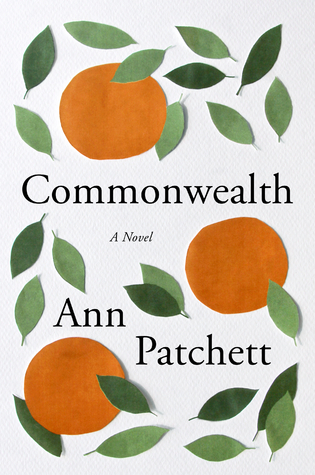
Commonwealth
Commonwealth by Ann Patchett. 336 pages
This book begins with a Sunday afternoon christening party for baby Franny. Bert Cousins shows up uninvited and by the end of the party, has kissed Franny's mother, Beverly, setting events in motion that will impact two marriages and two families.
This book covers five decades, where you get the stories of multiple characters. Mostly, you get the viewpoints from the children of the two families, but it's a total of four parents and six children. Spending summers together, the two groups of children form a lasting bond that is based on their shared disillusionment with their parents.
In her twenties, Franny (the same child from the infamous christening party) begins an affair with a legendary author. Telling him about her family, she doesn't expect that he's doing anything except listening . . . until he turns her family's story into a bestselling book. Now, she and the rest of the family have to come to terms with each other, their shared losses, and the connection they have to each other.
I enjoyed this book, although I sometimes found that it took me a minute to re-orient myself when it moved between time periods. It isn't a strictly linear book, so there is movement back in forth in time. I also had to pay attention so I could remember who was who, and what their individual storyline was. This is mostly Franny's story, and some of the characters don't have as much of their own individual part in the story (which was fine with me). The characters are realistically written, as is a lot of the storyline. This means there isn't necessarily a happy ending for everyone, but would you expect that? If you've read other books by this author, no. It's a deep study in family dynamics, but with a smooth pace that pulls you in and just makes the reading fly by.
This book begins with a Sunday afternoon christening party for baby Franny. Bert Cousins shows up uninvited and by the end of the party, has kissed Franny's mother, Beverly, setting events in motion that will impact two marriages and two families.
This book covers five decades, where you get the stories of multiple characters. Mostly, you get the viewpoints from the children of the two families, but it's a total of four parents and six children. Spending summers together, the two groups of children form a lasting bond that is based on their shared disillusionment with their parents.
In her twenties, Franny (the same child from the infamous christening party) begins an affair with a legendary author. Telling him about her family, she doesn't expect that he's doing anything except listening . . . until he turns her family's story into a bestselling book. Now, she and the rest of the family have to come to terms with each other, their shared losses, and the connection they have to each other.
I enjoyed this book, although I sometimes found that it took me a minute to re-orient myself when it moved between time periods. It isn't a strictly linear book, so there is movement back in forth in time. I also had to pay attention so I could remember who was who, and what their individual storyline was. This is mostly Franny's story, and some of the characters don't have as much of their own individual part in the story (which was fine with me). The characters are realistically written, as is a lot of the storyline. This means there isn't necessarily a happy ending for everyone, but would you expect that? If you've read other books by this author, no. It's a deep study in family dynamics, but with a smooth pace that pulls you in and just makes the reading fly by.
Wednesday, July 6, 2016
The Classical Heritage
The Classical Heritage and Its Beneficiaries: From the Carolingian Age to the End of the Renaissance by RR Bolgar, 393 pages
In this book Bolgar attempts to summarize the development of education in the classics from the late antiquity through to the Reformation. This is largely the story of how classical education was adapted to fit the needs of successive eras, which in practice meant the long struggle to reconcile the pagan past with the Christian present. Bolgar contends that the classical heritage is not only of historical interest, but that it can be adapted to today's needs as it was to yesterday's. Indeed, writing in 1954, he fears that the decline of classical education in favor of technical training will result in a generation with a radically truncated idea of human nature, giving rise to a narrowness of outlook and cultural stagnation.
Even under the best circumstances, it would be a daunting task to survey the reception of ancient literature and thought over a thousand year span. And the actual circumstances are far from ideal - records of how schools operated are few, and most of those are prescriptive rather than descriptive. Bolgar is himself quite open about the fact that his study is incomplete. That he was able to succeed to the remarkable extent that he did is a testament to the power of a lifetime of experience as a student and teacher.
Stiletto
Stiletto by Daniel O'Malley. 583 pages.
"STILETTO is a novel of preternatural diplomacy, paranoia, and snide remarks." It's also the sequel to one of my favorite books, The Rook.
This is a sequel where I would definitely suggest that you read the first book because without the background from The Rook, many things in this story won't make sense. In this sequel, the two deadly rivals from the first book are forced to make an alliance against a shared enemy. We have Rook Myfanwy (rhymes with "Tiffany") Thomas again, but we also have two strong supporting characters, Pawn Felicity Clements and from the Grafters, Odette Liliefield. Felicity and Odette don't like each other at all, and don't really trust each other, but when they are forced to work together to find who is behind recent horrendous attacks, they need to put old hatreds behind them.
I had been wondering if this book would be as enjoyable as the first one, and when I picked it up and noted how big it was, I was a little concerned. However, from the very first chapter forward, I was hooked and enjoying myself immensely. I enjoy O'Malley's snarky sense of humor and dry wit, and how he writes things like, "Joe, meanwhile, had been so absorbed by the Curious Incident of the Sporadically Vaporous Asian Woman in the Alleyway that he's missed his friend's discommoding behind him." I snickered to myself a few times, and found that I was frequently surprised by the story (which is nice, because I wasn't always able to predict what was going to happen).
So, if you haven't read The Rook and now you're curious, let me tell you a little bit. The Rook begins with this quote, "The body you are wearing used to be mine," and a woman named Myfanwy Thomas who has woken up in a London park surrounded by bodies who are all wearing latex gloves. Myfanwy has no recollection of who she is, but luckily, it appears that she has left notes for herself. She soon discovers that she is a Rook, a high-ranking member of a secret organization called the Chequy that fights supernatural forces in Britain. Most members of the Chequy have their own supernatural abilities, and Myfanwy soon discovers that she has powers of her own. However, at the same time she is trying to piece together just who she is (or was), she discovers someone within the Chequy is responsible for her memory loss . . . and this person (or people) are determined to take her out. The Rook is a thriller of sorts, filled with quirky and compelling (and for me, unforgettable) characters, and an interesting plot that has a smoothly accelerating pace. You can read my original review of The Rook here.
Did I say this was one of my favorite books? Well, now I'd say these are two of my favorite books.
"STILETTO is a novel of preternatural diplomacy, paranoia, and snide remarks." It's also the sequel to one of my favorite books, The Rook.
This is a sequel where I would definitely suggest that you read the first book because without the background from The Rook, many things in this story won't make sense. In this sequel, the two deadly rivals from the first book are forced to make an alliance against a shared enemy. We have Rook Myfanwy (rhymes with "Tiffany") Thomas again, but we also have two strong supporting characters, Pawn Felicity Clements and from the Grafters, Odette Liliefield. Felicity and Odette don't like each other at all, and don't really trust each other, but when they are forced to work together to find who is behind recent horrendous attacks, they need to put old hatreds behind them.
I had been wondering if this book would be as enjoyable as the first one, and when I picked it up and noted how big it was, I was a little concerned. However, from the very first chapter forward, I was hooked and enjoying myself immensely. I enjoy O'Malley's snarky sense of humor and dry wit, and how he writes things like, "Joe, meanwhile, had been so absorbed by the Curious Incident of the Sporadically Vaporous Asian Woman in the Alleyway that he's missed his friend's discommoding behind him." I snickered to myself a few times, and found that I was frequently surprised by the story (which is nice, because I wasn't always able to predict what was going to happen).
So, if you haven't read The Rook and now you're curious, let me tell you a little bit. The Rook begins with this quote, "The body you are wearing used to be mine," and a woman named Myfanwy Thomas who has woken up in a London park surrounded by bodies who are all wearing latex gloves. Myfanwy has no recollection of who she is, but luckily, it appears that she has left notes for herself. She soon discovers that she is a Rook, a high-ranking member of a secret organization called the Chequy that fights supernatural forces in Britain. Most members of the Chequy have their own supernatural abilities, and Myfanwy soon discovers that she has powers of her own. However, at the same time she is trying to piece together just who she is (or was), she discovers someone within the Chequy is responsible for her memory loss . . . and this person (or people) are determined to take her out. The Rook is a thriller of sorts, filled with quirky and compelling (and for me, unforgettable) characters, and an interesting plot that has a smoothly accelerating pace. You can read my original review of The Rook here.
Did I say this was one of my favorite books? Well, now I'd say these are two of my favorite books.
Tuesday, July 5, 2016
Age of Consent
Age of Consent by Marti Leimbach. 336 pages.
Thirty years ago, June was a young widow with a huge crush on Craig, a local disc jockey. Unfortunately, Craig is a lot more interested in June's thirteen year-old daughter, Bobbie. Today, Bobbie feels she has moved on and put her secret life behind her, until she discovers that Craig has pursued a number of other young girls. Now, Bobbie is determined to bring her ugly past into the light, bringing Craig to trial. By now, June is remembering the past completely differently, and other people wonder why Bobbie would want to bring charges against someone for something that happened so many years ago. However, Bobbie is determined to face her past, and seek justice.
This is an uncomfortable story, to be sure. The story is mostly told from Bobbie's viewpoint, both in the present and in the past, although we do sometimes get June's point of view, as well. Craig is definitely a nasty character, and the author doesn't shy away from the the ugliness of who he is and what he does (in the past and in the present). This is the kind of story that I think is important, even though it's not a pleasant subject. It feels very realistic, and very true, and there is good character development. I can see, though, where this would not be a book for everyone; although I feel it would make an interesting book group book, because there's definitely a lot here to discuss and talk about.
Thirty years ago, June was a young widow with a huge crush on Craig, a local disc jockey. Unfortunately, Craig is a lot more interested in June's thirteen year-old daughter, Bobbie. Today, Bobbie feels she has moved on and put her secret life behind her, until she discovers that Craig has pursued a number of other young girls. Now, Bobbie is determined to bring her ugly past into the light, bringing Craig to trial. By now, June is remembering the past completely differently, and other people wonder why Bobbie would want to bring charges against someone for something that happened so many years ago. However, Bobbie is determined to face her past, and seek justice.
This is an uncomfortable story, to be sure. The story is mostly told from Bobbie's viewpoint, both in the present and in the past, although we do sometimes get June's point of view, as well. Craig is definitely a nasty character, and the author doesn't shy away from the the ugliness of who he is and what he does (in the past and in the present). This is the kind of story that I think is important, even though it's not a pleasant subject. It feels very realistic, and very true, and there is good character development. I can see, though, where this would not be a book for everyone; although I feel it would make an interesting book group book, because there's definitely a lot here to discuss and talk about.
Sunday, July 3, 2016
Harmonium
No word seems to describe Stevens' poetry as well as "sensuous". His writing slides silkily over surfaces, vividly word-painting images in shapes and colors and smells and tastes. His greatest strength is in his wordplay, toying masterfully with alliteration, repetition, repetition, and rhythm. There's a great deal of playfulness on display - the collection includes poems insulting swans and "Le Monocle de Mon Oncle". As a result, it is often difficult to differentiate between Stevens' sense and his nonsense, as his nonsense seems to enclose arcane secrets while his sense never seems entirely serious.
The fops of fancy in their poems leave
Memorabilia of the mystic spouts,
Spontaneously watering their gritty soils.
I am a yeoman, as such fellows go.
I know no magic trees, no balmy boughs,
No silver-ruddy, gold-vermilion fruits.
But, after all, I know a tree that bears
A semblance to the thing I have in mind.
Saturday, July 2, 2016
June Totals!
Congrats to Jason S, who read the most books and pages and earned the most points in June! Thanks for blogging!
June Stats:
June Stats:
| Blogger | Books | Pages | Points |
| Jason S | 26 | 6,297 | 43 |
| Dennis M | 13 | 3,331 | 14 |
| Jen O | 5 | 1,600 | 5 |
| Julie E-C | 5 | 1,254 | 5 |
| TOTALS | 49 | 12,482 | 67 |
Friday, July 1, 2016
Time and Tide
In this collection of his correspondence with a working class admirer, Ruskin summarizes and continues the social teaching he previously expounded in Munera Pulveris and Sesame and Lilies, while pulling in ideas he developed in works such as The Stones of Venice. A large part of Ruskin's appeal lies in precisely this comprehensive consistency, uniting ethics, economics, and aesthetics. Time and Tide calls for a comprehensive reform of society, beginning at the bottom. As always, Ruskin's central concern is to guard against the emergence of a mass society, and he is equally opposed to mass production and mass democracy.
There is much in Time and Tide that is rationally prescriptive and therefore entirely inorganic and ultimately impractical - Ruskin himself concedes it is "too large to receive at present any deliberate execution" and denies that he maintains "any idea of its appearing, to our present public mind, practicable even at a remote period." Taken at a slight distance, however, in the same light as Plato's Republic, there is a great deal of value in Ruskin's criticisms. The epistolary nature of the book allows the author to range freely over a wide variety of topics but also results in him changing subjects haphazardly. The end product is sometimes frustrating, often charming, and frequently insightful.
Subscribe to:
Posts (Atom)