Sunday, June 23, 2019

You Can’t Spell America Without Me:

You Can’t Spell America Without Me:  The Really Tremendous Inside Story of my Fantastic First Year as President Donald J. Trump (A So-Called Parody) by Alec Baldwin and Kurt Andersen      
 Audio Book:  5hrs, 57mins        Paperback Book 384pgs.                                  

If you like political comedy you will enjoy this book.    Historical History meets tongue in cheek humor in this sometimes biographical sometimes spot on humorous comments that the Donald has made and ones that it is quite possible he was thinking about saying.    Nothing is off-limits in this hysterical send up and truly it is so funny.    From poking fun at Trump wanting to buy the white house and lease it back to the government to calling Trump towers the North White House and  Trump’s Miralago the Southern Whitehouse to referring to the Royal Family as the Queen and all those others, to explaining his riding in a golf cart filled with secret service while all the other world leaders in the group walked to their destination without body guards –“it’s not like anyone would want to assassinate them.”   This is such a hilarious spoof that is so true to character using Trump’s own words that are often funny on their own, “That Kim Jong-un is one tough cookie.”       Jabs are taken at Hilary Clinton, President Barack Obama, Chris Christie, German Prime Minister, Angela Merkel,  no person in politics is safe from becoming the butt of serious political humor.    From Fake news to often referring to his brilliant uncle, John Trump from MIT, to that Russian stuff, to his Slovenian current wife, Melania who was born and raised in Yugoslavia when it was still a communist regime before it became Slovenia which is probably why Melania and Putin had so much to talk and laugh about over dinner.    Totally irreverent about as politically correct as a certain President’s tweets – oh yeah, the tweets are brought up, too.   All that is the Donald is played with in this fun book.    I really enjoyed it, I highly recommend it for light hearted folk who love a laugh and for the politically oriented that allow a bit of fun poked at both sides under their radar.   I don’t think younger folks would get as much a kick out of the jokes as adults, but if you like Saturday Night Live (SNL) you will get the humor here.

 - Shirley J

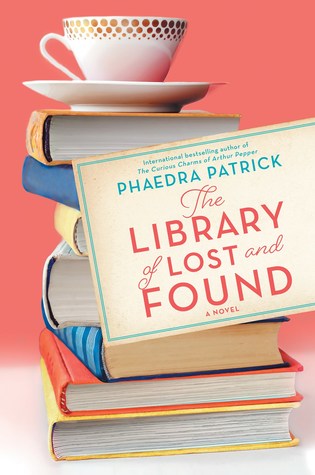
The Library of Lost and Found

The Library of Lost and Found by Phaedra Patrick         Audio Book:   10 hrs., 28 mins          Hardback Book:  352 pages                       

Much like her mother who was meek and mild and went along 100% with whatever her husband said all of her life, Martha Storm was meek and mild and backed up from confrontation and no matter what burden anyone laid on her, she dealt with it without complaint.     Martha loved to read and organized a book club  at her local library.   The funny thing about it was, most of the people in the bookclub didn’t read the titles they were supposed to but were always there to bring more work to Martha, one lady who complained of a bad back had fanagled a deal with Martha where she would bring her laundry in to to the bookclub with her and Martha would take the woman’s laundry with her to wash, dry and repair the woman’s clothes then return them to the woman’s home without so much as a farthing for her efforts.    She got roped into repairing papier mache’ dragons’ heads for the local Chinese New Year annual celebration,  she ended up moving back home in order to take care of her aging parents until their deaths after which she was left with a house full of all sorts of things to sort through because her sister was always evasive and would never commit to coming over and going through their parents thigns  with Martha.   When it came to work, her sister always had something better to do, using her failing relationship with her husband or her two kids as her main excuses and of course her me time with her friends as if Martha never needed any me time.   Her boss at the Library took major advantage of her, leaving her out of memos, not telling her when an author event got cancelled even though he had put Martha in charge of setting it up and buying the food, decorations and so forth and when Martha dragged all the stuff to the Library the night of the event only to see on the poster CANCELLED scrawled across it in big letters.   It was like she was invisible.   She tried several times to get better positions at the Library when a staff member would leave but was always passed over by her boss for a younger person.    She could never say no to anyone no matter what the project and ended up spending all of her time, darning her nephews and nieces clothes for her sister, running errands for other people,  taking care of one of the book club attendees plants and fish (for months now), being at every one’s beck and call waiting on them hand and foot and getting nothing not even respect in return.   This was Martha’s life until one day, a local used bookseller came across a book of fairytales with a dedication personally handwritten by the author to Martha.    He tracked her down and dropped it off at the Library for her.   Her life totally turned around when she read the mysterious dedication and begun a hunt to track down where the book came from.    Family mysteries and secrets are revealed in this story that takes Martha back to her childhood.   Her life is turned upside down in this tale that shows sometimes things aren’t always as we think they are.   Well told and a good, gripping story. Of a woman adrift just sort of floating through life who comes to grips with some harsh realities and finds nothing is as she thought it was and her whole life up to that moment had been lived in lies.   Good book, I would recommend this tale to Middleschoolers on up.    It has an 1890s feel even though it is set from the 1960s to current.   Well done, Phaedra Patrick.  

 - Shirley J

Life Will Be the Death of Me…And You, Too!

Life Will Be the Death of Me…And You, Too! By Chelsea Handler              Audio Book:  5 hrs., 25 mins        Hardback Book:  256 pages             

It seems the election of Donald Trump to the Presidency set Chelsea Handler off on a journey of anger and depression that led her to therapy which turned out to be the road to discovery and self-realization.      Chelsea takes the reader along with her from beginning to end with a lot of hilarious reveals about her own real life, family , friends, dogs, personal assistants and housekeepers as she works through her neurosis.   She finds out she doesn’t have any empathy for other people and wants to fix that.   She also reveals that while she hates Trump she has the hots for Special Counsel Robert Mueller (she has a thing for older men – up to 20 years older – she’s not sure she wants to go beyond that).   She knows he’s married but if he ever gets divorced…She loves “fluffy” dogs – they are great to cuddle with even if she does have to lift them up on her bed because they are so heavy they can’t jump up there by themselves.   She tends to see things from her own point of view but never the point of view of others, therapy has made her see that and she begins working on it once the realization is out there.   Really funny and Chelsea really goes bare bones in her honesty on her personal life.    Because she speaks “freely”  about all topics perhaps this one ought to remain with the adult crowd as she also liberally uses the vocabulary of a sailor.  J   I enjoyed it and if you like Chelsea Handler you will like this opening of the door to her life.   Well done, Chelsea.


 - Shirley J

Saturday, June 22, 2019

Paul Bunyan


Paul Bunyan by Darryl Wimberley    262 pages
As I was reading this enhanced tale of logger Paul Bunyan and his blue ox, Babe, I wondered if kids still learn about these mythological beings. It wouldn’t surprise to me discover that they don’t. How sad for them.

What author Wimberley has done is take the legend and invent a life behind it, filling in all the details. As the story starts, in 1920, an older Paul wants to have a will created. Oh, he has a few worldly possessions and that’s not why he wants this document. According to Paul, it’s “what a man wants fold to remember ‘bout hisself.”  I had to laugh when the narrator said that Paul was old.  That he didn’t know what was old for a lumberjack…thirty or forty… but Paul was older.

Paul’s story starts out simply: “I am a child of the forest.” I think that simple sentence is so profound, considering that Paul spent his entire life in the wilderness. Readers get a glimpse of how Wimberley imagined Paul’s life, from when he was found as a child until he was working his last log jam.

Wimberley provides lots of logging history, which I thoroughly enjoyed, and the descriptions of the forest, logging camps, log jams, cutting the trees, and more will stay with me a long time.

I do have one complaint about the novel and that is its lack of tension. I didn’t feel the sense of urgency/dangerousness in some situations, like unplugging a log jam. And that’s why  “Paul Bunyan” get 4 out of 5 stars in Julie’s world.

Thursday, June 20, 2019

Eucharist

The EucharistThe Eucharist: Mystery of Presence, Sacrifice, and Communion by Lawrence Feingold, 607 pages

Lawrence Feingold's The Eucharist is a comprehensive exploration of Church teaching on the nature and significance of the Blessed Sacrament, from its Old Testament types through the patristic age and medieval and modern developments.  In this narrative, all development occurs only so that what was held from the beginning may be more perfectly affirmed and understood, and a side effect of this is that deviations from orthodoxy are highlighted by their discontinuity.  Although the book was designed for use as a theology textbook, complete with study questions at the end of each chapter, it is well-written enough to captivate casual readers, drawing us deeper into the sacred mysteries.

Wednesday, June 19, 2019

Metropolitan Stories


Metropolitan Stories by Christine Coulson    208 pages

I’m not a huge television watcher, but I do enjoy watching the behind-the-scenes shows at zoos. Watchers get to take a peek behind the curtain at what it takes to care for the thousands of animals in their care. Fascinating stuff.

I feel the same way about Christine Coulson’s new novel, “Metropolitian Stories.” From a writer who worked at that renown institution for more than 25 years, reads are taken through to the offices, the storage rooms, the cafeteria and what seems to a million-mile labyrinth of hallways that connect the myriad of buildings, galleries and studios. On the down side, I had no real idea of where the vignettes were actually happening, and that confused me a bit. But it didn’t stop me from reading.

 I loved all the stories, but my favorite is “Meats and Cheeses.” It involves a 4,000-year-old leg of lamb. The narrator, Kate, is on a mission of a different kind, but winds up in a room full of hats---all types from pith helmets to straw boaters. Hebe and Helen, who work in the room, are a
riot. It seems that Kate’s, who has only been with the Met about a year, main job is to deliver the yellow interoffice envelopes known as “cheeses.” She is following a hand-drawn map and trying to get a sign off for a China exhibition’s title wall.  I won’t write anymore as I may give it away, but Kate’s adventures through the maze of hallways looking for a blue door is the perfect story for readers to understand the complexity of working at the Met.

Light-hearted, full of whimsy and just plain fun, I give “Metropolitan Stories” 4 out of 5 stars in Julie’s world.

Tuesday, June 18, 2019

Ever Faithful


Ever Faithful by Karen Barnett      352 pages
 Former park ranger Karen Barnett has given historical fiction readers a wonderful series in her stand-alone novels set in America’s National Parks. Almost like a Ken Burns for readers! We get the history, the beauty and wonderful tales about characters that feel oh so real.

In this, her third novel, she takes us to Yellowstone National Park in 1933. The Great Depression has hit America hard, and the National Parks are no exception. Visitors to the park are few, causing the management not to open certain lodgings and other services. It’s almost a double whammy to park employees.

The protagonist is a young adult, Elsie Brookes, who has grown up in the parks. She desperately wants to go to college and become a teacher. She has been working as maid in the park’s hotels, but after four years, she still hasn’t saved enough. 

I chuckled at the nicknames the park’s employees gave to position, terms like pillow pushers, savages, pack rats, gear jammers, etc.  And I like the way Barnett let the reader know what each nickname represented without overtly doing so.

Poor Elsie. She is facing another summer with little hope of saving enough money for college. However, FDR’s New Deal comes to the rescue without officials realizing it. The year is 1933 and the Civilian Conservation Corps (CCC) is sending a group of men to help work in the park, looking for bug-infested copses, culling trees and all around manual labor. For most, this is the first time they have ever seen this much wilderness. Elsie is offered a second job as a teacher to the men who are coming, and she jumps at the opportunity.

Enter Nate Webber. The Brooklyn-ite shows promise. He is a hard worker and a born leader. But he has a secret that he will protect at all costs. When Elsie uncovers that secret, she vows to do everything she can to protect that secret, it makes for some dynamite reading. 

I give “Ever Faithful” 5 out of 5 stars in Julie’s world.

Traditional Japanese Poetry

Traditional Japanese PoetryTraditional Japanese Poetry: An Anthology, translated by Steven D Carter, 456 pages

This anthology collects 1157 poems written by Japanese poets between the 7th and 20th centuries.

     Hearing the echo
          of a bird-scarer announcing
               "He is here no more,"
     I am saddened by the loss
          of the world that went before.

Japan may be unique among the great cultures of the world in lacking an epic poetic tradition.  Famously, however, the Japanese developed the short poem to extreme levels of subtlety and refinement.  Along with the familiar haiku, which is a relatively late form, this collection includes a number of other established traditional forms, including linked poetry, each verse of which, often written by different poets, connects obliquely to those before and after.

     One can not be sure of living
          even until the evening.

     In the dim dawn light
          I watch the waves in the wake
               of a departing boat.

Carter provides short explanatory introductions to each section, and has even included several complete poem sequences, demonstrating the distinct art of compilation and arrangement.  The sheer scope of this collection will enrich even the casual reader, who can then, in turn, provide an answer to Shunzei's question.

     Far in the future,
     will someone remember me
          with a tender heart -
     sharing with me the habit
          of musing on the past?

Lessons From Lucy

Lessons From Lucy:   The Simple Joys of an Old, Happy Dog by Dave Barry                Audio Book:  4 hours 1 minute     Hardback Book:  240 pages               

Dave Barry is feeling his age having turned 70 and realizing he hasn’t that many years left which gave him pause to try to see life through his best dog, Lucy’s eyes.   Having passed her 10th birthday Lucy and Dave are the same age and with his immense dislike of mankind, he has decided to try seeing life from Lucy’s perspective.   Lucy is happy pretty much all of the time, she generally has good days all day long.   She stays young at heart because no matter what she is always ready to play.    She never stops having fun.    Lucy doesn’t worry about tomorrow.   She lives today and she lives every moment of today.   Lucy doesn’t hold grudges no matter if she is put off,  told off, shoved off, she still comes back, tail wagging with a big doggy smile in hopes maybe now she might get that pat on the head, belly rub or ball toss she is always hoping for.   Another of Lucy’s wise lessons is make new friends.    Personally, Dave Barry has all the friends and more than he really wants, but, Lucy is so happy making new friends.   She never turns down an opportunity to do so.   Most importantly, Lucy feels good in her own skin.    She doesn’t have to try to be something different, she is perfect just as she is.   She neither aspires to look or be different that what she is  and what she is in every way is enough.    She always has time to pay attention to the people she loves, in fact, nothing is more important than that.   Dave notes his frustration and quick anger, his dislike of people and being touched.   How many times work took and still sometimes takes precedence over the ones he loves, he is working on that but old habits are hard to break.    He is trying to add more fun to his life like the marching lawn mower group he is a part of who walk in parades (even President Obama’s inauguration celebration) doing formations and drills with their lawnmowers – kinds like the folks with the lawn chairs if you’ve ever seen that group.     He is trying to make himself call old friends he hasn’t talked to in years just to catch up and laugh over old times and share new times.   He is having a real tough time with that anger one but baby steps.    Lucy is such a loving teacher, I know she will forgive him his failings and continue to live the life and set the bar at being a role model that a loving pet companion does.   If only we all can aspire to the goodness and unconditional love found in our pets then the world really would be a better place.
I do highly recommend this one.   It shows the grace of dogs for our many shortfalls and what shining examples they are if only we will see.

 - Shirley J

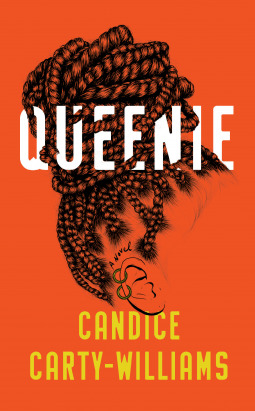
Queenie

Queenie by Candice Carty-Williams     Audio Book:  9 hrs, 45 mins      Hardback Book   336 pages                    Genre:  Adult Fiction   Growing up Jamaican in London,   Mental Breakdown -  Human Implosion

This was a REALLY good book.   One I couldn’t put down.    It walks you through a Jamaican young woman brought up in England, Queenie’s, life before her breakdown during her breakdown and dealing with her breakdown.     Circumstances in her life come together all at a volatile juncture and it is as if her brain is short circuited and she finds herself on this self-destructive path in which she keeps trying to sabotage herself.    It is as though her filter that would designate to her mind some folks are not to be trifled with – they are bad for you – ceases to protect her and she goes running at top speed with arms wide open embracing all that is wrong in the world.   She has a strong family background but keeps running into brick walls with this mixed up “I’m worthless and don’t deserve anything good to happen to me, I am unloveable and unloving and I just need someone or something to put me out of my misery” attitude.    Her friends try to be there for her, but, she just seems to want to hurt herself in spite of it all.   Things in her life go so wrong even worse because she is helping them to.   Her depression nearly takes her out many times and it is a wonder if therapy will do her any good, will she even stick to it.    Why can’t she move on and leave this funk behind?    She didn’t want what she had, but now that she doesn’t have it, she thinks she needs it to survive.   Some people no matter how much you love them just can’t be helped no matter how much friends and family try to pad the way for you and lead you by the hand.   Run, run. Run but who’s there when you fall flat?    Good book.   I highly recommend this one to Middle School through adult.    Takes the reader to new depths and understanding – Wow!

 - Shirley J

A Woman Is No Man: A Novel

A Woman Is No Man: A Novel by Etaf Rum                  Audiobook: 10 hrs. 15 min      Hardback Book 352 pages               

Excellent book.   The reader will be introduced to life in Palestinian households, Muslim customs,  the roles of women in the homes and the culture clashes of Palestinian women who grow up in homes in Palestine and those who are of Palestinian lineage but who grow up in America with influcences of both cultures.    The story is especially well told from many perspectives and while much of what is told is hard, harsh, often cruel but for the most part accepted at least by the older family membrs and community to be the way of things.    The balk comes with the younger generation especially those who grow up in America and go to public schools.    The culture and religion tend to be patriarchal and certainly the births of male children are favored over that of women.   It is explained how the birth of females brings shame, contempt and judgement from the family and the Muslim in this case Palestinian Muslim community at large.    No one intervenes if a man chastises his wife regardless of the severity and infractions by wives can be anything the husband deems worthy of a beating and often bad moods can trigger severe punishments.   Often sad for what the main character goes through this story is a peek behind the closed curtain that is Islam.    Standing ovation Etaf Rum.     Readers, this book will often make you angry but stay with it to learn all it has to share even if you are mulling your own empathetic reaction to sharia law.   I would highly recommend this book as required reading to middle schoolers on up.    This would make an excellent book club selection for adult groups.   It will give you a deeper understanding of why Muslims do what they do and how what they base their opinions on.   Excellent book.

 - Shirley J

First Comes Marriage: My Not-So-Typical American Love Story

First Comes Marriage: My Not-So-Typical American Love Story by Huda Al-Marashi          Audio Book:  9 hrs., 37 mins   Hardback Book:  297 pages                 

Huda Al-Marshi lets the reader in on many Muslim customs/traditions that have really enlightened me.    So many things about Muslims that every day Americans have no clue on came to light while enjoying this read.   Also, there are many adjustments to be made for Muslim children who grow up in America but have a foot in both worlds, the America of today and the Arabic world of yesterday and today.   While yes, it is a patriarchal society to this day, young women do have a say in whether they marry someone or not.   Not that their parents don’t also have a say and a lot of influence sometimes bullying the girl into acceptance but there is depending on the family more say than just total acceptance.   The mothers of the families tend to do the negotiations, to get the party started with the families and potential spouse- to- be,  getting together. so the want- to- be groom can size up the potential bride and to a lesser degree, vice-versa.    Neither party has to accept the other but if they do the contract is drawn up and signed and the couple is committed to go forward.    Muslim girls do not speak to nor touch boys nor men outside the family as they are growing up.   They must be modest in their dress, while not having to completely cover their skin and hair unless by choice as a commitment to the faith, many Muslim women choose to do so anyway.   They do not go swimming in public, do not make eye contact with males outside the family, etc.    So, by the time they marry, which many do straight out of highschool, they come as virgins to the marriage bed and unless a kindly older female, mother, grandmother or auntie, is kind enough to fill them in on what to expect – they get a rude awakening on their wedding night.    It is true that Muslim men still adhere to the custom that if they want to mistreat their wife for whatever minor offense it is accepted to do so without any flack from family nor friends.   Males are dominant and highly praised from birth and while growing up.   It is thought a bad thing when a female child is born, but, they keep hope alive that the next child will be a boy.    Muslim women are encouraged to be fruitful and multiply a.s.a.p. after marriage.   American born/raised Muslim children don’t all have it as strict in their households as Middle-Eastern and African nations do but are still expected to comply with their parents.  Huda was raised in America and even went to a Catholic all girls school.   By the time she was 18 several families had “visited,” to check Huda out for their sons, it finally came down to a family that her parents had been friends with since she was 6 years old.   This book is primarily about Huda’a relationship with their son and how when you grow up as an American girl Muslim or not, you are reared with storybook ideals of what romance and marriage should be and when reality doesn’t measure up to your fantasy trouble ensues.   This is that story.     Huda cannot keep from comparing what she has with what she wants and the result for her is disappointing and depressing.   She becomes resentful for all she is giving up in order to settle for way less than she expected.     This is a good book so full of information and background on the Muslim religion and teachings as well as the Muslim lifestyle.    Me eyes were opened and didn’t know what I didn’t know until I read this book.  It is truly fascinating the things you will learn here.   Also, you receive and education on American expectations and how in-grained in our society these presumptions are.   I even did a little self-reflection on how I, too, have been guilty of expecting so much more from others when I expected them to psychically determine my wants and needs without ever letting them know what I had in mind.    Sadly, others don’t always pick up on our whims by osmosis – we need to spell it out for them instead of waiting for them to guess correctly or be ostracized for getting it wrong.      Everyone should read this book to see not only what Huda went through, but, to look in the mirror and see through the glass clearly at last.    Very good book.    Clearly a case of both parties not putting all of their cards on the table and looking into each other’s eyes stating what they expect and want from the other so that the air would be cleared and both parties could commit to what they would be willing to go along with and what they absolutely would not because the request was not in keeping with their nature.    A clashing of cultures and media fed fairytale dreams that once each side realizes that could come to compromises if both sides agree.  But will they?   Not sure Jimmy Carter could have brought reasoning and peace to these two.    I highly recommend this book – such an eye-opener.


 - Shirley J

Mama’s Last Hug: Animal Emotions and What They Tell Us About Ourselves

Mama’s Last Hug: Animal Emotions and What They Tell Us About Ourselves by Frans De Waal        Audio Book:  10 hrs., 38 mins      Paperback Book:  336 pages            

Primatologist, Frans De Waal, begins his story talking about Mama a 59 year old Chimpanzee, who was the Matriarch of her chimp colony.   When Mama was dying, a biologist named Jan van Hooff, who had formed a deep bond with her, entered her night cage to say goodbye.  This was unprecedented.    Chimpanzee’s have uncanny strength and can be dangerous but van Hooff, loved her so, and knowing her end was near, wanted to say goodbye.    A video was made of the meeting.     Mama, though, weak and frail, was so happy to see him, her mouth fell open in surprise and delight and she reached for him to pat him on the neck and rub his head lovingly.    She embraced him with a big smile she was so happy to see him.   Mama’s story is told in snippets throughout the book, her intervening in disputes, her laughter, her reactions when shame-faced wrong doers within the colony came to her for forgiveness, etc.      Other examples are also given of other species, who have the ability to demonstrate that they too feel as we humans do and experience many emotions, love, hate, anger, sorrow, guilt and shame, disgust, fear, joy and empathy.    De Waal has studied animals, primarily primates for over 40 years and has come to the conclusion, unlike many of his naysayer colleagues, that animals do exhibit expressions and behavior that is congruent with what humans define as emotion.   He notes the empathy pets show when their human caregiver is sad.   He talks about how in elephant herds “Auntie” elephants will help care for youngsters even helping the mother to save them when they fall, are stuck in water or mud they cannot get out of,  etc.    Excellent book.    Check out the video of Mama an Jan van Hooff,  it will bring tears to your eyes, it is so dear.   Mama was so happy to see her old friend before her passing, two days later.   Bless her.   I highly recommend this book to everyone from Middleschool up.

 - Shirley J

Where the Crawdads Sing

Where the Crawdads Sing by Delia Owens        Audio Book:  12 hours, 12 mins.      Paperback Book:  496 pages            

This book was recommended to me by a friend and I am very glad she told me about it.    I think this would be an excellent selection for a read for a bookclub.   The story is a melancholy one, but, a very good story none the less.   A young woman from well to do means falls for a bad boy who takes her out in the marsh to a broken down house back in the swamp where they have little or nothing to live on and stop popping out babies one after the other.   The former bad boy now bad husband and bad father works sparsely while the mother and kids farm to try to keep some kind of food on the table.   Clothes and shoes aren’t bought till they literally rot off, kids eat or not, but the father comes in drunk quite often and beats everyone up.   One day, the mom just packs a case and goes walking down the lane and never comes back.   The kids, one by one do the same until all that is left is 7 year old Cya and her Dad.   The Dad gets mad cause everybody left and when he is drinking takes it out wholloping Cya but on his sober days, she and he learn to communicate.   In order to survive, Cya has to take on cooking, cleaning etc. and try to make do with the hardscrapple life she is thrust into.   Whenever her Dad gives her a couple of dollars (which isn’t often) she saves it till she has enough to get some grits and maybe another thing or two.   Then she walks into town to the store.    Folks in town take to calling her, “The Marsh Girl.”   They talk bad about her, calling her trash, and saying bad things about her because she lives out in the marshlands past Barkley Cove on the North Carolina coast.    Town people are really down on the people who live outside of town, especially those from the marsh.   They also mistreat black people.    The only people throughout her life that always treated her well was a black man and his wife who traded her clothes and food for smoked fish she would bring to barter.  (The fish were really too small to ever be good for anything but they left her dignity in tact by bartering instead of just donating to her.   The townspeople could care less about her and don’t want her coming in to town so she hardly ever does till she just has to.  Her father finally stops coming home and she is left with no electricity, no toilet and no running water out in the swamp all by herself, just her and the gulls and other marsh birds.   The story goes on from there and is such a good one, you won’t want to put th book down.    It really is a terrific story and I would recommend this book to everyone from Middleschool on up.  
- Shirley J

Friday, June 14, 2019

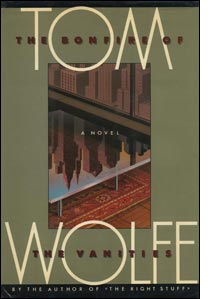
Bonfire of the Vanities

Image result for The Bonfire of the VanitiesThe Bonfire of the Vanities by Tom Wolfe, 659 pages

Sherman McCoy imagines himself a Master of the Universe, spending his days making multi-million-dollar bond trades, or, as his wife puts it, collecting golden crumbs.  Larry Kramer is an Assistant District Attorney in the Bronx, Jewish by birth but Irish by vocation, his heavy caseload and meager pay compensated for by fantasies of power and virility.  Peter Fallow is a reporter for the City Light tabloid, struggling to stay sober long enough to write a story that will justify his continued employment.  All of them are desperately trying to find, keep, and increase their place somewhere in the heap of humanity that is 1980s New York, the capital of the world.  In their persons, the worlds of finance, politics, and the press collide, though in the end their defeats seem to possess more dignity than their victories.

In 2007, The New York Times published a retrospective on Wolfe's debut novel in which it crowed that "the New York of 'Bonfire,' to a degree that might well have shocked people in 1987, no longer exists."  It is true, of course, that street crime in New York is far below the flood crest of the '70s and '80s, but street crime - as opposed to the fear of street crime - plays only an incidental part in The Bonfire of the Vanities, and the last decade has certainly witnessed a resurgence of social unrest and tribalism, complemented by an outrage culture endemic to social media and epidemic in the press, so that we seem more than ever to be living in Bonfire's jungle.  For proof, one need only compare the treatment of Sherman McCoy by a fictional tabloid with the treatment of the Duke Lacrosse players by the actual New York Times.  The same Qoheleth who informs us that "all is vanity" also reminds us that "there is nothing new under the sun."

Tuesday, June 11, 2019

Fra Angelico

Fra AngelicoFra Angelico: San Marco, Florence by William Hood, 123 pages

William Hood remarks that Bl Fra Angelico enjoyed an advantage rare among Renaissance artists - as a Dominican friar, he worked exclusively for the Order and therefore never had to worry about finding new commissions.  His frescoes for the cloister of San Marco have an advantage as well, remaining in their original context despite the transition of the building from convent to museum, a process completed by the departure of the last friars in 2014.  In addition to detailing the techniques employed, Hood carefully explicates the relationships of the frescoes to one another, to the daily life of the convent, to contemporary movements within the Order of Preachers, and to the political realities of Renaissance Florence, considerably enlarging the reader's understanding of the painter's radiant work.

Monday, June 10, 2019

The Nobodies: A Novel

The Nobodies: A Novel by Liza Palmer   259 pages  Due out Sept 2019 - I read a galley

Joan Dixon knows she is a damn good journalist. Even if she is laid off again. And even if the one person whose opinion she really values tells her her writing isn't very good. And, even though she's closer to 40 than 30 and living with her parents again.

When Joan gets a job as a junior copywriter at Bloom, a startup in LA where her bosses are 10 years younger than Joan, and everyone seems to be having fun (except Joan), she's happy to have a stable paycheck. She's even making friends at work. However, she has questions about the company she works for and, once a journalist, always a journalist, right?  Joan's determined to get under the surface of Bloom and once she does, may have the scoop of her lifetime.

Color me meh on this one. Joan reminded me of Harriet the Spy, eternally suspicious of everyone and everything, convinced that she's going to get to the bottom of things and uncover something really huge and important. I found Joan to be annoying, and perhaps this is just me --- but while I liked her determination to believe in herself as a good journalist, it annoyed me to no end that she starts working somewhere and then, instead of concentrating on actually working, thinks she has spotted a blight on the face of Bloom.  From that point on, she's on the case --- even involving her new friends at work to investigate things.  I found her too self-centered to be interesting and probably should have just closed this book about 3/4 of the way through; instead, I finished it . . . and then wished I had just closed it about 3/4 of the way through.

The Worst Kind of Want

The Worst Kind of Want by Liska Jacobs  p 205  Due out 11/5/19 - I read a galley

Priscilla (Cilla) Messing knows Italy will be just the escape she needs from her current life of caring for her difficult mother (after caring for her father and losing her sister). Asked by her brother-in-law to join him and Cilla's niece, Hannah, in Rome, Cilla isn't sure she wants to do nothing but babysit her wayward teenage niece. So instead, Cilla goes to Rom and relishes the heady atmosphere of an Italian summer and starts to feel like she's coming back to life.  However, being so close to Hannah, and an Italian boy Hannah has a crush on, starts Cilla into a spiral of bad decisions.

This is an edgy insight into the life of a character, but also an insight into what it means to be a woman who is getting older and feeling like life has been passing her by. Cilla reflects upon her past and at times, uses that to justify her decisions in the present, which has dangerous results.

The author does a great job of making the setting every bit as important as a supporting character. When Cilla goes to Italy, the summer weather is steamy and sultry, and Cilla often flushes with heat. There's an oppressiveness to this heat at times that permeates the story, and you can feel Cilla pressing against it, even as she seems to relish it.

For readers who enjoy the taut styling of Patricia Highsmith. I actually did not care for this book much, but it was mostly because I did not enjoy Cilla --- reading this was like watching an accident in slow-motion. I was curious enough to know what happened, even though I knew there would be no happy ending here.

Saturday, June 8, 2019

Kingdom of Man

The Kingdom of ManThe Kingdom of Man: Genesis and Failure of the Modern Project by Remi Brague, translated by Paul Seaton, 216 pages

The third part of Remi Brague's grand history of ideas, following The Wisdom of the World, which was centered in the classical world, and The Law of God, which focused on the medieval world, The Kingdom of Man looks at the modern world, or, as the subtitle significantly puts it, the modern project.  For Brague, this is the distinctive characteristic of modernity - that it sees itself as a project. This was itself the result of a shift of attitudes towards work - where classically freedom from work was the privilege of nobility, in the Renaissance it became the expression of human dignity and power.  The valorization of "useful" work above "useless" contemplation, while it begins by promising worldly abundance, ultimately positions man as an object rather than a subject, like all nature an unsatisfactory thing that exists only to be mastered and overcome, and thus the project of modernist humanism ends in the sacrifice of humanity to the project.

Brague's approach is entirely descriptive.  He does not consider the views of critics of modernity, nor does he explore alternatives to it.  Instead, he follows the logical development of modernism from nominalism to posthumanism from within, carefully tracing the origins and consequences of each idea, and illuminating a great many things even outside of his focus.

Friday, June 7, 2019

No Matter Where You Go There You Are

No Matter Where You Go There You Are by Jon Kabat-Zinn,  Ph.d                Audiobook:3hours, 9 mins      Paperback Book:  304 pages              


This is the best book I have read on mediation and meditation techniques.    I have read other books by Jon Kabat-Zinn but I have to say, this is the best of his books I have read so far and the one I would most highly recommend.   He talks a lot about  Buddhist and Zen principles in this one and how we can relate them to whatever situation we find ourselves in.    He mixes stories with real life and shows how we ourselves and others in our lives can put extreme pressure on us to adhere to a way of life that might not be our path, seeking peace with all decisions, requests on our time, frustations, resentments, can all be addressed through meditation.    He shows how as the saying goes, “Sleep on it,”  when we have major decisions to make or problems to solve, anxiety drenched pressures from work, family or uber commitments can stress us out and literally shorten our time in this incarnation by making us sick but meditation can heal us from the inside out.   Meditation can slow our roll so to speak.   It can soothe the soul like the balm of Gilead.   We can go so deeply into a meditative state once we give ourselves over to it that the experience approaches a metaphysical state.   It feels much like centering yourself and truly being in the zone or one with the universe where you feel the walls disappear and a feeling of being free lifts your spirits and your mind to the point that your alpha waves increase and you move into a creative state of mindfulness.    Jon Kabat-Zinn delivers.   It is amazing stuff and leaves you with a freeing of your mind experience.  Truly his best work.   Yes, I highly recommend it – this book would especially be helpful to those suffering from depression or other maladies of the mind or personhood.    Kabat-Zinn can lead you to a nirvana like place of contemplation.    Good book, I highly recommend it to everyone, kids on up.   It will open your mind.

Come Home

Come Home by Lisa Scottoline              AudioBook:  12 hrs., 25 mins.   Mass Market Paperback Book:  432 pages                    

Another good book by Lisa Scottoline,  dialogue true to teenagers and young adults but so whiny it was hard to take at times, but, that is just me, after a while the level of whine starts feeling like fingernails scratching down a chalk board – YIKES!    I wouldn’t say that this was one of my favorites of Lisa’s writing, but, that is only because there was so much estrogen floating through this one I went back into my menses.  GEEZ!   It was grating at times but again, that wasn’t any fault of Lisa’s but the female characters themselves being rude and bitchy which my tolerance level for is zero.    I did manage to grit my teeth and get through this one and wouldn’t you know this one was longer than her usual novel.  I like Lisa’s style of writing, I love her as a person from her interviews and talks but OMgosh this was a tough one to tolerate to the end.    All 4 of the main female characters in this one got really on my last nerve.    The best female character in the book is Katie, the best friend of Mom, Jill in the story.    I like her moxy.   The story itself is good and as usual Lisa Scottoline does a juggling act with lots of side plots for her characters which were good.   I have to say, I was often mad at the main character from the middle to the end for her o.c.d.   She got absurd passing by what should have been important things in her life to continue on like a terrier with a rat for following her obsession.   I lost trust in her and felt she was pretending to care when she seriously was diassociated from what should have mattered most to her.    Her obsession could have waited.   She dropped the ball and caused the death and near death of people.   Didn’t much like her by the end and had I been Sam believe me, patience would have not been my virtue.    I would recommend all of Lisa’s other books before this one even though I have to add the caveat that the writing is superb it is just the feeling of not liking most of the female characters in this one that is off putting.   Maybe it is because I grew up with brothers and boy cousins that gives me such a low tolerance for whiny females.   Whatever – read all of Lisa Scottoline’s wonderful books just put this one on the bottom of the heap.

 - Shirley J.

Joyful: The Surprising Power of Ordinary Things to Create Extraordinary Happiness

Joyful: The Surprising Power of Ordinary Things to Create Extraordinary Happiness by Ingrid Fetell Lee             Audio Book:  9.5 hours    Hardback Book:  368 pages       

TED speaker and designer,  Ingrid Fetell Lee, has made a study on the things in life that bring us joy from the simple, seeing or holding a balloon to the sublime being in New Mexico and counting all the colors in a sunset.    She has researched what it is about bubbles that make humans smile when they see them, or why we flock to see cherry blossoms blooming so much so  that we throw festivals to celebrate them.     What is it about babies, even baby animals that make us want to talk baby talk and kiss and snuggle them?    In her design business she has learned the power of confetti to make everything just a little more festive or how sprinkles on top of ice cream makes us all feel like a kid again and make kids gleefully happy.    She talks about learning through meditating how to tap into that joyful force within each of us.    Feel the calm that comes from meditation and notice the small things because while joy can come in big loud ways it can also be found in the ocean sound found in a shell washed up on the beach,  in the eyes of a child, in the purr of a cat or kitten wanting nothing more than to be close.   In the immence night sky filled with stars and planets or in the comfort of being with the one you love when your joy at being together transcends space, time and talk and all you need is the oneness you share.     She talks about how the world can feel overwhelming but the gentle sound of water flowing over rocks in a creek bed can still the noise to make it music.   Think how happy it is to hear birds sing.    They sing first thing in the morning and this is such a delightful greeting to the new day a oneness with all that is in nature and returns us to that pre-civilization time when man foraged for his existence, the peace of knowing all you need is at hand if you will still your mind long enough to grasp the extraordinary wisdom of acquiring what you need.   Still your mind and you will still your life.   In this ever advancing age of technology our minds are kept on a fast-track treadmill in what I call sensory overstimulation.   Technology and instant communication to anyone in the world at any time of the day or night where we can share a picture of what we had for lunch, facetime with our besties, download the latest film, book, game all while listening to our latest playlist and being bombarded with more ads, profiling of our likes as to what sites we visit most often and shopping habits all while chugging cups of coffee.   Its like our minds are running a marathon and our eyes are bouncing around keeping up with all we are seeing, we are dancing as fast as we can in this hyper race to acquire all we can so the one with the most stuff wins at the end – or so we are led to believe.    But no matter how much faster the pace of life gets, it is still enjoyable to smell newly mowed grass, get into a bed with clean sheets for that awwwww feeling.    The coolness of pressing our check against a frosted window pain when we are inside in the warm with a hot cup of chocolate or the lovely sweet-tart taste of lemonade on a hot day.    A little Buddhist, a little Zen and a whole lot of joy.    Really good book.  Yes, I would recommend this book to all of us middle-school through adulthood who need to slow down and enjoy the sweet smell of roses growing wild as we are covered in puppy kisses.

 - Shirley J.

Creativity, Inc.

Creativity, Inc.: Overcoming the Unseen Forces That Stand in the Way of True Inspiration
by Ed Catmull,  Amy Wallace  340 pages

“What does it mean to manage well?”

This is the idea that Ed Catmull, a co-founder of Pixar Animation Studios, explores in this book about creativity in business. Catmull takes you through the history of Pixar but also explores management topics along the way, explaining how Pixar has learned to do things in a way that works really well for them.  He and his colleagues have built an organizational culture that is based on philosophies including:

• Give a good idea to a mediocre team, and they will screw it up. But give a mediocre idea to a great team, and they will either fix it or come up with something better.
• It’s not the manager’s job to prevent risks. It’s the manager’s job to make it safe for others to take them.
• A company’s communication structure should not mirror its organizational structure. Everybody should be able to talk to anybody.

I had heard about this book in a webinar and thought it would make for an interesting read, both as a history of Pixar and as a management book.  I found some pretty thought-provoking things here about management (and I made a bunch of notes), but the book is also an interesting read as a history of Pixar, a company that has seen a lot of ups and downs.  I appreciated how this book was a combination, so some of the management philosophies would be illustrated by clear examples of how Pixar works through problems and difficult situations.

The Girl Who Reads on the Métro

The Girl Who Reads on the Métro by Christine Féret-Fleury  175 pages.  I read a galley -- book due to be published in the US October 2019

"Big-hearted, funny, and gloriously zany, The Girl Who Reads on the Métro is a delayed coming-of-age story about a young woman who dares to change her life, and a celebration of the power of books to unite us all."  (from the Goodreads summary)

Juliette leads a very ordinary life in Paris, working at an office job she finds boring, dating some "not-quite-right" men and feeling a little blue about her future. The bright spot in her days are her rides on the Metro to and from work, watching people reading and making up stories to herself about them.  

One morning, avoiding going into the office, Juliette gets off at a different stop and finds herself on a street she's never been on. Seeing a book wedging open a rusty gate, she goes in and discovers a shop filled with books, a man named Soliman and his young daughter Zaide.  Soliman assumes Juliette is there as a passuer, a person he has hired to take books from his shop and into the world, matching books to readers.  Before she can help herself, Juliette agrees to do this, leaving her job and moving into Soliman's story to become a passeur and to take care of Zaide while Soliman is away.

Okay, so what happens then I will leave up to you to discover.  Suffice to say, things happen and Juliette's life is changed forever. 

While I thought this book was okay, I didn't find it funny or big-hearted and definitely didn't find it to be "gloriously zany."  Maybe it is to the readers who first encountered this book in Europe? But I feel like this is a variation on a story I have read before, where there is a mysterious/enchanting/intriguing bookstore, a woman whose life is forever changed by these books . . .

Color me meh on this one.

Tuesday, June 4, 2019

Virtue of Nationalism

The Virtue of NationalismThe Virtue of Nationalism by Yoram Hazony, 234 pages

In the early twentieth century, all right-thinking people were nationalists - at least two of the great moral touchstones of the era, Wilson's Twelve Points and Gandhi's Indian independence movement, were founded on the principle of national self-determination.  This changed after the Second World War, both due to the rise and fall of fascism and the perceived need for supranational mediating institutions during the Cold War's nuclear-armed superpower standoff and the growth of international commerce, with the result that by the end of the century all right-thinking people were globalists.  In The Virtue of Nationalism Yoram Hazony makes the provocative contention that this shift endangers both international peace and individual liberties.

Central to Hazony's argument is an act of rhetorical sleight of hand in which he defines nationalism and imperialism as antithetical philosophies of government, attributing every positive development to the former and every misstep to the latter.  This is, of course, both philosophical and historical nonsense, requiring him to cast medieval localist feudalism as somehow more imperialist than the European nations at the height of colonialism.  This, in turn, involves a bizarre misconception of the Holy Roman Empire as an entity from which the nations of Europe "won their independence" at the beginning of the modern age, while even in his description the early modern European states appear less as consciously limited entities respecting each others' sovereignty than as competing empires.  Turning his attention to the contemporary world, he insists (plausibly) that international institutions, when given the power to interfere in the affairs of nations, will always seek to expand that power despite actual prohibitions, but then pretends (implausibly) that nations, which must of necessity sometimes interfere in the affairs of their neighbors, will self-consciously limit themselves in obedience to abstract principles.

Hazony makes a compelling case against globalist institutions as necessarily technocratic and therefore anti-democratic.  Even more significant is his observation that, left to itself, rational calculation can never instill the kind of loyalty that is necessary for the self-sacrifice that alone can sustain community.  Unfortunately, the book overreaches in its central argument and is then undone by its own inconsistencies.

Sunday, June 2, 2019

May 2019 totals

This month, we had less people blogging, but we still managed to rack up the pages:

5 people
read 50 books
for a total of 14,906 pages

Onward to Summer Reading!

The Whisperer

The Whisperer (Konrad Sejer #13) by Karin Fossum 324 pages galley - book due out August, 2019

Ragna Riegel, her voice reduced to a whisper from a botched operation, lives a solitary life. Living in her childhood home, her parents are deceased and her only son moved to Berlin years ago, only sending Ragna an occasional Christmas card. While her life is a series of routines, she finds comfort in sitting in the same seat on the bus every day, seeing the same things at her local shop, and the work she does. However, Ragna's life is uprooted the day she receives an anonymous letter in her mailbox with a clear threat written on the single sheet of paper. Now, threatened by an unknown and unseen enemy, Ragna feels she must use everything she has to defend herself.

We meet Ragna at the beginning of the story being interviewed by Inspector Konrad Sejer because she has been accused of murder. Just how did this quiet, seemingly meek woman get to this point? The book slowly unravels Ragna's life, giving a glimpse into this woman's increasingly claustrophobic life. At first, it seems like Ragna is fine and you wonder who is threatening her and then as the story continues, you get a sense that something is off. It's almost like it's at the peripheral edge of your vision; you can't quite get a hold of what it is, but you definitely feel like something's not right. And the something appears to be Ragna, herself.

I have not read many of the Konrad Sejer books, so I appreciate that Fossum doesn't require that you have a strong background for this character, or need to know in-depth details of his background. In this story, it is enough to know what his job is, and a little about him as is revealed through his conversations with Ragna. However, Ragna is the focus and as the story develops, I found I became quite intrigued by her character. At first, I felt sympathetic and wondered if perhaps Ragna had been the victim of trauma, or had a touch of Asperger's. I found myself thinking of the character of Eleanor Oliphant (Gail Honeyman's character).  However, as I continued to turn the pages, I started to find Ragna was perhaps not as sympathetic and instead, there was something darker at work here.

No spoilers on this ending. Suffice to say, if you like psychological mysteries where characters are slowly revealed, this is your kind of story.  For readers who like their mysteries to be thoughtful and who enjoy books by Ruth Rendell or Minette Walters.