Saturday, June 30, 2018

The Whole Thing Together


The Whole Thing Together by Ann Brashares, 293 pages
“Summer for Sasha and Ray means the sprawling old house on Long Island. Since they were children, they've shared almost everything--reading the same books, running down the same sandy footpaths to the beach, eating peaches from the same market, laughing around the same sun-soaked dining table. Even sleeping in the same bed, on the very same worn cotton sheets. But they've never met. Sasha's dad was once married to Ray's mom, and together they had three daughters: Emma, the perfectionist; Mattie, the beauty; and Quinn, the favorite. But the marriage crumbled and the bitterness lingered. Now there are two new families--and neither one will give up the beach house that holds the memories, happy and sad, of summers past. The choices we make come back to haunt us; the effect on our destinies ripples out of our control . . . or does it? This summer, the lives of Sasha, Ray, and their siblings intersect in ways none of them ever dreamed, in a novel about family relationships, keeping secrets, and most of all, love.” Reading this was a little like reading a soap opera.  I enjoyed it, and this is the type of book that teens who like realistic drama will enjoy.

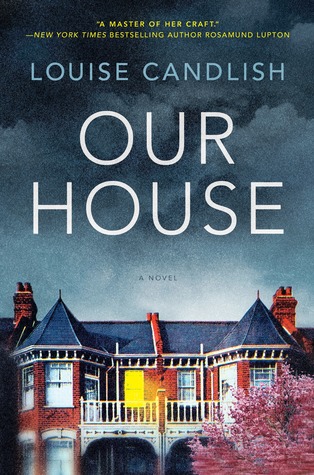
Our House

Our House by Louise Candlish     399 pages   read a galley - due to be published 8/2018

"On a bright January morning in the London suburbs, a family moves into the house they’ve just bought in Trinity Avenue. 

Nothing strange about that. Except it is your house. And you didn’t sell it. "


Fiona Lawson's making the best of her new living arrangement with her husband. Called a "bird's nest" solution, they alternate living in their house with their children in a co-parenting agreement to ease their separation and provide their family with stability. However, when Fiona comes home one day to find strange people in her house, people who are insisting they have purchased this house from Fiona and her husband, Bram, it becomes clear that something has gone horribly wrong.  Just where is Bram? And where are Fiona's children? And how did their house, their beautiful home, wind up in the hands of complete strangers?

This is the type of book that starts strong and just gets better as the story continues. It's the perfect kind of book where you can imagine the horror of this kind of thing happening because as the story unwinds, you realize just what is happening and how this could happen in reality. The characters are well-written and the story is compelling, but what I think drew me in was how carefully crafted the whole "house stealing" scheme happened.  That's true horror for me: not monsters under the bed or ghosts in the eaves, but how a domestic situation can go from not great to horrendously awful.

Where Bram is concerned, there is a definite cat-and-mouse game going on, so it's a good thing that you get his perspective in the story. Whether or not you're sympathetic to him . . . well, that's something else. Let's just say that more than one character has something to hide.

Terrific read for a weekend where you have plenty of time to settle in and enjoy a pageturner (with, as expected, a twist).

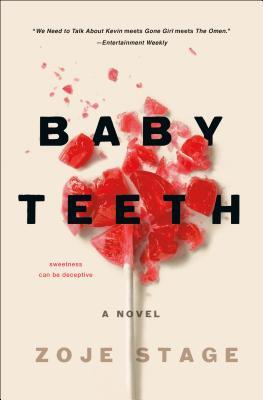
Baby teeth

Baby Teeth by Zoje Stage    320 pages  Read an e-galley -- book due to be published 7/17/18

Hanna's such a sweet child. It's such a pity that she doesn't speak. Her father knows she's a good girl. Her mother knows better.

In this disturbing (yet wholly compelling) story, we get the alternating viewpoints of both Hanna and her mother, Suzette. Suzette loves her daughter but she's exhausted. Home-schooling Hanna because she's not able to stay in other schools for long, Suzette finds her precarious health and sanity are starting to weaken. She wants to believe Hanna's not a monster, but increasingly, it's becoming clear that something's wrong with her daughter. Complicating everything is the fact that her husband doesn't seem to believe that Hanna's anything but a sweet, misunderstood girl.

Of course, Hanna loves her father. In fact, she loves him so much that she would be happy if her mother was out of the picture. In fact, she'd be happy if Suzette was completely out of the picture, buried six feet underground.

Having the alternating viewpoints of both Suzette and Hanna is fascinating, especially since you start to wonder if Suzette is perhaps going a little mad. With her Crohn's disease already making her unwell, Suzette's strained by being home all day with Hanna, all the while feeling more day by day that Hanna's a monster.  Hanna's inner dialogue is pretty sophisticated, which makes things feel even more unreal. She's quite aware of what she's doing, thank you very much, and doesn't appreciate that people think she's stupid because she doesn't talk. And she's sure that if she could just get her Mommy out of the picture, she and Daddy would be so, so happy.

This kid is chilling.  Suzette's not necessarily going to win Mother of the Year award, but her unraveling is something that Hanna's been working on, bit by bit (a little like pulling a thread slowly but surely).

I feel this is definitely going to be one of those divisive reads --- either people will love it or hate it. However, no matter what, I think it's the kind of book that people won't be able to stop talking about.

The Craftsman

The Craftsman by Sharon Bolton.  416 pages   I read a galley - book due out in October 2018

When Florence Lovelady convicted coffin-maker Larry Grassbrook of a series of child murders 30 years ago, she not only made her career, but she thought the case was closed. However, decades later, events from the past are beginning to repeat themselves. When her own son goes missing, Florence wonders if she had the right man all those years ago and if now, the original murderer has come back for some personal revenge.

Set in a small village in Lancashire, this moody thriller is a slow-building pageturner. More suspenseful and psychological than anything else, Bolton gives us a protagonist who makes her way in an inhospitable place to prove that she is as good at her job as she believes herself to be. There is a deeply foreboding feeling to this story, where the sense of place is quite clear. Bolton also brings the area's history of witches and witchcraft into this story, a place where you wouldn't expect it.

I wanted to like this book more than I did. It's a sophisticated story and I liked Lovelady ---but I found I was sometimes struggling with some of the details, or maybe the pace. I felt like the pace was detail-heavy in a way that made it a bit of a slog until about 3/4 of the way through --- and then I was whipping along.  This is probably just a case of "not the right book for me in the moment right now," because other readers' reviews on Goodreads are quite positive.

Friday, June 29, 2018

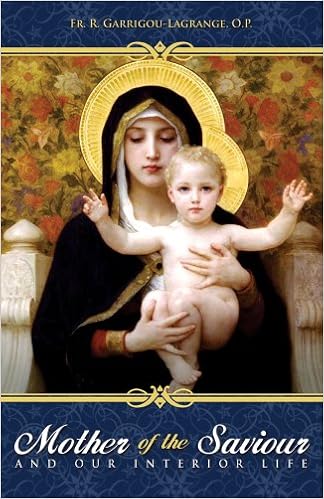
Mother of the Saviour

Image result for The Mother of the Saviour and Our Interior Life Garrigou-Lagrange, ReginaldThe Mother of the Saviour and Our Interior Life by Fr Reginald Garrigou-Lagrange, OP, translated by Bernard J Kelly, CSSP, 338 pages

Mother of the Saviour is both an examination and a celebration of the Mother of God - neither purely devotional nor purely intellectual, it uses devotion to draw us into deeper understanding and the intellect to draw us into deeper devotion. Fr Garrigou-Lagrange carefully proceeds with a theological inquiry into the Church's teachings, revealing the grounding of the Marian dogmas in the reality of the divine maternity and the mystery of human participation in the work of God.

Thursday, June 28, 2018

Louisiana Catch


Louisiana Catch by Sweta Srivastava Vikram    261 pages

When I was offered a chance to review this book by the author, I jumped at it. I like the to-the-point summary she gave: “The book is about a grieving daughter and abuse survivor who must summon the courage to run a feminist conference, trust a man she meets over the internet, and escape a catfishing stalker to find her power.” What I wasn’t prepared for was how terrifying it would be.
Thanks to her mumma, Ahanna has recently filed from divorce from her abusive husband. Her life with sex-addict Dev has been a living hell. Terrified that people, especially her family would harshly judge her, she does everything she can to hide what her life is really like. Living in New Delhi with her parents, readers get to see what life there is like for an average woman. The scary part was how unsafe it is for a woman to venture outside her alone. But Ahanna receives courage and support from her Mumma and the rest of her family. 

Tragedy strikes while Ahanna is the in process of organizing a world-wide, feminist conference called “No Excuse.” The conference will be held in New Orleans in one year. She works long days, trying to digest what has happened in her life. Two men come into her life.

First is Rohan Brady, who lives in New Orleans. His PR firm is helping with the conference and Rohan becomes her right-hand person. He likes to tease her, is smart, funny and caring, something that Ahanna is not used to from a man.

Then there is Jay Dubois. She meets him in her online therapy group. As the pages unfold, readers get to watch Jay slowly turn from a seemingly-also depressed individual to a terrifying manipulator.  Jay represents Ahanna’s love life over the years. Jay gave me the creeps from the minute he is introduced, and it turns out, rightly so.

Viram does an excellent job in the slow build-up of the plot. It’s so subtle in the first two-thirds of the novel, that I thought there really wasn’t a plot. That slowly rising tension is enhanced by the voice. It sounds more like a memoir than a novel, which only adds to Vikran’s creditability. The last third of the book read more like a novel with high suspense

I enjoyed reading “Louisiana Catch” and give 4 out of 5 stars in Julie’s world. I wish there had been an appendix that would define all the Indian words that Vikran uses. She defines the majority of them without getting in the way of the story, but I hated not being exactly sure that I understood correctly.

Breakfast at Tiffany's and Three Other Stories


Breakfast at Tiffany’s and Three Other Stories by Truman Capote    140 pages

It’s been decades since I last read the title novella in this short book.  I kept in on my shelf as I had never gotten around to reading the other three stories. That is why I chose this title to read as my June selection in my 2018 reading resolution. I’ve seen, and loved, the movie of the same name at least a dozen times.

Now that I have re-read the second of Capote’s masterpieces, I was majorly disappointed.  Set in New York City during the 1940s, the irreverent Holly Golightly adores the good life. She dates older men, stays out all night, and has little regard for her new best friend, the new guy in her building, a writer. Still, by the time I got to the end I was bored with Holly. She just seemed to do the thing over and over in each scene. 

But let’s talk about the other stories. First is “House of Flowers.” It is an odd little story that I really didn’t care for. Set in Haiti, Ottilie is a prostitute, a customer favorite.  The bordello’s madam does her best to keep Ottilie happy by giving her things the other girls must do without. She must decide whether to remain at the house or become the wife of Royal Bonaparte, a man from the mountains. I didn’t care for the ending at all.

Second is “A Diamond Guitar.” Set in a prison in Alabama, the two main characters are both convicts. Mr. Schaeffer is serving a 99-year sentence for murder and Tico the new guy on the block, serving a two-year sentence for stabbing two men. They attempt to breakout, with the ultimate goal of obtaining aa prized guitar.

The third story was my personal favorite and catapulted this review to three stars (up until then, it was going to get one. In “A Christmas Memory,” narrator Buddy is looking back the last Christmas he spent with this much-older cousin in rural Alabama. Every Christmas season they spend four days making thirty-one fruitcakes, evening going as far as sending one to President Franklin Roosevelt. It’s a fun, yet sad story that often rings of Capote’s own childhood.

“Breakfast at Tiffany’s and Three Other Stories” receives 3 out of 5 stars in Julie’s world.

The Future of Humanity:Terraforming Mars, Interstellar Travel, Immortality, and Our Destiny Beyond Earth

The Future of Humanity:Terraforming Mars, Interstellar Travel, Immortality, and Our Destiny Beyond Earth by Michio Kaku               Audio Book: 12 hours     Paperback Book: 592 pages        


The book lets readers know why Sheldon Cooper is so fascinated with physics.    A very well written book that speaks to the layman about things Einstein, Tesla, Schopenhauer, Hawking, Asimov and the world of the Science elite were and are involved in monitoring the state of the planet while monitoring the skies and whether life may exist beyond the earth.    Kaku keeps it so easy to follow along it is like an introduction to the universe, with a dollop of global warming thrown in mixed well together then served up to tell the reader where from a scientific, geological, meteorological, astronomical, engineering sector where it is that humanity finds itself in the scheme of life on earth and given all the factors how long we can expect life to continue as we know it and what must be done to save the human race from the impending meltdown path the earth is currently on.    Given the tracking of global warming and the rise in temperature of the earth’s core, Kaku tells in great detail many of the programs currently underway by the government and private funding sector, exploring  the potential of other planets, moons (not just our moon but also those circling the other planets in our Milky Way  galaxy and the Andromeda Galaxy, even beyond) that could be habitable as it becomes necessary for the continuation of the human civilization to carry on living that with overpopulation, the gravitational pull between earth, moon and even that of the galaxy stretching itself into a flatter shape,  the looming black hole found at the outermost reaches of the Milky Way show that things are going to have to change and within the next century.     Billionaires are investing in plans to work out interstellar travel.     Scientists are working on ways to make the atmospheres on other planets workable for colonization.   It will blow your mind to learn all that is going on that the public generally doesn’t hear much about.    Colonization training, is real.    It will take many years to send up exploration vehicles, robots to test the terrain,  even robots built to replicate themselves on another planet for the purpose of doing the necessary work – building factories on other planets to produce the materials necessary for putting up homes, biodomes,  hydroponics for sustaining life once the limited supplies taken there run out, etc.     Kaku tells the reader what is currently being discussed, planned, alternatives being researched, it is mind boggling all that is going on throughout the countries of the world to make sure that in the event of massive trauma to the earth there are viable alternatives to continue the human race so that we don’t go the way of the dinosaur if a huge asteroid were to plummet into the earth and bring on another ice age.    There are even plans and research going on that go out 1,000 years to future generations continuing colonizing as technology advances even further into space so that the human race, if it were to evolve into many colonies (replicating the move from Africa into Europe and the poles on this planet) that in the event humans living on a myriad of planets might begin to think of themselves as something other than Earthlings and splinter off into differing groups as they move further and further away from one another.     It is wild.    The book discusses how mankind might have to eventually become  hybrid into cyborg like states in order to stay strong enough to meet the demands put on human bodies living in vastly different environments given the state of the atmosphere on other planets (Searing heat, lethal gases, etc.) not to mention making communication remain stable and fast.    Aging is another field being worked on and it is thought that one day it might be possible to halt the aging process and Kaku outlines several areas of research currently going on and what their initial and long-term goals are.     He discusses research being done currently on lab animals to install microchips that would allow humans to communicate with their minds through whatever the internet becomes.    Though it sounds sci-fi and too much to believe scientists have already been able to capture memories of mice.    The stuff of Jules Verne, Ray Bradbury and others is nothing compared to the actual true programs currently in place.     This book will floor you.   Seriously.

The Financial Diet

The Financial Diet:  A Total Beginner’s Guide to Getting Good with Money by Chelsea Fagan         Paperback Book: 208 pages                        

I enjoyed this read.   It is a very easy, quick read and the style it is written in makes it fun and pleasant to get through.    I did not find it to be a real beginner’s guide as such.    There are things covered here the reader needs to have a working knowledge of so not exactly completely at step 1 but, certainly, a likeable explanation of most things covered in the book.    I suspect the reader would learn more by visiting the blog spot referred to in the book.   Having said that, the writing style is amusing and keeps you reading throughout.    I have to disagree with the recipes in the book.   O.K. maybe you can make them and freeze them for more than one extra meal, but, come on, folks, these ingredients are not items someone living check to check and trying to get on their feet monetarily would have at hand in their kitchen cabinet nor should they.   So, the recipes, though her grandmother’s and mother’s that sound really tasty just require over the top expensive and not too often used spices, cheeses, etc.   Not a good way to save a buck.    I like how she promotes everyone trying to save should have a job and at least one side hustle to pay off their bills and to start saving for emergencies, and possible job loss.    So her future You tips are very good and thorough.   She cusses throughout which is funny to read and makes the book very paletteable as if chatting with a friend or friends (the professionals she brings in to give mentoring tips to the reader),  you know the ones that you get a kick out of because their speech is so colorful and expressive.    She gives lots of great info on setting up a budget, but, I found myself a little lost when she goes into relationships, although, yes if you are going to cohabitate or marry – you do need to think out all of the issues you need to discuss –ie. how to break down the bills – you pay, I pay, whoever makes more pays and truly get through the conversation about each person’s debt load.   Investing she recommends but if the reader is starting out from a major in debt place it will surely take a while to get to the juncture she discusses.    Do not skip the introduction – there is so much worthy information there.   Step-by-step information on how to get good with money in a year.    And do NOT pass up here DYFDs!   They are simple common sense tips that we all ignore somewhere along the way and that is how folks get into debt.   Read them and make them your mantras.   They are truly words and concepts to live by that will save you so much grief in your financial future.    She brings a lot of experts in to share good information from those who know of what they speak.   Budget, check yourself and be accountable to yourself,  do not put more on your credit accounts than you can pay in a month.    She even goes into the tools you will need to do your own home repairs  to keep costs down on the simple stuff rather than having to pay outrageous fees to a pro when you can do it yourself for the cost of parts.   And her rule of four – always have at least 4 things other than work that simply put make you happy.    Allow yourself the off extra latte.  Tickets to a show,  admission to something fun or the one thing you thought you couldn’t live without but being mindful of your budget you did sleep on it as you promised yourself and you woke up still wanting it.   Indulge, but only that, not fifteen other things you see and think you might want while waiting in line to pay for your can’t live without item.     A fun read with good advice if overly gourmet recipes.     

The Celebration

The Celebration by Wanda E. Brunstetter                Audio Book: 12 hours, 3 mins      Paperback Book: 320 pages               

I enjoy reading stories about the Amish and Wanda E. Brunstetter never disappoints.   A sweet story about an Amish couple who are fostering two children whose parents were killed in a car wreck and of whom no other living relatives are known.   Interesting concept because I never considered that Amish would ever adopt “English,” children but they do in this book.     Lyle and Heidi Troyer are the Amish couple and as a way of introducing the two foster children to other local children, Heidi decides to teach a cooking class for kids.    It is a fun class but surprising, many parents stay to take the class with their kids instead of just dropping the kids off at the weekly activity.    There are so many side stories with all the families involved and the interactions of the students in the class (think the Breakfast Club for the under 12 set), adventures ensue, friendships and frenemies form, romance blossoms in the adult set, heartbreak, heartmending, prayer, tragedy and joy, kids and animals.    The book will keep you interested all the way to the end and is an enjoyable read.    I found out this is book 3 in the Cooking Class series so I will likely check out the other titles, too, because Brunstetter’s writing is calming and comforting kind of like snuggling up in a patchwork quilt on a rainy day with a mug of hot chocolate.   Very pleasing.    I would recommend Brunstetter’s books to anyone who enjoys reading/learning about the Amish lifestyle,  and anyone who wants an easy enjoyable read when you want something pleasant to fill your thoughts and turn on that projector in your head to carry you away with the story without a lot of heavy fare to contend with.   Good book

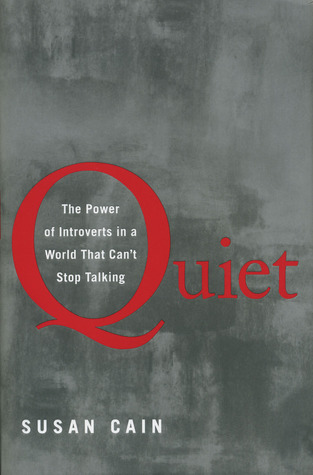
Quiet: The Power of Introverts in a World That Can’t Stop Talking

Quiet:  The Power of Introverts in a World That Can’t Stop Talking by Susan Cain                      Audio Book: 10 hrs. 30 min.    Paperback Book:  368 pages               

I loved this book.   It is so expansive explaining all the ins and outs of the introverted personality.    People who choose quiet to loudness,  people who prefer being at home with a good book rather than out partying till all hours,  people who can go on sensory overload when forced into an environment of constant talkers, people who value solitude and find it refreshes and invigorates them rather than the contact barrage of work chatter, those who find quiet pursuits suit them better than boisterous in your face pursuits that are the lifeline of extroverts will find validation in this book.   Often introverts grow up being chastised for their quiet preferences.   In a world where students are condemned for their lack of participation even though their papers and tests show remarkable insight, perserverance and profound research skills.   In a world where the quiet children prefer smaller gatherings to classrooms full of loud intimidating beratings from their extrovert fellow students.    Oft times the quiet, innocuous student studying in the Library is pounced upon by the far more gregarious jocks or popular crowd waiting outside to make their lives hell and this continues throughout their life even into college auditoriums where participation can count up to 1/3 and more of their final grade through the workplace where the quiet staff are generally passed over for the brash, pushier employees whose often arrogant behavior is seen as self-confidence while the quieter co-workers are misread often as lacking self-confidence, weak, pushovers and doormats.   Loud and abrasive does not equal intelligent.   Oftentimes the loud behave so to deflect anyone looking too close at them and pointing fingers at the meeker personalities in the room, who overwhelmed at being under scrutiny when they have always been exemplary in their behavior do not fight back nor stand up for themselves feeling hurt at not being understood thereby their silence showing at not defending themselves nor speaking the truth as they know it from quiet observation, yet, preferring to remain as invisible as possible so the bullies will leave them alone.    This book explains so much and lets the introvert know they are not misfits but more sensitive to their surroundings than others.   It tells how to tell as a baby if a child will grow up to be an introvert or an extrovert, it discusses how one-third or more of the population are introverts, discusses some of the most famous introverts – Albert Einstein, Bill Gates, Steve Wozniak, Michaealangelo,   Rosa Parks, Eleanor Roosevelt, Steven Spielberg, Mark Zuckerberg, Abraham Lincoln,  J. K. Rowling,  Warren Buffett, Mahatma Gandhi, Moses, Jonah,  Meryl Streep, Dr. Seuss,  Frederic Chopin, Barack Obama, etc., etc.    The author brings emphasis to the contributions throughout time of introverts and the affront from seemingly all sides against them to be more outgoing.    The author’s visit to research the topic at Harvard Business School was scoffed at.   She was told, “Good luck trying to find an introvert here, “  and she witnessed how all students in the classes she attended were virtually forced to speak out to show their ability to compete verbally as an upwardly  mobile business person, where the quiet were virtually ignored and down-graded by their professors for lack of participation.   Harvard students are taught to always speak up even if their premise is incorrect –they still get the better grade because in life the extroverts achieve and the introverts get pushed to the side.   A deeply enlightening book validating the introverted personality and shining a light on the behaviors of introverts in dealing with their environments and coping with the often harsh resistance they receive even in their own homes from parents, to teachers and schoolmates to co-workers and bosses in life.   Excellent book.    It should be a must read for everyone.    It delivers insights not often looked at.   Twenty thumbs up for this one!  Terrific book.

The Death of Stalin

The Death of Stalin by Fabien Nury                            Hardback Book: 119 pages                      

A telling of the events surrounding the death of Russian Leader, Stalin with poetic license as to likely conversations that occurred, the outcome being the same whether verbage is verbatim, likely not but the gist is the same.     A true account of the craziness of the times, since a committee had to all be present to vote on what action to take when it was finally decided that Stalin had experienced a heart attack and was only semi-conscious it took hours to get all of the committee assembled, then they had to decide who to call to attend to him nedically since Stalin had killed or exiled all of the best doctors in the country due to his racial hatred of their Jewish heritage.   The doctors left in the country were not thought to be that great in their field.    The committee had to decide who they should consult first as to which doctor or doctors to bring in.    A name was decided upon, they contacted her and she gave them the names of a number of doctors to contact.    The clock is ticking away hours while all of this is taking place and of course the committee has to take Vodka breaks along the way.    Once contacted it took more time for the doctors to get to Stalin’s residence, then again, the committee had to approve each of them by taking a vote after considerable discussion.    Hours later, Stalin it was decided had a cerebral hemorrhage and very likely would not survive.    The committee contacted Stalin’s daughter and sent  soldiers to find Stalin’s son who was a general equivalent in the Russian army and was drunk after having attended an orgy he had moved to lesser partners but still involved in debauchery.     He did not want to go with the soldiers even though they told him he needed to come with them to see his father.    Stalin’s daughter knew immediately something was wrong with her father and assumed the worst that he was already dead.    However, somehow Stalin managed to hang on to life by a thread and opened his eyes when his daughter drew near and touched his face.   He tried to tell her and the committee something but he was unable to control his vocal chords and could only point and make in comprehensible sounds until exhausted he slipped back into unconsciousness.    His son still drunk finally arrived but his father had died by then and the committee member grasping the reins of power at Stalin’s death told the doctors they could not take his body from there.   The doctors insisted they needed to do an autopsy.   The doctors were told they could do the autopsy on Stalin in the barn.    This is what was going on when Stalin’s son finally arrived.   He walked in to see his father naked on a gurney, one of the doctor’s with a bloody surgical knife in his hand, all of the doctors covered in Stalin’s blood and the doctor who carried Stalin’s brain in his hands dropped it on the floor of the barn at the entry of the son.    A nightmare but all part of the true craziness that occurred at Stalin’s death.    Certainly an interesting retelling in excellent graphic style.    Not for the young nor squeamish due to sexual and violent scenes.    Graphic Novel fans will enjoy this one.

Wednesday, June 27, 2018

Marius the Epicurean

Image result for Marius the Epicurean Pater WalterMarius the Epicurean: His Sensations and Ideas by Walter Pater, 467 pages (2 vols)

The great aesthetician Walter Pater's celebrated novel is superficially a fictional biography of a literary Roman aristocrat in the reign of Marcus Aurelius, but primarily it is an exploration of the culture of that era, as well as that of Pater's own Victorian era and indeed all eras.  Marius the Epicurean is therefore about ideas rather than characters, an exposition of the author's aesthetic and cultural theories.  Pater never drops his modern viewpoint, and while it can be jarring at first to hear a second-century philosopher compared to Rousseau's Savoyard Vicar, the reader may gradually come to appreciate the author's awareness of the historical moments of both himself and his characters.

Monday, June 25, 2018

Art in Japanese Esoteric Buddhism

Image result for Art in Japanese Esoteric BuddhismArt in Japanese Esoteric Buddhism by Takaaki Sawa, 151 pages

Esoteric Japanese Buddhism, in contrast to the exoteric variety, maintained that the substance of Buddhist teaching exceeded the intellect's powers of comprehension, and therefore sought to embody it in ritual practice.  For this very reason, the tradition produced a rich array of art and architecture to aid in the expression of mysteries that lie beyond (and behind) words.

Art in Japanese Esoteric Buddhism ably showcases a wide selection of medieval Japanese buildings, sculptures, paintings, and mandalas, many of which benefit from remaining in their intended cultural and religious context.  Inevitably, the book touches on obscure elements of Japanese Buddhism, unfortunately, it does not have the space necessary to explain them.

Saturday, June 23, 2018

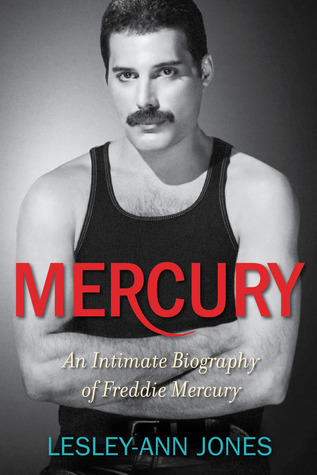
Mercury

Mercury: An Intimate Biography of Freddie Mercury     368 pages

As lead vocalist for the iconic rock band Queen, Freddie Mercury’s unmatched skills as a songwriter and flamboyant showmanship made him a superstar, and Queen a household name. But few people ever really glimpsed the man behind the glittering faÇade.      

Mercury was the first major rock star to die from AIDS. Now, twenty years after his death, those closest to him are finally opening up about this pivotal figure in rock n’ roll. With unprecedented access to Mercury’s tribe, rock journalist Lesley-Ann Jones has crafted the definitive account of Mercury’s legendary life. Jones details Queen’s slow but steady rise to fame, and Mercury’s descent into dangerous, pleasure-seeking excesses. Jones doesn’t shy away from Mercury’s often colorful lifestyle—this was, after all, a man who once declared, “Darling, I’m doing everything with everyone.”     

In her journey to understand Mercury, Jones traveled to London, Zanzibar, and India—talking with everyone from Freddie’s closest friends, to the sound engineer at Band Aid (who was responsible for making Queen louder than the other bands), to second cousins halfway around the world, an intimate and complicated portrait emerges. Meticulously researched, sympathetic yet not sensational, Mercury offers an unvarnished, revealing look at the extreme highs and lows of life in the fast lane.      


A decently written biography about a legendary rock singer. Jones' extensive interviewing reveals the thoughts and feelings of figures surrounding Freddie, with occasional quotes from the artist himself. Jones also interjects her own thoughts and feelings into the mix, which is fine. The book has follows a basic chronological order, paralleling Freddie's early life, his time with Queen, and his solo projects. No stone is left un-turned. While the writing isn't necessarily compelling, it covers important moments Freddie's life and it is pretty complete as far as information about him and those he was close to.

I would recommend it to any Queen fan or those curious to know more about the personal life of the fairly mysterious Freddie Mercury.

Delusions of Gender

Delusions of Gender: How Our Minds, Society, and Neurosexism Create Difference by Cordelia Fine     338 pages

It’s the twenty-first century, and although we tried to rear unisex children--boys who play with dolls and girls who like trucks--we failed. Even though the glass ceiling is cracked, most women stay comfortably beneath it, and everywhere we hear about vitally important “hardwired” differences between male and female brains. The neuroscience we read about in magazines, newspaper articles, books, and sometimes even scientific journals increasingly tells a tale of two brains, and the result is more often than not a validation of the status quo. Women, it seems, are just too intuitive for math, men too focused for housework.

Drawing on the latest research in neuroscience and psychology, Cordelia Fine debunks the myth of hardwired differences between men’s and women’s brains, unraveling the evidence behind such claims as men’s brains aren’t wired for empathy, and women’s brains aren’t made to fix cars. She then goes one step further, offering a very different explanation of the dissimilarities between men’s and women’s behavior. Instead of a “male brain” and a “female brain,” Fine gives us a glimpse of plastic, mutable minds that are continuously influenced by cultural assumptions about gender.


This was a very interesting book to read - I would have rated it higher if I felt the writing was more accessible to the lay-person. It's a very science-heavy read, so if you like being given lots of facts and info from studies, you probably won't mind the writing-style. For me, it was a little too boring - even though I find the subject matter in itself fascinating.

Still, that aside, I am glad I read this book. Fine brings up some important facts - like how even if people try to raise a child in a genderless way, they are still subconsciously subscribing to gender norms and children are living in a world filled with gender norms, making it an almost impossible task. Or how many gender-studies scientists make big assumptions about gender based on very limited data or make correlations that aren't really supported by the trials and studies they make, . She also brings up how everyone, no matter how old they are, can subconsciously be swayed by gender-specific information, even when people are not prone to thinking in sexist ways. Sexism is so entrenched in our society that even for those who, as Fine calls it, have "have changed minds," (meaning they reject sexist ideas and try to combat sexism), sexism is still occurring in subtle ways that would be difficult to spot or prevent. 

Basically, it's a long way to go before society will be capable of overthrowing gender norms, but it is doable and there is nothing wrong with trying to fix sexism where you see it or to try to raise your children without gender norms. It's a good read and I'd highly recommend it.

The Lost Carousel of Provence


The Lost Carousel of Provence by Juliet Blackwell   384 pages

From the first moment I saw the title of this novel, I wanted to read it. I received an advanced reader’s copy via Netgallery.com, but since I don’t have an eReader, the folks at Berkley Publishing were kind enough to send me a print copy.

When I read the back copy, the deal was sealed. What reader could resist “An artist lost to history, a family abandoned to its secrets, and the woman who discovers it all?” I was hooked, and the story did not disappoint. This is the book I’ll be talking about probably for the rest of the year.

The story goes like this: Cady Drake is alone in the world. A victim of California’s foster care system, she has a tough time getting close to people. There are only two people whom she trusts, her benefactor, Maxine, and a friend, Olive. Cady barely scrapes by as a local photographer, shooting school pictures, weddings, etc.  She is thrust into a spiral when Maxine suddenly dies. Cady owns an antiques carousel figure, Gus the Rabbit, whom she believes is the work of 20th century master carver Gutave Bayol. If it is, it would be worth quite a sum. But antiques dealers assure her it is not. One night Cady accidentally breaks Gus. Inside she finds a wooden box. That box changes Cady’s life forever.

Told in dueling timelines, author Blackwell weaves a tale that had me ignoring my family, sending them out for fast food, as I read. The story bounces around from Oakland, California to Paris and other areas of France. It’s a story that transports readers from present day to 1900 to the early 2000s, and other years as they fit the story. It’s a tale of crumbling chateaus, undiscovered treasures, a mysterious photograph, and a surprising twist.

“The Lost Carousel of Provence” received 6 out of 5 stars in Julie’s world. 


Poems and Letters

Image result for Poems and Letters SidoniusPoems and Letters (Volume 1) by St Sidonius Apollinaris, translated by WB Anderson, 241 pages

The 5th century is generally regarded as the century that saw the end of the Roman Empire in the West.  In 410, Alaric sacked Rome.  A few decades later, the Vandals took possession of North Africa, while the Anglo-Saxons invaded Roman Britain and Attila ravaged Italy and Gaul.  Finally, in 476, the Emperor Romulus was deposed by his general Odoacer, who sent the imperial insignia to Constantinople.

Sidonius Apollinaris witnessed much of this history.  Born into the aristocracy of Roman Gaul, he died under the heel of the barbarian Burgundians.  He composed a panegyric celebrating the accession of his father-in-law Avitus as Emperor, and another a few years later exalting Avitus' usurper Majorian, and another a few years later celebrating the accession of Majorian's successor's successor, Anthemius.  As bishop of Auvergne, he rallied the people during the siege of that city by the Goths, and was imprisoned by the victors after the city fell.  After his release he resumed his ministry to the vanquished, as well as his correspondence with figures ranging from his fellow Gallic bishops to barbarian kings and princes.

Admittedly, even the best poems of Sidonius have more antiquarian than aesthetic interest.  The fading of the classical world is exemplified by the Christian saint's invocation of pagan deities in praise of ephemeral emperors created and destroyed by barbarian generals.  More subtle are Sidonius' overriding concern with form at the expense of sense and his own distance from the literary masters of Augustan Rome he strives to imitate.  And yet the decadence itself presumes continuity, and Sidonius and his correspondents provide ample evidence of the stubborn persistence of Latin culture despite political disintegration.

Thursday, June 21, 2018

Young Lincoln


Young Lincoln  by Jan Jacobi   208 pages


Abraham Lincoln is still popular in the twenty-first century. Rather unusual for a man who’s been dead for more than 150 years. Best-selling novelists, historians and  mystery writers are among the many genres who tackle our sixteenth president, the man most consider our greatest president ever.


One thing we don’t have though, is many authors writing about his childhood, at least from a novelistic approach. Most of us know that his mother died young, and he was raised by a overbearing father and stepmother. Most books that I have read either concentrate on his adulthood, especially after he became a lawyer and started pursing his political ambitions.


But Jan Jacobi has given readers a rare glimpse into just how hard life was for young Abe with his new young adult novel, “Young Lincoln.” The cover is beguiling, isn’t it? 


Abe and his sister, Sarah grow up under the domineering personality of their father. Life in Indiana is hard.  The cabin is either too hot or too cold. There isn’t always enough to eat, which could account for Abe’s lankiness.


He jumps at the chance to to take a flatboat down the Mississippi to New Orleans. This changes his whole outlook on life, and he never looks back.


After moving to New Salem, Illinois, Abe becomes a shopkeeper and begins to study law. He also falls in love with the beautiful Ann Rutledge.

Jacobi’s story takes us from Abe’s life as a little boy until he is elected to the Senate. The beginning is rather rushed, racing from one scene to another, almost if Abe knows that his life will be short and he must fit in as much as he can.


About a third through, the writing settles down and reads can esacpe into the primitive world of early-1800s America.  But Jacobi keeps his audience in mind and doesn’t try to go too deep, espcecially into Abe’s bouts with melancholy (or depression as we would know it today).


Perhaps the most poignant scene in the book is the very last one. I won’t give it away, but readers, I hope, will be amazed at how well Jacobi foreshadows Abe’s death. This book is geared toward middle school readers, whom I sure have learned about Abe’s demise. Hopefully, they too will be able to see the poetry in that last scene.  It’s worth reading the whole book alone. 


“Young Lincoln” receives 5 out of 5 stars in Julie’s world.


Wednesday, June 20, 2018

Somebody I used to know: a memoir

Somebody I used to know: a memoir by Wendy Mitchell   259 pages

Wendy Mitchell had a busy job, juggled many responsibilities, kept track of every detail, raised her two daughters on her own and on the weekends, went running and also climbed mountains. Then one day, she noticed she felt a little . . . foggy. She couldn't remember details the way she had. She fell for no reason when she was running.  What was happening was early-onset Alzheimer's at age 58.

In this book, Mitchell shares about her cognitive decline but also about what she has learned not only about Alzheimer's, but about how she can make adjustments and still live independently. While the diagnosis was scary and unknowable, Mitchell was determined that she could figure out how to outwit the disease as long as she could.  Seeing her condition as a gift and a way for her to educate others about, Mitchell has spent time educating caregivers, doctors and other people living with dementia, ceaselessly determined to reduce the stigma surrounding Alzheimer's.

I found this book to be a really good read. It's a little scary to imagine what Wendy Mitchell is up against but it's an incredibly uplifting and inspiring story. It's fascinating to read about how she approached her situations, making adjustments, adjusting those adjustments, and figuring out ways to deal with situations.  She very much understands that each day can be one of different challenges and some of them new and pretty daunting. However, her attitude of meeting these challenges head-on is inspiring. 

The Bad Food Bible

The Bad Food Bible: How and Why to Eat Sinfully by Aaron Carroll, MD.     Audio Book:  7hrs. 11 mins    Hardback Book:  272 pages              


Really good book, I am so glad to have gleaned the knowledge that Dr. Carroll imparts here.   First of all, I fell madly in love with him when he admitted the dirty little secret of doctors is when diagnosing patients they give their best guess.     I realized this some years ago, but, to actually hear a doctor say it – he had me in the palm of his hand for the rest of the book.    And it is a good book.    He talks about the different types of studies and surveys that people tend to believe and why they shouldn’t      If a finding is based on animal testing he says like the saccharin studies that say saccharin causes cancer in lab rats, don’t give up coffee, msg, or any number of other foods, because in the labs they dose the animals with multiple mega doses of whatever it is the study is based on and besides the study tells you it is done on rats not people.    He says never believe any study done on animals.   Also, don’t believe short terms studies on small groups of people.    Only pay attention  to studies done on huge groups of humans that are blind, random procedures, ie. somebody gets the real thing, somebody else gets a placebo throughout the thousands of people with differing lifestyles, different cultures, different ages, different eating habits, those who are obese and those who are not, those who have type 1 Diabetes and those who do not have Diabetes in other words, really random like real life is and the study must go on over a long period to be of value.    If 7 people are studied for 1 week that is basically useless information.   The trial hasn’t gone on long enough to really make any type of evaluation other than speculation rather than causation.    In one of his classes at Indiana State University he asked his students to go online and find studies on 40 different foods that promote their beneficial and/or healing qualities, then he asked them to go back online and look for studies showing how each of these same 40 foods cause cancer.    Each of the 40 foods were said to make you live longer then each food was shown in other studies to cause cancer in various parts of the body.    A wise person told me once, you can’t get funding to study the same thing someone else did, you have to take the opposite approach if you want backing.   Hence why the assignment Dr. Carroll assigned his students proved that out.    He dispels the rat tests, the coronary analysis, and multitudinous other studies that are familiar from the media promotions over the years berating a thing one day then praising it for its benefits the next.   He says there is nothing wrong with enjoying a nice steak (red meat) or fish said to contain mercury that will poison you – it won’t.   Dr. Carroll says a person would have to consume so much each day for msg, aspartame, caffeine, alcohol, glutten, you name the offending ingredient, to do the outrageous claims made that it would be humanly impossible to do so.  He says salt is not bad for you, unless, your blood pressure happens to be outrageously high, then you might want to cut down, but, none of the foods we are told are bad for us can really hurt us unless like the poor beasts injected with mega doses we gorge ourselves to extinction which is not going to happen.    No one is going to overindulge every day for the rest of their life on any suspect ingredient.    He recommends savoring the food and beverages we enjoy until we come across a double-blind study of every human being following  the course of their eating habits for a couple of decades – that would be believable.   And he discusses the pros and cons of organic food and food grown wherever by whoever using pesticides, weed killers and more on their crops, and free-range verses factory farms/ slaughterhouses.      There is no real difference proven statistically that shows one is bad and one is good for you, nothing proving one is better for you than the other.   Natural honey is not better for you than sugar substitutes.    He is really entertaining and interesting in how he explains the ins and outs of the food trade, food myths and how the public has been force fed bad information so long that we come to believe it even though it is absolutely not true.   Dr. Carroll promotes enjoying Chinese food, eating a muffin loaded with glutten smothered in real butter, chased down by a diet soda or Scotch.     It turns out nothing is bad for you in moderation which is how most of us eat anyhow.   Dr. Carroll promotes enjoying life and savouring food and stop worrying about the latest food findings (information can be manipulated any way you want it to and statistics can be made to reflect whatever the person compiling them wants them to whether they are honestly true or not.    The one thing he says is true is that smoking is bad for you and yes, it does cause cancer.    So put the cigarettes down and treat yourself instead to your favorite meal guilt-free.

Temple of the Golden Pavilion

The Temple of the Golden PavilionThe Temple of the Golden Pavilion by Yukio Mishima, 262 pages

"Ever since my childhood, Father had often spoken to me about the Golden Temple."  From an early age, then, the ideal of the Golden Temple of Kinkaku-ji dominated Mizoguchi's imagination, but what is a portal for the father becomes a barrier for the son.  Distanced from others by his stutter, convinced of his own essential unloveliness, Mizoguchi comes to hate the Golden Temple more the more he is captivated by its beauty.  After the death of his father, he becomes a novice at the Temple, and it becomes the ultimate symbol of his father, his religion, his country, his traditions, his future, and everything that stands in the way of his freedom to be a beast.

Based on the true story of the novice priest who burned down the Golden Temple in 1950, The Temple of the Golden Pavilion is full of Mishima's characteristic alternately achingly beautiful and shockingly brutal enigmatic vignettes.  The novel - part biography, part prose poem, part koan - is an enchanting tragedy both personal and civilizational.

Monday, June 18, 2018

Giovanni Pisano, Sculptor

Giovanni Pisano, Sculptor by Michael Ayrton and Henry Moore, 192 pages
Image result for Giovanni Pisano, Sculptor Ayrton, Michael

Together with his father Nicola, Giovanni Pisano stands on the border between the Middle Ages and the Renaissance - indeed, the authors of this book place that border between them.  Of course, this only highlights how insubstantial that border is - Giovanni's sculptures mark a turn towards expressive Renaissance naturalism but are animated by the Medieval imagination.

To properly appreciate Giovanni Pisano's accomplishments requires a considerable work of imaginative reconstruction, given how much of his output is lost, damaged, or altered in the name of "renovation".  For this labor, the assistance of guides such as Ayrton and Moore, not only art experts but working sculptors themselves, is both a source of pleasure and a cause for gratitude.

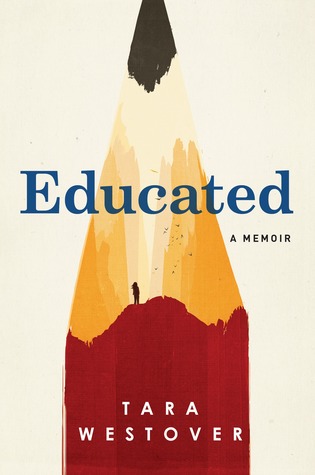
Educated: A memoir


Educated: A Memoir by Tara Westover               Audio Book:  12 hours     Paperback Book: 512 pages                    

Tara Westover has led a surprisingly dysfunctional existence.     Living isolated on her family’s compound I first thought there was going to be something nefarious about sister-wives and gun hoarding instead, while the topic of sister-wives is addressed it did not take place within Tara’s immediate family.    Though it was condoned within sects of their Mormon faith.     In Tara’s home, her father was a screamer, moody, hysterically violent at times and so was one of her brothers.    Each could flip in an instant from calmly chatting to her father forcing her to load scrap metal into a new contraption he had come up with to cut the metal up.  Unfortunately one of her brothers nearly lost his arm trying to use it and when none of the other brothers wanted to go next her father made her pick up scrap and load it into the machine.    She was nearly hurt several times but diligently obeyed her father.    Her Dad does not believe in the government nor doctors so any time someone in the family was hurt, sick or needed medical care of any kind – her father expected her mother to take care of it.    Her mother self-taught herself to deliver babies, sew incisions and cure with poultices, tinctures and oils.   She learned plant lore and which botanicals were good for what and became quite savvy at natural healing.    She had friends that did energy and chakra work and eventually people came to her wanting to buy her medicinal herbal cures.   So much so that she has a thriving business selling them now internationally.  The kids did not go to school, again her father’s idea since he believes public schools teach nothing but propaganda and control the populace by controlling their minds through what they teach.   He saw government conspiracy in most everything so he and her mother built a bomb shelter and keep it stocked with a year’s worth of supplies for everyone in the family.   They believe a mix of the Book of Mormon and the Bible so they are preparing for the End of Days as foretold in the Bible but also adhere to the writings of  the founder of Mormonism, Joseph Smith, Jr.    Tara’s parents also excused the behavior of her mentally deranged brother believing that whatever he did to her (shoving her head in the toilet was his favorite move, beating her senseless, breaking her bones – pushing her fingers, wrists, etc. the wrong way until they snapped) she deserved.    They never corrected him for the awful things he did, but, they would mistreat her for being headstrong and agreeing with her brother for what he did to her.     Finally, she decided that she wanted to go to school and managed to work it out between her parents, though they fought her tooth and nail on it and others in family services positions, etc. helping her out of the compound.     Much happens along the way and it is certainly a miracle how many things fell into place and how many people were networked to help her along her path.   Having been in that environment so long she is noticeably a bit damaged in her perspective (when witnesses in town would see her brother abusing her and physically hurting her seriously, she would laugh it off like it was all in fun – Why?   The guy is a lunatic and needs to be put away.   But she always held up for him to outsiders and had long ago given up trying to defend herself against him nor try to get sympathy from others in the family.   The brief time she received empathy from her sister – it didn’t last long and now her sister sides with the family against her.    She didn’t really see how outsiders, (people living in town) saw the Westover family until she made a few friends at school and later acquired a semi boyfriend who, after witnessing one of her brother’s rages against her first hand while the family went on about their business as if nothing out of the ordinary was taking place, then Tara herself, though hand prints shown red on her throat and her face was swelling and bruising, her boyfriend refused to ever enter their home again, because Tara played it off even then as though it was all fun and games and she was o.k. though she likely had a concussion.    What a family of enablers to an abuser, yikes!    Tara, while adapting to life in school, she was shunned by some because she really didn’t have a clue as to how to behave in class and was so at sea with the most simple of classes, she basically had to be taught how to behave and how to seek help with catching up on all the topics she didn’t know that she didn’t know, like when she asked in class what the word “holocaust” meant as she had never seen nor heard about it.      She made a phenomenal come back, catching up by reading up on history, working with math tutors, etc.    She ends up attending, Brigham Young University, where she receives a B.A.,  She received a Gates Cambridge Scholarship,    She attended Trinity College, Cambridge where she earned a MPhil and the next year was a visiting fellow at Harvard University!  She returned to Cambridge where she earned a PhD in history.    Amazing!   From such a rough start, with little or no schooling this lady went on to earn degrees at some of the most prodigious universities there are.     It is a worthy read to see how it all took place.    Props to Tara.   Divine providence and self- determination seem to have led this young lady out of the darkness into the light.   Good book, though hard to read at times when she is being brutalized and ostracized.  

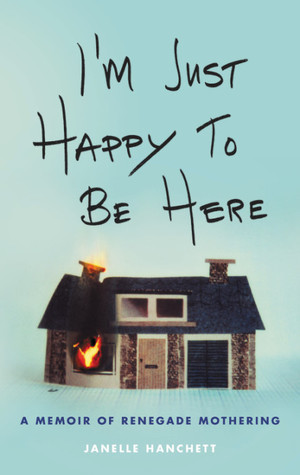
I'm Just Happy to Be Here

I'm Just Happy to Be Here: A Memoir of Renegade Mothering by Janelle Hanchett  310 pages

"From the creator of the blog "Renegade Mothering," Janelle Hanchett's forthright, wickedly funny, and ultimately empowering memoir chronicling her tumultuous journey from young motherhood to abysmal addiction and a recovery she never imagined possible."

At 21, Janelle Hanchett didn't expect to get pregnant, especially not with a guy she'd only known for three months. Rebellious and a free spirit by nature, Janelle found that after having the baby, she was bored, feeling directionless, and seeking relief in wine way too often.  Over time, her drinking habit became worse and she started taking drugs. Along the way, she had more children, but she was still battling addiction and wound up separating from her children. For 10 years, she went through rehab to therapists and finally found sobriety (although in a way she never expected).

I had read a review of this book as well as the above quote and this one (both from the publisher): "This is a story we rarely hear--of the addict mother not redeemed by her children; who longs for normalcy but cannot maintain it; and who, having traveled to the bottom of addiction, all the way to "society's hated mother," makes it back, only to discover she will always remain an outsider."  I found this to be an interesting book, and definitely a kind of memoir that I had not read before ----- but I actually didn't enjoy it that much.  I didn't find the book "wickedly funny," and actually most of the time found I was pretty unsympathetic towards the author.  That's a personal reaction --- and I know some readers may really enjoy this book.  I just didn't like it that much.

Friday, June 15, 2018

The Radium Girls

The Radium Girls: The Dark Story of America's Shining Women by Kate Moore     496 pages

The Radium Girls fully illuminates the inspiring young women exposed to the "wonder" substance of radium, and their awe-inspiring strength in the face of almost impossible circumstances. Their courage and tenacity led to life-changing regulations, research into nuclear bombing, and ultimately saved hundreds of thousands of lives.


Wow, wow, wow. This story is powerful! Fate brought Kate Moore to this story and thank goodness it did because she has done a great service to woman's history by bringing this story back into the light. This was not a story I was familiar with at all - not even in my periphery - and so with each page, I became more and more incensed at the horrors these women suffered at the hands of ruthless, unfeeling businessmen and their corporations who couldn't be bothered to care about the health and safety of their female workers.

The sheer amount of time Moore spent on this story shows - in her author's note she mentions coming to America to visit with the families of the radium girls and their grave sites, the countless hours of library research, reading everything she could of what the actual women themselves wrote. This book was amazingly researched and delves deeply into the history of the women's lives before and after, not just focusing on the court cases that made them famous. All the key figures are given their due time and it was fascinating to hear so many first-hand accounts of not just the families of these women, but the women themselves, remarking on what was happening to them and how the felt.

Needless to say, I would highly recommend this book to anyone. It's an important story in American history and these women did so much to secure workplace safeties that our modern world enjoys as well as offering themselves up to science for future studies done to better understand radioactive substances and what they can do to the human body.

Though this work is a piece of non-fiction, it's narrative quality makes it a real page-turning story that you only wish was fiction. The devastating illnesses these women suffered make you wish you could go back in time and warn them. This story truly moved me to tears.

I listened to the audiobook of this story, which was well read and I enjoyed listening to it. 

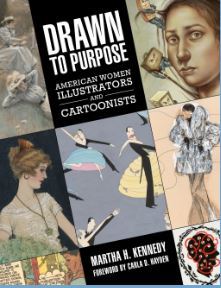
Drawn to Purpose: American Women Illustrators and Cartoonists

Drawn to Purpose: American Women Illustrators and Cartoonists by Martha H Kennedy   255 pages

This book was published in partnership with the Library of Congress and is a presentation of women in American illustration from the late 19th into the 21st century.  The author focuses on forms that haven't received much attention before, including political cartoons, editorial illustrations and cover designs, to show off the contributions of many women whose work has been overlooked.  She breaks down the book into sections, so you read about women who did cover designs, advertising work, etc. The book focuses on 80 women who created these works and you learn about their stories, artistic training, their experiences of gender bias in the workplace and much more.

I found this book fascinating!  I knew about some of these women, but I didn't know about a lot of them ---- and being able to learn about them and their work in the context of the societal norms of their day was really interesting. 

The Other Woman

The Other Woman by Sandie Jones.  294 pages   I read a galley - this book is due out in August, 2018

It's so sweet when a man's close to his mother, right? Unless his mother's the type of women who doesn't like to share.

Emily thinks Adam's the perfect man for her. However, she didn't count on Pammie, Adam's mother, who seems to be doing anything to keep Emily away from Adam. This fast-paced psychological thriller, complete with a huge twist, explores the twisted relationships between Emily, Adam and Pammie. Emily's determined to have Adam for herself; however, Pammie's made it clear that will happen over her dead body. Or is that Emily's dead body?

This is definitely a fast-paced book! I was intrigued by the characters, although admittedly, if I had been Emily, I would have started thinking there was maybe something wrong with Adam or would have just given up.  Emily's got a lot of determination, even when she's up against Pammie, who is all about the psychological, emotional manipulation of both Adam and Emily. You start to wonder after a while if Emily really wants Adam, or if she's just hell-bent on not letting Pammie win.  There is a BIG twist in the book that I didn't see coming and I don't think other readers will, either.