Wednesday, October 15, 2014

The Song of the Quarkbeast

The Song of the Quarkbeast by Jasper Fforde
289 Pages

Fforde, known for his irreverent Thursday Next series has the second young adult book about the Ununited Kingdoms.  With magic again on the rise, Jennifer Strange is all that stands between Bad King Snodd IV's attempt to corner the magic market.  A book of fun and wit.

The Silent Life

The Silent Life by Thomas Merton, 176 pages
 
http://media-cache-ec0.pinimg.com/736x/b5/e1/2a/b5e12a2585ded814a07ad947681ac991.jpgThis is a sustained, book-length reflection on the nature and meaning of monastic life and the monastic vocation, divided into two broad classes - the monk in community and the hermit, the former being represented by the Benedictines and Cistercians, the latter by the Carthusians and Camaldolese.  Merton does not deal with the more externally active orders, such as the mendicants, since his central theme is a rebuke of the Josephist attitude (just as prevalent in our time as in 18th century Vienna) that external works - that is, social utility - justify an order's existence.  The vital reason for monasteries is so that men may seek God more freely and fully.  All else is secondary.
 
This is not one of Merton's confessional works (The Seven-Storey Mountain), but it is clearly shaped by his own experiences (and struggles) as a Trappist monk.  This adds a certain additional depth to the work - Merton was only too aware that the voice of his abbot did not always sound to him like the voice of God, but understood that this, too, is part of the monastic vocation.  But Merton does not allow his own tradition to dominate his outlook, either, presenting a truly Catholic balance which recognizes the diversity of human experiences.  In keeping with this, there is much for those living outside the cloister to learn and apply as well.

Beautiful Music For Ugly Children, Kristin Cronn-Mills

Cover image for Beautiful Music for Ugly Children / Kirstin Cronn-Mills.Beautiful Music For Ugly Children, Kristin Cronn-Mills, 2012, 271 pages


    Gabe is about to graduate high school and seems to be on the cusp of everything. Except that most people do not know him by the name Gabe, they know him as Elizabeth. He has a radio show on his town's community station called Beautiful Music For Ugly Children, (much like St.Louis's own KDHX ) where he is comfortable being Gabe on the air.  The story follows Gabe through his coming out to his community as a trans-dude and some of the adversity he faces as a result of this. 
     The writing is pretty good, (except some of the music references are off, in my humble opinion) but I felt like Gabe's story could have been a bit more nuanced as per his developing gender identity.  I do however, think this was an earnest effort by the author, who did her research. Describing an experience like transitioning gender is no easy task, especially if the author is a cis-gendered person.  What saved the book for me, was that she included a note that functioned like a PSA at the end, although I might have like to have seen it at the beginning of the book.  Again, this would be a great book for questioning youth, as Gabe's character is fleshed out in a believable way. 

The letter Q : Queer Writers' Notes To Their Younger Selves


Cover image for The letter Q : queer writers' notes to their younger selves / edited by Sarah Moon ; with contributing editor James Lecesne.
The letter Q : Queer Writers' Notes To Their Younger Selves, edited by Sarah Moon, 281 pages


      What a fantastic book that should be in every teen non-fiction section of every library across the land. No Joke. This book is the real deal.  While the book has entries from Queer writers of all kind, the entries all take the form of a letter each person has written to their younger selves.  These letters are often humorous, witty, and poignant. Some of the letters speak about things that happened to the authors that should never happen to anyone, and all of the letters speak about how much better it gets as they have grown into adulthood.  For LGBTQIA questioning youth, this is an invaluable book that can actually make a difference.

Tuesday, October 14, 2014

Wraith

Cover image for Wraith / created & written by Joe Hill ; art by Charles Paul Wilson III ; colors by Jay Fotos.Wraith by Joe Hill, 204 pages


Having just come off 20th Century Ghosts, which I didn't care for, I was hoping for a Hill novel that would bring out the excitement and dread that Hill does so well. Wraith did not disappoint. Those that liked NOS4A2 will also enjoy this. Featuring the same protagonist Charlie Manx we get to look deeper into who he is. We also get so see how Christmastown came to be, how Manx came about owning the Wraith and what made him who he is.


Wraith is filled with bloody brutal murders and some, at times, sickening transformations. But that is what really adds to the horror that is Joe Hill. There are some somewhat adult themes and intense graphics so mature teenagers and up would probably be best.

Megahex


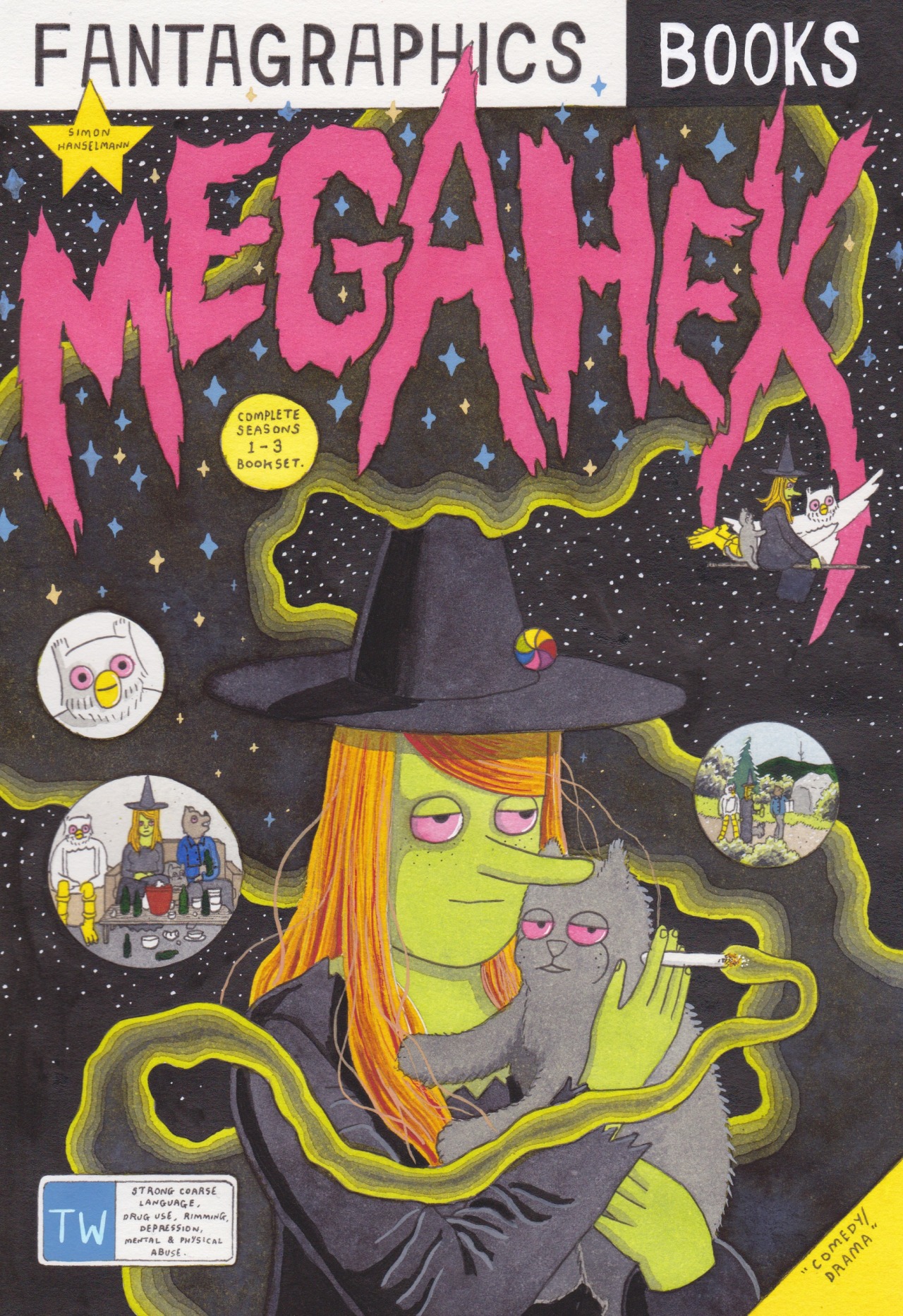
 Megahex by Simon Hanselmann, 207 pages

A witch and a black cat that are sometimes lovers. A werewolf who's known for his outrageous antics at parties. An owl who just wants to find love. A warlock thrown in the mix. This is Megahex! All these lovable characters are also hardcore drug users, fyi. How can an owl have a muffin top when he's not even wearing pants? How does a cat get naked for some skinny dipping? How does a witch fight depression? Who will win the horrible feet contest? Find out in Megahex!
This is a highly entertaining, but definitely meant for grown-ups graphic novel. (Warning on the cover: "strong coarse language, drug use, rimming, depression, mental & physical abuse"). It's set up in grids and was originally done in watercolor.
For an extra laugh, look this Tasmanian-born author up on the Internet. There are many photos of him in drag. Awesome.

Monday, October 13, 2014

Seventh Grave and No Body

Seventh Grave and No Body by Darynda Jones
336 Pages

"Lead me not into temptation.Follow me instead! I know a shortcut! "


Charley Davidson is back in the latest from Darynda Jones and in as much trouble as ever.  Now twelve beasts from hell are out to get her and just when her plate is already full with the disappearance of her father,  a rash of suicides where the victims are missing, and a bun in the oven.

I think I would read these books just for the quotations that start every chapter (see opening line).   Seven books in and the action is still going strong with a good development of the overall story arc.  Yes, there is sex but if you aren't interested, it is possible to skip the sections without losing the plot, or much of the book. Lots of humor.

We are All Completely Fine

We Are all Completely Fine by Daryl Gregory
182 Pages

This short novella has a therapy group meeting under the leadership of Dr. Jan Sayer.  The members of the group quickly find out that all of them are victims of violence, often of supernatural origin.    As the therapy develops the members start to help one another until the action culminates to a surprise ending.

A perfectly fine book.  Neither great nor horrible.  


Ancillary Justice

Ancillary Justice by Ann Leckie
409 Pages


Written by local author Ann Leckie, Ancillary Justice is the first of a series in which Breq, a remnant of the starship Justice of Toren is seeking revenge for the destruction of the rest of her.  To understand this further, the Starship is a sentient entity which controls the minds of several captured humans.   Leckie has attempted to capture how a mind used to several different perspectives and information flows would process information differently than we do and what would happen if that process was disrupted.  The book has Breq, making her way back to the leader of the Radch empire who is currently in a battle with her cloned selves. 

You have to admire the way Leckie has created not only a new world, but a new point of view.  It does however get confusing, especially since Breq is really bad at assigning the correct genders to others.  Thus several times I had to reread a section to figure out what was going on.


The Best of McSweeney's Internet Tendency

The Best of McSweeney's Internet Tendency  / edited by Chris Monks and John Warner

207 Pages


A collection of humours posts from an internet website covering a variety of topics such as: 

What I Would Be Thinking About if I Were Billy Joel Driving Toward a Holiday Party Where I Knew There Was Going to Be a Piano"

I Regret to Inform You That My Wedding to Captain Von Trapp Has Been Canceled

While many fail to live up to their titles, it is worth reading the continuing debate on the feasibility of having a trash compactor on board the Death Star and whether a creature could actually live in such a machine.  All of this is available online for free. 


Napoleon of Notting Hill

http://www.chesterton.omne.pl/style/images/books/covers/The%20Napoleon%20of%20Notting%20Hill.jpg
The Napoleon of Notting Hill by GK Chesterton, 300 pages

In the far off future of eighty-years-from-now, the King of England is an absolute monarch, but one selected randomly by lottery.  When the newest occupant of the throne begins whimsically issuing decrees establishing special sumptuary rules for local officials and heraldic totems for London neighborhoods, the last thing he expects is for someone to take him seriously.  Yet that is exactly what happens, when the mayor of Notting Hill refuses to accept a plan by the surrounding municipalities to build a highway through his town, instead choosing to defy all the rules of business and common sense and rally his loyal halberdiers around the standard of the Red Lion.  Will tender Romance be trampled underfoot by brutal Fact, or will imaginative Sanity triumph over blinkered Madness?

This was Chesterton's first novel, and already his gifts are in full evidence, not least his evocation of the poetry that surrounds us every day, demonstrating how even a humble grocer, seen rightly, is a fabulous merchant trading in exotic goods from distant lands, and every community a sacred fellowship.

Sunday, October 12, 2014

Vitamin D2: New Perspectives In Drawing

Cover image for Vitamin D2 : new perspectives in drawing.Vitamin D2: New Perspectives In Drawing  351 pages, 2013


    The second installment in the Vitamin D series (and there is also a Vitamin P for Painting), this is an excellent selection of contemporary drawing.  The layout and images of the work are clear, and there are short essays accompanying each artist's work that is featured.  When I was in graduate school, the first volume was invaluable to my research and studio practice, and this second volume should be no different for anyone interested in looking at a serious monograph that presents a wide array of what people are drawing now, and how they are drawing.
   Drawing as a medium is a serious endeavor these days, and this book gives the reader an idea of just how versatile drawing can be. Vitamin D2 is a book for anyone interested in contemporary drawing, at any level.  There are some really lovely images and exciting ways that artists are approaching the medium.


Deliver us From Evie

Deliver Us From Evie, M.E. Kerr   1994       177 pages


Cover image for Deliver us from Evie / M.E. Kerr.  This is an older LGBT YA title, but I remembered reading M.E. Kerr when I was a kid, and was curious to see how the writing held up over time. The story still felt relevant, but the pop culture references did not hold up in the slightest, although I was amused to be reading about the main character's tape collection, especially the K.D. Lang tape they make mention of.  I also enjoyed that the story was set on a farm in rural Missouri.  Evie is an eighteen year old who is on the cusp of becoming an adult and deciding what kind of future she wants to have fore herself. She has always been different, and tough, but always herself.  Then she meets Patty, who changes everything.  Obviously, there is going to be some drama surrounding their blossoming romance, but what made the story readable was that it was told from the perspective of her sixteen year old brother.  I thought that this was a great way to talk about how coming out issues affect family members.  Kerr also gives readers a character who challenges gender stereotypes, and also challenges the stereotypes of what gays and lesbians "look" like, which was so relevant at the time this book was published.


Knockout Games, G. Neri

Cover image for Knockout games / G. Neri.Knockout Games, G. Neri   298 pages


     This book disturbed me from the very beginning to the very end, and I have to say that I really enjoyed it. A new girl moves to St. Louis amidst the divorce of her parents, and has a really hard time fitting in at her new high school.  She ends up falling in with a group of kids who play a game known as the Knockout Game.  One of the more enjoyable parts of reading this book was the fact that it was set here, and that G. Neri gives SLPL a shout out, but the book felt familiar.  He is able to discuss issues of race and class in a way that is palatable for teens and so very relevant to our times and climate surrounding the city as of late.

Those Who Save Us

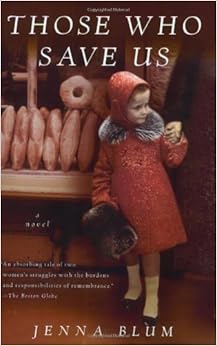
Those Who Save Us by Jenna Blum, 482 pages

I have a fascination with anything pertaining to World War II and this was some of the best historical fiction about it I have read. Those Who Save Us tells the story of Trudy, a middle aged German history professor, herself born in Germany during the war, and her mother Anna, who has come to live with her after a fire destroys the farmhouse of Trudy's childhood, where Anna was still living. Trudy has always had a strained relationship with her mother and she has never been told the story of what led up to herself and her mother coming to live in America with an American soldier.
The book alternates between present day, which is the late 90s, and the late 30s early 40s, when Anna was around the age of 20, living in Nazi Germany.
Trudy embarks on a project for work in which she interviews Germans about their experiences during the war. Her goal in the project is to see if any Germans feel any remorse or responsibility for the tragedies of the Jews.
Trudy learns much in these interviews, including things about herself and eventually, the details from when she was young.

*One of the fun details of this story was that Anna worked in a bakery in Germany when she was young. Many delicious sounding German cakes and breads are mentioned, and the mouth waters just reading about them.

Saturday, October 11, 2014

Beyond the Chocolate War

Beyond the Chocolate War by Robert Cormier, 278 pages

Cover image for Beyond the chocolate war : a novel / Robert Cormier.The school year is almost at an end, and the chocolate sale is considered by most students to be old news. Archie Costello, commander of the Vigils however still has plans before he graduates. Meanwhile his right-hand and man, Obie, has started to move away from the Vigils, and Archie. When Archie tries to fix this by sending his stooges, but what he may end up causing could be worse than anything he could possibly plan.
I picked this book up hoping that it would answer some of my questions about the ending of The Chocolate War, which I felt it did, as well as providing questions to answers I hadn't even thought about.

It differs from the first book in that it has a wider focus, which I felt helped to make it more character driven and helped to add more layers to the plot. Having enjoyed The Chocolate War, I felt this was the a really good sequel and that it did a great job tying everything up.

Friday, October 10, 2014

The Undertaking of Lily Chen

The Undertaking of Lily Chen by Danica Novgorodoff, 429 pages

After Deshi's brother's death, he is tasked with finding a wife (preferably a not-too-rotten corpse) to accompany his brother in his grave and into to the afterlife.  What follows is something of a morbid-Goldilocks tale - this corpse is too old, this one too young... until Deshi runs into Lily Chen.  She's just right, unfortunately she's still alive.

I found Novgordoff's tale to be somewhat uneven.  The characters aren't particularly well developed despite the novel clocking in at a whopping 429 pages (when you break the 400 page mark, I start expecting Craig Thompson levels of character development).  I personally don't care for Novgordoff's character drawing style, but her background water colors do live up to the promise of the lovely sky/skull cover illustration.  Lily is a bit of a Manic Pixie Dream Girl, a trope that never goes over very well with me.  While this book wasn't my cup of tea, I have a feeling I may be in the minority - it has loads of glowing reviews out there.

Art and the Religious Experience

 
http://img1.imagesbn.com/p/9780838779354_p0_v1_s114x166.gifThis is an analysis, from a perspective grounded in Heidegger's ontology and Whitehead's theory of perception, of the nature of art, and especially the religious dimension of art, whether implicit or explicit.  In this view, true art is an immanetization of the transcendent, a pointer to the depths of reality which underlie shallow surface appearances.  As such, the aesthetic experience, properly understood, is a participative experience which involves a relationship with Being itself.  Furthermore, since Being-as-Being cannot be apprehended through sense data, the aesthetic is an indispensable element in the analogical path to God.  Different types of art utilize different approaches to this Mystery, whether the unfolding of music from the freedom of temporal possibility, the immediate visual presence of the surface of an abstract painting, the retrospective foundations of literature, or the manifestation of space in architecture.
 
Martin deals deftly with his subject, but this book is even more interesting for the manner in which it touches on a variety of ideas and perspectives which are outside the scope of this book.  This is the kind of book that is as valuable for the thoughts it provokes as the ideas it presents.

Thursday, October 9, 2014

And the winner of the 2013/2014 Missouri Book Challenge is.....

US!!! That's right - SLPL was awarded the coveted MO Book Challenge trophy at the Missouri Library Association Conference this week.  Take a gander at Terra and Kara accepting our spectacular trophy.

Any SLPL staff who are reading this and aren't already contributing reviews to the blog - we need YOU!  Let's keep our winning streak up for a second year!

UPDATE: To help us in our quest to keep up our winning streak, take a gander at the About the Blog page, which has new wild card categories listed. Starting this month, you'll get two points for every book you blog about that was originally published more than 100 years ago, as well as two point for every book told from an animal's perspective. Happy hunting for that perfect 150-year-old book from a cow's point of view!

The Fur Person

The Fur Person by May Sarton, 106 pages


This is the story of Tom Jones, a cat, told from his perspective.  Rescued as a tiny kitten by a young boy, Alexander, the Fur Person put up with Alexander’s antics for several months before deciding to set out on his own.  He spent another couple years roaming the streets, a Gentlemen Cat, living by the rules a Gentleman Cat lives by, until he felt that it was time to settle down.  Finding just the right place and just the right people is a challenge, but Tom Jones, as his eventual people came to call him, was up for the challenge.  A fun story from a cat’s perspective, anyone who has ever owned or loved a cat will find this little book completely believable.  Readers who like animal stories should definitely check this one out.

Extremities

Extremities by David Lubar, 205 pages

This is a collection of short, creepy stories.  These are actually pretty scary and a little gory at times.  I liked all of the stories, although a couple were so short, they were almost unsatisfying because I wanted just a little more.  But even the very short stories told a complete story.  One of my favorites was Blood Magic, in which a boy and an acquaintance are caught in a robbery gone bad and taken as hostages by the robbers, who have shot the store clerk.  The narrator is sure that he and his companion, Eddy, are going to die, but Eddy has a trick up his own sleeve.  Of course, Eddy’s tricks could kill them as easily as the robbers’ guns.  Not all of the stories have a supernatural bent either.  The first story, Running Out Of Air, is about a group of high school girls that exact their revenge on a sadistic gym teacher.  This book will appeal to teens who like horror fiction.

Frogged

Frogged by Vivian Vande Velde, 198 pages


Imogene isn’t your usual princess.  She is two weeks away from turning thirteen and her mother has given her an early birthday present, a book, titled, “The Art Of Being A Princess”.  Her mother hopes that if she starts reading it now, then by the time her birthday comes she will finally start to look and act like a real princess.  Instead, Imogene gets fed up with the book and goes for a walk down by the mill pond.  There she encounters a talking frog, who claims to be a prince under an enchantment and he needs her to kiss him to break the spell.  Although she is a little repulsed by the idea of kissing a frog, Imogene, as a princess, knows that she should try to be helpful and kisses him.  He does turn into a boy but, not, as it turns out a prince.  He is actually Harry, the wainwright’s son.  The worst part, however, is that when Imogene kissed him, she turned into a frog.  And, she realizes, the way to break the spell is to get someone to kiss her, who will then turn into a frog themselves.  Not happy with that idea, Imogene sets out to find another way to break the spell and has some interesting adventures along the way.  A really entertaining fractured fairy tale, kids who like funny magic stories will probably enjoy this.

Heidi

Heidi by Johanna Spyri, 383 pages (pub. 1880)

Although I have read this book multiple times, I never get tired of it.  Most people know the story of the little girl who, after living with her grandfather in the mountains, is taken to Frankfurt as a companion for the invalid, Clara, and stays so long that she becomes homesick and ill herself and is forced to return to her grandfather to rest and heal.  Although it’s a really old-fashioned story, there are a lot of kids out there that like this type of book and would enjoy reading it.

Lost In The River Of Grass

Lost In The River Of Grass by Ginny Rorby, 255 pages


Sarah, who is a new scholarship student at Glades Academy, has gone a science field trip to the Everglades.  She thought that she might be able to make some friends if she tried to participate in something extra-curricular, but the students on the trip are rude and unfriendly.  After they arrive at their cabins, Sarah meets a boy named Andy, who is friendly.  He invites her to come with him the next day for a ride into the Everglades on an airboat.  So, the next day, Sarah pretends to be sick so she doesn’t have to go with the group and then heads out with Andy.  They have a pretty good time, except that Sarah is scared of almost everything, and when Andy lets her drive the boat, she accidentally runs over a duck nest, killing one of the baby ducks and frightening the mother away.  She insists on taking the other baby with them.  They arrive at a cabin where Andy planned to have a picnic lunch.  After lunch, when they get ready to go back, Andy realizes that he has left the plug out of the boat and the boat has sunk.  The only way out is to walk, which will take them a couple of days, but if they wait it could be more than a week before anyone finds them and they have no food or water.  This was a really good adventure story, and also a nice coming of age type story.  A lot of teens would like it.

Three Books By/About Audre Lorde


Warrior Poet: A Biography of Audre Lorde, Alexis De Veaux  446 pages
Cover image for Sister outsider : essays and speeches / by Audre Lorde ; [new foreword by Cheryl Clarke].Cover image for Zami, a new spelling of my name / Audre Lorde.Zami: A New Spelling of My Name, Audre Lorde 256 pages
Sister Outsider: Essays & Speeches, Audre Lorde 190 pages


      I can not believe that I lived my entire adult life without ever having read anything by Audre Lorde. Starting with the excellent biography written by Alexis De Veaux, the reader is presented with a woman who was fiery, a poet, an activist, and someone who never compromised who she was, ever. Lorde suffered from the stigma of being an African-American woman, feminist, and out of the closet lesbian well before any of that was in fashion or acceptable, which is part of the reason she did not get the level of attention that she so deserved.  De Veaux does a great job telling the story of a very complex person, by describing her life in separate stages, both the personal struggles and professional achievements of her lengthy career as a poet and activist.


     Zami: A New Spelling of My Name is one of Lorde's best known works, and functions as a biography and personal mythology.  As a reader, I responded to the idea that not everything she was writing about actually happened.  It was refreshing, raw, and well worth my time.


     Sister Outsider is a collection of essays that still resonates now, thirty years later.  In regards to issues of race and equality, she provides essays that are readable, moving, and stirring.  I recommend "The Master's Tools Will Never Dismantle the Master's House". 
Cover image for Warrior poet : a biography of Audre Lorde / Alexis De Veaux.

Proxy

Proxy by Alex London, 379 pages


Syd has been a Proxy for as long as he can remember.  He has never known who his Patron is, because no one does, but his Patron is always getting into trouble.  When his Patron gets into trouble, it’s Syd who is punished.  His Patron paid for his upbringing and schooling and in return, Syd is required to pay when his Patron breaks the law.  He only has two years left on his debt when his Patron kills a girl in a car accident and Syd is about to be sentenced to more than ten years in a work camp.  Instead, he escapes and attempts to find a way to get a fake i.d. set up so that he can escape the city.  That is when he meets his Patron, Knox, who actually feels guilty about the accident, the girl’s death, and Syd’s subsequent punishment.  Knox is the one who can help Syd get a new identity and, considering the circumstances, he agrees to do so.  But both of their lives are about to become much more complicated and Syd’s escape may take more work than just a new identity can handle.  A really good dystopian novel, teens who like dystopia with a lot of action will probably like this story.

Wednesday, October 8, 2014

A Year After Henry


A Year After Henry by Cathie Pelletier   268 pages

In the opening line of Pelletier’s novel, the reader learns that Henry Munroe had a fatal heart attacked in the summer of 2002. It’s one of my all-time favorite lines: Henry had been gone a year now, but Jeannie would never forget the moment he dies, how the bed became lighter, his soul floating upward like a white balloon.  Beautiful, isn’t it?

Now it’s the summer of 2003. The story’s focus is where his wife, son, brother, and mistress are in their grief process. Widow Jeannie is stuck.  She’s still furious at Henry for his infidelity, obsessed with his mistress, Evie, who she stalks, and dreading the memorial service his mother insists be held.

Chad, Henry’s fifteen-year-old son, is trying to numb his pain with drugs and alcohol. He’s a relatively minor character, but his appearance and the affect Henry’s death has on him is important. I often wondered why Jeannie didn’t do more to comfort him, or at least acknowledge his existence.

Larry, Henry’s brother, has hit rock bottom. Henry’s death came at the end of a nasty divorce in which Larry not only loses his wife, but also his son and his job. He’s back at home, living with his parents, barely able to get out of bed.

Evie Cooper is the only character now wallowing in grief. Yes, she’s shattered, but her work as a spiritual portraitist gives her comfort. The idea of an occupation drawing pictures of the dead people she sees is unique and interesting.

As time hurls toward the first anniversary of Henry's passing, each of the characters comes to a resolution about life, death, and Henry. Through all of these eyes, the reader not only gets to know the characters, but gets to know Henry. He's not quite the wonderful man that everyone thought he was when he first died, but he becomes a real person again, not a sainted memory.

There are not as many beautiful passages as the first line A Year After Henry, but it an exquisitely written work.


Restoration of Rome

 
Having already covered the decline of the Roman Empire (The Fall of the Roman Empire) and the peoples that filled its wake (Empires and Barbarians), in this book Heather focuses on three attempts to reestablish the western Empire - Theodoric and Justinian in the sixth century, and Charlemagne in the ninth.
 
Heather is more conversational in this book than in Empires and Barbarians, which is sometimes a strength (comparing succession rules amongst the Goths to The Godfather) and sometimes not (claiming that Theodoric's empire was "totalitarian").  In fact, the book is rough all around, with text problems (a "cessation" of territory) and graphic problems (on one page the map and the map key disagree).  This is especially odd since this book was published by Oxford University Press, not known for sloppiness.  Worse, Heather is not in his element when discussing Church history (that the "congregations of the early Church had assumed they all believed approximately the same things" would have come as a surprise to the foes of Marcion, Montanus, and Paul of Samosata, not to mention all the gnostic gurus).
 
Despite this, The Restoration of Rome is a fine book.  The narrative is strong, with enough detail to support the author's interpretations without boring the lay reader.  The memory of the Roman Empire has both inspired and haunted Europeans for two millennia - this is an excellent account of the first five centuries of the dream.

Tuesday, October 7, 2014

Barrel Fever

Barrel Fever: Stories and Essays by David Sedaris, 196 pages

In this short collection, Sedaris presents us with a series of essays and short stories drawing from both his personal life and his off-kilter imagination. I have always enjoyed Sedaris' stories about his family life, and he does not disappoint here, with frequent tales of his foul-mouthed redneck brother Paul and his wacky sister Amy; the rest of his siblings and his parents also have roles, but theirs are relegated to supporting characters. He also throws in some fictional tales, ranging from his imagined tabloid-covered relationships with male celebrities (including Bruce Springsteen and Mike Tyson) to the long, meandering Oscar acceptance speech by a lazy schlub named Don.

If you're a fan of Sedaris' odd brand of humor, I highly recommend checking this out, especially in audio format. Sedaris reads most of these stories and essays, though his sister Amy had my sides splitting in her take on their brother Paul, as well as in her delivery of a rude, spiteful suicide note meant to be read at the funeral of the teen girl who wrote it (that last one is definitely fiction). This was fantastic.

Monday, October 6, 2014

Patterns of Episcopal Leadership

Patterns of Episcopal Leadership, edited by Gerald P Fogarty, SJ, 249 pages
 
http://ecx.images-amazon.com/images/I/51mQRc%2Br9mL._SL500_SY344_BO1,204,203,200_.jpgThe first in the six volume Makers of the Catholic Community series, tracing the development of the Catholic Church in the United States from 1789 to 1989, Patterns of Episcopal Leadership studies the lives and personalities of selected American bishops from John Carroll of Baltimore (first Catholic bishop in the US, ordained in 1789) to John Patrick Cardinal Cody of Chicago (died in 1982).  The influence of Cody's successor, Joseph Cardinal Bernardin, is felt strongly in this book, as his mentor, Bishop Paul Hallinan of Atlanta, is profiled as the archetype of the postconciliar bishop, even as Cody is quietly criticized.
 
Unfortunately, this book's lack of a strong unifying theme is ultimately unsatisfying.  The biographical essays are too long for encyclopedic reference, too short for real understanding.  There's nothing positively wrong with this book, but it lacks insight and impact.

September Results are Finally In!

At long last, we have the results for September! First and foremost, we'd like to welcome our new bloggers, Molly P and Jeff S, who are already giving the rest of us a serious run for our money in the competition! Everyone else, feel free to apply various methods of peer pressure (guilt, bribes, mockery) to get your co-workers blogging. The more, the merrier!

Also, check back next week to find out how we did in the statewide competition, and to find out what the new wild card categories will be.

On to the results! Congratulations to our pages winner Krista R (6,982), our points leader Jason S (26), and newbie Jeff S, who nabbed the random drawing prize. We'll be in contact with each of you to discuss your prizes. The rest of the results are below.


September Stats:
TOTALS

BloggerBooksPagesPoints
Krista R206,98220
Ed W186,43618
Jason S175,89526
Kara K144,11920
Dennis M133,80913
Jeff S93,1779
Molly P71,57512
Terra S27492
Steve J26712
Julie E-C24662
Karen Y23532
TOTALS10634,232126

Thinner Than Thou

Thinner Than Thou by Kit Reed, 334 pages

Cover image for Thinner than thou / Kit Reed.
 This novel is set in the semi-future where youth and thinness has become the new religion, pushing all other religions underground. Leading this new religion is Reverend Earl who preaches about the Afterfat, where you eat whatever you want and still look like a Greek god. The narrative itself focuses on several characters Annie, an anorexic, and her friend Kelly, who are imprisoned in a religious convent for people with eating disorders, It also follows middle-aged Jeremy who discovers that Sylphania, Reverend Earl's exclusive weight-loss spa is a concentration camp where failure to lose weight and tone up leads to brutal punishment. And hidden under all of this lies a world of teen competitive eating contests, fat porn, and where an underground railroad of rebellious religions.

I originally saw this book on a science fiction display and thought that it sounded like an interesting read. After reading I still think it's an interesting idea, but I feel that it wasn't as good as I would have liked it to be. My first problem with the book was the pacing, some parts of it just seemed unnecessary and really only added onto the overall length. My other complaint with this book was deciding whether or not it actually glorified eating disorders or not which I can't really discuss without spoiling certain parts. Over all it was kind of interesting, but I wouldn't necessarily recommend it. 

Seven Wonders

Sevens Wonders by Ben Mezrich
314 Pages

Not even rated as one wonder, Mezrich should stick to non-fiction  if this is an example of what he churns out in this genre.

When Jeremy Grady is murdered, his brother discovers that Jeremy may have uncovered a mystery that has the modern wonders of the world running parallel to the ancient wonders of the world.  If you lay them out they form a spiral, similar to the structure of DNA.  Some secret group apparently is behind hiding, some mystery for an unknown reason that will never be explained. 

The problem is that Jack had already stumbled on one site prior to the murder (the first of many coincidences).  As  Jack Grady travels from Wonder to Wonder he easily uncovers mysteries that have remained hidden for centuries, with no problem.  Motivations are muddy, characters are shallow, plot twists are ridiculous and there is no resolution at the end as to what the hell is going on. 

Sunday, October 5, 2014

Cape Fear


Cape FearCape Fear, by John D. MacDonald, 224 pages


Sam Bowden is a successful attorney with a beautiful wife and children. Life is pretty perfect for him.  When he finds out that Max Cady, a man he put in prison for sexual assault, has been released,  he gets mildly worried.  But when he sees Cady in his town, scary accidents start to occur and the authorities can't seem to protect him or his family.  Sam has to take matters into his own hands.  I had no idea that this book, upon which the movie was based, was from the late 1950s.  I just had vague recollections of a man strapped to the undercarriage of a car, which doesn't actually happen in the book.  This is a work of slow building suspense, and I have no idea how it made it onto my to-read list and why I ultimately read it.  It is well-written, but I wouldn't recommend it.  

Love Minus Eighty

Love Minus Eighty, by Will McIntosh, 432 pages

Love Minus EightyIn the "not-that-distant" future, cryogenics has evolved in such a way that corpses can be frozen and revived, for a hefty amount of money.  For young, attractive women who died without freezing insurance, their bodies are frozen and preserved for a dating service, where wealthy men can court them and bring them back to life if they like what they see.  This is a notion that is so reprehensible, it doesn't seem that unrealistic.  There are a few intersecting story lines in this book, the main one being that of Rob, who accidentally kills a woman in a car accident and spends all of his money and time visiting her as penance.  I liked the idea of this story,which is what it originated as- a short story; but the execution fell flat for me.

Party Monster: a Fabulous But True Tale of Murder in Clubland

Party Monster: A Fabulous But True Tale of Murder in ClublandParty Monster: a Fabulous But True Tale of Murder in Clubland , by James St. James, 287 pages

With the recent release of Michael Alig from prison, I found myself saying, "Who?"  I had no knowledge about the Club Kids culture of New York City in the '90s, so I read this true-crime tale written by James St. James.  (Note: if interested in drag queen makeup tutorials, google James St James transformations on Youtube).  James St. James writes of an incredibly decadent, superficial, drug-fueled nightlife, where the cast of characters is simultaneously sympathetic and repulsive, all at once.  He describes at length the rise of Michael Alig, from shunned party-goer to the organizer of must-attend, blow-out bashes, where wild events would take place, all in a frenzy of tons of drugs.  Alig, who comes across as someone who just desperately wanted to be loved, soon becomes addicted- both to drugs and notoriety, which soon spirals out of control, culminating in a night of murder and months of denial.  The writing is very scattered and conversational, which I found engaging, but others might not.  There are many funny events in this book, but those, combined with the shadow of addiction and murder, made me feel a little uncomfortable laughing.  This was later turned into a movie with Macaulay Culkin.

Saturday, October 4, 2014

Violence of Love

The Violence of Love by Oscar Romero, compiled and translated by James R Brockman, SJ, 206 pages
 
Cover image for The violence of love / Oscar Romero ; compiled and translated by James R. Brockman.In 1977, Ven Oscar Romero became the Archbishop of San Salvador.  Initially, his appointment was welcomed by the Salvadoran oligarchy, but after the assassination of his friend Fr Rutilio Grande he became a dynamic voice for change in a country divided by massive economic inequality and bloody civil war.  As a result, he was assassinated by a paramilitary death squad while saying Mass in 1980.
 
The Violence of Love is a selection from Romero's writings and sermons, edited in such a way as to turn them into a sort of poetry.  Although it is not difficult to imagine this approach decontextualizing and deforming a body of work into something unrecognizable, that is not the case here.  Especially interesting is that the selections, although divided into chapters with thematic titles, are nonetheless arranged in strict chronological order.  This allows the reader to grasp both the development and the continuity in Romero's teaching from his installation as Archbishop to the sermon he gave immediately prior to his assassination.  It is unfortunate that there is nothing here from the first sixty years of his life, as opposed to the last three, but since this is not a biography the flaw is forgivable.
 
Fr Brockman concentrates the wisdom and power of Romero's teaching, neglecting neither his love of God nor his love of neighbor, resulting in a work that is simultaneously enlightening and inspiring.

Thursday, October 2, 2014

Say What You Will

Cover image for Say what you will / Cammie McGovern.Say What You Will by Cammie McGovern, 343 pages

When the first sentence of your book's blurb says that it's Eleanor and Park meets The Fault in Our Stars, you've got lofty boots to fill (wait, what? why are the boots up there?). Say What You Will doesn't quite live up to those expectations, though it's obvious why the comparisons fit. And it comes darn close - it matches them in terms of how engrossing it is, how interesting and endearing the characters are, and how quickly you'll burn through the pages. I suspect some will actually appreciate it more.

This is a friendship/romance story between two misfits both of whom have their own types of illness that contribute not only to their ostracization, but also contribute to their kinship with one another. See the comparisons? Despite the similarities, though, Say What You Will stands on its own. It's similar without being an imitation. It has its own statements to make, and its own insight to bring. It dips a bit in the second act, when it tries to cram a bit too much drama where it doesn't fit, but by the end it comes full circle and makes up for its faults.

I feel like it's a bit unfair to review a book exclusively by comparing it to other books, but they are pretty perfect read-alikes. If you're looking for a touching story of misfit love (whether it's your first dose or your third), then look no further. It may not be 100% laser-refined, but it's got great, multifaceted characters, and a brisk, engrossing story.

The True Blue Scouts Of Sugar Man Swamp

The True Blue Scouts Of Sugar Man Swamp by Kathi Appelt                         327 pages


This is the story of two raccoons, Bingo and J’miah, two of the Official Sugar Man Swamp Scouts, sworn to protect the Swamp and wake the Sugar Man if necessary.  This is also the story of Chap and his mother who are struggling to keep their café and home from their landlord, Sonny Boy Beaucoup.  Sonny Boy wants to turn the swamp into an alligator theme park and since Chap’s grandpa, Audie, died a few days ago, Sonny Boy has closed in and raised the rent so that they can’t afford to piay.  This is also the story of two wild hogs, Buzzie and Clydine, and all 15 of their children, who have decided that they have a hankering for the wild sugarcane that grows in the Sugar Man Swamp.  This means that they’ll destroy it while eating it.  This is the same sugar that Chap and his mother need to make fried sugar pies in their café.  The hogs will also terrorize and destroy other parts of the swamp while they’re there.  Bingo and J’miah really need to wake the Sugar Man.  The only problems are they don’t know where he is, he’s not easy to wake up if they find him, sometimes he wakes up cranky, and he has a pet rattlesnake, Gertrude, guarding him.  A really fun and exciting story, kids who like animal stories or mostly true-life stories with  a bit of fantasy thrown in will enjoy this book.

A Girl Called Problem

 A Girl Called Problem by Katie Quirk                       242 pages


Shida means problem in Swahili.  She was given this name because bad luck surrounded her birth.  Because mothers are called by their first born children’s names, Shida’s mother is called Mama Shida and most of the bad luck seems centered around her, especially as Shida has gotten older.  She is almost the right age to get married but she doesn’t want that yet.  She wants to continue to learn about healing and help the people in her village.  Her grandfather has decided to move their village and merge with another, larger, nearby village so that both villages will benefit from schools and a clinic, as the president of Tanzania has asked people to do.  Even girls will go to the school so maybe Shida can have her dream.  But her mother is reluctant to move and many people are upset that girls will be allowed at the school.  They think that only boys should be educated and that their village may be cursed if the allow all of these changes.  Will Shida be able to follow her dreams?  A fairly easy read for young teens, this is a pretty good story about life in Tanzania and kids who are interested in other cultures will probably like it.

Rump The True Story Of Rumpelstiltskin

Rump The True Story Of Rumpelstiltskin by Liesl Shurtliff              264 pages


When Rump was born his mother was unable to speak his whole name aloud before she died so he has been known his whole life as Rump.  When Rump turned 8, he stopped growing.  This story takes place when he is 12 and spends his days working in the mine, looking for gold.  He lives with his grandmother, since both of his parents are dead.  The rest of the story tells a tale that we are all familiar with, of straw spun into gold, a bargain with a miller’s daughter and an agreement about a baby but not everything is quite the way we might have heard the original tale.  Rump’s side of the story explains a lot that isn’t answered in the story of Rumpelstiltskin and lets the reader into Rump’s thinking and motivations.  This was an excellent story and one that I would give any kids interested in magic or fairy tale retellings.

The Book Of Life

The Book Of Life by Deborah Harkness                  561 pages


This is the final book in the All Souls Trilogy.  In this book, Matthew and Diana have returned from the past to face the problems in their present.  The Congregation still wants to punish them for creating a union between a vampire and a witch, they still haven’t found all of the missing sheets from The Book of Life, so they can’t retrieve the actual book, and Benjamin, Matthew’s son, is wreaking havoc among the witches, trying to figure out how to procreate, as Matthew and Diana have done.  Although Diana is eagerly awaiting the birth of the twins, she is grieving the death of her aunt, Emily, and worried about all of the turmoil, including the fact that the head of the family, Phillipe, made her a member of the family officially.  Now the current head of the family, Matthew’s brother, Baldwin, needs to acknowledge that she is family member, which Matthew finds necessary, but makes Diana nervous, especially about what it could mean for her children.  A lot happens in this book, including some very satisfying confrontations with some characters that we have grown to hate throughout the three books.  Better read in order, this series will appeal to readers of the supernatural that don’t mind some sex and violence in their stories.

The Diary of Edward the Hamster 1990-1990

The Diary of Edward the Hamster 1990-1990, translated from the original Hamster by Miriam and Ezra Elia, 83 pages

In this slim volume, Edward the Hamster, a philosopher on par with Sartre, Kierkegaard and the other great existentialists, considers the nature of life, death and captivity. His diary entries explore the absurdity of repetition, the oppression inherent in residing in a panoptic prison and the dialectical nature of captivity and freedom. Will the world ever know another mind as great as that which belonged to Edward? Bien sûr que non!

Recommended for: philosophes, thinkers, artists and hamster-owners.

Wednesday, October 1, 2014

A Paris Apartment

A Paris Apartment by Michelle Gable
378 Pages


This book was previously reviewed by another person on this blog in August so I won't go into a lot of detail, you can read that entry below.  I also enjoyed the novel which was based upon a true event.


http://slplbookchallenge.blogspot.com/2014/08/a-paris-apartment.html  

Barracuda


Barracuda by Christos Tsiolkas    431 pages

 At 14-years old, Danny Kelly wants nothing more to swim, to be a champion, and to fit in. While he excels at swimming, the other two goals remain slightly out of reach, which is the conflict of Tsioklas’s novel.

He’s won a scholarship to a prestigious private school, but Danny is from a lower, working-class household. His father is abusive---physically, emotionally, and mentally---while his mother, younger sister, and younger brother think that Danny is the cat’s meow.

 Danny knows he has the talent to take him all the way to the Olympics; that’s why he practices four hours a day and puts up with a coach who is almost as warm-hearted as his father. Danny hates his life, and all he wants to do is swim. When he loses an important meet, Danny’s self-loathing reaches a new low. He hates the world and everyone in it. He lashes out on more than one occasion, ending with a prison sentence.

Fast-forward 20 years, Danny, now called Dan, is trying to make a new life for himself and his partner, Clyde. Clyde wants to move back to his native Scotland. Dan goes, but soon returns to Australia.  Scotland doesn’t feel right. Although he is still angry all the time, Dan does his best to keep the violence inside.

 I almost gave up on this novel after the first 107 pages. Danny whines and carries on like a five-year-old girl. He constantly feel sorry for himself and refuses to let go of any of the negativity which surrounds him.  Then I read reviews on Amazon, and decided to give the rest of the book a chance. Oh, yes, I read all 431 pages, and through it all I want to tell Danny/Dan to get over it, quit wallowing in something that happened decades earlier.

 While other have called Barracuda tender, savage, and blazingly brilliant, I call it whining, full of self-pity, and dull.


 I give Barracuda 1 out of 5 stars.

 I received this book for free from Blogging for Books for this review.

Citadel of God

Citadel of God: A Novel of St Benedict by Louis de Wohl, 352 pages 
 
http://wp.production.patheos.com/blogs/crywoof/files/2014/08/CitadelOfGod.pngCitadel of God is the story of Benedictus, that is, St Benedict, the father of Western monasticism, but more space is taken up with the parallel, fictional story of Peter, Benedictus' former pupil, a young Roman nobleman who becomes deeply involved in the political intrigue between the courts of Constantinople and Ravenna.  In the tradition of pious classics such as Ben Hur, The Robe, and Quo Vadis, the invented characters are used to illuminate the significance of the real subjects without overly distorting the historical record.
 
After a successful career as a writer in Weimar Germany (and an odd turn as an astrologer with MI5 during the War), de Wohl became famous in the '40s and '50s for his novelistic treatment of the lives of holy men and women from King David to Pope Pius XII.  He does an excellent job here of contrasting decadent semi-Christian Rome to the monastery of Monte Cassino, and the transitory nature of worldly politics with the lasting power of truth.  The author inevitably takes considerable liberties with certain subjects, but avoids the obvious pitfalls (his Theoderic is an excellent administrator and a charismatic leader, not a stereotypical brutish barbarian).  Some issues are considerably oversimplified, of course, and there are occasional anachronisms (while Justinian had spies, they were not the medieval equivalent of the CIA), but nothing overly jarring, indeed, the changes probably make the story more accessible to modern audiences.
 
A light, easy read with a pointed message.

Girl Walks Into a Bar...

Girl Walks Into a Bar... by Rachel Dratch, 248 pages

You'd probably recognize Rachel Dratch. She was on Saturday Night Live for 12 years (her best-known character was Debbie Downer), and she's appeared as mannish lesbians and goofy old ladies in various movies and TV shows since she left the show in 2011. For the last several years, however, she's been pretty much off the map. In Girl Walks Into a Bar..., Dratch discusses those SNL years and the improv years leading up to them, as well as the few years since.

At the beginning of the book, Dratch explains that this isn't meant as a showbiz memoir and, while she certainly does talk about showbiz for a while at the beginning, she largely sticks to that promise. Instead, this memoir offers insights into Dratch's personal life, with stories about her miserable dating life (including one guy she refers to as The Cannibal) and her unexpected pregnancy at the age of 43.

Dratch does a great job of presenting these everyday stories with a heaping dose of self-effacing humor, while making the reader aware of how, yeah, things are the same for those people on TV (well, as close to "the same" as you can get when a spontaneous trip across the country is nothing to bat an eye at, financially speaking). I listened to the audiobook of this, and I highly recommend it in that format; in fact, I don't know that I'd want to read the actual book, as it doesn't come with Dratch's voice and comedic delivery. Those made the book for me.

Read this if you liked Tina Fey's Bossypants, or if you just can't wait for Amy Poehler's Yes, Please to come out this fall.

Fun Home

Fun Home: A Family Tragicomic by Alison Bechdel, 232 pages

When Alison Bechdel was in college, she came out to her parents as a lesbian. A few weeks later, her mother informed her that Alison's father, Bruce, was gay. And a few weeks after that, Bruce died in what was likely a freak accident, though Alison suspects it may have been suicide. Fun Home explores Alison's evolving relationship with her father, both before and after his death, as she attempts to unlock the mysteries of his life.

This memoir is told through Bechdel's detailed drawings and meticulous memoirs, discussing Bruce's life through the literary works that he loved. This is a beautiful, haunting book that opens up as many questions as it answers; it is clear by the end that Bechdel is still working through her childhood relationship to her dad and the influences it had on her early adulthood. There are some pages and panels that may not be appropriate for everyone--Bechdel is frank in her depiction and discussion of sex--though nothing is gratuitous. Otherwise, I highly recommend this memoir.